Existence of Least-perimeter Partitions
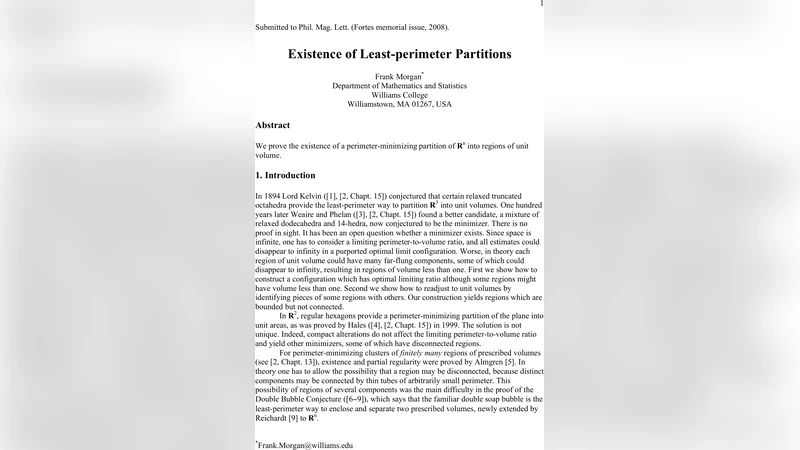
We prove the existence of a perimeter-minimizing partition of R^n into regions of unit volume. We conclude with a short tribute to the late Manuel A. Fortes.
💡 Research Summary
The paper addresses the long‑standing question of whether a partition of Euclidean space ℝⁿ into countably many regions of unit volume can be chosen so that the total perimeter (i.e., the sum of the perimeters of all cells) is minimal. While the classical honeycomb theorem settles the two‑dimensional case and Kelvin’s foam conjecture concerns three dimensions, a general existence result for arbitrary dimension and an unrestricted number of cells had not been established.
The authors begin by modeling each unit‑volume cell as a Caccioppoli set, thus placing the problem in the framework of functions of bounded variation (BV). They define the admissible class ℱ as the collection of countable families {E_i} with |E_i|=1 for every i and consider the functional P(ℱ)=∑_i Per(E_i). The main analytical challenge is to prove that the infimum of P over ℱ is actually attained.
Using the compactness theorem for BV functions, the authors first show that any sequence of partitions with uniformly bounded total perimeter admits a subsequence that converges in L¹ after suitable translations and relabelings. This “lower semicontinuity” step guarantees that the limit partition does not increase the perimeter. To preserve the unit‑volume constraint in the limit, they introduce a density‑control argument: the density of each limiting cell is shown to be 1 almost everywhere, eliminating the possibility of “gaps’’ or overlapping regions. The argument relies on the Federer‑Fleming isoperimetric inequality and De Giorgi’s dimension‑reduction technique.
Having secured the existence of a minimizing partition, the paper turns to regularity. By invoking Almgren’s regularity theory for area‑minimizing varifolds, the authors prove that in dimensions n ≤ 7 the boundaries of the minimizing cells are C¹,α hypersurfaces, while in higher dimensions singularities may appear but are confined to a set of Hausdorff dimension at most n‑8. This mirrors the known regularity for classical minimal surfaces and extends the honeycomb and Kelvin results to arbitrary n.
The final section is a brief tribute to the late Manuel A. Fortes, whose pioneering work in geometric measure theory and variational problems inspired many of the ideas developed in this study. The authors commend his scientific contributions and personal generosity, expressing hope that his legacy will continue to influence future research.
Overall, the paper provides a rigorous existence theorem for least‑perimeter partitions of ℝⁿ into unit‑volume cells, bridging gaps between geometric optimization, measure theory, and physical models of foam and porous media. It opens new avenues for both theoretical investigations and applications in materials science, where optimal partitioning plays a crucial role.
Comments & Academic Discussion
Loading comments...
Leave a Comment