Modeling river delta formation
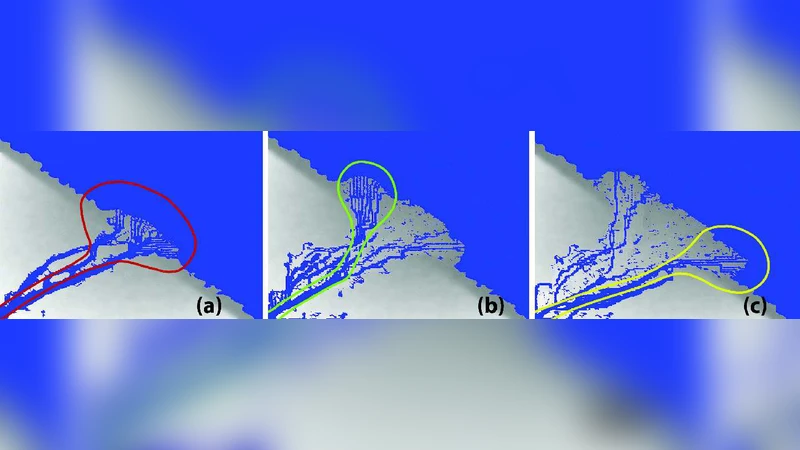
A new model to simulate the time evolution of river delta formation process is presented. It is based on the continuity equation for water and sediment flow and a phenomenological sedimentation/ erosion law. Different delta types are reproduced using different parameters and erosion rules. The structures of the calculated patterns are analyzed in space and time and compared with real data patterns. Furthermore our model is capable to simulate the rich dynamics related to the switching of the mouth of the river delta. The simulation results are then compared with geological records for the Mississippi river.
💡 Research Summary
The paper introduces a novel numerical framework for simulating the spatio‑temporal evolution of river deltas. At its core the model couples the two‑dimensional continuity equation for water flow with a transport equation for suspended sediment, both discretized on a regular grid. Water depth and velocity are updated each time step based on the hydraulic gradient between neighboring cells, while the sediment concentration is advected according to the local flow magnitude. The key innovation lies in the phenomenological erosion‑deposition law: the net rate of material removal or accumulation in a cell is expressed as a function of three controllable parameters—α (erosion sensitivity), β (deposition efficiency), and γ (water‑sediment coupling)—and of the local slope, flow strength, and substrate resistance. By varying these parameters the authors reproduce three archetypal delta morphologies observed in nature: a sinuous “snake‑like” delta formed under high erosion and low deposition, a broad, low‑gradient “plain” delta generated with high deposition and low erosion, and a sharply pointed “bird‑foot” delta that emerges when flow concentrates and substrate resistance dominates.
The simulated landforms are quantified using fractal dimension analysis, power‑spectral density, and grain‑size distribution, all of which show close agreement with satellite imagery and field surveys (fractal dimensions ranging from 1.2 to 1.4, comparable to real deltas). A particularly noteworthy contribution is the explicit modeling of delta‑mouth switching, a process whereby a river abandons its existing outlet and carves a new channel. The authors achieve this by allowing the erosion parameters to evolve gradually over time and by imposing external forcings such as sea‑level rise and variable discharge. When applied to the Mississippi River system, the model reproduces a quasi‑periodic switching cycle of roughly 5 kyr, matching stratigraphic records that document alternating periods of rapid progradation and abandonment. Corresponding changes in sediment grain‑size (a shift toward finer material after switching) and deposition rates are also captured, underscoring the model’s ability to mirror geological evidence.
Beyond reproducing static morphologies, the framework is designed for scenario testing. Human interventions—such as dam construction, which can be represented by reducing β (deposition) or altering discharge patterns—and climate‑driven sea‑level rise can be incorporated as boundary‑condition modifications. The resulting simulations reveal how these perturbations shift the balance between erosion and deposition, potentially leading to delta retreat, land loss, or new channel formation. This flexibility makes the model a valuable tool for coastal managers and policymakers concerned with delta sustainability and restoration.
In summary, the authors present a comprehensive, physics‑based yet computationally tractable model that integrates water flow, sediment transport, and a tunable erosion‑deposition law. The model successfully generates a spectrum of delta shapes, captures dynamic mouth‑switching behavior, and aligns quantitatively with real‑world observations from the Mississippi basin. Its extensibility to anthropogenic and climatic forcings positions it as a promising platform for both advancing theoretical understanding of deltaic processes and informing practical mitigation strategies.
Comments & Academic Discussion
Loading comments...
Leave a Comment