On Properties of Hamiltonian Structures for a Class of Evolutionary PDEs
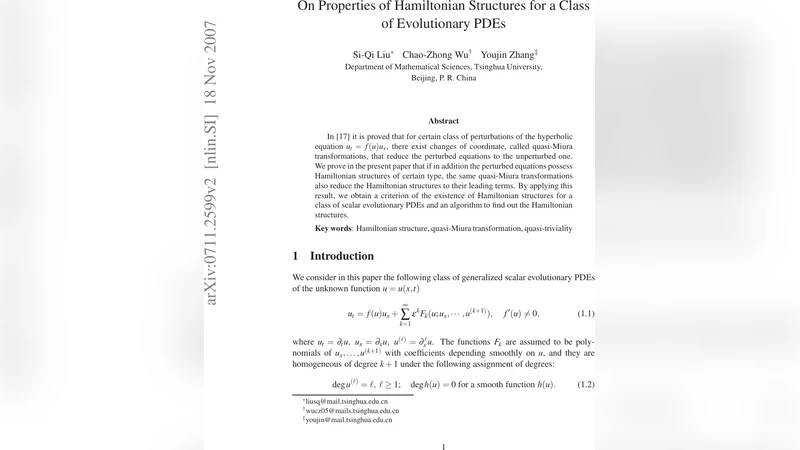
In \cite{LZ2} it is proved that for certain class of perturbations of the hyperbolic equation $u_t=f(u) u_x$, there exist changes of coordinate, called quasi-Miura transformations, that reduce the perturbed equations to the unperturbed one. We prove in the present paper that if in addition the perturbed equations possess Hamiltonian structures of certain type, the same quasi-Miura transformations also reduce the Hamiltonian structures to their leading terms. By applying this result, we obtain a criterion of the existence of Hamiltonian structures for a class of scalar evolutionary PDEs and an algorithm to find out the Hamiltonian structures.
💡 Research Summary
The paper investigates a class of scalar evolutionary partial differential equations (PDEs) that arise as perturbations of the simple hyperbolic equation (u_t = f(u) u_x). Building on the earlier work of Liu and Zhang (LZ2), which showed that for such perturbations there exist quasi‑Miura transformations that eliminate all higher‑order terms and reduce the perturbed equation to its unperturbed form, the authors extend the analysis to the Hamiltonian structures associated with these equations.
A Hamiltonian structure for a scalar evolutionary PDE is represented by a differential operator
(P = g(u)\partial_x + \frac12 g’(u) u_x + \sum_{k\ge 1}\varepsilon^{k} P_k),
where (g(u)) is a non‑vanishing scalar function and each (P_k) is a differential operator of order (k+1). The condition that (P) defines a Poisson bracket is expressed by the vanishing of the Schouten bracket (
Comments & Academic Discussion
Loading comments...
Leave a Comment