Temporal decorrelation of collective oscillations in neural networks with local inhibition and long-range excitation
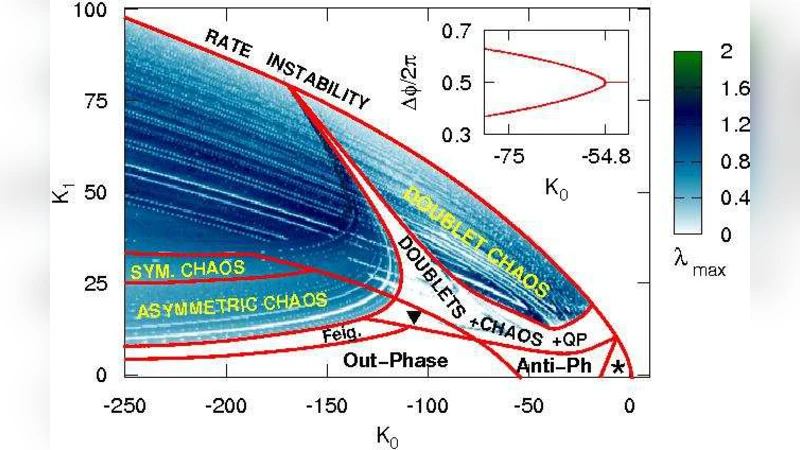
We consider two neuronal networks coupled by long-range excitatory interactions. Oscillations in the gamma frequency band are generated within each network by local inhibition. When long-range excitation is weak, these oscillations phase-lock with a phase-shift dependent on the strength of local inhibition. Increasing the strength of long-range excitation induces a transition to chaos via period-doubling or quasi-periodic scenarios. In the chaotic regime oscillatory activity undergoes fast temporal decorrelation. The generality of these dynamical properties is assessed in firing-rate models as well as in large networks of conductance-based neurons.
💡 Research Summary
**
The paper investigates the dynamical consequences of coupling two neuronal assemblies through long‑range excitatory projections while each assembly generates gamma‑band oscillations via strong local inhibition. Using a combination of analytically tractable firing‑rate equations and large‑scale conductance‑based spiking simulations (≈10 000 neurons), the authors map out how the balance between local inhibition and remote excitation shapes inter‑network phase relationships, stability, and the emergence of chaotic dynamics.
When the excitatory coupling is weak, each module sustains a regular gamma rhythm that locks to the partner rhythm with a constant phase offset. The offset is not arbitrary; it scales systematically with the strength of the local inhibitory feedback, confirming that inhibition acts as a “phase‑tuner” for the oscillation. This phase‑locked regime is robust across both model classes and persists despite realistic synaptic delays and heterogeneity.
Increasing the excitatory weight beyond a critical threshold destabilizes the phase‑locked state. Two canonical routes to chaos are identified. In the first scenario, a cascade of period‑doubling bifurcations is observed: the inter‑spike interval doubles repeatedly until the orbit becomes aperiodic, a classic Feigenbaum‑type route. In the second scenario, a quasi‑periodic (torus) bifurcation occurs, where two incommensurate frequencies coexist, the torus folds, and the system ultimately undergoes a transition to a strange attractor via a Ruelle‑Takens mechanism. Both routes are confirmed by positive maximal Lyapunov exponents and by the disappearance of a dominant spectral peak.
In the chaotic regime, the cross‑correlation between the two populations decays within a few milliseconds, indicating rapid temporal decorrelation. This fast loss of synchrony implies that overly strong long‑range excitation can degrade the fidelity of inter‑area communication, despite each area still producing robust gamma oscillations locally. The authors argue that such decorrelation may limit the capacity of cortical circuits to maintain coherent representations across distant regions, a hypothesis that resonates with experimental observations of impaired gamma coherence in certain neuropsychiatric conditions.
The conductance‑based simulations, which incorporate AMPA, NMDA, and GABAergic conductances, reproduce the same bifurcation structure seen in the reduced firing‑rate model. Spike timing jitter increases markedly in the chaotic regime, yet the population‑level power spectrum remains centered in the gamma band, underscoring that chaos can coexist with preserved oscillatory frequency content.
Overall, the study highlights the ratio of long‑range excitation to local inhibition as a pivotal control parameter for cortical dynamics. By delineating the precise conditions under which phase‑locking gives way to chaotic decorrelation, the work provides a mechanistic framework for interpreting how the brain balances coherent rhythmic communication with the flexibility required for rapid information processing. The findings also suggest design principles for neuromorphic systems: moderate excitatory coupling can synchronize modules without sacrificing robustness, whereas excessive coupling may induce undesirable chaotic fluctuations that impair reliable signal transmission.
Comments & Academic Discussion
Loading comments...
Leave a Comment