Influence of synaptic interaction on firing synchronization and spike death in excitatory neuronal networks
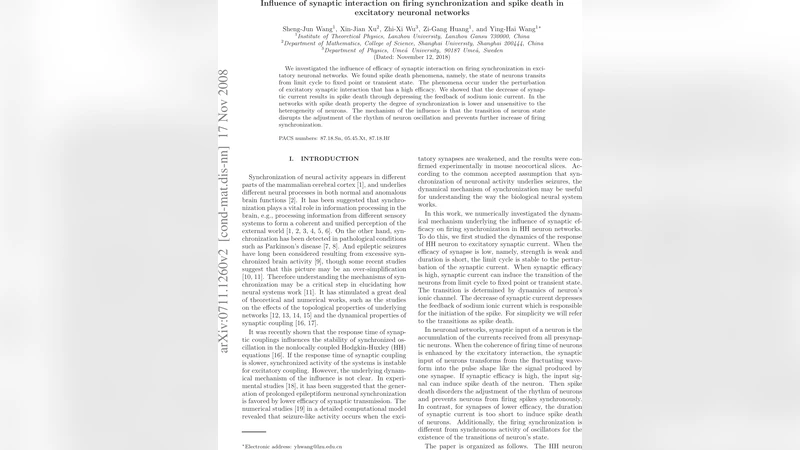
We investigated the influence of efficacy of synaptic interaction on firing synchronization in excitatory neuronal networks. We found spike death phenomena, namely, the state of neurons transits from limit cycle to fixed point or transient state. The phenomena occur under the perturbation of excitatory synaptic interaction that has a high efficacy. We showed that the decrease of synaptic current results in spike death through depressing the feedback of sodium ionic current. In the networks with spike death property the degree of synchronization is lower and unsensitive to the heterogeneity of neurons. The mechanism of the influence is that the transition of neuron state disrupts the adjustment of the rhythm of neuron oscillation and prevents further increase of firing synchronization.
💡 Research Summary
The paper investigates how the efficacy of excitatory synaptic interactions influences firing synchronization in neuronal networks. Using a Hodgkin‑Huxley single‑neuron model, the authors introduce an α‑shaped synaptic current whose peak amplitude (g_syn) and decay time (τ_syn) are varied to represent “high‑efficacy” (large amplitude, short duration) and “low‑efficacy” (small amplitude, long duration) conditions. In the high‑efficacy regime, a brief, strong excitatory pulse drives the membrane potential rapidly upward, but the subsequent rapid decay of the synaptic current prevents the positive feedback of the sodium (Na⁺) current from being sustained. As a result, the neuron’s trajectory leaves the limit‑cycle oscillation and either settles to a fixed point or exhibits only a short transient oscillation before returning to rest. The authors term this transition “spike death.” By plotting voltage‑current (N‑V) curves they show that a reduction of Na⁺ current by more than ~30 % dramatically raises the probability of entering the fixed‑point state.
To assess network‑level consequences, the authors construct a fully connected excitatory network of 100 Hodgkin‑Huxley neurons. Each neuron receives a heterogeneous external drive I_app, with the degree of heterogeneity controlled by the standard deviation σ_I. Under high‑efficacy synapses, the average pairwise correlation coefficient R remains low (≈0.2) and is largely insensitive to increases in σ_I, indicating that synchronization does not improve even when neurons become more diverse. In contrast, with low‑efficacy synapses, R rises sharply with σ_I (up to ≈0.7), reflecting the classic enhancement of synchrony by excitatory coupling.
A third set of simulations manipulates the synaptic decay time: extending τ_syn beyond ~5 ms restores sustained Na⁺ feedback, eliminates spike death, and leads to a rapid increase in R. Conversely, selectively removing neurons that have undergone spike death also raises network synchrony. These manipulations confirm that spike death is the primary mechanism by which high‑efficacy excitatory synapses suppress synchronization.
The discussion connects these findings to pathological brain states. The authors suggest that excessive excitatory synaptic efficacy—such as might occur during NMDA‑receptor up‑regulation in pre‑seizure conditions—could induce spike death, destabilize individual firing rhythms, and set the stage for an abrupt transition to hyper‑synchrony (seizure). Conversely, spike death might serve as a protective “reset” mechanism that prevents runaway synchrony under certain conditions.
In summary, the study reveals a counter‑intuitive effect: while excitatory synapses are generally thought to promote synchrony, when their efficacy is too high they can cause a rapid decline in synaptic current, suppress the Na⁺ feedback loop, and drive neurons into a spike‑death state. This state disrupts the phase‑adjustment process required for coherent oscillations, leading to lower overall synchronization that is robust against neuronal heterogeneity. The work provides a novel mechanistic insight into how synaptic efficacy shapes network dynamics and offers a potential framework for interpreting excitatory‑driven disorders such as epilepsy.
Comments & Academic Discussion
Loading comments...
Leave a Comment