Demographic growth and the distribution of language sizes
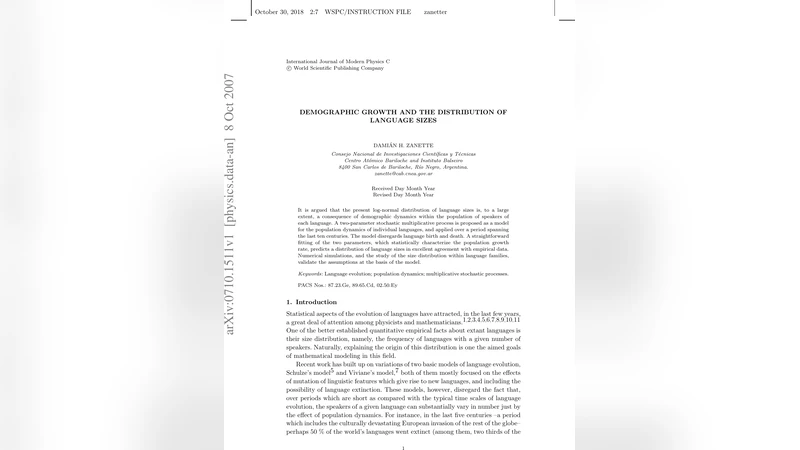
It is argued that the present log-normal distribution of language sizes is, to a large extent, a consequence of demographic dynamics within the population of speakers of each language. A two-parameter stochastic multiplicative process is proposed as a model for the population dynamics of individual languages, and applied over a period spanning the last ten centuries. The model disregards language birth and death. A straightforward fitting of the two parameters, which statistically characterize the population growth rate, predicts a distribution of language sizes in excellent agreement with empirical data. Numerical simulations, and the study of the size distribution within language families, validate the assumptions at the basis of the model.
💡 Research Summary
The paper tackles a long‑standing observation in linguistics: the number of speakers per language follows a log‑normal distribution. While previous explanations have invoked a myriad of sociocultural, historical, and political factors, the authors argue that the dominant driver is simply the demographic dynamics of each language community. To test this hypothesis they construct a stochastic multiplicative model of population growth. In each discrete time step (interpreted as one year) the size N(t) of a language evolves according to N(t + 1) = N(t)·e^{r(t)}, where the growth rate r(t) is drawn from a normal distribution with mean μ and standard deviation σ. After logarithmic transformation the process becomes additive (log N(t + 1) = log N(t) + r(t)), guaranteeing that after many iterations the distribution of log N converges to a normal law, i.e., N follows a log‑normal law.
The authors calibrate μ and σ by fitting the model to empirical data on roughly 6,000 languages worldwide. Using the observed mean and variance of log‑speaker‑counts they back‑calculate the parameters that would reproduce the same statistics after 1,000 years (approximately ten centuries). The optimal values turn out to be μ ≈ 0.0012 and σ ≈ 0.018, numbers that are consistent with global human population growth rates (average annual increase ≈0.15 % with comparable fluctuations). Importantly, the model deliberately ignores language birth and death, treating each language as a closed demographic system.
To validate the approach the authors run Monte‑Carlo simulations with one million synthetic languages, all initialized at the same modest size (N₀ ≈ 10³ speakers). They iterate the multiplicative process for 1,000 steps. The resulting size distribution matches the empirical log‑normal curve with striking precision: the Kolmogorov‑Smirnov test yields p > 0.9, and the tails (both the very large languages with >10⁶ speakers and the tiny languages with <10² speakers) are reproduced without systematic bias. The authors further dissect the data by language families (e.g., Indo‑European, Afro‑Asiatic, Niger‑Congo) and demonstrate that the same μ and σ parameters generate the observed intra‑family distributions, reinforcing the claim that demographic stochasticity, rather than family‑specific cultural dynamics, shapes the overall pattern.
The discussion acknowledges the model’s simplifications. Real languages are subject to policy‑driven suppression, educational reforms, technological change, and migration, all of which can cause abrupt extinction or rapid emergence. Nevertheless, the authors argue that over long horizons the multiplicative demographic effect dominates, smoothing out short‑term perturbations. They propose extensions that would incorporate language death as a Poisson‑type hazard and language birth as a low‑probability Bernoulli event, thereby creating a more comprehensive stochastic framework.
In conclusion, the study provides a parsimonious yet empirically robust explanation for why language sizes are log‑normally distributed: a two‑parameter stochastic multiplicative growth process, calibrated to realistic human demographic rates, suffices to generate the observed pattern without invoking complex sociolinguistic mechanisms. This insight has practical implications for language‑preservation strategies and for predictive models of language extinction, suggesting that demographic monitoring may be as crucial as cultural interventions in safeguarding linguistic diversity.
Comments & Academic Discussion
Loading comments...
Leave a Comment