Quantum Knizhnik-Zamolodchikov equation: reflecting boundary conditions and combinatorics
We consider the level 1 solution of quantum Knizhnik-Zamolodchikov equation with reflecting boundary conditions which is relevant to the Temperley--Lieb model of loops on a strip. By use of integral formulae we prove conjectures relating it to the we…
Authors: ** - P. Di Francesco (Université de Paris‑Saclay, Institut de Physique Théorique) - P. Zinn‑Justin (Université de Paris‑Saclay, Institut de Physique Théorique) **
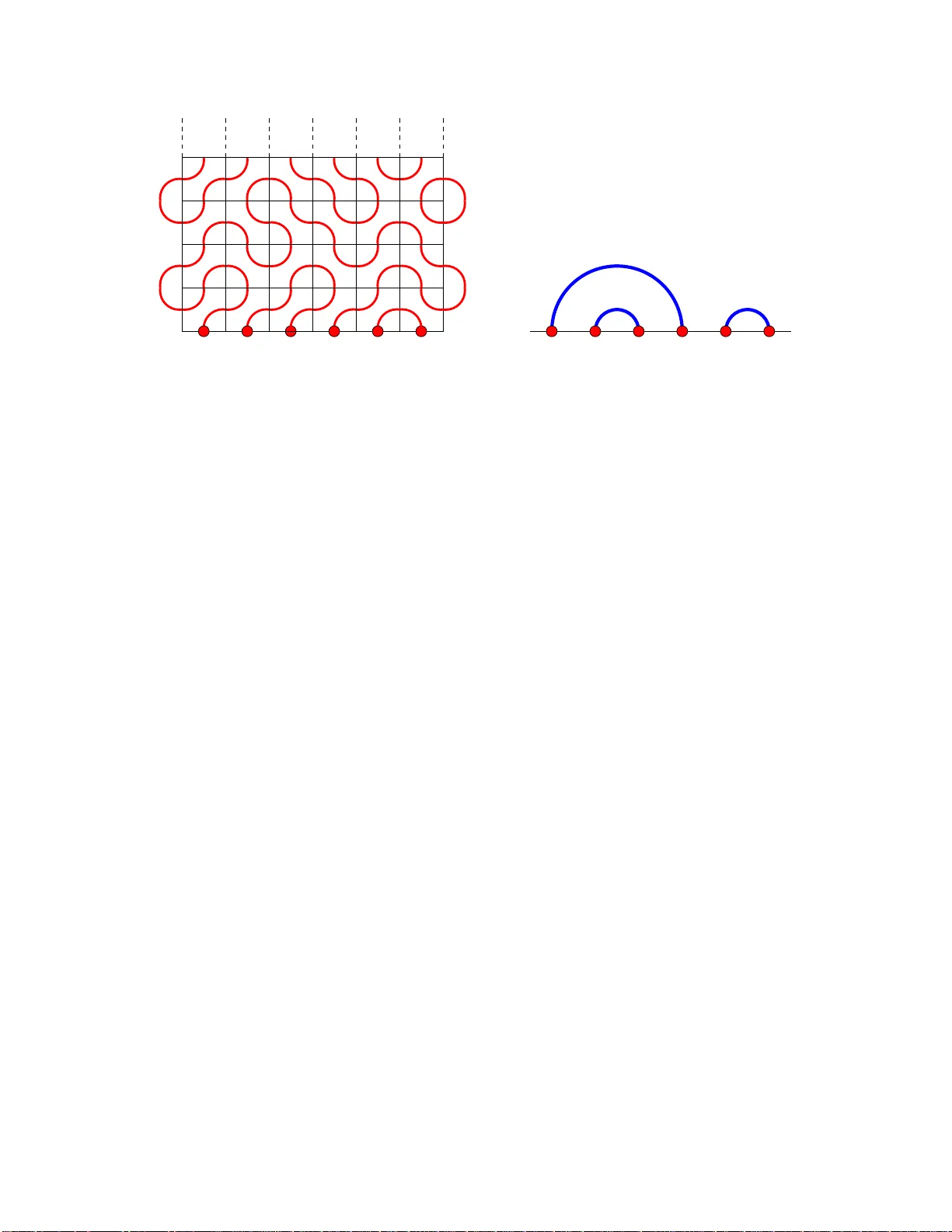
Quan tum Knizhn ik–Zamolo dc hik o v Equation: Reflec ting b oundary conditi on s and Com binatorics P . Di F rancesco and P . Zinn-Jus t i n W e consider the lev el 1 soluti o n of quan tum Knizhnik–Zamolo dc hik ov equation with re- flecting b oundary conditions whic h is relev an t to the T emperley– Lieb mo del of lo ops on a stri p. By use of in tegral form ulae we pro v e conjectures relating it to the weigh ted en u- meration of Cyclically Symmetric T ranspose Complemen t Pla ne P artit ions and related com binatorial ob jects. 09/2007 1. In tro du ction Since the pap ers [1 , 2], there has b een a great deal of work on the com binatori al in terpretatio n of q uantum integrable mo dels at sp ecial p oints of their parameter space. The original observ at ion is that the n um b ers of Alternating Sign Matrices (ASM) and Plane P arti t ions (P P ) i n v ari ous symmetry classes app ear naturally in the gro und state en tries of the T emp erley –Lieb O ( τ = 1 ) mo del of (non-crossings) lo ops with v arious b oundary conditions (and related models). The app earance of ASM n um b ers w as developed further and to some exten t explai ned b y the Razumo v–Stroganov conjecture [3] and v arian t s [ 4,5] in terpreting eac h ground stat e en try as a num ber of certain subsets of ASM. The role of plane partiti o ns remained more obscure un til the recen t work [ 6 , 7] whic h show ed that the enu merat i on of symmetry classes of PP also o ccurs naturally on condit i on that o ne consider a slightly mor e general problem, namely the quantum Knizh nik –Zamolo dch i k ov equation ( q KZ), first intro duced in this con tex t i n [8] , and in which the parameter τ is no w free. This provided a (conjectural) bridge b et we en en umerations of symmetry classes of A SM and PP , which is a fascinating t opic of enu merati v e combinatorics in i tself. The presen t work is concerned more sp ecifically with t he case of the T emp erley– Lieb lo op mo del (and its q KZ generalization) defined on a strip with reflecting b oundary conditions ( the case of p erio dic bo undary conditions w as treated simila r l y in [9]). The corresp onding ASM w ere disco v ered in [4 , 10 ] : they are V ertically Symmetric Alternating Sign Matrices (VSASM) of size (2 n + 1) × (2 n + 1) in even strip size N = 2 n , a nd mo dified VSASM of size (2 n + 1) × (2 n + 3) i n o dd strip size N = 2 n + 1. As to the P P , they w ere discussed in [7] : they are Cyclicall y Symmetric T ransp ose Complemen t Plane P arti t ions (CSTCPP) [11] in o dd st r i p size, and certain mo dified CSTCPP (referred to as CSTCPP △ in the following) in even strip size. The conjectures of [7 ] concerning the τ -en umeration of these plane partiti o ns are t he main sub ject of this work. In Sect. 2 w e shall rev i ew the basics of in tegrable lo op mo dels based on the T emp erley–Lieb alg ebra; in Sect. 3 we shall discuss the related q KZ equati on, a nd review the conjectures of [ 7]; i n Sect. 4 w e in tro duce the mai n tec hnical to ol , that is certain expli ci t integrals solv ing q KZ; and finally in Sect. 5 and 6 w e pro ve the conjectures o f [7], considering separately ev en and o dd cases. 1 2. Lo op mo del with refl ecting b ound ary conditions and lin k patt e rns 2.1. Dens e L o op mo del on a strip W e consider the v ersion wit h reflecting b o undaries 1 of the i nhomogeneous O (1) non- crossing lo o p mo del [12 ]. The mo del i s defined on a semi-infinite strip of width N (eve n or o dd) of square latt i ce, w i th cen ters of the low er edges lab elled 1 , 2 , ..., N . On eac h face of t his domain of t he square l attice, w e draw at random, sa y wit h resp ective probabil i ties 1 − t i , t i in t he i -th column (at the vertical of the p oin t lab elled i ) one of the t wo following configurations (2 . 1) The strip i s moreo ver suppleme nted wit h the following pattern of fixed configurations of lo ops on the (left and righ t ) b oundaries: N 1 2 . . . (2 . 2) With probability 1, a configuration wil l lead t o a pairing of the p oi n ts 1 , 2 , ... , N according to their connection vi a the paths (except for one p oin t if N is o dd whic h is connected to the infinit y along the strip). Suc h a pattern of connections is called a link p attern , and an individual pairing is called an arc h. The set of l ink patterns on N p oi nts is denoted b y LP N , and has cardinal it y (2 n )! / ( n !( n + 1) !) for N = 2 n or N = 2 n − 1. Eac h link pattern of o dd size N = 2 n − 1 ma y indeed be viewed as a link pattern of size 2 n but with t he p oint 2 n sent to i nfinity on t he strip: this provides a natural bijection b et wee n LP 2 n − 1 and LP 2 n . A link pattern π ∈ LP N ma y also b e viewed as a p ermutation 1 These b oundary conditions are sometimes call ed “op en”, in reference to the equiv alent op en XXZ spin c hain, or “cl osed”, due to the w ay the l o ops cl ose at the b oundaries of the strip. 2 1 2 3 4 5 6 1 2 3 4 5 6 Fig. 1: A sample configuration of the Dense Lo o p mo del on a strip of width N = 6 (left). W e ha ve i ndicated the corresp onding op en non-crossing li nk pattern of connection of the p oints 1 , 2 , 3 , 4 , 5 , 6 (right). π ∈ S N with only cycl es of l ength 2 (except one cycle of length 1 for N o dd), and w e shall use the notat i on π ( i ) = j to express that p oi n ts i and j are connected b y an arc h. F or a pair ( i, j ) suc h that j = π ( i ) and i < j , w e wil l call i the op ening and j the closing of the arch connecting i and j . A n example of lo op configuration together with i ts l ink pattern are depicted in Fig. 1 . W e use a standard pictorial represen tat i on for link patterns in the form of configurati o ns of non-in tersecting a rc hes connecting regularly spaced p oints on a l i ne, wit hin t he upp er-half plane it defines. F or o dd N , the unmatc hed p oi n t ma y b e represen ted as connected to infinit y in the upp er-half plane via a vertical half-line. W e moreo v er at t ac h a w eigh t τ = − ( q + q − 1 ) = 1 to eac h lo op (hence the denomination O( τ = 1) mo del, q = − e iπ / 3 ). W e may then compute the probability Prob( π ) for a giv en randomly generated configuration of the lo op mo del on the st ri p to b e connecting the b oundary p oints according to a given link pattern π . In Ref. [12], the mo del w as solved b y m eans of a transfer matrix tec hnique, using solutions of the b oundary Y ang–Baxter equation [1 3 ] [14] that parametrize the inhomoge- neous probabilities t i via integrable Bolt zmann weigh ts, co ded b y a sta ndard trigonometric R -matri x. Using the in tegrability of the system, and follo wing t he philosoph y of [15], the suitably renormali zed vector of probabili ties Ψ ≡ { Ψ π } π ∈ LP N w as sho wn to satisfy the quan tum Knizhnik–Zamolo dc hiko v equation wit h reflec t i ng b oundaries for q = − e iπ / 3 , in the link pattern basis. In the follo wi ng, we wi ll consider the more general case of generic q , τ , which do es not ha ve stricto sensu an interpretation in terms of latt ice l o op mo del [ 16]. 3 2.2. R matrix The R -matri x of the mo del is an op erator acting on l ink patt erns of LP N : ˇ R i,i +1 ( z , w ) = q z − q − 1 w q w − q − 1 z + z − w q w − q − 1 z = q z − q − 1 w q w − q − 1 z I + z − w q w − q − 1 z e i (2 . 3) where z and w are complex n um b ers a t tac hed to the p oin ts i and i + 1 and where e i , i = 1 , . .., N − 1 are the generators of the T emperley-Lieb algebra T L N ( τ ), sub ject to the relations e 2 i = τ e i , [ e i , e j ] = 0 if | i − j | > 1 , e i e i ± 1 e i = e i (2 . 4) with the parametrizatio n τ = − q − q − 1 (2 . 5) i+1 = i i+1 k j j k i i+1 = τ i i+1 i Fig. 2: Action of t he T emperl ey-Lieb generators e i on link patterns. In (2.3), we hav e depicted the T emperley-Lieb g enerators as t ilted squares wit h edge cen ters connected b y pairs. The correspo nding action o n link patterns should b e under- sto o d as follo ws (see Fig. 2): assume t he p o i n ts i, i + 1 are connected to sa y the p oints j, k in a link pattern π . Then, unless j = i + 1 and k = i , the link pattern π ′ = e i π is iden ti cal to π except t hat i i s no w connected to i + 1, and j to k . If j = i + 1 and k = i , t he p oi n ts i, i + 1 are connected to each other in π , and e i π = τ π . The l atter is a direct consequence 4 of the pro jector condition e 2 i = τ e i , as any link pattern wi th i connected to i + 1 lies in the image of e i . The ab o ve R -matrix satisfies the Y ang–Baxt er equation and t he unitarity relation ˇ R i,i +1 ( z , w ) ˇ R i +1 ,i +2 ( z , x ) ˇ R i,i +1 ( w , x ) = ˇ R i +1 ,i +2 ( w , x ) ˇ R i,i +1 ( z , x ) ˇ R i +1 ,i +2 ( z , w ) ˇ R i,i +1 ( z , w ) ˇ R i,i +1 ( w , z ) = I (2 . 6) as consequencs of the T emp erley-Lieb algebra relations (2.4). 2.3. Link p atterns, dyck p aths, and c ontainment or der (c) (b) (a) Fig. 3: Dyck path (b) asso ciated to a l ink pattern (a) . The former is obtai ned as t he discrete path on the non-negative integer line: 0 , 1 , 2 , 1 , 2 , 3 , 2 , 1 , 0 , 1 , 0. W e ha ve represen ted i n ( c ) t he b o x decomp ositi o n of t he Dyck path. Before turning to the q KZ equation, w e wish to emphasize a n um b er of useful prop- erties satisfied by the link patterns, and t he action of the T emp erley-Lieb generators. An alternative picto rial represen tation of link pat terns is v ia Dyck pat hs, namely paths from and to the orig in on the non-negative integer li ne, wi t h steps of ± 1 only . The bijection b et wee n link patt erns and Dyck paths is illustrated on Fig. 3 for N = 10. F or ev en N = 2 n , w e construct the Dyck path b y v isiting the p oi n ts of t he link pat tern from 1 to N , starti ng from the origi n of t he non-negative in teger half-line, and with the fol l o wing rule: if an arc h op ens (resp. closes) a t i , then the path go es up (resp. do wn) one step betw een time i − 1 and i . The path is guaran teed to come bac k to t he origin a t time 2 n as t here are as man y op enings as closings o f arc hes, and moreo ver sta ys in the non-negative half-line as all arc hes mus t first op en b efore closing. In the case of o dd N = 2 n − 1, o ne a rc h exactly 5 has an op ening and no closing p oi n t (it is connected to infinity), hence the path ends up at the p oi n t 1 on t he integer half-line. It can b e completed into a path of length 2 n b y a final step to the origin, thu s expressing on Dyck paths the ab o vemen tioned bijection b et ween LP 2 n − 1 and LP 2 n . The Dyc k path is represen ted in the plane as the (broken-line) g raph of t he function ( t, h ( t )) , t = 0 , 1 , ..., N . Dyc k paths allow to endow t he set of link patterns with a natural “ containmen t” order, namely π < π ′ iff the Dy ck path of π con tains strictly that of π ′ . This notion is made explicit b y in tro ducing the “box decomp ositio n” of an y given Dyc k path (see Fig. 3 (c)), namely the decomp osit ion of the regio n of the pl a ne delimited b y the path and a broken line ( 0 , 0) → (1 , 1) → (2 , 0) → · · · → ( N − 1 , 1) → ( N , 0) if N = 2 n , without the last step for N = 2 n − 1 , by use of squares of edge √ 2 tilted b y 45 ◦ . Then a Dy c k path δ con tai ns strictly another δ ′ iff δ is o bt a ined from δ ′ b y additi on of at least one b o x. A b ox additi on at p osition m consists simply in replacing a p ort ion of path ( m − 1 , h ) → ( m, h − 1) → ( m +1 , h ) that visits successiv ely the p oin ts h, h − 1 , h of the integer half-line at times m − 1 , m, m + 1, b y the p ort ion ( m − 1 , h ) → ( m, h + 1) → ( m + 1 , h ), thu s adding a b o x with cen ter at co ordinates ( m, h ). This ma y also b e describ ed as transforming a lo cal minim um in to a lo cal maximum at p ositi on m on the path. The “smallest” link pattern ( whose Dyc k path con tains a l l others) is the pat tern π 0 with li nks π 0 ( i ) = 2 n + 1 − i , i = 1 , 2 , ..., n for N = 2 n , and i = 2 , ..., n , for N = 2 n − 1, while π 0 (1) = 1. It corresp onds t o the farthest excursion, reac hing p oi n t n on the integer half-line. The “largest” link pattern ( whose Dyc k path is con tained in all others) π max has π max ( i ) = i + 1 for i = 1 , 3 , .., 2 n − 1 when N = 2 n and i = 1 , 3 , . .., 2 n − 3 when N = 2 n − 1 , while π max (2 n − 1) = 2 n − 1. It corresp onds to the shortest ra nge excursion, alternati ng betw en the origin and p oint 1 on the in teger half-line. So we ha ve π 0 < π < π max for all π ∈ LP N suc h that π 6 = π 0 , π max . Finally , w e shall denote b y β ( π ) the total n umber of b oxes in the b ox decomp osition of the Dyc k path asso ciated to π . W e ha ve for instance β ( π 0 ) = n ( n − 1) / 2 and β ( π max ) = 0. The action of e i on l ink patterns ma y b e easily t ranslated in to the language of b oxes on Dyc k paths. The actio n of e i ma y indeed b e view ed as a b o x addition at p osit ion i on the corresp onding Dyck paths. Then 3 situati ons may o ccur (Fig. 4): (i) The pat h has a mi ni mum at p oin t i : the b ox addition transforms it in to a maximu m. (ii) The path has a ma x im um at p oin t i : the b ox-add ed pat h is unc hanged, but pic k s up a factor of τ . (iii) The path has a slop e at i , namely a succession of tw o up or tw o down steps: the b ox addition act ual ly destroys the tw o ro ws of b oxes at its heig ht and i mmediately b elo w 6 (iii) (i) (ii) τ Fig. 4: Box a ddit ion a t p osition i on Dyck paths corresp onding to t he action of e i . W e hav e depicted three generic situations for the addition: (i) at a lo cal minim um (ii) at a lo cal maxim um (i ii) at a slop e. B oth (ii) and (iii) l ead to a Dyc k path con t a ined b y the original one, whi l e (i ) pro duces a Dyck path con taining it, with exactly one additio nal b ox. un til the other side of the path is reached . The net result ma y b e i n terpreted as an a v alanc he, in which the mo un tain shap e b et wee n the p oin t of i mpact and the other side falls do wn by tw o units. This al l o ws to see that among all possible actions of e i on a li nk pattern π , only one leads to a “larger” Dyck path (containing π ): e i π = π ′ < π , namely in the situation ( i ), while all other situations lead to π < π ′ = e i π . This observ ation will b e used b elo w. The in terpretation of the action of e i on Dyc k paths w as used in [5] to rephrase the homogeneous lo op mo del as the sto ch asti c mo del of a gro wing interf ace. 3. The q KZ equat ion for reflectin g b ou n dary condi tion 3.1. The e quation The reflecting b oundary q KZ equation consists of the following system of equati ons for a v ector Ψ whic h dep ends p olynomially on the v ariables z 1 , . . . , z N (and q , q − 1 ): ˇ R i ( z i +1 , z i )Ψ N ( z 1 , . . . , z i , z i +1 , . . . , z N ) = Ψ N ( z 1 , . . . , z i +1 , z i , . . . , z N ) (3 . 1 a ) c N ( z N )Ψ N ( z 1 , . . . , z N ) = Ψ N ( z 1 , . . . , z L − 1 , s/z N ) (3 . 1 b ) c 1 ( z 1 )Ψ N ( z 1 , . . . , z N ) = Ψ N (1 /z 1 , z 2 , . . . , z N ) (3 . 1 c ) 7 Here c 1 and c N are scalar functions to b e sp ecified lat er, and s = q 2( k +2) is a parameter whic h determines the “l ev el” k o f the equation: here we consider the so-called lev el 1 case, namely with s = q 6 . One can think of Eqs. (3 . 1) as an analogue of the quan tum Knizhnik–Zamol o dc hiko v equation ( q KZ) in the form introduced by Smirno v [17] (see al so [ 1 8]), i n whic h one re- places the p erio dic b oundary conditions, implicit in the usual q KZ, with reflecting b ound- aries [14] . More precisely , Eq. (3 . 1 a ) is the exc hange relation corresp onding to the bulk, indep enden t of b oundary condit i ons, whereas Eq s. ( 3 . 1 b, c ) implemen t t he reflections at the t wo b oundaries. In [16], it was remarked t hat solving t hese equations for eve n size N = 2 n automat- ically pro vides a solution for o dd size N − 1 b y tak i ng the last parameter z N to zero (or equiv alen tly to infinit y) . W e therefore discuss i n detai l the case of ev en size no w, p ostp oning to Sect. 6 the discussion of the o dd case. 3.2. Mi nimal p olynomial solution In [12], it w as claimed that t he system of eq uations (3 . 1) p ossesses a p olynomial solution of minimal degree 3 n ( n − 1) which is unique up t o mu l tiplication b y a scalar. T o actually solve the equations (3 . 1), o ne first remark s that the N − 1 equations ( 3 . 1 a ) from a t riangular system with resp ect t o t he con tainmen t order of Dy c k paths introduced i n Sect. 2.3. Indeed, when written in comp onen ts, this equati on reads: q − 1 z i +1 − q z i z i +1 − z i ( τ i − 1)Ψ π ( z 1 , . . . , z 2 n ) = X π ′ : π ′ 6 = π e i π ′ = π Ψ π ′ ( z 1 , . . . , z 2 n ) (3 . 2) where τ i acts on functions o f the z ’s by in terc hanging z i and z i +1 . No w consider t he sum on the r.h.s.: it extends ov er the prop er inv erse images of π under e i . Picking π in t he image of e i (i.e. w i th an arc h connecting p oin ts i and i + 1, as explai ned a b o ve), i t s inv erse images π ′ under e i all hav e dyc k paths con taining that of π (i.e. π ′ < π ) except one, sa y π ∗ , corresp onding to t he Dyc k path of π with the b ox at p osition i remov ed, hence with π < π ∗ . H ence Eq . (3.2) allows to express Ψ π ∗ in terms of only Ψ α , with α < π ∗ . The solution is therefore uniquely fix ed b y sp ecifying the comp onen t corresp onding to the smallest li nk pattern π 0 defined ab ov e, whose Dyc k path that contains all others. The 8 latter is en tirely fixed b y the degree condition and factorization prop erties deduced from the q KZ system; the result is: Ψ π 0 = Y 1 ≤ i i i s strictly larger in π than in α . Consequen tly , applying the ab o ve algorithm to t he arc hes of π op ening at p ositi ons > i , w e see that at least one little arc h in the pro cess will ha ve no arc h op ening of α b elo w it, th us receiv i ng a weigh t U − 1 = 0, a nd therefore the corresp onding matrix elemen t C α,π v anishes . Finally , one can rewrit e the q KZ equation it self using the linear comb inat ions defined b y Eq. (4.1). No t e here that w e are forced to use not only the comp onen ts corresp onding to our basis O N of increasing sequences, but also those corresp onding to any non-decreasing sequence. In principle al l of them can b e reexpressed as linear com binations of increasing sequences only , but it is preferrable t o av oid ha vi ng to wri te these linear dep endence relations explicitl y . All that is needed is the action of the e i on t he Ψ a . W e ha ve the following Theorem 1: F or any non-dec reasing sequence a 1 , . . . , a n suc h t hat the n um b er i o ccurs exactly k times, k ≥ 0 , we ha ve t he form ula: ( e i Ψ) a 1 ,..., i,...,i |{z} k ,...,a n = U k − 1 U k − 4 Ψ a 1 ,...,a n − U k − 1 U k − 3 Ψ a 1 ,...,i − 1 , i, ...,i |{z} k − 1 ,...,a n + Ψ a 1 ,..., i,...,i |{z} k − 1 ,i +1 ,...,a n + U k − 1 U k − 2 Ψ a 1 ,...,i − 1 , i, ...,i |{z} k − 2 ,i +1 ,...,a n (4 . 4) (where for k = 0 the r. h.s. is zero). Pro of: expand the l.h.s. in the basis of link patterns b y using Eq. (4.1 ) . W e find: ( e i Ψ) a = X π : π ( i ) 6 = i +1 C a , e i ( π ) Ψ π + τ X π : π ( i )= i +1 C a ,π Ψ π (4 . 5) where w e ha ve dist i nguished among t he entries o f e i its diagonal en tries, equal to τ , and its non-diagonal en tries, equal t o 1. The Ψ π m ust b e regarded here as indep enden t ob jects, so that we m ust now ch eck Eq. (4. 4) for eac h link pat tern π . This wil l b e p erformed b y a case b y case a nalysis of the situation a round the sites ( i, i + 1). Each time only the co efficien ts in volving t he arche s 12 starting or ending at i, i + 1 differ from term to term in the equati o n, so that w e can i gnore the remaining factors. The pro of will b e explained pictorial ly using the same conv en tions as i n app endix 1 of [9] , t hat is b y drawing the co efficien t C a ,π as the usual (lo cal) depiction of the link patt ern π decorated b y placing b etw een sites i and i + 1 (inside a circle) the total n um b er k of a ’s suc h that a j = i . There are 4 cases: (i) If i is an op ening and i + 1 a closing of π , then π has a lit tle arch ( i, i + 1): π ( i ) = i + 1. In this case the equality reduces pictorial l y to τ k i i+1 = U k − 1 U k − 4 k i i+1 − U k − 1 U k − 3 k-1 1 i i+1 − U k − 1 U k − 3 k-1 1 i i+1 + U k − 1 U k − 2 k-2 1 1 i i+1 or explicitly τ U k − 1 = U k − 1 U k − 4 × U k − 1 − U k − 1 U k − 3 × 2 U k − 2 + U k − 1 U k − 2 × U k − 3 (4 . 6) whic h is easily che ck ed b y noting t hat U k − 1 U k − 4 − τ = U k − 2 U k − 3 . In all other cases there is no little arc h ( i, i + 1) . (ii) If b oth i and i + 1 are op enings, cal l p the total “weigh t” under the arch leaving i + 1, that is p = card { ℓ | i + 1 ≤ a ℓ < π ( i + 1) } − i +1 − π ( i +1) − 1 2 , and q the remaining weigh t under the bigger arch starting from i , excluding what is under the small er arc h and the weigh t k under the segment [ i, i + 1), in o rder to make the pictoria l description simpler: q = card { ℓ | π ( i + 1) ≤ a ℓ < π ( i ) } − π ( i ) − π ( i +1) − 1 2 . Then the identit y t o pro ve is: k p q i i+1 = U k − 1 U k − 4 k p q i i+1 − U k − 1 U k − 3 k-1 1 p q i i+1 − U k − 1 U k − 3 k-1 p+1 q i i+1 + U k − 1 U k − 2 k-2 1 p+1 q i i+1 U k − 1 U q − 1 = U k − 1 U k − 4 × U p − 1 U k + p + q − 2 − U k − 1 U k − 3 × U p − 1 U k + p + q − 3 − U k − 1 U k − 3 × U p U k + p + q − 2 + U k − 1 U k − 2 × U p U k + p + q − 3 (4 . 7) whic h is again a routine chec k. 13 (ii’) The case where i and i + 1 are b oth closings is treated analogously . (iii) Finall y , if i is a closing and i + 1 an op ening, call p the w eight under the arc h ( π ( i ) , i ) defined as b efore, and q the w eight under the arc h ( i + 1 , π ( i + 1) ). Similary the pro of of the iden tity p k q i i+1 = U k − 1 U k − 4 p k q i i+1 − U k − 1 U k − 3 p+1 k-1 q i i+1 − U k − 1 U k − 3 p k-1 q+1 i i+1 + U k − 1 U k − 2 p+1 k-2 q+1 i i+1 U k − 1 U k + p + q − 2 = U k − 1 U k − 4 × U p − 1 U q − 1 − U k − 1 U k − 3 × U p U q − 1 − U k − 1 U k − 3 × U p − 1 U q + U k − 1 U k − 2 × U p U q (4 . 8) is left to the reader. This completes the pro of of the theorem 1. 4.2. Inte gr al solution of q KZ e quation: gener al princi ple The idea t o use in tegral represen tations for solutions of t he q KZ equati on is not new and there is a v ast literat ure on the sub ject (cf t he references in Sect. 11.2 of [19 ]). W e consider here a very sp ecific type of level 1 sol utions, for whic h one exp ects a m uch simpler form ula than generically . In the presen t con text, this idea was used in [ 9] in t he case of t he q KZ equati on with the usual p eri o dic b oundary conditions. W e no w describ e the pro cedure in a sligh tl y more general (b oundary conditions-indep enden t) setting. The idea is to define for an y non-decreasing sequence ( a 1 , . . . , a n ) the follo wing q uan- tity: Ψ a 1 ,...,a n ( z 1 , . . . , z N ) = Y 1 ≤ i i or m + k = N . Sta rt ing from the expression ( 4.4), and subtracting τ Ψ on b oth sides, w e wish to express ( e i − τ )Ψ as the acti o n on Ψ of the divided difference op erator t i . W e are left wi th proving t he follo wing Theorem 2: The function (4.9 ) sol v es the exc hange rel a tion of t he q KZ equation, namely it satisfies: ( t i Ψ) a 1 ,...,a m − 1 , i,...,i |{z} k ,a m + k ,...,a n = U k − 2 U k − 3 Ψ a 1 ,...,a m − 1 , i,...,i |{z} k ,a m + k ,...,a n − U k − 1 U k − 3 Ψ a 1 ,...,a m − 1 ,i − 1 , i,...,i |{z} k − 1 ,a m + k ,...,a n + Ψ a 1 ,...,a m − 1 , i,...,i |{z} k − 1 ,i +1 ,a m + k ,...,a n + U k − 1 U k − 2 Ψ a 1 ,...,a m − 1 ,i − 1 , i,...,i |{z} k − 2 ,i +1 ,a m + k ,...,a n (4 . 10) Pro of: Two i mp ortan t remarks are in order. Firstly , the op erat or t i acts o nl y on the pieces of Ψ t hat are non-symmetric in ( z i , z i +1 ). When acti ng wit h t i on (4.9), w e ma y restrict our atten t i on t o the non-symmetric part of t he in tegrand. Secondly , we note t hat for an y function S ( u 1 , . . . , u k ) satisfying the follo wing v anishing an ti sy mmetrizer prop ert y that A ( S ) ≡ X σ ∈ S k ( − 1) σ S ( u σ (1) , . . . , u σ ( k ) ) = 0 (4 . 11) then the m ulti ple i n tegral I k ≡ I du 1 · · · du k S ( u 1 , . . . , u k ) Y 1 ≤ ℓ
Original Paper
Loading high-quality paper...
Comments & Academic Discussion
Loading comments...
Leave a Comment