Denaturation transition of stretched DNA
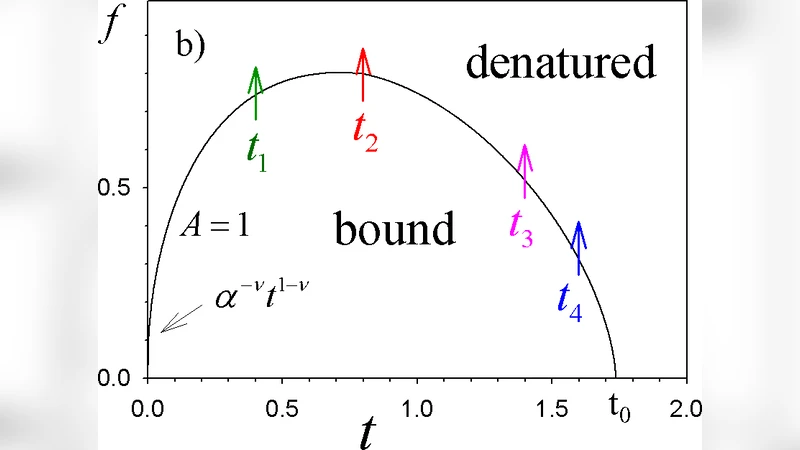
We generalize the Poland-Scheraga model to consider DNA denaturation in the presence of an external stretching force. We demonstrate the existence of a force-induced DNA denaturation transition and obtain the temperature-force phase diagram. The transition is determined by the loop exponent $c$ for which we find the new value $c=4\nu-1/2$ such that the transition is second order with $c=1.85<2$ in $d=3$. We show that a finite stretching force $F$ destabilizes DNA, corresponding to a lower melting temperature $T(F)$, in agreement with single-molecule DNA stretching experiments.
💡 Research Summary
The authors extend the classic Poland‑Scheraga (PS) model of DNA denaturation to incorporate the effect of an external stretching force F. In the conventional PS framework, the double‑stranded DNA is represented as an alternating sequence of bound (helical) segments and denatured loops. The statistical weight of a loop of length l scales as (l^{-c}), where the loop exponent c determines the order of the melting transition: c > 2 yields a first‑order transition, while c < 2 leads to a continuous (second‑order) transition. The novelty of this work lies in coupling the mechanical work performed by the force to the polymeric degrees of freedom of both bound and looped segments, thereby modifying the loop entropy and the overall free‑energy landscape.
The model treats bound segments as extensible elastic rods that align partially with the applied force, contributing a term (-F,x) (with x the extension) to the free energy. Denatured loops are modeled as self‑avoiding walks (SAWs) in three dimensions, characterized by the Flory exponent ν (≈ 0.588). By performing a scaling analysis of the partition function under tension, the authors derive a new expression for the loop exponent: \
Comments & Academic Discussion
Loading comments...
Leave a Comment