Comparison of reduced-order, sequential and variational data assimilation methods in the tropical Pacific Ocean
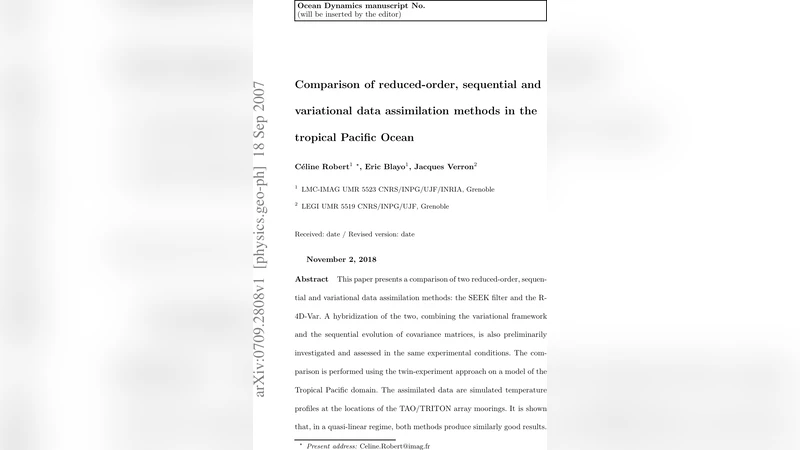
This paper presents a comparison of two reduced-order, sequential and variational data assimilation methods: the SEEK filter and the R-4D-Var. A hybridization of the two, combining the variational framework and the sequential evolution of covariance matrices, is also preliminarily investigated and assessed in the same experimental conditions. The comparison is performed using the twin-experiment approach on a model of the Tropical Pacific domain. The assimilated data are simulated temperature profiles at the locations of the TAO/TRITON array moorings. It is shown that, in a quasi-linear regime, both methods produce similarly good results. However the hybrid approach provides slightly better results and thus appears as potentially fruitful. In a more non-linear regime, when Tropical Instability Waves develop, the global nature of the variational approach helps control model dynamics better than the sequential approach of the SEEK filter. This aspect is probably enhanced by the context of the experiments in that there is a limited amount of assimilated data and no model error.
💡 Research Summary
This paper conducts a systematic comparison of three reduced‑order data‑assimilation schemes applied to a tropical Pacific ocean model: the Sequential Ensemble‑Kalman (SEEK) filter, the reduced‑order four‑dimensional variational method (R4D‑Var), and a hybrid approach that merges the variational framework with the sequential covariance‑evolution of SEEK. Using a twin‑experiment design, the authors generate a “truth” simulation from the model, add synthetic observation errors to temperature profiles at the TAO/TRITON mooring locations, and then assimilate these data under identical model settings, deliberately excluding model error to isolate algorithmic performance.
The SEEK filter operates sequentially: at each observation time the prior error covariance is projected onto a low‑dimensional subspace (derived from an empirical orthogonal function basis), the innovation is computed, and the state is updated. The covariance matrix is then propagated forward using the linearized model dynamics, which is efficient but can become inaccurate when the system exhibits strong non‑linearity.
R4D‑Var, by contrast, formulates a variational cost function over a finite time window (e.g., ten days). The prior covariance is also reduced‑order, but the analysis seeks a global minimum of the cost function, thereby incorporating the full temporal coupling of observations and model dynamics. This global optimization can better accommodate non‑linear evolution, at the expense of higher computational cost.
Two dynamical regimes are examined. In a quasi‑linear regime, where temperature gradients are gentle and tropical instability waves (TIWs) are absent, both SEEK and R4D‑Var achieve comparable reductions in root‑mean‑square error (RMSE) and similar spectral characteristics. The results demonstrate that, provided the reduced basis captures the dominant variability, a sequential scheme can perform as well as a variational one in near‑linear conditions.
In a more non‑linear regime, characterized by the emergence of TIWs that produce rapid, localized temperature fluctuations, the variational method outperforms the sequential filter. R4D‑Var’s global window allows it to adjust the state consistently before, during, and after wave development, preserving wave phase and amplitude more accurately. The SEEK filter, constrained by its linearized covariance propagation, lags behind, showing larger RMSE and poorer spectral fidelity.
The hybrid method embeds the SEEK covariance‑evolution step within the R4D‑Var analysis cycle. Consequently, the prior covariance is refreshed sequentially while the analysis still solves the variational problem over the full window. This combination yields modest but consistent improvements over either method alone, especially in the non‑linear regime where it mitigates some of SEEK’s linear‑approximation errors without sacrificing the global control offered by R4D‑Var.
Key conclusions are: (1) when observations are sparse and model error is negligible, reduced‑order variational assimilation provides superior control of non‑linear dynamics; (2) sequential reduced‑order filters remain attractive for their computational efficiency and can match variational performance in quasi‑linear settings; (3) hybridizing the two approaches can capture the best of both worlds, offering a promising pathway for operational ocean forecasting where model error, observation density, and computational constraints coexist. The authors recommend extending the study to include realistic model error, larger observation networks, and adaptive basis selection to fully assess the operational viability of the hybrid scheme.
Comments & Academic Discussion
Loading comments...
Leave a Comment