Generalized entropies and open random and scale-free networks
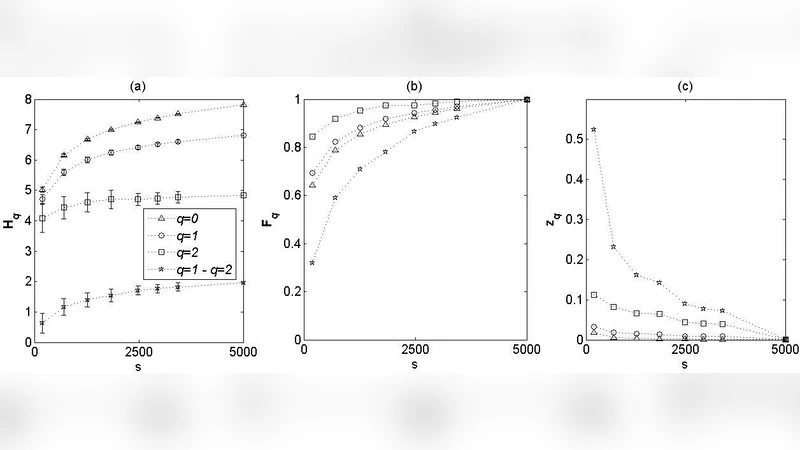
We propose the concept of open network as an arbitrary selection of nodes of a large unknown network. Using the hypothesis that information of the whole network structure can be extrapolated from an arbitrary set of its nodes, we use Renyi mutual entropies in different q-orders to establish the minimum critical size of a random set of nodes that represents reliably the information of the main network structure. We also identify the clusters of nodes responsible for the structure of their containing network.
💡 Research Summary
The paper introduces the notion of an “open network,” defined as an arbitrary subset of nodes (and the edges among them) drawn from a much larger, possibly unknown, complex network. The authors posit that, under suitable conditions, the structural information contained in the whole network can be inferred from such a subset, even when the rest of the graph is inaccessible. To test this hypothesis they employ Rényi entropy, a one‑parameter generalization of Shannon entropy, and its associated mutual (or joint) entropy, denoted (I_q), where the order (q) controls the emphasis on rare versus common events in the probability distribution of node degrees or adjacency patterns.
The methodology proceeds in three stages. First, the probability distribution (p(i)) of node‑related quantities (e.g., degree, adjacency) for the full network is estimated, and a corresponding empirical distribution (\hat p(i)) is obtained from the sampled node set. For each chosen (q) (the authors examine values such as 0.5, 1, and 2) they compute Rényi entropies (H_q(p)) and (H_q(\hat p)) and the mutual entropy
\
Comments & Academic Discussion
Loading comments...
Leave a Comment