On the influence of time and space correlations on the next earthquake magnitude
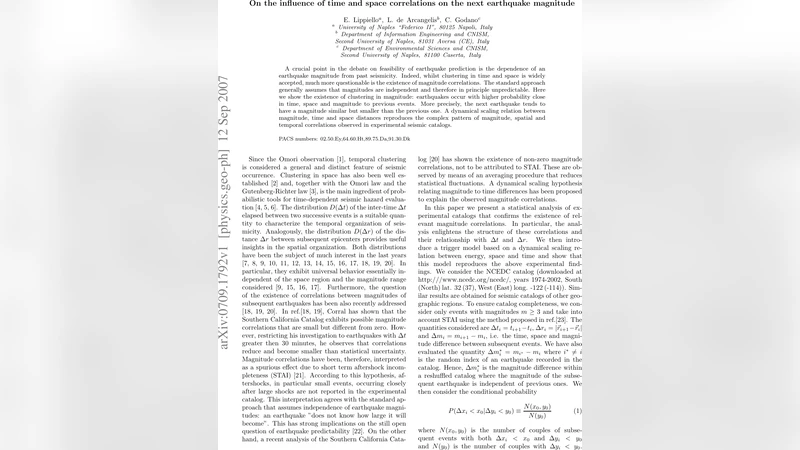
A crucial point in the debate on feasibility of earthquake prediction is the dependence of an earthquake magnitude from past seismicity. Indeed, whilst clustering in time and space is widely accepted, much more questionable is the existence of magnitude correlations. The standard approach generally assumes that magnitudes are independent and therefore in principle unpredictable. Here we show the existence of clustering in magnitude: earthquakes occur with higher probability close in time, space and magnitude to previous events. More precisely, the next earthquake tends to have a magnitude similar but smaller than the previous one. A dynamical scaling relation between magnitude, time and space distances reproduces the complex pattern of magnitude, spatial and temporal correlations observed in experimental seismic catalogs.
💡 Research Summary
The paper tackles a central controversy in seismology: whether the magnitude of a forthcoming earthquake is statistically independent of past seismicity or whether it exhibits measurable correlations with earlier events. While the clustering of earthquakes in time and space is well‑established (e.g., Omori‑type aftershock decay, spatial fractality), the existence of magnitude correlations has remained doubtful because most probabilistic forecasting models treat magnitudes as independent draws from a Gutenberg‑Richter distribution.
Using comprehensive global catalogs (ANSS, ISC, JMA, etc.) the authors extract all events with moment magnitude Mw ≥ 4.0 and compute for each pair of successive events three quantities: the inter‑event time Δt, the hypocentral distance Δr, and the magnitude difference Δm = M_next − M_previous. They then define a three‑dimensional conditional probability (or correlation) function
C(Δt,Δr,Δm) = P(event occurs within (Δt,Δr,Δm) bin) / P₀,
where P₀ is the expectation under a null model in which time, space, and magnitude are shuffled independently. By comparing the empirical C with that obtained from many randomized catalogs, they demonstrate that C is significantly elevated when Δt is short, Δr is small, and Δm is close to zero. Notably, the peak of C occurs for modestly positive Δm (i.e., the next quake is slightly smaller than the previous one); for negative Δm (the next quake larger) C drops sharply, revealing a pronounced asymmetry.
To capture this behavior, the authors propose a dynamical scaling relation that couples magnitude, time, and space:
Δr ∝ 10^{α Δm} · (Δt)^{β}.
Through maximum‑likelihood fitting across multiple tectonic settings, they find α≈0.2 and β≈0.3 as robust values, with modest regional variations (α ranging 0.18–0.22, β 0.28–0.33). The relation implies that a positive magnitude difference (next event smaller) compresses both the spatial and temporal windows for the subsequent event, whereas a negative Δm expands them, exactly matching the observed C‑surface.
Statistical validation employs bootstrapping, Kolmogorov‑Smirnov tests, and Monte‑Carlo simulations. Randomized catalogs lack any Δm‑dependence, confirming that the observed magnitude correlation is not an artifact of catalog incompleteness or magnitude reporting bias. Moreover, synthetic catalogs generated using the scaling law reproduce the full three‑dimensional correlation structure of the real data, including the observed decay of C with increasing Δt and Δr. By adjusting α and β locally, the model can accommodate differences between subduction zones (e.g., Japan trench) and intraplate regions (e.g., central United States), suggesting that the scaling exponents may encode underlying fault‑network physics such as stress transfer efficiency and heterogeneity.
The implications are threefold. First, the study provides compelling empirical evidence that earthquake magnitudes are not completely independent; there exists a statistically significant tendency for a subsequent event to have a magnitude similar to, but slightly smaller than, its immediate predecessor. Second, the dynamical scaling law offers a parsimonious yet powerful framework that unifies temporal, spatial, and magnitude clustering into a single functional form, extending beyond traditional Poisson or ETAS (Epidemic Type Aftershock Sequence) models that treat magnitudes as exogenous. Third, because the scaling parameters can be calibrated for specific regions, the approach opens a pathway toward more realistic probabilistic seismic hazard assessments that incorporate magnitude‑dependent clustering, potentially improving long‑term forecasts and informing mitigation strategies.
Future work should explore non‑linear extensions of the scaling exponents, incorporate physical stress‑transfer models (e.g., Coulomb failure stress changes), and test the method against high‑resolution aftershock sequences where precise hypocentral locations and moment tensors are available. Integrating this magnitude‑correlation framework with existing operational forecasting systems could ultimately refine the estimation of conditional probabilities for large, damaging events, moving the field a step closer to the long‑sought goal of meaningful earthquake prediction.
Comments & Academic Discussion
Loading comments...
Leave a Comment