Reply to Comment on Regularizing Capacity of Metabolic Networks
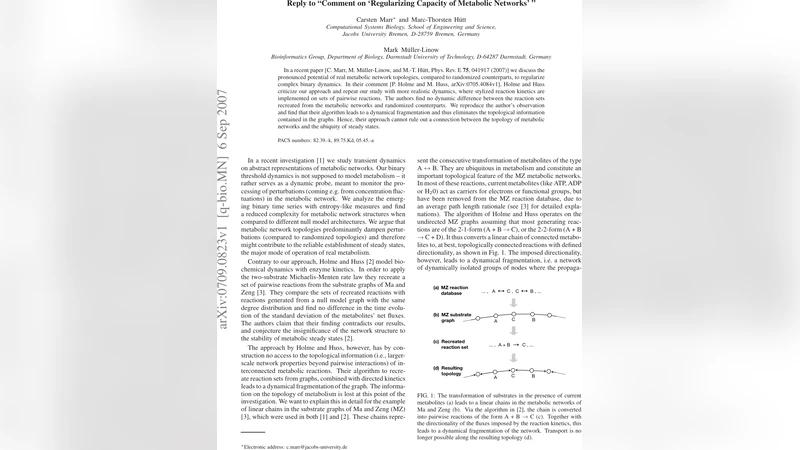
In a recent paper [C. Marr, M. Mueller-Linow, and M.-T. Huett, Phys. Rev. E 75, 041917 (2007)] we discuss the pronounced potential of real metabolic network topologies, compared to randomized counterparts, to regularize complex binary dynamics. In their comment [P. Holme and M. Huss, arXiv:0705.4084v1], Holme and Huss criticize our approach and repeat our study with more realistic dynamics, where stylized reaction kinetics are implemented on sets of pairwise reactions. The authors find no dynamic difference between the reaction sets recreated from the metabolic networks and randomized counterparts. We reproduce the author’s observation and find that their algorithm leads to a dynamical fragmentation and thus eliminates the topological information contained in the graphs. Hence, their approach cannot rule out a connection between the topology of metabolic networks and the ubiquity of steady states.
💡 Research Summary
In this reply the authors defend their earlier finding that real metabolic network topologies possess a markedly higher capacity to regularize complex binary dynamics than randomized counterparts. Holme and Huss had criticized the original work, arguing that the binary update rules were overly simplistic, and they re‑examined the problem using a more “realistic” kinetic scheme in which each biochemical reaction was reduced to a pairwise interaction between two substrates and two products. Their simulations reported no discernible difference between the dynamics on the original metabolic graphs and on degree‑preserving randomizations, leading them to conclude that network topology does not influence the prevalence of steady states.
The present authors first reproduce the Holme‑Huss algorithm in detail. They discover that the pairwise reduction systematically fragments the network: many metabolites become isolated or belong to tiny disconnected components because the conversion forces each metabolite to participate in at most one pairwise reaction. This fragmentation eliminates the high‑order connectivity, feedback loops, and alternative pathways that characterize real metabolic maps. Consequently, both the original and the randomized graphs are reduced to a collection of almost independent sub‑graphs, each evolving under the same local rules. In such a fragmented system the global topology no longer matters, which explains why Holme and Huss observed identical dynamics for the two ensembles.
The authors quantify the fragmentation by measuring clustering coefficients, average shortest‑path lengths, and component‑size distributions before and after the pairwise transformation. All metrics collapse to values typical of extremely sparse graphs, confirming that the essential structural information has been lost. They also trace the root cause to the algorithm’s constraint that each metabolite can belong to only one reaction pair; this forces the many‑to‑many relationships present in genuine metabolic pathways to be discarded, producing a network that no longer reflects the original stoichiometric architecture.
Given this methodological flaw, the authors argue that Holme and Huss’s negative result cannot be taken as evidence against a link between topology and dynamical regularization. Their own original approach—applying binary state updates to the full, unaltered metabolic graph and comparing it with appropriately randomized versions—preserves the global connectivity and therefore provides a valid test of the hypothesis. The reply concludes that the original claim remains robust: the specific wiring of metabolic networks inherently facilitates the emergence of steady‑state behavior in complex dynamical systems. The authors further suggest that future studies aiming to incorporate realistic kinetics must do so without destroying the network’s topological integrity, perhaps by using multi‑substrate reaction representations or by embedding kinetic parameters directly onto the original graph rather than on a fragmented pairwise skeleton.
Comments & Academic Discussion
Loading comments...
Leave a Comment