Homotopy theoretic models of identity types
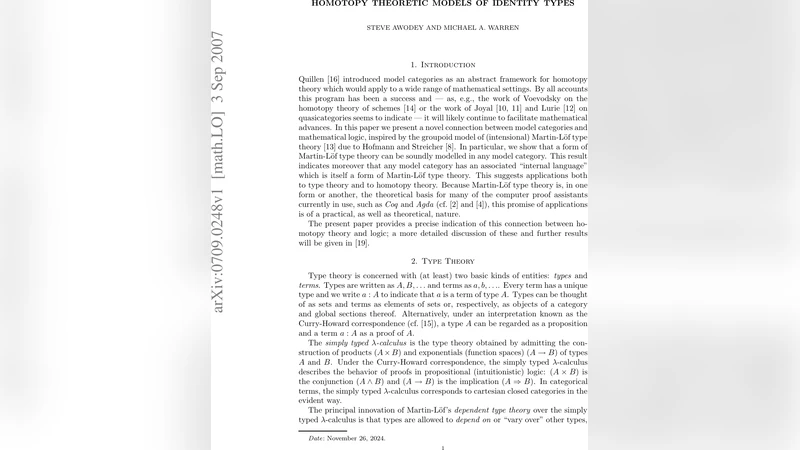
This paper presents a novel connection between homotopical algebra and mathematical logic. It is shown that a form of intensional type theory is valid in any Quillen model category, generalizing the Hofmann-Streicher groupoid model of Martin-Loef type theory.
💡 Research Summary
The paper establishes a broad bridge between homotopical algebra and intensional Martin‑Löf type theory by showing that the core rules of identity types can be interpreted in any Quillen model category. The authors begin by recalling the syntax of intensional type theory—contexts, dependent types, terms, and especially the formation, introduction, elimination, and computation rules for identity (Id) types. They then introduce the basic notions of a model category: cofibrations, fibrations, and weak equivalences, together with the two‑out‑of‑three property and the existence of functorial factorisations.
The central technical contribution is the interpretation of an identity type Id_A(a,b) as a path object P(A) over the product A×A. In a model category, for each object X there exists a factorisation of the diagonal Δ_X : X → X×X as a cofibration followed by a fibration X → P(X) → X×X. The object P(X) is called a path object; its points correspond to homotopies (paths) between points of X. The authors map a term a : A in context Γ to a morphism Γ → A, and a proof p : Id_A(a,b) to a lift Γ → P(A) making the two projections equal to a and b respectively. Reflexivity is interpreted by the canonical section (the “constant path”) s : A → P(A); transitivity by the composition map μ : P(A)×_A P(A) → P(A); and symmetry by the reversal map ι : P(A) → P(A). All these maps exist because of the model‑category axioms, and they satisfy the required equations up to homotopy, which is sufficient for the intensional setting.
Having secured the identity‑type interpretation, the paper proceeds to interpret dependent sum (Σ) and dependent product (Π) types. Σ‑types are modelled by pullbacks together with the left adjoint to the pullback functor (a “push‑forward” of fibrations), while Π‑types are modelled by the right adjoint (the dependent product of fibrations). The authors prove that, under the usual stability conditions for fibrations under pullback and composition, the Σ‑ and Π‑rules are sound in any model category.
The work then revisits the Hofmann‑Streicher groupoid model, showing that it is precisely the special case where the ambient model category is the category of (small) groupoids equipped with the canonical model structure (where weak equivalences are equivalences of groupoids, fibrations are isofibrations, and cofibrations are functors injective on objects). In that setting, the path object of a groupoid G is the groupoid of arrows of G, and identity proofs correspond to actual isomorphisms. By placing this example inside the general framework, the authors demonstrate that the groupoid model is not an isolated curiosity but a concrete instance of a much larger phenomenon.
To illustrate the generality, the paper supplies three further families of examples. In the category of chain complexes of modules (with the projective model structure), path objects are given by mapping cones, and identity proofs become chain homotopies. In the category of topological spaces (with the Quillen model structure), path objects are the usual path spaces X^I, and Id‑types are interpreted as actual continuous paths. In the category of simplicial sets (with the Kan model structure), path objects are the simplicial path objects, and identity proofs are simplicial homotopies. In each case the authors verify that the Id‑type rules hold strictly enough to support the full intensional type theory.
A notable philosophical consequence is that the uniqueness of identity proofs (UIP) does not hold in general model categories; instead, identity types can have non‑trivial higher homotopies. This aligns the interpretation with the emerging Homotopy Type Theory (HoTT) perspective, where types are viewed as ∞‑groupoids. The paper hints at extending the construction to higher identity types, suggesting that iterated path objects provide a natural model of the infinite tower of Id‑types required for an ∞‑categorical semantics.
The conclusion summarises the impact: by showing that any Quillen model category yields a sound model of intensional type theory with identity types, the authors provide a unifying semantic framework that subsumes the groupoid model and opens the door to applying type‑theoretic reasoning in a wide array of homotopical contexts. Future work is outlined, including the development of universe types within this setting, normalization results, and the integration of these models into proof assistants to exploit the computational content of homotopical semantics.
Comments & Academic Discussion
Loading comments...
Leave a Comment