Self-consistent theory of reversible ligand binding to a spherical cell
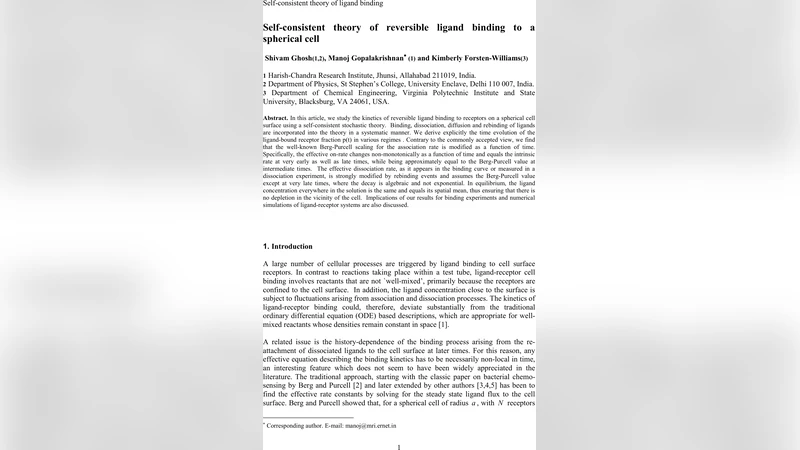
In this article, we study the kinetics of reversible ligand binding to receptors on a spherical cell surface using a self-consistent stochastic theory. Binding, dissociation, diffusion and rebinding of ligands are incorporated into the theory in a systematic manner. We derive explicitly the time evolution of the ligand-bound receptor fraction p(t) in various regimes . Contrary to the commonly accepted view, we find that the well-known Berg-Purcell scaling for the association rate is modified as a function of time. Specifically, the effective on-rate changes non-monotonically as a function of time and equals the intrinsic rate at very early as well as late times, while being approximately equal to the Berg-Purcell value at intermediate times. The effective dissociation rate, as it appears in the binding curve or measured in a dissociation experiment, is strongly modified by rebinding events and assumes the Berg-Purcell value except at very late times, where the decay is algebraic and not exponential. In equilibrium, the ligand concentration everywhere in the solution is the same and equals its spatial mean, thus ensuring that there is no depletion in the vicinity of the cell. Implications of our results for binding experiments and numerical simulations of ligand-receptor systems are also discussed.
💡 Research Summary
In this paper the authors develop a self‑consistent stochastic framework to describe reversible binding of ligands to receptors distributed on the surface of a spherical cell. Unlike the classic Berg‑Purcell treatment, which provides a static “effective” association rate, the present theory incorporates diffusion, binding, dissociation and, crucially, rebinding events in a unified manner, allowing the time‑dependence of the observable bound‑receptor fraction p(t) to be derived analytically.
The model treats the cell as a sphere of radius R bearing N uniformly spaced receptors. Ligands diffuse in the surrounding medium with diffusion coefficient D and are present at bulk concentration c₀. The microscopic association and dissociation rates are k_on and k_off. By solving the diffusion equation with a mixed boundary condition that couples the flux at the surface to the stochastic reaction of receptors, the authors obtain an exact expression for p(t).
Two distinct temporal regimes emerge. At very early times (t ≪ R²/D) the ligand cloud has not yet felt the curvature of the cell; the effective on‑rate equals the intrinsic k_on and the bound fraction grows linearly. At intermediate times (t ≈ R²/D) diffusion brings ligands to the surface faster than they can escape, and the effective association rate approaches the Berg‑Purcell value k_on^BP = 4πDR·(N/4πR²). Remarkably, the on‑rate is non‑monotonic: it starts at k_on, rises to the Berg‑Purcell plateau, and then returns to k_on at long times when the system reaches equilibrium.
Rebinding dramatically reshapes the apparent dissociation kinetics. The effective off‑rate k_off^eff coincides with the intrinsic k_off only at the earliest and latest stages; during the intermediate regime it is reduced to the Berg‑Purcell value because a ligand that dissociates is likely to re‑bind before diffusing away. At very long times the decay of p(t) follows an algebraic t⁻³/² law rather than a simple exponential, indicating that the system never truly behaves as a first‑order reaction in the asymptotic limit.
Equilibrium analysis shows that the ligand concentration everywhere in the solution equals the spatial mean, i.e., c_eq = c₀. Consequently there is no depletion zone around the cell, a result that validates the use of bulk concentration in many experimental protocols.
The authors discuss practical implications. In binding assays that monitor p(t) on single cells, fitting data with a constant Berg‑Purcell rate will misestimate kinetic parameters at early and late times. Numerical simulations that ignore rebinding (e.g., standard Brownian dynamics with absorbing boundaries) overpredict association speed and underpredict dissociation. The paper therefore recommends implementing time‑dependent effective rates or explicitly modeling rebinding events in computational studies.
Beyond the methodological advance, the theory is directly applicable to a wide range of biological contexts—immune synapse formation, neurotransmitter receptor dynamics, and drug‑target interactions on cell membranes—where ligand diffusion and receptor density are comparable to the scales considered here. By providing a rigorous, analytically tractable description of how diffusion and rebinding shape observed kinetics, the work offers a valuable tool for both experimental design and the interpretation of kinetic data in cell‑surface biochemistry.
Comments & Academic Discussion
Loading comments...
Leave a Comment