On the self-adjointness of certain reduced Laplace-Beltrami operators
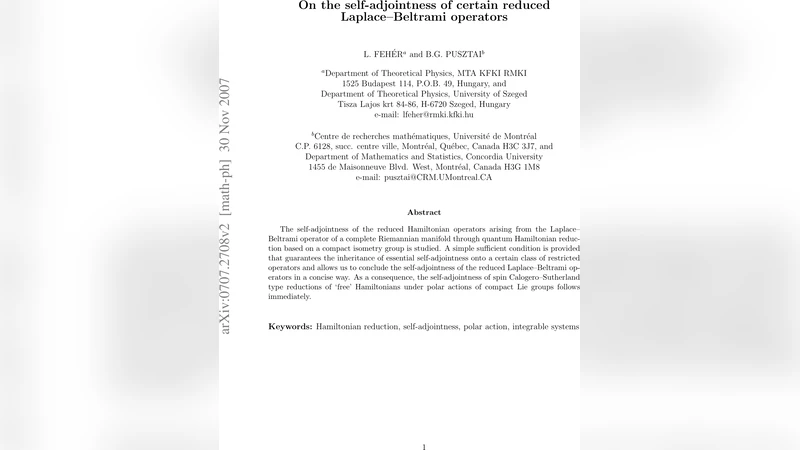
The self-adjointness of the reduced Hamiltonian operators arising from the Laplace-Beltrami operator of a complete Riemannian manifold through quantum Hamiltonian reduction based on a compact isometry group is studied. A simple sufficient condition is provided that guarantees the inheritance of essential self-adjointness onto a certain class of restricted operators and allows us to conclude the self-adjointness of the reduced Laplace-Beltrami operators in a concise way. As a consequence, the self-adjointness of spin Calogero-Sutherland type reductions of `free’ Hamiltonians under polar actions of compact Lie groups follows immediately.
💡 Research Summary
The paper addresses a fundamental question in geometric quantum mechanics: when a Laplace‑Beltrami operator on a complete Riemannian manifold is reduced by a compact isometry group, does the resulting reduced Hamiltonian retain essential self‑adjointness? The authors provide a concise and powerful sufficient condition that guarantees the inheritance of essential self‑adjointness from the original operator to a broad class of restricted operators, and they apply this condition to a variety of physically relevant reductions, most notably spin Calogero‑Sutherland models obtained via polar actions of compact Lie groups.
The work begins by recalling that on a complete Riemannian manifold ((M,g)) the Laplace‑Beltrami operator (\Delta) is essentially self‑adjoint on the dense domain (C_c^\infty(M)). When a compact Lie group (G) acts by isometries, the Hilbert space (L^2(M)) decomposes into a direct sum of (G)-invariant subspaces according to the Peter–Weyl theorem. For any such invariant subspace (S) the restriction (A_S) of a symmetric operator (A) (here (A=\Delta)) is again symmetric, but essential self‑adjointness is not automatic. The authors prove the following theorem: if (i) (S\subset D(A)) and (A S\subset S) (i.e., (S) is invariant under (A)), and (ii) the intersection (D(A)\cap S) is dense in (S), then the closure of (A_S) coincides with the restriction of the closure of (A). Consequently, (A_S) is essentially self‑adjoint whenever (A) is. The proof relies on standard graph‑closure arguments and shows that the deficiency indices of (A_S) vanish because any vector orthogonal to the range of ((A_S\pm i)) would also be orthogonal to the range of ((A\pm i)), which is impossible for an essentially self‑adjoint (A).
Having established this abstract result, the authors turn to the concrete setting of polar actions. A polar action admits a global section (\Sigma) that meets every (G)-orbit orthogonally, allowing the manifold to be written locally as a product (\Sigma\times G/K). In this situation the Laplace‑Beltrami operator splits into a “radial” part on (\Sigma) and an angular part on the homogeneous space (G/K). By introducing the appropriate weighted measure on (\Sigma), the authors verify that the radial operator (\Delta_{\text{red}}) satisfies the two conditions above: its domain contains (C_c^\infty(\Sigma)), it maps this space into itself, and (C_c^\infty(\Sigma)) is dense in the Hilbert space (L^2(\Sigma,\mu)). Hence (\Delta_{\text{red}}) is essentially self‑adjoint.
The most striking application is to spin Calogero‑Sutherland systems. These models arise by reducing the free Hamiltonian on a compact Lie group (or on a symmetric space) under a polar action, and they feature a kinetic term on the section (\Sigma) together with inverse‑square interaction potentials and matrix‑valued spin couplings. All potential terms are smooth and bounded on the regular part of (\Sigma), so they do not disturb the domain properties required for essential self‑adjointness. As a direct corollary, the quantum Hamiltonians of these spin many‑body systems are guaranteed to be essentially self‑adjoint, ensuring a unique self‑adjoint extension, real spectrum, and unitary time evolution without the need for elaborate boundary‑condition analysis.
In the concluding remarks the authors emphasize the generality of their sufficient condition: it applies to any compact symmetry reduction where the invariant subspace can be chosen to be invariant under the original operator and dense in the reduced Hilbert space. They suggest that future work could explore non‑compact groups, singular reductions, or manifolds with incomplete metrics, where the present technique may need refinement. Overall, the paper provides a clean, conceptually simple tool that resolves a long‑standing technical obstacle in the quantization of symmetry‑reduced systems and opens the door to rigorous analysis of a wide class of integrable and superintegrable quantum models.
Comments & Academic Discussion
Loading comments...
Leave a Comment