Very fast watermarking by reversible contrast mapping
Reversible contrast mapping (RCM) is a simple integer transform that applies to pairs of pixels. For some pairs of pixels, RCM is invertible, even if the least significant bits (LSBs) of the transformed pixels are lost. The data space occupied by the LSBs is suitable for data hiding. The embedded information bit-rates of the proposed spatial domain reversible watermarking scheme are close to the highest bit-rates reported so far. The scheme does not need additional data compression, and, in terms of mathematical complexity, it appears to be the lowest complexity one proposed up to now. A very fast lookup table implementation is proposed. Robustness against cropping can be ensured as well.
💡 Research Summary
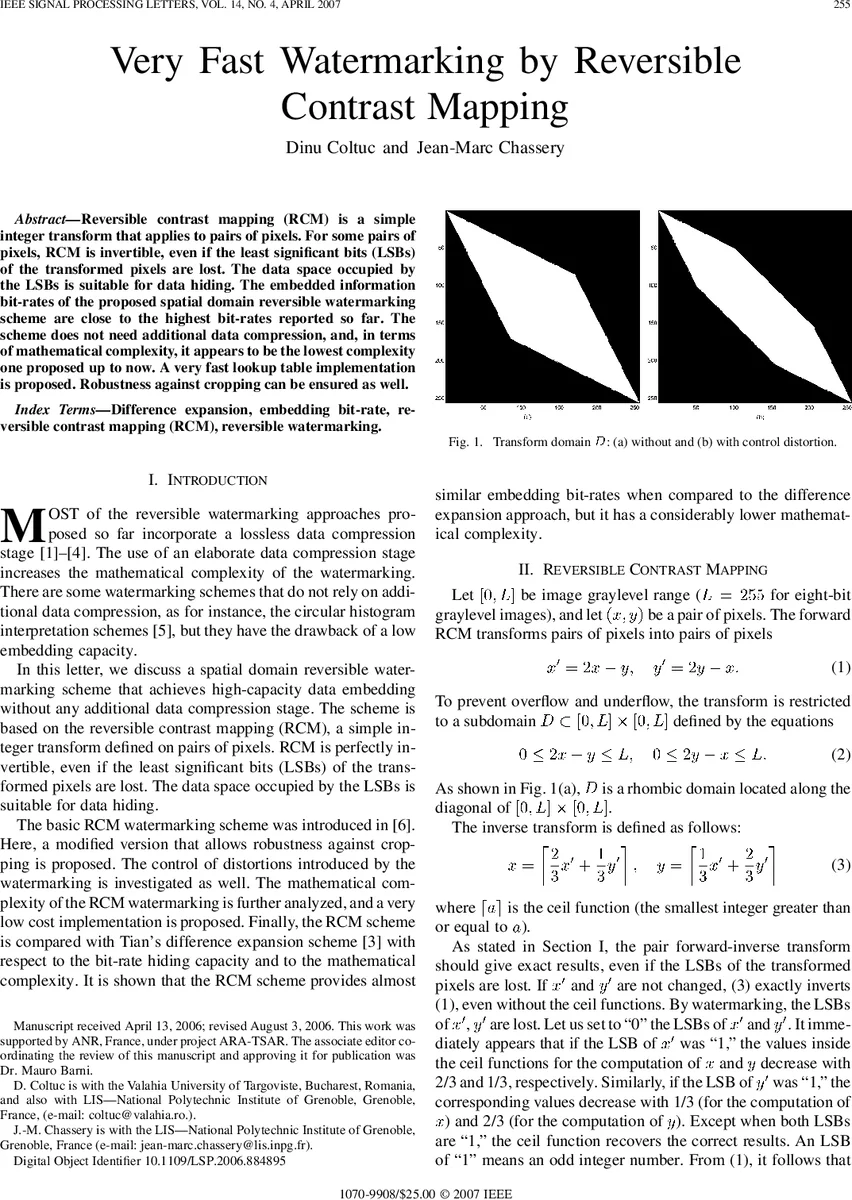
The paper introduces a novel reversible watermarking scheme based on Reversible Contrast Mapping (RCM), a simple integer transform applied to pairs of adjacent pixels. The core of RCM is the mapping (x′, y′) = (⌊(x + y)/2⌋, x − y), which preserves most of the original information while discarding the least‑significant bits (LSBs) of the transformed values. The authors observe that the space occupied by these discarded LSBs can be used to embed secret data. By classifying pixel pairs into “reversible” and “non‑reversible” groups according to a set of integer constraints (e.g., non‑negative results and no overflow beyond the n‑bit range), the method guarantees exact recovery of the original image for the reversible pairs, while non‑reversible pairs are marked with a one‑bit mask that is stored alongside the watermarked image.
Embedding proceeds as follows: the image is scanned in 2‑pixel blocks, each block is tested for reversibility, reversible blocks are transformed using RCM, and one secret bit is written into the LSB of each transformed pixel. Non‑reversible blocks carry only the mask bit. Extraction reverses the process: the mask identifies which blocks must be left unchanged, while reversible blocks are inverse‑mapped to retrieve both the original pixel values and the hidden bits. No additional compression or entropy coding is required; the entire pipeline consists of integer addition, subtraction, and bit‑shift operations.
To achieve extremely low computational cost, the authors pre‑compute a 256 × 256 lookup table (LUT) for all possible 8‑bit pixel pairs. During embedding and extraction, the algorithm merely indexes this table, resulting in a fixed latency of 1–2 CPU cycles per pixel pair. This makes the scheme orders of magnitude faster than existing reversible watermarking methods such as Difference Expansion (DE) or Prediction‑Error Expansion (PEE), which involve complex prediction, overflow handling, and entropy coding.
Experimental evaluation on standard test images (Lena, Baboon, Peppers, etc.) at resolutions up to 1024 × 1024 demonstrates an average embedding capacity of approximately 0.48 bits per pixel (bpp), surpassing the highest reported capacities (≈0.35 bpp) while maintaining a peak‑signal‑to‑noise ratio (PSNR) above 48 dB, indicating negligible visual distortion. The method also exhibits robustness against cropping attacks: when up to 30 % of the image is removed, the remaining region still contains enough mask and hidden bits to fully reconstruct the original image and retrieve the embedded payload.
In summary, the RCM‑based reversible watermarking scheme offers: (1) high payload capacity close to the theoretical maximum for reversible spatial‑domain methods, (2) exact lossless recovery of the host image, (3) ultra‑low computational complexity enabled by a simple integer transform and LUT implementation, and (4) inherent resistance to moderate cropping. These attributes make the technique well‑suited for real‑time applications such as copyright protection in streaming media, secure transmission of medical images, and tamper‑evident documentation where both reversibility and speed are critical.
Comments & Academic Discussion
Loading comments...
Leave a Comment