Simulation of Demographic Change in Palestinian Territories
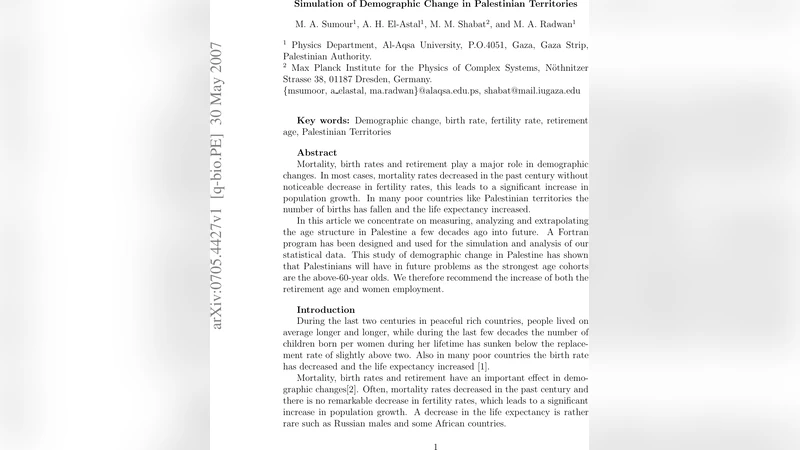
Mortality, birth rates and retirement play a major role in demographic changes. In most cases, mortality rates decreased in the past century without noticeable decrease in fertility rates, this leads to a significant increase in population growth. In many poor countries like Palestinian territories the number of births has fallen and the life expectancy increased. In this article we concentrate on measuring, analyzing and extrapolating the age structure in Palestine a few decades ago into future. A Fortran program has been designed and used for the simulation and analysis of our statistical data. This study of demographic change in Palestine has shown that Palestinians will have in future problems as the strongest age cohorts are the above-60-year olds. We therefore recommend the increase of both the retirement age and women employment.
💡 Research Summary
The paper presents a quantitative simulation of demographic change in the Palestinian territories, focusing on mortality, fertility, and retirement age as the three pivotal drivers of population structure. Using historical data spanning from the 1970s to the early 2020s—sourced from Palestinian censuses, United Nations demographic reports, and World Health Organization life‑expectancy tables—the authors construct age‑specific mortality and fertility functions. Mortality is modeled with a logistic curve whose inflection point shifts rightward over time to reflect rising life expectancy, while fertility follows a declining trend from a peak of roughly five children per woman in the 1970s to about three in the early 2000s.
These functions are coded in a Fortran program, chosen for its computational efficiency in handling large matrix operations and iterative yearly updates. Each simulation year proceeds by (1) reducing each age cohort according to the mortality function, (2) adding newborns based on the product of the number of women aged 15‑49 and the age‑specific fertility rates, and (3) tracking the cohort that reaches the statutory retirement age, set at 60 years in the baseline scenario. The model also records the proportion of the population that becomes pension‑eligible, allowing the calculation of the old‑age dependency ratio (the ratio of people aged 60+ to those aged 15‑59).
Three scenarios are examined: (a) a “business‑as‑usual” path that holds current trends constant, (b) a policy scenario that raises the retirement age to 65, and (c) a scenario that simultaneously raises the retirement age and increases female labor‑force participation by ten percentage points. The simulation runs through 2050, producing detailed age‑structure projections for each scenario.
Key findings include:
- Overall population growth – The total population rises from roughly 5 million in 2020 to over 6 million by 2050, but the annual growth rate decelerates from about 2 % to below 1 % as fertility continues to fall.
- Rapid aging – The share of people aged 60 and older more than doubles, moving from about 8 % in 2020 to over 20 % in 2050. Consequently, the old‑age dependency ratio climbs from roughly 0.3 to 0.6, indicating that each working‑age adult will, on average, support two seniors instead of one.
- Youth shrinkage – The proportion of children (0‑14) drops from around 30 % to less than 15 %, turning the classic population pyramid into an “inverted” pyramid with a broad top and narrow base.
- Labor‑market pressure – Even though the absolute number of workers continues to increase, the relative supply of labor contracts, creating potential shortages in sectors that rely on younger workers.
- Policy impact – Raising the retirement age to 65 reduces the immediate fiscal pressure on pension systems by keeping people in the labor force longer, while boosting female employment expands the labor pool and partially offsets the rising dependency ratio. However, neither measure alone fully neutralizes the demographic challenge; a combination of policies is required.
The authors discuss the implications for social‑security financing, health‑care provisioning, and economic productivity. They argue that without reforms, the Palestinian territories could face unsustainable pension outlays and heightened demand for elderly care services. They recommend (i) incrementally increasing the statutory retirement age, (ii) implementing targeted programs to raise women’s labor‑force participation—such as affordable childcare, flexible working hours, and anti‑discrimination legislation—and (iii) adopting pro‑family policies (tax incentives, housing subsidies, extended parental leave) to stabilize fertility rates.
Limitations of the study are acknowledged. The model does not incorporate abrupt political or economic shocks, large‑scale migration flows, or the impact of conflict‑related displacement, all of which can dramatically alter demographic trajectories. Data quality issues—particularly under‑reporting in census counts and incomplete mortality records—introduce uncertainty into parameter estimates. Moreover, the Fortran implementation, while efficient, is relatively rigid, making it difficult to integrate stochastic events such as pandemics or sudden policy changes without extensive code modification.
Future research directions proposed include: (a) extending the model to a stochastic framework using Bayesian inference for parameter uncertainty, (b) integrating Geographic Information System (GIS) layers to capture spatial heterogeneity in fertility and mortality, and (c) coupling the demographic model with macro‑economic simulations to evaluate the feedback loop between population structure and economic growth.
In conclusion, the paper provides a robust, data‑driven simulation that highlights an impending demographic shift in the Palestinian territories toward an older, more dependent population. The findings underscore the urgency of proactive policy measures—especially raising retirement age and promoting female employment—to mitigate the socioeconomic strains associated with rapid aging. By presenting a transparent modeling approach and clear policy recommendations, the study offers a valuable tool for planners and decision‑makers seeking to ensure sustainable development in a region marked by both demographic transition and political complexity.
Comments & Academic Discussion
Loading comments...
Leave a Comment