Accumulation horizons and period-adding in optically injected semiconductor lasers
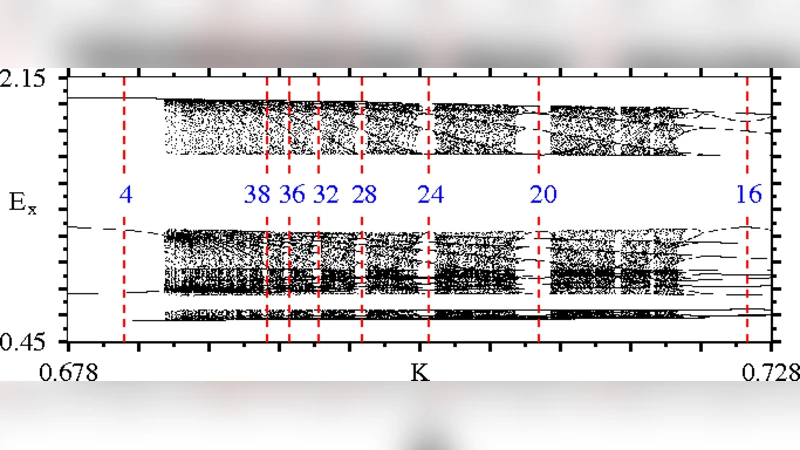
We study the hierarchical structuring of islands of stable periodic oscillations inside chaotic regions in phase diagrams of single-mode semiconductor lasers with optical injection. Phase diagrams display remarkable {\it accumulation horizons}: boundaries formed by the accumulation of infinite cascades of self-similar islands of periodic solutions of ever-increasing period. Each cascade follows a specific period-adding route. The riddling of chaotic laser phases by such networks of periodic solutions may compromise applications operating with chaotic signals such as e.g. secure communications.
💡 Research Summary
The paper investigates the intricate organization of periodic solutions within chaotic regions of a single‑mode semiconductor laser subject to optical injection. Using the standard rate‑equation model (a Lang–Kobayashi‑type system) the authors treat the injected optical power and the frequency detuning between master and slave lasers as the two main control parameters. By performing high‑resolution two‑dimensional parameter scans (step size 10⁻³) and combining Lyapunov exponent calculations, Poincaré‑section analysis, and a dedicated period‑detection algorithm, they map out the full dynamical landscape of the device.
The most striking observation is that, embedded inside the chaotic sea, there exist numerous “islands of periodic solutions.” Each island corresponds to a stable limit cycle of a definite period N (e.g., 3‑cycle, 5‑cycle, etc.). These islands are not isolated randomly; instead they line up along well‑defined directions, forming infinite cascades in which the period increases by a fixed integer amount when the control parameters are varied monotonically. This phenomenon is termed a period‑adding route, distinct from the classic period‑doubling cascade.
As the cascades progress, they converge onto sharply defined boundaries that the authors call accumulation horizons. An accumulation horizon is a curve (often nearly straight) in the (detuning, injection‑power) plane that is approached by an infinite sequence of periodic islands whose widths shrink geometrically while their periods grow without bound. Near these horizons the system exhibits riddling: the basin of attraction of the periodic orbit becomes interwoven with the chaotic basin, so that infinitesimal parameter changes or tiny variations in initial conditions can flip the trajectory from chaos to a high‑period orbit.
Numerical evidence is reinforced by experimental measurements on a real optically injected semiconductor laser. By tuning the injection strength and frequency offset, the researchers observe the same hierarchy of periodic windows and the approach to an accumulation horizon, confirming that the model captures the essential physics.
From a practical standpoint the findings have two major implications. First, laser designers seeking stable single‑frequency operation must avoid the vicinity of accumulation horizons, because the dense packing of high‑period islands makes the device highly sensitive to noise and parameter drift. Second, applications that exploit chaotic laser output for secure communications—such as chaos‑based encryption or random number generation—must consider the possibility that the chaotic carrier can be riddled with high‑period deterministic components. These hidden periodicities could be exploited by an eavesdropper or could degrade the statistical properties of the transmitted data.
In summary, the study reveals that the parameter space of an optically injected semiconductor laser is not a simple dichotomy of chaos versus low‑order periodicity. Instead, it possesses a multilayered structure composed of infinite period‑adding sequences that accumulate on well‑defined horizons. This new perspective enriches the theoretical understanding of nonlinear laser dynamics and provides concrete guidance for engineering robust laser systems and for assessing the security of chaos‑based communication schemes.