The unified geometric theory of mesoscopic stochastic pumps and reversible ratchets
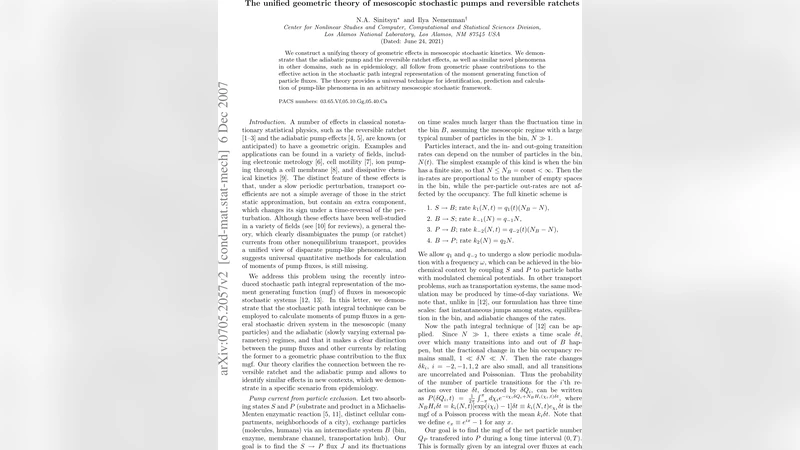
We construct a unifying theory of geometric effects in mesoscopic stochastic kinetics. We demonstrate that the adiabatic pump and the reversible ratchet effects, as well as similar new phenomena in other domains, such as in epidemiology, all follow from geometric phase contributions to the effective action in the stochastic path integral representation of the moment generating function. The theory provides the universal technique for identification, prediction and calculation of pump-like phenomena in an arbitrary mesoscopic stochastic framework.
💡 Research Summary
The paper presents a unified geometric framework for understanding and predicting pump‑like phenomena in mesoscopic stochastic systems. Starting from the master equation description of a Markovian process, the authors reformulate the moment‑generating function as a stochastic path integral. By taking the logarithm of this functional integral they obtain an effective action that depends on a set of externally controllable parameters λ(t). In the adiabatic limit—when λ(t) varies slowly compared to the intrinsic relaxation time—the effective action separates into a dynamical part, which reproduces the instantaneous steady‑state behavior, and a geometric part, which is a line integral of a connection over the trajectory of λ in parameter space. This geometric term is directly analogous to the Berry phase in quantum mechanics; its curvature (the antisymmetric derivative of the connection) governs the accumulation of a phase whenever the parameters trace a closed loop.
The authors show that this geometric phase manifests as a non‑zero average current (or flux) even in the absence of any explicit bias. For a cyclic, time‑periodic modulation of the parameters the average current is given by the line integral of the connection around the loop, i.e. the Berry phase. This is identified as the adiabatic pump effect. When the loop lacks time‑reversal symmetry, the resulting current is directional and reversible, corresponding to the reversible ratchet phenomenon. Both effects are thus unified under a single mathematical object: the curvature of the parameter‑space connection.
To illustrate the generality of the theory, three concrete models are analyzed. First, a two‑state system with transition rates modulated by an external voltage and temperature reproduces the classic stochastic pump, confirming that the geometric contribution alone predicts the net particle flow. Second, a Brownian particle moving in a spatially periodic, asymmetric potential whose amplitude and phase are slowly varied demonstrates the reversible ratchet; the curvature associated with the potential parameters yields a net drift despite zero average force. Third, the authors extend the formalism to epidemiological dynamics (SIR model) where infection and recovery rates are seasonally or policy‑driven. The geometric phase predicts a “infection pump”: a net increase or decrease in the average number of infected individuals over a cycle, contingent on the asymmetry of the rate modulation.
A key practical outcome is the identification of the curvature tensor as a universal diagnostic: if the curvature vanishes for a given set of parameters, no pump effect can arise; a non‑zero curvature guarantees a finite geometric contribution to the current. Consequently, one can compute the curvature for any mesoscopic stochastic model to assess the possibility of pump‑like behavior without solving the full dynamics. This provides a powerful design principle for experiments and engineered systems, ranging from nano‑electronic devices (where voltage and temperature cycles can be tuned) to biological control strategies (where drug administration schedules can be optimized to suppress or enhance population fluxes).
The paper concludes by emphasizing that the geometric perspective bridges previously disparate phenomena—adiabatic pumps, reversible ratchets, and even epidemiological cycles—into a single theoretical structure. Future directions include extending the theory beyond the adiabatic regime to fast driving, exploring multi‑parameter interference effects, and applying the framework to hybrid quantum‑classical systems where stochastic and coherent dynamics coexist. Overall, the work offers a universal, mathematically rigorous tool for identifying, predicting, and quantifying geometric pump effects across a broad spectrum of mesoscopic stochastic processes.
Comments & Academic Discussion
Loading comments...
Leave a Comment