Markov properties in presence of measurement noise
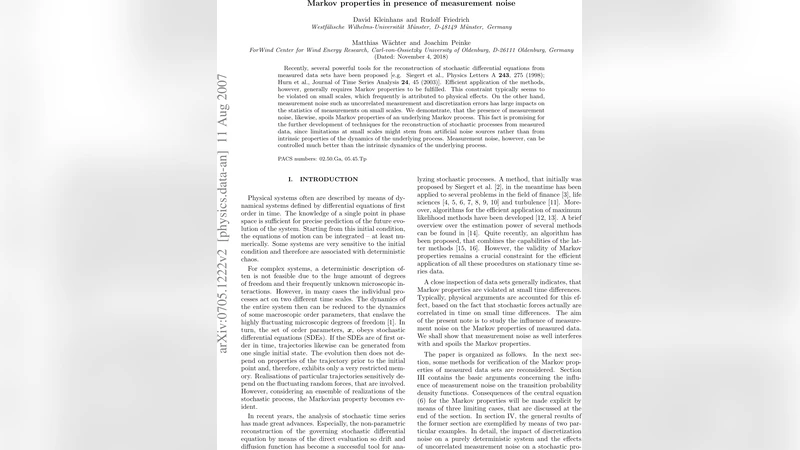
Recently, several powerful tools for the reconstruction of stochastic differential equations from measured data sets have been proposed [e.g. Siegert et al., Physics Letters A 243, 275 (1998); Hurn et al., Journal of Time Series Analysis 24, 45 (2003)]. Efficient application of the methods, however, generally requires Markov properties to be fulfilled. This constraint typically seems to be violated on small scales, which frequently is attributed to physical effects. On the other hand, measurement noise such as uncorrelated measurement and discretization errors has large impacts on the statistics of measurements on small scales. We demonstrate, that the presence of measurement noise, likewise, spoils Markov properties of an underlying Markov processes. This fact is promising for the further development of techniques for the reconstruction of stochastic processes from measured data, since limitations at small scales might stem from artificial noise sources rather than from intrinsic properties of the dynamics of the underlying process. Measurement noise, however, can be controlled much better than the intrinsic dynamics of the underlying process.
💡 Research Summary
The paper addresses a fundamental prerequisite of many modern techniques for reconstructing stochastic differential equations (SDEs) from empirical data: the assumption that the underlying process is Markovian. A Markov process is defined by the property that the conditional probability of future states depends only on the present state, not on the full past history. This property underlies the Kramers‑Moyal expansion and the associated Fokker‑Planck equation, which are used to estimate drift and diffusion functions directly from time‑series measurements.
In practice, however, researchers frequently observe violations of the Markov property at short time scales. The prevailing interpretation attributes these violations to intrinsic physical complexities such as hidden variables, multi‑scale dynamics, or non‑linear interactions. The authors challenge this view by demonstrating that measurement noise—specifically uncorrelated white Gaussian noise and discretization errors—can by itself destroy the apparent Markovian character of an otherwise Markov process.
The theoretical argument proceeds as follows. Let X(t) be a genuine Markov process and η(t) an independent measurement error with zero mean and variance σ². The observed signal Y(t)=X(t)+η(t) is a convolution of the true transition density p_X(x₂|x₁) with the noise density. This convolution alters the conditional probabilities so that the Chapman‑Kolmogorov equation, p_Y(y₃|y₁)=∫p_Y(y₃|y₂)p_Y(y₂|y₁)dy₂, no longer holds in general. Consequently, the observed series Y(t) fails standard Markov tests even though the underlying dynamics remain Markovian.
To substantiate the claim, the authors simulate an Ornstein‑Uhlenbeck process—a linear, analytically tractable Markov system—and add Gaussian noise of varying strength. They then apply conventional Markov diagnostics: conditional probability density estimation, Kullback‑Leibler divergence between left‑ and right‑hand sides of the Chapman‑Kolmogorov relation, and direct tests of the Markov property. The results show a clear monotonic increase in the degree of apparent non‑Markovian behavior as the noise variance grows, especially for small sampling intervals Δt. Moreover, the estimated drift and diffusion coefficients become increasingly biased, illustrating how uncorrected measurement noise can lead to erroneous physical interpretations.
These findings have two major implications. First, any empirical assessment of Markovianity must explicitly account for measurement noise; otherwise, observed violations may be mistakenly ascribed to complex dynamics rather than to the measurement process itself. Second, because measurement noise is an external, controllable factor, its mitigation offers a practical route to improve the reliability of SDE reconstruction. Strategies include using higher‑precision instrumentation, increasing sampling rates, applying signal‑processing filters, or incorporating explicit noise models into the inference algorithm (e.g., via deconvolution or Expectation‑Maximization schemes).
The authors also discuss potential extensions. By estimating the statistical properties of the noise beforehand, one can correct the observed transition densities before applying the Kramers‑Moyal analysis. Alternatively, joint estimation of the hidden Markov process and the noise parameters can be performed within a Bayesian framework, allowing simultaneous recovery of the true dynamics and the measurement error characteristics. Such approaches are particularly relevant for fields where measurement errors are substantial, such as biophysics, finance, and climate science.
In summary, the paper overturns the common assumption that short‑scale violations of the Markov property necessarily reflect intrinsic dynamical complexity. It shows that uncorrelated measurement noise alone suffices to produce such violations, thereby highlighting the critical importance of noise quantification and correction in data‑driven stochastic modeling. This insight paves the way for more robust reconstruction techniques that can distinguish genuine dynamical features from artefacts introduced by the measurement apparatus.
Comments & Academic Discussion
Loading comments...
Leave a Comment