Critical phenomena in complex net w orks S. N. Dor ogovtsev ∗ and A. V. Goltsev † Departamento de F ´ ısica da Univers idade de Aveir o, 3810-193 Aveiro, P o rtugal and A.F. Ioffe Ph ysico-T echnical Institut e, 1940 21 St. P etersburg, Russia J. F. F. Mendes ‡ Departamento de F ´ ısica da Univers idade de Aveir o, 3810-193 Aveiro, P o rtugal The combination of the compactne ss of netw orks, f eaturing smal l diamete rs, and their complex arc hitectures results in a v ari et y of critical effec ts dramatically different from those in coop er a- tiv e systems on lat tices. In the l ast few y ears, researche rs ha v e made imp ortan t steps to w ard understanding the qualitativ ely new critical phenomena in complex net w orks. W e review the re- sults, conce pts, and methods of t his rapidly dev eloping field. Here we mostly consider tw o closely related classes of these critical phenomena , namely structural phase transitions in the netw or k arc hitectures and transitions in cooperative models on net w orks as substrates. W e al s o discuss systems where a net w ork and i n teracting agen ts on it i nfluence eac h other. W e o v erview a wide range of critical phenomena i n equili br ium and growing netw orks including the birth of the gi- an t conne cted component, percolation, k -core percolation, phenomena near epidemic thresholds, condensat ion transitions, critical phenomena i n spin mo dels placed on net w orks, sync hronization, and self-organized criticality effects in interact ing systems on net wo rks. W e also discuss strong finite size effects in these systems and highlight op en proble ms and p ersp ectiv es. Contents I. INTRODU CTION 2 II. MODELS OF COMPLEX NETWO RKS 3 A. Structural characte ristics of netw orks 3 B. Cayley tree v ersus Bethe lattice 4 C. Equilibr ium random trees versus growing ones 4 D. Classi cal r andom graphs 4 E. Uncorrelated net works with ar bi trary degree distributions 5 1. Configuration model 5 2. Static model 6 3. Statistical mechanics of uncorrelated netw orks 6 4. Cutoffs of degree distributions 6 F. Equilibr i um correlated net w orks 6 G. Lo ops i n net w orks 7 H. Evolving netw orks 7 1. Pr eferen tial attac hmen t 7 2. Determinis tic graphs 8 I. Small -world net w orks 8 II I. THE BIR T H OF A GIANT COMPONENT 8 A. T ree ansatz 8 B. Organization of uncorrelated netw orks 9 1. Evolution of the giant connected componen t 9 2. Percolation on uncorrelated netw orks 10 3. Statistics of finite connect ed componen ts 11 4. Fi nite size effec ts 13 5. k - core architecture of net w orks 13 C. Percolation on degree-degree correlated netw orks 16 D. The r ole of clustering 16 E. Giant component in directed netw orks 17 F. Giant component in growing netw orks 17 G. Percolation on small -world net works 18 H. k -cli que p ercolation 19 ∗ Electronic address: sdorogov@fis.ua.pt † Electronic address: goltsev@fis.ua.pt ‡ Electronic address: j fmendes@fis.ua.pt I. e - core 19 IV. CONDENSA TION T RANSITION 20 A. Condensation of edges in equilibrium netw orks 20 B. Condensation of triangles in equilibrium nets 21 C. Condensation of edges in gro wing netw orks 22 V. CRITICAL EFFECTS IN THE DISEASE SPREADIN G 23 A. The SIS, SIR, SI, and SIRS mo dels 23 B. Epidemic thresholds and pr ev alence 24 C. Evolution of epidemics 24 VI. THE ISIN G MODEL ON NETWORKS 25 A. Main metho ds for tree-li k e netw orks 26 1. Bethe approach 26 2. Belief-pr opagation algorithm 27 3. Annealed netw ork approac h 28 B. The Ising model on a regular tree 29 1. Recursion metho d 29 2. Spin correlations 29 3. Magnetic prop erties 30 C. The fer romagnetic Isi ng model on uncorrelated net w orks 30 1. Deriv ation of thermodynamic quan tities 31 2. Phase transition 31 3. Finite-size effects 33 4. F erromagnetic corr elations 33 5. Degree-dependent i n teractions 34 D. The Ising model on small-world net w orks 34 E. Spin glass tr ansi tion on netw orks 34 1. The Ising spin glass 35 2. The an tiferromagnetic Ising m odel and MAX-CUT problem 36 3. Antiferromagnet in a magnetic field, the hard-core gas mo del, and vertex cov ers 37 F. The random-field Ising m odel 39 1. Phase diagram 39 2. Hysteresis on a fully connected graph 39 3. Hysteresis on a complex net w ork 40 4. The random-field mo del at T = 0 41 G. The Ising mo del on gr owing netw orks 41 1. Deterministic graphs with BKT-like transitions 41 2 2. The Ising m odel on gr o wing random netw orks 42 VII. THE POTT S MODEL ON NETW ORKS 42 A. Solution for uncorrelated net w orks 43 B. A first order transition 43 C. Coloring a graph 44 D. Extracting communities 45 VII I. THE XY MODEL ON NETWORKS 46 A. The XY m odel on s mall-world net wo rks 46 B. The XY m o del on uncorrelated net w orks 46 IX. PHENOMENOLOGY OF CRITICAL PHENOMEN A IN NETWORKS 47 A. Generalized Landau theory 47 B. Finite-size scaling 48 X. SYNCHRO NIZA TION ON NETW ORKS 49 A. The Kur amoto m odel 49 B. Mean-field approach 50 C. Numerical study of the Kuramoto model 51 D. Coupled dynamical systems 52 1. Stability criterion. 52 2. Numeri cal study . 53 XI. SELF-ORGANI ZED CRITICALITY PR OBLEMS ON NETWORKS 54 A. Sandpiles and av alanches 54 B. Cascading failures 55 C. Congestion 56 XII. OTHER PR OBLEMS AND APPLICA TIONS 57 A. Contac t and r eaction-diffusion pr ocesses 57 1. Contact pr ocess 57 2. Reaction-diffusion pro cesses 58 B. Zero-range pro cesses 59 C. The voter mo del 60 D. Co-evolution mo dels 61 E. Lo calization transitions 62 1. Quantum l ocalization 62 2. Bi ased random w alks 62 F. Decen tralized search 63 G. Graph partitioning 6 3 XII I. SUMMAR Y AND OUTLOOK 64 A. Op en problems 64 B. Conclusions 64 Ac knowledgmen ts 64 A. BETHE-PEIERLS APPR O A CH: THERMOD YNAMIC P ARAMETERS 65 B. BELIEF-PROP AGA TION ALGORITHM: MA GNETIC MOMENT AND THE BETHE FREE ENERGY 65 C. REPLICA TRICK 65 D. MAX-CUT ON THE ERD ˝ OS-R ´ ENYI GRAPH 67 E. EQUA TIONS OF ST A TE OF THE POTTS MODEL ON A NETW ORK 67 References 68 I. INTRODUCTI ON By definition, complex netw orks are netw orks with more complex architectures than classical random gra phs with their “s imple” Poissonian dis tributions of co nnec- tions. The great ma jority of real-world netw orks, in- cluding the W orld Wide W e b, the Int ernet, ba sic cellular net works, and man y others, are complex o nes. The com- plex organiza tion of t hese nets typically impli es a skew ed distribution of co nnections with many h ubs, strong in- homogeneity and high clustering, as well as non-trivial tempor al evolution. These ar chit ectures a re quite co m- pact ( with a small degree of separ ation b etw een vertices), infinitely dimensional, whic h is a fundamental prop erty of v arious netw orks—small w orlds. Physicists intensiv ely studied structural prop er ties of complex netw orks s ince the end of 90’s, but the current fo cus is essentially on co o p erative systems defined on net- works and on dyna mic pr o cesses ta king place on net- works. In recent y ears it was revealed that the extreme compactness of netw orks together with their co mplex or- ganization result in a wide sp ectrum of non-traditional critical effects and intriguing singular ities. This paper reviews the progr ess in the unders tanding of the un usual critical phenomena in netw orked systems. One should note that the tremendous current inter- est in critical effects in netw orks is ex plained not o nly by n umerous impo rtant applications. Critical phenomena in disordered systems were among the hottest fundamen tal topics of condensed matter theo ry and statistical physics in the end of XX century . Complex netw orks imply a new, pr actically unkno wn in condensed matter, type o f strong disorder, where fluctuations of structura l c harac- teristics o f vertices (e.g., the nu m ber of neig h bo rs) may greatly exceed their mean v alues. One s hould add to this large-sc ale inhomogeneit y which is significant in many complex netw o rks—statistical prop erties of vertices may strongly differ in different parts of a netw ork. The first studies of a cr itical phenomenon in a net- work were made by Solomo noff and Rap op o rt (1951) and Erd˝ os and R´ enyi (1959) who in tro duced classica l random graphs and describ ed the structural phas e transition of the birth of the gia nt connected co mpo nen t. These sim- plest random graphs were widely used by ph ysicists as substrates for v ario us co op erative models. Another basic s mall-world substrate in statistical me- chanics and co ndensed matter theory is the B ethe lattice—an infinite regular tree—and its diluted v a ria- tions. The Bethe lattice usually allows exa ct analytica l treatment, and, typically , eac h new co o per ative mo del is inspec ted on this net work (as w ell as on the infinite fully connected gra ph). Studies of critical phenomena in complex net works es- senti ally use approaches developed for these tw o fun- dament al, related classes o f net w orks—clas sical random graphs and the Bethe lattices. In these g raphs and many others, small and finit e loops (cycles) are rare and not es- senti al, the architectures a re locally tree-like, whic h is a 3 great simplifying feature extensively exploited. O ne may say , the existing a nalytical and alg orithmic approaches already allow one to exhaustively analyse any lo cally tree-like netw ork and to describe co o per ative mo dels on it. Moreov er, the tree ansatz works w ell ev en in numerous impo rtant situations for loopy a nd clustered netw orks. W e will discuss in detail v ario us tec hniques based on this standard approximation. It is these tech niques, includ- ing, in particular, the Bethe-Peierls approximation, that are ma in instruments for study the critical effects in net- works. Critical phenomena in netw orks include a wide range of issues: structural c hanges in net w orks, the emergence of critical—scale-fre e—net w ork architectures, v arious p er- colation phenomena, epidemic thresholds, phase transi- tions in co op era tiv e mo dels defined o n netw orks, criti- cal points of div erse optimization pr oblems, transitions in co-evolving couples—a co op erative mo del and its net- work substrate, transitions b et ween different regimes in pro cesses taking p lace on net w orks, and many others. W e will show that many o f these critical effects are c losely related and univ ersal for different mo dels and ma y be describ ed and explained in the framework of a unified approach. The outline of this r eview is a s follows. In Sec. I I we briefly describ e basic mo dels of co mplex netw orks. Sec- tion I II contains a discussion of structural phas e transi- tions in net w orks: the bir th of the gia n t connected co m- po nent of a complex random net w ork and v ar ious related per colation pro blems. In Sec. IV we describe condensa - tion phenomena, wher e a finite fractio n of edges, trian- gles, etc. are attached to a single vertex. Section V ov erviews main critical effects in the disease spreading. Sections VI, VII and VII I discuss the Ising, P otts and X Y mo dels on netw orks. W e use the Ising model to in tro duce main techniques of analysis of interacting sys - tems in net w orks. W e place a co mprehensive description of this analytical apparatus, more useful for theor etical ph ysicists, in the Appe ndix. Section IX contains a gen- eral phenomenological approach to critical phenomena in net works. In Secs . X a nd XI we discuss sp ecifics of syn- chronization and self-org anized c riticality on netw orks. Section X II briefly describes a num b er of other critical ef - fects in netw orks. In Sec. XI I I w e indica te open problems and pers pectives of this field. Note that for a few in ter- esting problems, as yet uninv estigated for co mplex net- works, w e discuss o nly the classical rando m graph ca se. I I. MODELS OF COMPLEX NETW ORKS In this section we briefly introduce ba sic net works, which are used as substra tes for mo dels, and ba sic terms. F or more detail see bo o ks and r eviews of Alber t and Barab´ asi (2002), Dorogovtsev and Mendes (2002, 200 3), Newman (20 03a), Bollob´ as and Riordan (2003), Pastor-Satorra s and V espigna ni (2004), Bo ccaletti et al. (2006), Durrett (2006), and Caldarelli (2007). A. Structural characteristics of net wo r k s A random net w ork is a s tatistical ensemble, where each member—a particular configura tion o f vertices and edges—is realized with some prescr ibe d pro bability (sta- tistical weigh ts). Each gra ph o f N vertices may b e de- scrib ed b y its adjac ency N × N matrix ( a ij ), where a ij = 0 if edges betw een vertices i and j a re abse n t, and a ij > 0 otherwise. In simple g raphs, a ij = 0 , 1. In w eight ed net- works, the adjacency matrix elemen ts are non-nega tiv e n um ber s which may be non-integer—w eights of edges. The simplest characteristic of a vertex in a graph is its de gr e e q , that is the n um ber o f its nearest neig h bo rs. In ph ysics this is often ca lled connectivit y . In directed graphs, at least some of edges are directed, and one should introduce in- and out-degr ees. F or random net- works, a vertex degree distribution P ( q ) is the first sta- tistical measure. The presence of connections b etw een the neares t neigh- bo rs of a vertex i is described by its clustering c o effi- cient C ( q i ) ≡ t i / [ q i ( q i − 1) / 2], where t i is the num ber of triangles (loops of length 3) attached to this v ertex, and q i ( q i − 1) / 2 is the maximum po ssible num ber of such triangles. Note that in gener al, the mean clustering h C i ≡ P q P ( q ) C ( q ) should not coincide with t he cluster- ing coefficient (t ransitivity) C ≡ h t i i / h q i ( q i − 1) / 2 i which is three tim es the ratio of the total nu m ber of tria ngles in the netw ork and the total num b er of c onnected tr iples of vertices. A connected triple here is a vertex with its tw o nearest neighbors. A triang le can b e trea ted as a three connected triples, whic h explains the co efficient 3. A lo op (simple cycle) is a closed pa th visiting each its vertex only once. By definition, t r e es a re graphs without lo ops. F or each pair of vertices i and j connected by at least one path, one ca n in tro duce the sho rtest path length, the so-ca lled intervertex distanc e ℓ ij , the corr esp onding n um ber of edges in the shortest path. The distr ibu- tion o f intervertex distances P ( ℓ ) describ es the g lobal structure of a random netw ork, and the mean interver- tex distance ℓ ( N ) characterizes the “compactness” of a net work. In finite-dimensional systems, ℓ ( N ) ∼ N 1 /d . W e, how ev er, mostly discuss netw orks with the smal l- world phenomenon —the s o called smal l world s , where ℓ increases with the total n um ber of vertices N slow er than any p ositive pow er, i.e., d = ∞ (W atts, 1999). Typically in netw orks, ℓ ( N ) ∼ ln N . Another important c haracteristic of a vertex (o r edge) is its b etwe enness c ent r ality (or, which is the same, lo ad ): the n um ber of the sho rtest paths b et ween other v ertices which run through this vertex (or edge). In mor e strict terms, the b etw e enness centralit y b ( v ) of vertex v is de- fined as follows. Let s ( i, j ) > 0 b e the n um ber of the sho r- test paths betw een vertices i and j . Let s ( i, v , j ) b e the n um ber of these paths, pass ing through vertex v . Then 4 FIG. 1 The Cayley tree (on the left) versus the Bethe lattice (on the righ t). b ( v ) ≡ P i 6 = v 6 = j s ( i, v , j ) /s ( i, j ). A b etw eenness cen trality distribution is in troduced for a random net work. A ba sic notion is a giant c onne cte d c omp o nent analo- gous to the per colation cluster in co ndensed matter. This is a set of m utually rea chable v ertices and their in ter- connections, co n taining a finite fraction of vertices of an infinite net work. Note that in ph ysics the infinite net- work limit, N → ∞ , is also called the thermo dynamic limit. The relative size o f the gian t component (the r el- ative num b er of its vertices) and the size distr ibution of finite co nnected co mpo nen ts des crib e the topo logy of a random netw ork. B. Ca yley tree versus Bethe lattice Two very different regula r gr aphs are extensively use d as substrates for co op erative mo dels. Both are small worlds if the degre e of their vertices exceeds 2. In the (regular) Cayley tr e e , explained on Fig . 1 , a finite fraction of vertices are dead ends. These vertices for m a sharp bo rder o f this tree. There is a central vertex, equidistant from the bounda ry v ertices. The pr esence of the b or der essentially determines the ph ysics of in teracting systems on the Ca yley tree. The Bethe lattic e is an infinite regula r g raph (see Fig. 1 ). All vertices in a Bethe lattice are top olog - ically equiv alen t, a nd bo undaries ar e absent. Note that in the thermo dynamic limit, the so called r andom r e gular gr ap hs as ymptotically approach the Bethe lat- tices (Jo hnston and Plec h´ a ˇ c, 19 98). The ra ndom reg ular graph is a maximally random net work of v ertices o f equal degree. It is constructed of vertices with the same num- ber (degree) of stubs b y connecting pairs of the stubs in all p ossible wa ys. C. Equilibrium random trees versus growing ones Remark a bly , random connected trees (i.e., consisting of a single connected compo nent ) ma y or may not be small worlds (Bialas et al. , 2003; Bur da et al. , 2001) . The e qui- librium r andom c onn e cte d t r e es have extremely extended architectures c haracterising by the frac tal (Hausdorff ) dimension d h = 2, i.e., ℓ ( N ) ∼ N 1 / 2 . These random trees are the s tatistical ensem bles that c onsist of all p os- sible co nnected trees with N la belled v ertices, taken 2 1 2 1 equilibrium trees growing trees 12 2 × × 4 4 × × N 1 N N =3 N =4 1 =2 =1 2 1 3 1 2 3 1 1 1 2 2 3 3 3 2 FIG. 2 Statistical ensembles of equilibrium random con- nected trees (left-hand side) and of gro wing connected trees (righ t-hand side) for N = 1 , 2 , 3 , 4. The ensemble of equi- librium trees consists of all possible connected trees of N la- b elled v ertices , where eac h tree is tak en with the same w eigh t. The ensem ble of growing (causal) trees is th e follo wing con- struction. Its mem bers are the all p ossible connected trees of size N that can b e made b y sequ enti al attachmen t of new la- b elled v ertices. Eac h of these trees of N vertices is taken with the same w eigh t. Notice that at N = 3, one of the lab elled graphs of the equilibrium ensem ble is absent in the ensem ble of growing trees. At N = 4, w e indicate the num bers of iso- morphic graphs in both ensem bles. ( By definition, isomorphic graphs differ from each other only by vertex labels.) Already at N = 4, the equilibrium random tree is less compact, since the probabilit y of realization o f the chai n is higher in th is case. with equa l probability—Fig. 2, left s ide. The degree distributions of these netw o rks are rapidly decreasing, P ( q ) = e − 1 / ( q − 1 )!. How ev er one may a rrive at s cale- free degree distributions P ( q ) ∼ q − γ b y , for exa mple, in tro ducing s pecia l degree dep enden t statistical weigh ts of different members of these ensembles. In this case, if γ ≥ 3, then d h = 2 , and if 2 < γ < 3, then the fractal dimension is d h = ( γ − 1) / ( γ − 2) > 2. In contrast to this, the gr owi ng (c ausal, r e cursive) r an- dom c onne cte d tr e es a re sma ll worlds. These trees are constructed b y sequen tial attac hmen t of new (labelled) vertices—Fig. 2, rig ht side. The r ule of this attachmen t or, alternatively , sp ecia lly introduced degree dependent weigh ts for different realiza tions, determine the resulting degree distributions. The mean in tervertex distance in these graphs ℓ ∼ ln N . Thus, even with iden tical degree distributions, the equilibrium r andom trees and growing ones have quite differen t geometries . D. C lassical random graphs Two simplest models of random net w orks ar e s o close (one may s ay , asymptotically coincident in the thermo- dynamic limit) tha t they are together called clas sical random graphs. The Gilb ert mo del , o r the G np mo del, (Gilbert, 19 59; S olomonoff a nd Ra po po rt, 1951) is a ran- 5 dom g raph where an edg e b etw een each pair of N vertices is present with a fixed proba bilit y p . The slightly more difficult for a nalytical treatment Er d˝ os-R ´ enyi mo del (Erd˝ os a nd R´ enyi , 1 959), which is also ca lled the G nm mo del, is a statistical ensem ble where all members—a ll p ossible graphs with a g iven num bers of vertices, N , and edges, M ,—have equal pro babilit y of realization. The relationship betw een the Erd˝ os-R´ e n yi mo del a nd the Gilb ert one is given by the following equalities for the mea n deg ree: h q i = 2 M / N = p N . If h q i / N → 0 as N → ∞ , a net w ork is sp arse , i.e., it is far mor e sparse than a fully connected g raph. So, the Gilber t mo del is sparse when p ( N → ∞ ) → 0. The classica l random gra phs are maximally r andom graphs under a single constrain t—a fixed mean deg ree h q i . Their degree distribution is Poissonian, P ( q ) = e −h q i h q i q /q !. E. Unco rrelated net wo rks with arbitra r y degree distributions One should emphasize that in a rando m net w ork, the degree distribution o f the near est neigh bor P nn ( q ) (or, which is the same, the degree distribution of a n end ver- tex of a randomly c hosen edge) do es not coincide with the vertex degree distribution P ( q ). In general random net works, P nn ( q ) = q P ( q ) h q i , h q i nn = h q 2 i h q i > h q i , (1) see Fig. 3. These simple rela tions play a key role in the theory o f complex net w orks. By definition, in uncorrelated netw orks correlations are absent, in particular, there are no corr elations b etw een degrees of the nearest neig hbors. That i s, the join t distri- bution of degrees o f the nea rest neig h bo r v ertices factors in to the product: P ( q , q ′ ) = q P ( q ) q ′ P ( q ′ ) h q i 2 . (2) Thu s, the a rchitect ures of uncor related netw orks are determined b y their degre e distr ibutions. The Erd˝ os- R ´ enyi and Gilb ert mo dels a re simple uncorrelated net- works. Below we list the mo dels o f complex uncorr elated P(q) / q 2 q q / q 2 q q q q’P(q’)/ qP(q)/ FIG. 3 The distribution of connections and the mean degree of a randomly chosen ver tex (on the left) differ sharply from those of end v ertices of a randomly chose n edge (on the righ t). net works, w hic h are actually very close to each other in the thermodynamic limit. In this limit all these net w orks are lo cally tr ee-like (if they are sparse, of co urse), with only infinite loops. 1. Configuration mo del The direct g eneralization of the E rd˝ os-R´ enyi graphs is the famous configura tion mo del for m ulated by Bollob´ as (1980), see also the work o f Bender a nd Canfield (1978). In gra ph theory , these netw orks are als o called r andom lab elled gr aphs with a given degree sequence . The co n- figuration model is the statistical ensemb le, whose mem- ber s ar e realized with equal proba bilit y . These members are all p o ssible gr aphs with a given set { N q = N P ( q ) } , q = 0 , 1 , 2 , 3 , . . . , where N q is the n um ber of vertices of de- gree q . In simple terms, the configuration model provides maximally rando m graphs with a given degree distribu- tion P ( q ). This construction may b e a lso po rtray ed in mor e graphic terms: (i) A ttac h stubs—edge- halves—to N v er- tices according to a given seq uence of n um bers { N q } . (ii) Pair randomly chosen stubs together in to edges. Since stubs of th e same vertex may b e paired to gether, the c on- figuration mo del, in principle, allows a n um ber of loops o f length one as well a s m ultiple connections. F ortunately , these may be neglected in many problems. Using relation (1) g ives the for mul a z 2 = h q 2 i − h q i for the mean num ber of the second neares t neighbor s of a vertex. That is, the mean branching coefficient of the configuration mo del and, genera lly , of a n uncorrelated net work is B = z 2 z 1 = h q 2 i − h q i h q i , (3) where z 1 = h q i . Consequen tly , the mea n num ber of the ℓ th nearest neigh bor s of a v ertex is z ℓ = z 1 ( z 2 /z 1 ) ℓ − 1 . So the mea n interv ertex distance is ℓ ( N ) ∼ = ln N/ ln( z 2 /z 1 ) (Newman et al. , 2001). The distribution of the interv ertex distances in the configuration model is quite narrow. Its r elative width approaches zero in the thermodynamic limit. In other words, in this limit, a lmost all vertices of the configur a- tion mo del a re m utually equidistant (Dorog ovtsev et al. , 2003a). W e emphas ise that this rema rk able prop erty is v alid for a v ery wide class of netw orks with the small- world phenomeno n. The configur ation mo del w as generalize d to bipartite net works (Newman et al. , 2001). By definition, a bip a r- tite gr aph co nt ains tw o kinds o f vertices, a nd o nly vertices of different kinds may b e int erlinked. In short, the co n- figuration mo del of a bipartite net w ork is a maximally random bipartite gr aph with t w o given degree distribu- tions for t w o types of v ertices. 6 2. Static mo del The direct generalization of the Gilb ert mo del is the static one (Goh et al. , 2001), see also w orks of Chung and Lu (2 002), So derb erg (2002), a nd Caldarelli et al. (200 2). These are gra phs with a given sequence of desired deg rees. These desired degrees { d i } play role of “hidden v ar iables” defined on vertices i = 1 , 2 , . . . , N . Pairs of vertices ( ij ) are connected with probabilities p ij = 1 − exp( − d i d j / N h d i ). The deg ree distribution of resulting net w ork P ( q ) tends to a g iven distribution of desir ed degre es at sufficiently large q . It is impo rtant that at small enough d i , the pro babilit y p ij ∼ = d i d j / ( N h d i ). The exp onential function k eeps the probability below 1 even if d i d j > N h d i which is p ossible if the desired degree distribution is heavy tailed. 3. Statistical mecha n ics of uncorrelated n etw orks It is also easy to gener ate random netw orks b y using a standard thermo dynamic appr oach, see Burda et al. (2001), Bauer and Bernard (200 2), and Dorogovtsev et al. (2003b). In particular, assuming that the n um ber of v ertices is co nstant, one may in troduce “thermal” hopping of edges or their rewiring. These pro cesses lead to relaxational dyna mics in the sys tem of edges c onnecting v ertices. The final state of this re- laxation pro cess —an equilibrium statistical ensemble— may b e tr eated as a n “equilibrium random netw ork”. This net work is uncorr elated if the ra te/probability of rewiring dep ends o nly on degrees of hos t vertices and on degrees o f tar gets, and, in addition, if rew irings are independent. The resulting diverse deg ree distributions are determined by tw o factor s: a sp ecific deg ree dep en- den t rewiring a nd the mean vertex degree in the net work. Note that if m ultiple connections are a llow ed, this co n- struction is essentially equiv alent to the simple b al ls-in- b oxes (or b ackgammon) mo del (Biala s et al. , 2000, 1997), where ends of edges—balls—are statistically distributed among vertices—b oxes. 4. Cutoffs of degree distributions Heavy tailed degree distributions P ( q ) = h N ( q ) i / N in finite netw orks, inevitably end by a rapid drop a t large degrees—cutoff. Here, h N ( q ) i is the n um ber of vertices of degree q in a r andom net w ork, a veraged ov er all mem bers of the corresp onding statistical ens em ble. The knowledge of the size dep endence of the cutoff p osition, q cut ( N ) is critically imp orta n t for the es timation o f v arious size ef- fects in complex net works. The difficult y is that the form of q cut ( N ) is highly model dependent. W e here pres ent estimates of q cut ( N ) in uncorrela ted scale-free netw orks, wher e P ( q ) ∼ q − γ . The results es- senti ally dep end on (i) whether exp onent γ is abov e or below 3, and (ii) whether m ultiple connections are al- low ed in the netw ork or no t. In the rang e γ ≥ 3, th e r esulting estimates are the same in netw orks with m ultiple connections (Burda et al. , 2001) and without them (Dorogovtsev et al. , 2 005). In this range , strict ca lculation of a degree distr ibution tak- ing in to acco un t all mem bers of a statistical netw ork e n- semble leads to q cut ( N ) ∼ N 1 / 2 . The total n um ber of the mem bers of an equilibrium net w ork ensemble (e.g., for the configuratio n mo del) is huge, say , of the order of N !. How ev er, in empirical r esearch or simulations, en- sembles under in v estigation hav e rather small n um ber n of mem ber s—a whole ensemble ma y consist of a single empirically studied map or of a few runs in a simulation. Often, only a single netw ork co nfiguration is used as a substrate in simulations of a coo per ative mo del. In these measurements, a natur al cutoff of an observ ed degree dis- tribution a rises (Cohen et al. , 2000; Dorogovtsev et al. , 2001c). Its deg ree, muc h low er than N 1 / 2 , is estimated from the follo wing co ndition. In the n studied ensem ble mem ber s, a vertex degree exceeding q cut should o ccur one time: n N R ∞ q cut ( N ) dq P ( q ) ∼ 1. This gives the really observ able cutoff: q cut ( N , γ ≥ 3) ∼ ( nN ) 1 / ( γ − 1) (4) if n ≪ N ( γ − 3) / 2 , which is a t ypical situation, and q cut ( N , γ ≥ 3 ) ∼ N 1 / 2 otherwise. In the int eresting range 2 < γ < 3, the cut- off esse n tially dep ends on the kind of an uncorre- lated net w ork. If in an uncorrelated net w ork, mul- tiple connections ar e allow ed, then q cut ( N , 2 <γ < 3) ∼ N 1 / ( γ − 1) . In uncor related netw orks without m ul- tiple connections, q cut ( N , 2 <γ < 3) ∼ N 1 / 2 ≪ N 1 / ( γ − 1) (Burda and Krzywicki , 2003), although see Dorogovtsev et al. (20 05) for a diff erent estimate for a sp ecific mo del without m ultiple connections. F or discus- sion of the cutoff pro blem in the static model in this rang e of exp onent γ , see Lee et al. (2006a). Seyed-allaei et al. (2006) found that in scale-free un- correla ted netw orks with exp onent γ < 2, the cutoff is q cut ( N , 1 <γ < 2) ∼ N 1 /γ . They sho wed that the mean degree of these net w orks increases with N : namely , h q i ∼ N (2 − γ ) /γ . F or the sake of completeness , we here men- tion that in g rowing s cale-free recursive net w orks, q cut ( N , γ > 2 ) ∼ N 1 / ( γ − 1) (Dorogovtsev et al. , 200 1c; Krapivsky and Redner, 20 02; W aclaw and Sokolov , 2007). Note that the growing net w orks a re sur ely correla ted. F. Equilibrium correlated net w o rks The s implest kind of correlations in a netw ork ar e cor - relations b etw een degrees of the neares t neigh bo r ver- tices. These correla tions are describ ed by the joint degree–deg ree distribution P ( q , q ′ ). If P ( q , q ′ ) is not fac- torized, unlike equality (2), the netw ork is corr elated (Maslov a nd Snepp en, 2002; Newman, 2002b). 7 The na tural generalization of uncorrelated netw orks, which is still sometimes analytica lly tr eatable, ar e net- works maximally random under the constraint that their joint degr ee-degree distributions P ( q, q ′ ) ar e fixed. That is, only these correlations are prese n t. In the hierar ch y of equilibrium netw ork mo dels, this is the next, higher, level, after the cla ssical random g raphs a nd unco rrelated net works with a n arbitrary degree distribution. Note that net w orks with this kind of cor relations a re still lo- cally tree-like in the spa rse netw ork regime. In this s ense they may b e treated as r andom Bethe lattices. These netw orks may be co nstructed in the spirit of the configura tion mo del. An alter native construction— networks with hid den variables —directly gener alizes the static mo del. These are netw orks, where (i) a random hidden v ariable h i with distribution P h ( h ) is assigned to each vertex, and (ii) ea ch pair of vertices ( ij ) is co nnected b y an edge with prob- abilit y p ( h i , h j ) (Bogu ˜ n´ a and P astor-Sator ras , 2003; Caldarelli et al. , 200 2; Soder be rg, 2002). The res ulting joint degree–degr ee distribution is determined by P h ( h ) and p ( h, h ′ ) functions. G. Loops in netw o rks The a bove-described equilibrium netw ork mo dels share the co n venien t lo ca lly tree-like structure in the spars e net work regime. The num ber of loo ps N L of length L in a netw ork allo ws us to quantify this imp ortant prop- erty . W e str ess that the total num ber of lo ops in these net works is in fact very large. Indeed, the typical inter- vertex distance ∼ ln N , so that the n um ber of lo ops with lengths & ln N should be h uge. On the other hand, there is few lo o ps of smaller lengths. In simple terms, if the second moment of the degree distribution is finite in the thermo dynamic limit, then the num b er of lo ops of any given finite length is finite ev en in an infinite net work. Consequently , the probabilit y that a finite lo op passes through a vertex is quite small, which explains the tree- likeness. In more pr ecise terms, the num ber of lo ops in uncor related undirected net w orks is given by the following expr ession (Bianconi and Cap o cci, 20 03; Bianconi a nd Marsili, 2005a): N L ∼ 1 2 L h q 2 i − h q i h q i L , (5) which is v alid for sufficien tly shor t (at least, for fini te) lo ops, so that the clustering co efficient C ( k ) = C = h C i = ( h q 2 i−h q i ) 2 / ( N h q i 3 ) (Newman, 2 003b). In addi- tion, there are exp onentially man y , ln N L ∝ N , lo ops of essentially lo nger lengths (roug hly sp ea king, longer than the netw ork diameter ). These “infinite loo ps”, as they are longer than a c orrelation length for a coop er- ative system, do not vio late the v alidit y of the tr ee ap- proximation. Moreov er, without these loops —in per fect trees—phase transitions ar e o ften impo ssible, as, e.g., in the Is ing mo del on a tree. The mean num ber of lo ops of length L passing through a vertex o f degree k is N L ( k ) ≈ [ k ( k − 1) / ( h q i N )] [( L − 1) /L ] N L − 1 . With degree distribution cutoffs represen ted in Sec. I I.E.4, form ula (5) leads to finite N L in uncorr elated netw orks with γ > 3, and to a larg e n um ber of lo ops N L ∼ 1 2 L ( a/ h q i ) L N L (3 − γ ) / 2 , (6) for 2 < γ < 3 and h q 2 i ∼ = aN (3 − γ ) / 2 , where a is a con- stant. F or th e s tatistics of loops in directed net w orks, see Bianconi et al. (200 7). Note that form ulas (5) and (6) indicate that even the spar se uncorr elated netw orks are actually loo py if γ < 3. Nonetheless, we suppose that the tree ansatz still works even in this situation (see discussion in follo wing sections). H. Evolving net w o rks Self-organiza tion of non-equilibrium netw o rks during their evolution (usually growth) is one of traditional ex- planations of netw ork a rchitect ures w ith a gre at ro le of highly connected h ubs. One should also stress that non- equilibrium netw orks inevitably hav e a wide sp ectrum o f correla tions. The simplest random gr owing n et work is a r andom r e- cursive tr e e defined as follows. The evolution starts from a single vertex. At each time step, a new vertex is at- tached to a ra ndom e xisting one by an edge. The result- ing rando m tree ha s an exponential degree distr ibution. 1. Prefer ential attachment T o ar rive at a heavy-tailed degree distribution, one may use preferential attac hmen t—v ertices for linking are chosen with probability prop ortional to a special f unction f ( q ) of their degrees (preference function). In particular, the scale-free net w orks are generated with a linear pref- erence function. A recursive netw ork growing b y the following way is rather representativ e. The g rowth star ts with so me ini- tial configuration, and at each time step, a new v ertex is attached to preferentially chosen m ≥ 1 existing vertices b y m edges. Each vertex for attachmen t is chosen with probability , prop ortio nal to a linear function of its de- gree, q + A , where the constan t A > − m . In particular, if A =0—the pr op ortional preference ,—this is the Bara b´ a si- Alber t mo del (Ba rab´ asi and Albert, 199 9), where the γ exp onent of the degree distribution is equal to 3. In gen- eral, for a linear prefer ent ial attachmen t, the degr ee dis- tribution exp onent is γ = 3 + A/m (Dorogovtsev et al. , 2000; K rapivsky et al. , 2000). Among these r ecursive netw orks, the Ba rab´ asi-Alb ert mo del is a very sp ecial case: it has ano malously weak degree–deg ree correlations for the near est neigh bor s, and so it is frequently treated a s “almo st uncorrelated”. 8 ... ... ... (d) (b) (a) (c) ... FIG. 4 Examples of deterministic small w orlds: (a) of Barab´ asi et al. (2001), (b) of Dorogo v tsev and Mendes (2002) and Dorogo vtsev et al. (2002a), (c) of Andrade et al. (2005) and Doy e and Massen (200 5), (d) of Jung et al. (2002). The γ exponent for eac h of these four deterministic graphs equals 1 + ln 3 / ln 2 = 2 . 585 . . . . The idea of preferential attachmen t providing com- plex net w ork ar chi tectures was well explore d. The smo oth v ariations of these diverse structures with v ar- ious mo del parameters were ex tensiv ely studied. F or ex- ample, Szab´ o et al. (2003) describ ed the v aria tions of the degree-dep endent clustering in s imple g eneralizations of the Ba rab´ asi-Alb ert mo del. 2. Deterministic graphs Deterministic graphs o ften provide t he only poss ibilit y for ana lytical treatment of difficult problems. Moreov er, b y using these g raphs, one may mimic complex ra ndom net works surpr isingly w ell. Fig. 4 demonstrates a few simple “scale -free” deter ministic graphs, which show the small-world phenomenon and whos e discrete degree dis- tribution have a pow er-law envelope. I. Small-w o rld net wo r ks The small-world net w orks in troduced by W atts and Stro gatz (1998) are sup erp ositions of fi- nite dimensional lattices and cla ssical r andom graphs, th us comb ining their prop erties. One of v ariations of the W atts-Strogatz mo del is explained in Fig. 5: randomly chosen pairs of vertices in a one-dimensional lattice a re connected b y sho rtcuts. There is a smooth crossover from a lattice to a small-world geometry with an increa sing num ber of sho rtcuts. Remar k ably , even with ex tremely low relative n um bers of shortcuts, these net works demonstrate the small-w orld phenomenon. Kleinberg (19 99, 20 00) used an imp ortant generaliza - tion of the W atts-Strogatz mo del. In the Kleinberg net- work (“the gr id-based mo del with exp onent α ” ), the FIG. 5 A simple v ariation of the W atts-Strogatz model (W atts, 1999; W atts and Strogatz, 1998) . Adapted from Newman (2000). probability tha t a shor tcut connects a p air of vertices sep- arated by Euclidean distance r decrea ses as r − α . The re- sulting netw ork geometr y critically depends on the v alue of exp onent α . W e end this section with a short remark. In so lid state ph ysics, boundar y conditions play an impor tant ro le. W e stress that as a rule, the netw orks under discussion hav e no b order s. So the question of b oundar y conditions is meaningless her e. Ther e a re very few exceptions, e.g., the Cayley tree. I I I. THE BIRTH OF A GIANT COMPONENT This is a basic structural trans ition in the net w ork ar - chi tecture. Numero us critical phenomena in co op erative mo dels on net w orks can be explained by taking into ac- count the specifics of this transition in complex net w orks. The birth of a gian t connected comp onent cor resp onds to the p ercolation threshold notion in c ondensed matter. The study of random graphs w as started with the disco v- ery and descr iption of this tra nsition (Erd˝ os and R´ enyi, 1959; Solomonoff and Rapop or t, 1951). Remar k ably , it takes place in sparse net works, at h q i ∼ const, which makes this range of mean degrees most int eresting. A. T ree ansatz The great ma jor it y o f analytical results for co op erative mo dels on complex netw orks w ere obtained in the fra me- work o f the tree a pproximation. This ansatz assumes the a bsence of finite lo ops in a netw ork in the thermo dy- namic limit and allo ws only infinite lo ops. The allow ance of the infinite loops is of primary impor tance since they greatly influence the critical b ehavior. Indeed, without lo ops, that is o n p erfect tree s, the ferroma gnetic or der, say , in the Ising mo del o ccurs only at zero temper ature. Also, the remov al of ev en a v anishingly small fraction of vertices or edge s from a p erfect tr ee eliminates the gia n t connected comp onent. The tree ansatz allows one to us e the con venien t tech- niques of the theory of rando m branching pro cesses. On the other ha nd, in the framew ork of this ansa tz, equilib- rium netw orks a re actually equiv alen t to random Bethe 9 = + + + + ... 1−S (c) = + + = + + x (b) (a) ... FIG. 6 (a) The gra phic notatio n for the probabilit y x that, follo w ing a randomly c hosen edge to one of its end vertices, w e arrive at a finite connected comp onent. (b) Equation (8) or, equiv alen tly , Eq . (10) in graphic form. ( c) The graphic represen tation of formula (9) and of equiv alen t relation (11) for the relati ve size S of the gian t connected component. lattices. B. Organization of uncorrelated net wo rks The mathematical solution of the problem of or- ganization o f arbitra ry uncor related net w orks a s a system of connected components was propo sed b y Molloy a nd Reed (1995, 1 998). In the works of Newman et al. (20 01) and of Ca llaw a y et al. (20 00) these ideas were represented and developed using the a ppara- tus and language of physics. Here w e describ e these fun- dament al results a nd ideas in simple terms. The r eader may refer to the pa pe rs of Newman et al. (2001) and Newman (2003b) for the details of this theory bas ed on the gener ating function technique. 1. Evolutio n of the giant connected comp onent The theory of unco rrelated net w orks (w e mostly dis- cuss the c onfiguration model, which is completely de- scrib ed by the degree distribution P ( q ) and size N ) is based on their following simplifying features: (i) The sole characteristic of a vertex in these net- works is its degree, in any other respect, the vertices are statistically equiv a len t—there are no b order s o r cent ers, or o lder or younger vertices in these mo d- els. The same is v alid for edges. (ii) The tree ansatz is suppo sed to be v alid. (iii) F ormulas (1) and (2 ) ar e v alid (see Fig. 3). F eature (i) a llows o ne to in troduce the proba bilit y x that, following a randomly ch osen edge to one of its end vertices, he or she a rrives at a finite connected comp o- nen t. In more s trict terms, c hoo se a random edge; choose its rando m end; then x is the probability that after r e- moving this edg e, the chosen end vertex will b elong to a finite connected comp onent. A gra phic representation of x is introduced in Fig. 6(a ). The probability that an edge b elongs to one of finite comp onents is, graphically , − − − − = x 2 . (7) This is the probabilit y that following an e dge in an y di- rection, we arrive at finite trees . Th us 1 − x 2 is a fraction of edges whic h are in the giant connected component. This simple r elation enables us to measure x . Using fea- tures (i), (ii), and (iii) immediately leads to the following self-consistent equation for x and expr ession for the pro b- abilit y 1 − S that a v ertex belongs to a finite connected comp onent: x = X q q P ( q ) h q i x q − 1 , (8) 1 − S = X q P ( q ) x q . (9) In par ticular, re lation (9) is explained as follows. A ver- tex belongs to a finite connected component if a nd only if follo wing every its edge in direction f rom this v ertex we arrive at a finite tree. The probabilit y of this ev en t is x q for a vertex o f degr ee q . F or a randomly chosen vertex, we must sum ov er q the pr o ducts of x q and the proba- bilit y P ( q ). O ne can see that S is the relative size o f the giant connected compo nen t. Figures 6 (b) and (c) presen t these formulas in graphic fo rm and explain them. Note that if P ( q = 0 , 1 ) = 0, then Eq. (8) has the only solution x = 1, and so S = 1, i.e., the g iant connected comp onent coincides with the net w ork. Using the g enerating func- tion of the degree distribution, φ ( z ) ≡ P q P ( k ) z q and the notatio n φ 1 ( z ) ≡ φ ′ ( z ) /φ ′ (1) = φ ′ ( z ) / h q i g ives x = φ 1 ( x ) , (10) S = 1 − φ ( x ) . (11) These rela tions demonstrate the usefulness o f the g ener- ating function technique in netw ork theor y . The devia- tion 1 − x plays the role of the order parameter. If Eq. (8) has a non-trivial solution x < 1, then the net w ork has the giant connected component. The size of this comp onent can be found by substituting the solution of Eqs. (8) or (10) in to formulas (9) or (11). Remark ably , the resulting S is obtained by only considering finite connected compo- nen ts [which are (almost) sur ely trees in these netw orks], see Fig. 6. Kno wing the size o f the giant connected com- po nent and the tota l num ber of finite compo nent s, one can find the n um ber of lo ops in the gian t component. F or the calculation of this num ber , see Lee et al. (2004 c) . Applying generating function tec hniques in a similar w a y one may also d escrib e the org anization o f connected com- po nent s in the bipa rtite uncorrelated netw orks, see, e.g., So derb erg (200 2). 10 The analysis of Eq . (8) shows that an uncorrela ted net work has a gia n t connected comp onent when the mea n n um ber of second nea rest neighbo rs of a ra ndomly chosen vertex z 2 = h q 2 i− h q i exceeds t he mean nu m ber of nearest neighbors: z 2 > z 1 . This is the Mol loy-R e e d criterion : h q 2 i − 2 h q i > 0 (12) (Molloy and Reed, 199 5). F or the P oisson deg ree distri- bution, i.e., for the cla ssical rando m gra phs, z 2 = h q i 2 , and so the birth po in t of the giant connected comp onent is z 1 = 1. In the Gilb ert mo del, this corresp onds to the critical pro babilit y p c ( N → ∞ ) ∼ = 1 / N that a pair vertices is connected. These relations explain the imp or - tance of the spars e net w ork regime, wher e this tra nsition takes place. The Molloy-Reed cr iterion shows that the divergence of the second moment of the degree distri- bution guara nt ees the presence of the giant connected comp onent. Exactly a t the birth point of the giant connected co m- po nent , the mean size o f a finite comp onent to which a randomly chosen vertex belo ngs diverges as follo ws: h s i = h q i 2 2 h q i − h q 2 i + 1 (13) Newman et al. (2001). This formula is given for the phase without the giant connected comp onent. In this problem, h s i plays the ro le of susceptibilit y . Usually , it is conv enien t to express the v ariation of the giant compo- nen t near the critical point and other critical proper ties in terms of the deviation of one parameter, e.g., the mean degree h q i , from its critical v a lue, h q i c . Usually , the re- sulting singular ities in terms of h q i − h q i c are the sa me as in terms of p − p c in the p ercola tion problem on co mplex net works ( p is the concentration o f undeleted vertices, see b elow). Note that in scale-free netw orks with fixed exp onent γ one may v ary the mean deg ree by changing the low degree par t o f a deg ree distribution. 2. P ercolatio n on uncorrelated netw o rks What happ ens with a net w ork if a r andom fraction 1 − p of its v ertices (or edg es) are remov ed? In this site (or b ond) p ercola tion problem, the g iant connected com- po nent pla ys the role of the p erco lation cluster which may b e destroy ed by dec reasing p . Two equiv alen t ap- proaches to this problem are p os sible. The first wa y (Cohen et al. , 20 00) uses the following idea. (i) Find the degree distribution o f the damaged netw ork, whic h is ˜ P ( q ) = P ∞ r = q P ( r ) C r q p q (1 − p ) r − q bo th for the site a nd bo nd p erco lation. (ii) Since the damag ed netw ork is ob- viously still uncorrela ted, Eqs. (8) and (9) with this ˜ P ( q ) describ e the perco lation. The second wa y is tec hnically mor e conv enien t: de- rive direct g eneralizations of Eqs. (8) and (9) with the parameter p and the degree distribution P ( q ) o f the orig- inal, undamaged net work (Callaw a y et al. , 2000). Simple γ > 4 4 < 3 γ < < − 3 γ 0 p 1 1 0 S FIG. 7 The eff ect of the heavy-tailed architecture of a n et- w ork on the v aria tion of its gian t connected comp onent under random damage. The relati ve size of th e gian t connected com- p onent, S , is shown as a function of the concentrati on p of the retained vertices in the infinite netw ork. arguments, similar to those illustrated by Fig. 6, imme- diately lead to x = 1 − p + p X q q P ( q ) h q i x q − 1 , (14) 1 − S = 1 − p + p X q P ( q ) x q . (15) Although Eq. (14) is v alid for both the s ite and b ond per colation, relation (15) is v a lid only for site percola tion. F or the b o nd p erco lation problem, use Eq. (9). One can see that the giant connected comp onent is pr esent w hen pz 2 > z 1 , (16) that is, the p ercolation threshold is at p c = z 1 z 2 = h q i h q 2 i − h q i , (17) So, in pa rticular, p c = 1 / h q i for cla ssical r andom graphs, and p c = 1 / ( q − 1) for random reg ular g raphs. Rela - tions (16) and (17) show that it is practically impo ssible to eliminate the giant connected comp onent in an in- finite uncorrela ted net w ork if the second moment of its degree distribution diverges— the n et work is ultr ar esilient against r a ndom damage or failur es (Alb ert et al. , 20 00; Cohen et al. , 2000). In s cale-free netw orks, this takes place if γ ≤ 3. Callaw a y et al. (2000) consider ed a more g eneral pr oblem, where the probabilit y p ( q ) that a vertex is remov ed dep ends on its degree. As is natural, the remov al o f highly connected hubs from a scale-free netw ork— an intent ional da mage —effectiv ely destroys its giant connected comp onent (Albert et al. , 2000; Co hen et al. , 2 001). Near the critical p oint, the rig ht hand side of Eq . (14) for the order parameter 1 − x b ecomes non-ana lytic if th e higher moments of the degree distribution diverge. This leads to unusual critical singularities in these perco lation 11 problems and, mo re generally , to un usual critical phe- nomena at the birth point of the gia nt connected comp o- nen t in netw orks with heavy-tailed degree distributions (Cohen et al. , 2002, 2 003a). F or the sake of conv enience, let the infin ite uncorrelated net w ork be scale-free. In thi s case, the critical behavior of the siz e S of the giant con- nected co mponent is as follows (Cohen et al. , 2 002): (i) if γ > 4, i.e., h q 3 i < ∞ , t hen S ∝ p − p c , which is the standard mean-field result, also v alid fo r classical random gra phs; (ii) if 3 < γ < 4, then S ∝ ( p − p c ) 1 / ( γ − 3) , i.e., the β exp onent eq uals 1 / ( γ − 3); (iii) if γ = 3, then p c = 0 a nd S ∝ p exp[ − 2 / ( p h q i )]; (iv) if 2 < γ < 3, then p c = 0 a nd S ∝ p 1 / (3 − γ ) . These res ults are schematically shown in Fig. 7. W e stress that the unusual c ritical exp onents her e ar e only the co nsequence of a fat-tailed degr ee distribution, and the theory is essentially o f mean-field na ture. Note that we discuss only unw eighted net w orks, where edges hav e unit w eights. F or p ercolation on weigh ted netw orks, see Braunstein et al. (200 3a, 2 004); Li et al. (2007) and ref- erences therein. In weighted net w orks one can naturally in tro duce a mean length of the path along edges with t he minim um sum of w eights, ℓ opt . Based on the p ercola tion theory Braunstein et al. show ed that in the E rd˝ os-R´ enyi graphs with a wide weigh t distributi on, the optimal path length ℓ opt ∼ N 1 / 3 . Numerous v ariatio ns of pe rcolation on netw orks ma y be considere d. In particular , one ma y remov e vertices from a netw ork with a degree- dependent probability (Albert et al. , 2000; Callaw ay et al. , 2000; Gallo s et al. , 2005). The probability that a vertex of degree q b elongs to the giant connected component is 1 − x q [compare with Eq (9 )], so that it is high for highly connected vertices. Here x is the physical ro ot o f Eq. (8) for the order pa- rameter. The degree distribution of vertices in the giant connected comp onent (GCC) is P GCC ( q ) = P ( q )(1 − x q ) 1 − P q P ( q ) x q . (18) Therefore at the birth po int ( x → 1 ) of the gian t connected comp onent, the degree distribution of its vertices is pro- po rtional to q P ( q ). Thu s, in net w orks with slowly de- creasing deg ree distributions, the gian t connected com- po nent near its birth p oint mostly consists of vertices with high degrees. Cohen et al. (2 001, 2 003a) found that at the birth po in t, the giant co nnected comp onent does not hav e a small-world geometry (that is, with a diameter gr owing with the num ber of vertices N slow er than any pos itiv e power o f N ) but a fractal one. Its fra ctal dimension—a chem ical dimension d l in their no tations—equals d l ( γ > 4) = 2 and d l (3 < γ < 4) = ( γ − 2) / ( γ − 3). That is, the mean interv ertex dista nce in the giant co nnected comp onent (of size n ) a t the point o f its disappea rance is quite large, ℓ ∼ n d l . T o b e clear, suppo se that w e are destroying a small world by deleting its v ertices. Then precisely at the moment o f destruction, a tin y remnan t o f the netw ork has a m uc h g reater diameter than the or igi- nal compact netw ork. It is important that this r emnant is an equilibrium tr ee with a degree distribution c haracter- ized b y exp onent γ − 1. Indeed, r ecall that in Sec. II.C w e indicated that equilibrium connected trees hav e a fra ctal structure. So substituting γ − 1 fo r γ in the expression for the fractal dimensio n of equilibrium connected tre es [Burda et al. (200 1), see Sec. II.C], we readily explain the form of d l ( γ ). 3. Statistics of finite connected components The s izes of larg est connected comp onents s ( i ) depend on the n um ber of vertices in a net work, N . Here the index i = 1 is for th e largest comp onent, i = 2 is f or the second lar gest compo nen t, and so on. In the classical random graphs, s ( i ) ( N ) with a fixed i and N → ∞ are as follows (for more detail see the gr aph theory pap ers of Borgs et al. (200 1) and of Bollob´ as and Rio rdan (2003)): (i) for p < p c (1 − C N − 1 / 3 ), s ( i ≥ 1) ( N ) ∼ ln N ; (ii) within the so ca lled sca ling window | p − p c | < C N − 1 / 3 , s ( i ≥ 1) ( N ) ∼ N 2 / 3 ; (iii) for p > p c (1 + C N − 1 / 3 ), s (1) ( N ) ∼ N , s ( i> 1) ( N ) ∼ ln N (Bollob´ as, 19 84). Here C deno tes corr esp onding constants and p = h q i / N . In Sec. IX.B w e will present a general phenomenolog- ical approa ch to finite-size sc aling in complex netw orks. The application o f this appro ach to scale- free netw orks with degree distribution expo nen t γ allows o ne to de- scrib e the sizes of the large st connected comp onents: (i) if γ > 4 , the same form ulas hold, as for the classical random g raphs; (ii) if 3 < γ < 4, then s ( i ≥ 1) ( N ) ∼ N ( γ − 2) / ( γ − 1) within the scaling window | p − p c | < C N − ( γ − 3) / ( γ − 1) (Kalisky a nd Cohen, 2 006), and the classica l re- sults, repres en ted ab ov e, hold outside of the scaling window. Similarly , one ca n write p c ( N = ∞ ) − p c ( N ) ∼ N − ( γ − 3) / ( γ − 1) (19) for the deviation o f the per colation thre shold in the range 3 < γ < 4. (Note that rig orously spea king, p c is well defined o nly in the N → ∞ limit.) W e will discuss the size effect in netw orks with 2 < γ < 3 in Sec. II I.B.4. Let us compare these results with the corres po nding formulas for the standard p ercolatio n on lattices. If the 12 dimension o f a lattice is b elow the upp er critical dimen- sion for the p ercolation problem, d < d u = 6, then s ( i ≥ 1) ( N ) ∼ N d f /d (20) within the scaling window | p − p c | < co nst N − 1 / ( ν d ) . Here d f = ( d + 2 − η ) / 2 = β /ν + 2 − η is the fractal dimensio n of the p ercola tion cluster in the critical p oint measured in the d -dimensional s pace b y using a b ox counting pro- cedure, ν is the correla tion length ex po nen t, and η is the Fisher exponent. (The b oxes in this b ox counting pro - cedure are based o n a n o riginal, undamaged netw ork.) Above the upp er critical dimension, which is the case for the small worlds, one must replace, as is usual, d in these formulas (and in scaling rela tions) b y d u and substitute the mean-field v alues of the critica l exp onents ν , η , and β . Namely , use ν = 1 / 2 and η = 0. F or net w orks, the mean- field exp onent β = β ( γ ), and so, similarly to Hong et al. (2007a), we ma y formally in troduce the upp er critical di- mension d u ( γ ) = 2 β /ν + 2 − η = 4 β ( γ ) + 2 and the fra ctal dimension d f ( γ ) = β / ν + 2 − η = 2 β ( γ ) + 2. With the k nown order parameter exp onent β ( γ ) from Sec. I I I.B.2 this heuristic appro ach gives the fractal di- mension d f ( γ ≥ 4 ) = 4 a nd d f (3 < γ < 4) = 2 γ − 2 γ − 3 (21) (Cohen et al. , 2003a). Note that this fractal dimension d f do es not coincide with the “chemical dimension” d l discussed ab ove but rather d f = 2 d l . Similar ly , d u ( γ ≥ 4 ) = 6 a nd d u (3 < γ < 4) = 2 γ − 1 γ − 3 (22) (Cohen et al. , 200 3a; Hong et al. , 2007a; W u et al. , 2007a). With these d u ( γ ) a nd d f ( γ ), we repro duce the ab ov e fo rmulas for finite-size netw orks. The distribution of sizes o f connected compo nent s in the config uration mo del w as derived by using the gener- ating function technique (Newman, 20 07; Newman et al. , 2001). Let P ( s ) be the siz e distribution of a finite c om- po nent to which a rando mly ch osen vertex belo ngs and Q ( s ) b e the distribution of the total num ber of vertices reachable followi ng a randomly chosen edge. h ( z ) ≡ P s P ( s ) z s and h 1 ( z ) ≡ P s Q ( s ) z s are t he corresp o nding generating functions. Then h ( z ) = z φ ( h 1 ( z )) , (23) h 1 ( z ) = z φ 1 ( h 1 ( z )) (24) (Newman et al. , 200 1). T o get h ( z ) and its in v erse trans- formation P ( s ), o ne should substitute the so lution of Eq. (24) in to rela tion (23). Equations (23 ), (24) have an in teresting consequence for scale-free net w orks without a giant co nnected compo - nen t. If the degree distribution exp onent is γ > 3, then in this situation the s ize dis tribution P ( s ) is a lso as ymp- totically pow er-law, P ( s ) ∼ s − ( γ − 1) (Newman, 2007). T o arrive at this result, one m ust reca ll that if a function is power-la w, P ( k ) ∼ k − γ , then its g enerating function near z = 1 is φ ( z ) = a ( z ) + C (1 − z ) γ − 1 , where a ( z ) is some function, analytic at z = 1 a nd C is a constan t. Substi- tuting this φ ( z ) in to Eqs. (23) and (24) immediately re- sults in the nonanalytic contribution ∼ (1 − z ) γ − 2 to h ( z ). [One m ust also take into accoun t that h (1) = h 1 (1) = 1 when a giant compo nent is absent.] This corresp onds to the power-la w asymptotics of P ( s ). Remark ably , there is a qualitative difference in the co mpo nent s ize distri- bution b etw e en undamaged netw orks and netw orks with randomly r emov ed v ertices or edges . In per colation pro b- lems for arbitrary uncorrelated netw orks, the power law for the distribution P ( s ) fails everywhere except a p er- colation threshold (see b elow). In uncor related scale-free netw orks without a giant connected comp onent, the largest connected component contains ∼ N 1 / ( γ − 1) vertices (Durrett, 200 6; Janso n, 2007), wher e we assume γ > 3. As is natural, this size coincides with the cutoff k cut ( N ) in these net w orks. Near the critical point in uncorrelated scale-free net- works with a g iant connected comp onent, the size dis- tribution of finite connected comp onents to which a ran- domly chosen vertex belongs is P ( s ) ∼ s − τ +1 e − s/s ∗ ( p ) , (25) where s ∗ ( p c ) →∞ : s ∗ ( p ) ∼ ( p − p c ) − 1 /σ near p c (Newman et al. , 2001). The distribution of the sizes of finite connected comp onents is P s ( s ) ∼ P ( s ) /s . In uncor- related net w orks with rapidly decreasing degree distribu- tions, relatio n (25) is a lso v a lid in the absence of a g iant connected comp onent. Note that this situation, in partic- ular, includes randomly dama ged scale-free netw orks— per colation. The distribution P ( s ) nea r critical p oint in undamaged s cale-free net w orks without a giant comp o- nen t, in simple terms, loo ks as follows: P ( s ) ∼ s − τ +1 at sufficiently sma ll s , and P ( s ) ∼ s − γ +1 at sufficiently large s ( γ > 3 , in this region the inequality γ > τ is v alid). E xpo nent s τ , σ , and β satisfy the scaling rela- tions τ − 1 = σ β + 1 = σ d u / 2 = d u /d f . W e str ess that the mea n size of a finite connected comp onent, i.e., the first momen t o f the distribution P s ( s ), is finit e at the critical point. A divergent quantit y (and an analogue of susceptibilit y) is the mean size o f a finite connected comp onent to which a randomly c hosen vertex belongs , h s i = X s s P ( s ) ∼ | p − p c | − ˜ γ , (26) where ˜ γ is the “susceptibilit y” cr itical exp onent. This exp onent do es not dep end on the form of the degree distribution. Indeed, the w ell-kno wn scaling relation ˜ γ /ν = 2 − η with ν = 1 / 2 a nd η = 0 substituted lea ds to ˜ γ = 1 within the entire regio n γ > 3. The resulting exponents for finite connected comp o- nen ts in the sca le-free configuration model are as follows: (i) for γ > 4, the exponents a re τ = 5 / 2 , σ = 1 / 2, ˜ γ = 1, whic h is als o v alid for clas sical random graphs; 13 (ii) for 3 < γ < 4 , τ = 2 + 1 / ( γ − 2), σ = ( γ − 3) / ( γ − 2), ˜ γ = 1 (Cohen et al. , 200 3a) . The s ituation in the range 2 < γ < 3 is not so clea r. The difficulty is that in this interesting region, the gian t connected comp onent disappear s at p = 0, i.e., only with disapp earance of the net work itself. Consequently , one cannot separa te “critical” and non-cr itical con tributions, and so scaling relatio ns fail. In this ra nge, (iii) i.e., fo r 2 < γ < 3 , h s i ∝ p , τ = 3, σ = 3 − γ . Note that the last tw o v alues imply a s pecific cutoff of the degr ee distribution, na mely q cut ∼ N 1 / 2 . In principle, the statistics of connected comp onents in the b ond p ercola tion problem for a net w ork may b e obtained by analysing the solution of the p -state Pott s mo del (Sec. VI I) with p =1 placed on this net. Lee et al. (2004c) rea lized this approach for the static mo del. The c o rr elation volume of a vertex is defined as V i ≡ X ℓ =0 z ℓ ( i ) b ℓ , (27) where z ℓ is the num ber of the ℓ - th neares t neighbors of vertex i , and b is a para meter characterizing the deca y of cor relations. The pa rameter b may b e calcula ted for sp ecific co op erative mo dels a nd dep ends on their cont rol parameters, Sec. VI.C.4. In particular , if b =1, the cor re- lation volume is reduced to the size of a connected c om- po nent . Let us estimate the mean correlation volume in uncorrelated net work with the mean branching coefficient B = z 2 /z 1 : V ∼ P ℓ ( bB ) ℓ (w e ass ume that the net work has the giant connected co mpo nen t). So V ( N → ∞ ) di- verges at and a bove the critica l v alue of the para meter, b c = 1 /B . A t the cr itical p oint, V ( b c ) = P ℓ 1 ∼ ln N . Since B ℓ ( N ) ∼ N , we obtain V ∼ N ln( bB ) / ln B for b > b c . Thu s, as b incr eases from b c to 1, the ex po nen t of the correla tion v olume grows from 0 to 1. The correla tion volume takes into account remote neighbors with exp onentially decreasing (if b < 1 ) weigh ts. A somewhat r elated quan tit y—the mean num- ber vertices at a distance less than a ℓ ( N ) from a vertex, where a ≥ 1,—was analysed by L´ op ez et al. (2007) in their study of “limited path p ercolation” . This num ber is of the order of N δ , wher e exp onent δ = δ ( a, B ) ≤ 1. 4. Finite size effects Practically all real-world netw orks ar e small, whic h makes the factor of finite size of para moun t impor tance. F or example, empirically s tudied metab olic netw orks contain about 1 0 3 vertices. Even the larg est artificial net—the W orld Wide W eb, whose size will so o n approa ch 10 11 W eb pag es, show qualitatively str ong finite size effects (Bogu ˜ n´ a et al. , 2004; Dorogovtsev and Mendes, 2002; May and Lloyd, 20 01). T o understand the stro ng effect of finite s ize in r eal scale-free net w orks one must recall that exp onent γ ≤ 3 in most of them, that is the second mo men t of a degr ee distribution div erges in the infinite netw ork limit. Note that the tree ansatz may b e used even in this re- gion ( γ ≤ 3), where the uncorr elated netw orks ar e lo opy . The same is true for at least the great ma jority o f inter- acting systems o n these netw orks. The reason for this surprising applicability is not clear up to now. Let us demonstrate a p o o r-man’s appro ach to p erc ola- tion on a finite size (uncorrelated) netw ork with γ ≤ 3, where p c ( N → ∞ ) → 0. T o be sp ecific, let us, for exam- ple, find the size dependence of the p ercolation thresh- old, p c ( N ). The idea of this estimate is quite simple. Use E q. (17), which w as derived for an infinite net w ork, but with the finite net work’s deg ree distribution substi- tuted. Then, if the cutoff of the degree distribution is q cut ∼ N 1 / 2 , we readily arrive at the following results: p c ( N , 2 <γ < 3) ∼ N − (3 − γ ) / 2 , p c ( N , γ =3 ) ∼ 1 / ln N . (28) These r elations sugg est the emergence of the notice- able percolation thresholds even in surprisingly large net - works. In o ther words, t he ultra resilience ag ainst rando m failures is effectiv ely broken in finite net w orks. Calculations of o ther quan tities for p er colation (and for a wide circle of co o per ative mo dels) on finite nets are analo gous. Physicists, unlike mathematicians, rou- tinely apply estimates of this sort to v a rious pr oblems defined on net w orks. Usually , these intuitiv e estimates work but e viden tly demand t horough verification. Unfor- tunately , a strict statistical mechanics theory of finite size effects for net w orks is tec hnically har d and w as developed only for v ery sp ecial mo dels (see Sec. IV.A). F or a phe- nomenologica l a pproach to this problem, see Sec. IX.B. 5. k -core architecture of netw o rks The k -core o f a net w ork is its lar gest subgr aph whose vertices ha ve degr ee at least k (Bollo b´ a s, 1984; Chalupa et al. , 1979). In other w ords, each of vertices in the k - core ha s at least k nea rest neigh bo rs within this subgraph. The notion of the k - core na turally generalizes the giant connected co mpo nen t and offers a more com- prehensive view of the netw ork or ganization. The k -cor e of a gra ph may b e obtained by the “pruning algorithm” which lo o ks as follo ws (see Fig . 8). Remove from the graph all vertices of degrees less than k . Some of re- maining v ertices ma y no w have less than k edges. Prune these vertices, and so on until no further pruning is po s- sible. The result, if it exists, is the k -co re. Th us, a net- work is hierarchically orga nized a s a s et of successfully enclosed k -cores, similarly to a Russian nesting do ll— “matrioshk a”. Alv ar ez-Hamelin et al. (2006) used this k -core architecture to pro duce a set of b eautiful visual- izations o f diverse net w orks. The k -c or e (b o otstr ap ) p er c olation implies the break - down of the giant k - core at a threshold concentration of vertices o r edges remov ed at random from an infinite 14 5 4 4 5 5 4 3 3 2 2 1 1 3 2 1 3-core FIG. 8 Construction of the 3-core of a given graph. First we remo ve vertices 1, 2 and 4 toge ther with their links because they have degrees smaller than 3. In the obtained graph, vertex 3 has degree 1. Remo ving it, we get th e 3-core of the graph. net work. P ittel et al. (1996) found the wa y to analyti- cally describe the k -core archit ecture of classical r andom graphs. More r ecent ly , F ernholz and Ramachandran (2004) mathematica lly proved that the k -core o rganiza- tion o f the configur ation mo del is asymptotically exactly describ ed in the framework of a simple tree ansatz. Let us discuss the k -core p erco lation in the con- figuration mo del with degr ee distribution P ( q ) by using intuitiv e arguments based on the tree ansa tz (Dorogovtsev et al. , 20 06a,b; Goltsev et al. , 200 6). The v alidity of the tree a nsatz here is non-trivial s ince in this theory it is applied to a gian t k -co re which has lo ops. Note that in tree-like net w orks, ( k ≥ 3)-co res (if they ex- ist) are gia n t—finite ( k ≥ 3 )-cores are imp ossible. In con- trast to the gian t connected compo nent problem, the tree ansatz in a pplication to higher k -cores fails far from the k -core birth p oints. W e assume that a vertex in the net- work is presen t with probabilit y p = 1 − Q . In this locally tree-like net w ork, the giant k -core coincides with the in- finite ( k − 1 )-ary subtree. By definition, the m -ary tree is a tree where all v ertices hav e branching at least m . Let the order pa rameter in the problem, R , b e the probability that a given end of an edge of a net w ork is not the r o ot of an infinite ( k − 1)-ar y subtree. (Of cours e, R dep ends on k .) An edge is in the k -core if b oth ends o f this edge are ro o ts of infinite ( k − 1)-ary subtrees, which happ ens with the proba bilit y (1 − R ) 2 . In other words, (1 − R ) 2 = n um ber of edge s in the k -cor e n um ber of edge s in the net w ork , (29) which expresses the or der par ameter R in terms of o b- serv a bles. Figure 9 graphically explains this and the fol- lowing tw o relations . A vertex is in the k -cor e if at le ast k of its neighbor s are ro ots of infin ite ( k − 1 )-ary trees. So, the probabilit y M k that a ra ndom vertex b elongs to the k - core (the rela tive size of the k -core) is given by the equation: M k = p X n ≥ k X q ≥ n P ( q ) C q n R q − n (1 − R ) n , (30) where C q n = q ! / [( q − n )! n !]. T o obtain the relativ e size of the k -co re, one m ust substitute the physical solution o f the equation for the o rder para meter in to Eq. (30). W e write the eq uation for the or der parameter, no ticing that (b) R 1−R (a) > − k Σ p − k −1 > = (d) ∀ (c) ∀ FIG. 9 Diagrammati c representa tion of Eqs. (29)–(31). (a) Graphic notatio ns for the order parameter R and fo r 1 − R . (b) The probability that both ends of an edge are in t he k - core, Eq. (29). (c) Configurations contributing to M k , whic h is the probabilit y that a vertex is in th e k -core, Eq. (30). The symbol ∀ h ere indicates that there may b e any num ber of the nearest neighbors which are not trees of infin ite ( k − 1)-ary subtrees. (d ) A graphic representation of Eq. (31) for t he order parameter. Ad apted from Goltsev et al. (2006). a giv en end of an edge is a ro o t of a n infinite ( k − 1 )-ary subtree if it has a t leas t k − 1 children whic h ar e ro o ts of infinite ( k − 1)- ary subtrees. Therefore, 1 − R = p ∞ X n = k − 1 ∞ X i = n ( i +1) P ( i +1) z 1 C i n R i − n (1 − R ) n . (31 ) This equation strongly differs from that for the or- der par ameter in the ordinar y perco lation, compa re with Eq. (14). The so lution of E q. ( 32) a t k ≥ 3 indicates a quite unusual critical phenomenon. The order parame- ter (and also the size of the k -cor e) has a jump at the critical p oint like a first order phase tra nsition. On the other hand, it has a square r o ot critical singularity: R c − R ∝ [ p − p c ( k )] 1 / 2 ∝ M k − M kc , (32 ) see Fig. 10. This intriguing critical phenomenon is often called a hybrid phase tr ansition (Parisi and Rizzo, 20 06; Sch wartz et al. , 2006). Relations (32) are v alid if the second moment of the deg ree distribution is finite. Oth- erwise, the picture is very similar to what we o bserved for ordinary p ercola tion. In this range, the k -c ores, even of high order, practically cannot be destroy ed by th e ran- dom remov al of v ertices fro m an infinite net w ork. The 2-core of a graph ca n be obtained from the giant connected c ompo nent of this graph b y pruning dangling branches. At k = 2 , Eq. (31) for the order parameter is iden tical to Eq. (14) fo r the o rdinary p ercolation. There- fore the bir th p oint o f the 2- core co incides with that of the giant co nnected compo nent , and the phase transition 15 1 0.8 0.6 0.4 0.2 0 0.6 0.4 0.2 3 4 5 6 k =7 M k Q FIG. 1 0 Relativ e siz es o f the k -cores, M k , in classica l random graphs with th e mean degree z 1 = 10 versus the concen tra- tion Q = 1 − p of randomly remov ed vertice s.Adapted from Dorogo vtsev et al. (2006a). is cont in uous. According to Eq. (30) the size M 2 of the 2-core is prop ortional to (1 − R ) 2 near the critical po in t, and so it is prop ortional to the square of the size of the giant connected comp onent. This gives M 2 ∝ ( p − p c ) 2 if the degree distribution dec ays rapidly . In stark c ont rast to or dinary per colation, the birth of ( k > 2 )-cores is not related to the divergence of corre- sp onding finite co mponents whic h are absent in tree-like net works. Then, is there any divergence asso ciated with this h ybrid t ransition? The answer is yes. T o unrav el the nature of this div ergence, let us introduce a new notion. The k -c or e’s c or ona is a subset of vertices in the k -cor e (with their edges) which hav e exactly k nearest neig h- bo rs in the k - core, i.e., the minimum p ossible num ber of connections. O ne ma y see that the corona itself is a set of dis connected c lusters. Let N crn be the mean total size of corona cluster s attached to a vertex in the k -cor e. It turns out that it is N crn ( p ) which diverges at the birth po in t o f the k - core, N crn ( p ) ∝ [ p − p c ( k )] − 1 / 2 (33) (Goltsev et al. , 2006; Sch w artz et al. , 20 06). Mo reov er, the mea n interv ertex distance in the coro na clusters di- verges by the same law as N crn ( p ) (Goltsev et al. , 2006). It loo ks lik e the corona clusters “merge together” exactly at the k -core p erco lation threshold and sim ultaneously disapp ear tog ether with the k -c ore, which , of course, do es not ex ist at p > p c ( k ). Similarly to the mean size of a cluster to which a vertex belongs in ordinary pe rcolation, N crn plays the role o f susceptibilit y in this problem, see Sc h wartz et al. (2006) for mor e detail. The ex po nen t of the singularity in Eq. (33), 1 / 2, dra matically differs from the sta ndard mean-field v alue of expo nent ˜ γ = 1 (see Sec. II I.B.3). A t this point, it is appro priate to mention a useful a s- so ciation. Reca ll the temp erature dependence o f the or - der parameter m ( T ) in a first order phase transition. In normal thermo dynamics, metastable states cannot be re- alized. Nonetheless, consider the metas table branch o f FIG. 11 3-core of a graph and its corona (remov ed vertices and links are n ot sho wn). The corona consists of a set of clusters with vertice s (op en circles) having exactly 3 n earest neigh b ors in this 3-core. 1 10 100 0.001 0.01 1 0.1 k M k FIG. 1 2 Relativ e siz e of the k -cores vs. k in several netw orks. , M k calculated neglecting correlations, by usi ng the degree distribution of Internet router netw ork, N ≈ 190 000, adapted from Dorogo vtsev et al. (2006a). △ , measuremen ts for t he Autonomous System netw o rk (CAIDA map), N = 8542, adapted from Alv arez-Hamelin et al. (2005 b). • , results for a maximally random scale-free ( γ =2 . 5) n etw ork of 10 6 vertice s, and , for a similar netw ork but with a given strong cluster- ing, C = 0 . 71, adapted from Serrano and Bogu˜ n´ a (2006a). m ( T ). One ma y ea sily find that near the end ( T 0 ) of this branch, m ( T ) = m ( T 0 ) + c onst[ T 0 − T ] 1 / 2 , and the susceptibilit y χ ( T ) ∝ [ T 0 − T ] − 1 / 2 . Compare these sin- gularities with those of Eqs. (32) and (33). The only essential difference is that, in con trast to the k -co re p er- colation, in the o rdinary thermo dynamics this r egion is not appro achable. Parallels o f this kind were discusse d already by Aizenman a nd Leb owitz (1988). By using Eq s. (30) and (31), w e can easily find the k -core size s, M k in the impor tant r ange 2 < γ < 3: M k = p 1 / (3 − γ ) ( q 0 /k ) ( γ − 1) / ( 3 − γ ) , (34) where q 0 is the minimal degr ee in the sca le-free deg ree distribution (Dorogovtsev et al. , 2006a). The exp onent of this p ow er la w agrees with the obser ved one in a rea l- world net w ork—the Internet at the Autonomous Sys- tem level and t he map o f routers (Alv arez-Hamelin et al. , 2005b; Carmi et al. , 2006b; Kirk patrick , 20 05). In the in- finite scale-free netw orks o f this kind, there is an infinite sequence of the k -cores (34). All these co res hav e a prac- tically iden tical ar chit ecture—their degr ee distributions asymptotically co incide with the degree distr ibution of the netw ork in the range of high degrees. The fi niteness of netw orks restricts the k -core sequence b y some maximum n um ber k h for the highest k -cor e. 16 Goltsev et al. (2006) and Doro govtsev et al. (200 6a,b) estimated k h substituting empirical degree distributions in to the equations for unco rrelated net w orks. Unfortu- nately , the resulting k h turned out to be several (3) times smaller than the obser ved v alues (Alv a rez-Hamelin et al. , 2005b; Carmi et al. , 20 07). Later Serrano and Bogu ˜ n´ a (2006a,c) ar rived at muc h more realistic k h , taking into account high clustering (see Fig. 12). (They simulated a maximally random netw ork with a given degree distribu- tion and a given clustering .) There is also another w ay to diminish k h : random da maging first destro ys the hig hest k -core, then the second highest, and s o on. C. Percolation on degree-deg ree c orrelated netw o rks Let in a rando m netw ork only pair co rrelations b e- t ween nearest neighbor deg rees be present. Then this netw ork has a lo ca lly tree -like structure, and so one ca n easily analyse the o rganiza tion of connected comp onents (Bo gu ˜ n´ a et al. , 2003b; Newman, 2002 b; V´ a zquez and Moreno, 2 003). The netw ork is completely describ ed b y the join t degr ee-degree distribution P ( q , q ′ ), see Sec. I I.F (and, of cours e, by N ). It is conv enien t to use a conditional probabilit y P ( q ′ | q ) that if an end vertex of a n edge has degree q , then the second end has degree q ′ . In uncorrela ted net w orks, P ( q ′ | q ) = q ′ P ( q ′ ) / h q i is in- dependent of q . Obviously , P ( q ′ | q ) = h q i P ( q , q ′ ) / [ q P ( q )]. The importa n t quan tit y in this problem is the pr obabil- it y x q that if an edge is attached to a vertex o f degree q , then, following this edge to its second end, w e will not app ear in the giant connected compo nen t. F or the sake of brevity , let us discuss only the site p erc olation prob- lem, wher e p is the pr obability that a vertex is retained. F or this problem, equations for x q and an expression for the r elative size of the giant connected comp onent take the following form: x q = 1 − p + p X q ′ P ( q ′ | q )( x q ′ ) q ′ − 1 , (35) 1 − S = 1 − p + p X q P ( q )( x q ) q (36) (V´ azq uez and Moreno, 20 03), which natura lly g eneral- izes Eqs. (14) and (15 ). So lving the system of equa - tions (3 5) gives the full set { x q } . Substituting { x q } in to Eq. (36) provides S . Newman (20 02b) originally derived these equations in a more formal wa y , using g enerating functions, a nd numerically solved them for v ar ious net- works. The resulting curve S ( p ) was found to signifi- cantly depend on the type of corr elations—whether the degree-degr ee cor relations w ere assortative or disasso r- tative. Compared to an uncorrelated netw ork with the same degree distribution, the assortative cor relations in- crease the resilience of a net w ork against ra ndom dam- age, while the disas sortative cor relations diminish this resilience. See Noh (20 07) for a similar observ ation in another netw ork mo del with correla tions. Equation (35) shows that the bir th of the gian t con- nected co mponent is a contin uous phase transition. The per colation threshold is found by linearizing E q. (35) for small y q = 1 − x q , which results in the condition: P q ′ C qq ′ y q ′ = 0, where the matrix elements C qq ′ = − δ qq ′ + p ( q ′ − 1) P ( q ′ | q ). With this matrix, the gener- alization of the Mo lloy Reed criterion to the co rrelated net works is the following c ondition: if the lar gest eigen- value of the matrix C qq ′ is p ositive, then the c orr elate d network has a giant c onne cte d c omp onent. The p erco la- tion threshold may b e obtained by equating the la rgest eigenv alue of this matrix to zero. In uncor related net- works this reduces to criterion (17). In terestingly , the condition of ultra-resilience ag ainst random da mage do es not depend on correlations. As in uncorrelated net w orks, if the seco nd momen t h q 2 i di- verges in a n infinite net w ork, the gian t co nnected com- po nent cannot b e eliminated b y ra ndom remov al of ver- tices (Bogu˜ n´ a et al. , 20 03b; V´ a zquez and Moreno, 2003). V ery simple calculations sho w that the mean num ber z 2 of the seco nd nearest neighbor s of a vertex in a degree- degree correlated netw ork div erges sim ultaneously with h q 2 i . It is this divergence of z 2 that guara nt ees the ultra- resilience. Percolation and optimal shor test path pr oblems were also studied for weight ed netw o rks with correlated weigh ts (W u et al. , 20 07a). D. The role of clustering The statistics of c onnected compo nent s in hig hly clus- tered net works, with n umerous triangles (i.e., the clus- tering coe fficien t C do es not a pproach zero as N →∞ ), is a difficult and p o o rly studied problem. An imp ortant step to the resolution of this problem has been made by Serrano a nd Bogu ˜ n´ a (2006a,b,c). These authors studied constructions of net works with giv en degree distributions and given mean clustering s of vertices o f degree q , C ( q ). It turns o ut that only if C ( q ) < 1 / ( q − 1 ), it is po ssi- ble to build an uncorr elated net w ork with a given pa ir of characteristics: P ( q ) a nd C ( q ). Since clustering of this kind does not induce degree–degre e correlations, the regime C ( q ) < 1 / ( q − 1) was conv en tionally called “weak clustering”. (When C ( q ) < 1 / ( q − 1), then the n um- ber of triangles based on an edge in the netw ork is one or zero.) On the other hand, if C ( q ) is higher than 1 / ( q − 1) at least at some degrees—“stro ng clustering”,—then the constructed netw orks necessarily ha ve at least correla- tions b etw een the deg rees of the neares t neigh bo rs. Serrano a nd Bogu ˜ n´ a (2006 a,b,c) made a helpful sim- plifying assumption that the triangles in a netw ork can- not hav e joint edges and neg lected long lo ops. This as- sumption a llow ed them to effectively use a v ariation of the “tree ans atz”. In pa rticular they s tudied the b ond per colation problem for these netw orks. The co nclusions of this w ork are a s follows: (i) If the second momen t o f the degr ee distribution 17 0 0.2 0.4 0.6 0.8 Q 0 0.2 0.4 0.6 0.8 1 S 0.2 0.3 0.4 0.5 Q 0 0.1 0.2 S Weak clustering Strong clustering Unclustered FIG. 13 Bond p ercolation on unclustered, and “strongly” and “w ea kly” clustered scale-free netw orks. Exp onent γ = 3 . 5. The relative size S of the gia nt connected comp onent is sho wn as a function of the concentra tion Q = 1 − p of remov ed edges. F rom Serrano and Bogu˜ n´ a ( 2006c). is finite, the “weak clustering” makes the netw ork less resilient to random damage—the p erco lation threshold (in terms of Q = 1 − p , wher e Q is the fraction of remov ed edges) decrea ses, see Fig. 13. Contrastingly , the “strong clustering” mov es the per colation thr eshold in the opp osite direction, al- though small damage (low Q ) noticeably diminishes the gia nt connected component. (ii) If the second mo men t of the degr ee distribution di- verges, neither “weak” nor “s trong” clustering can destroy the g iant co nnected comp onent in an infi- nite netw ork. Newman (2003b) pro po sed a different appro ach to highly clustered net works. He used the fact that a one- mo de pr o jection of a bipartite uncorrelated netw ork has high clustering, while the origina l bipar tite net w ork has a lo cally tree-like str ucture. (In this pr o jection, tw o ver- tices of, s ay , t ype 1, are the nearest neighbors if they hav e at least one joint v ertex of type 2.) This conv enien t feature allows one to descr ibe pr op erties of the clustered one-partite netw ork with a tunable clustering a nd a tun- able degree distribution by applying the tree ansatz to the bipa rtite net w ork. F o r details—a pplications to p er- colation a nd epidemic process es,—see Newman (200 3b). E. Giant comp onent in directed netw o rks The structure o f the giant connected comp onent in unco rrelated directed netw orks was studied by Dorogovtsev et al. (2001a ). By definition, edges of di- rected netw orks are directed, so that the configur ation mo del is describ ed b y the joint in-, out-degree distribu- tion P ( q i , q o ). Directed netw orks have a far mor e com- plex organiza tion a nd topolog y of the gian t connected comp onents than undirected ones. This o rganization may include s pecifica lly interconnected giant sub com- po nent s with differen t birth po in ts. Applying the tree ansatz, these a uthors found the birth p oint s of v ar ious giant co mpo nen ts and obtained their sizes for an ar bi- trary P ( q i , q o ), see also Sch w artz et al. (2002). F or more detailed description of the gian t comp onents in directed net works see Serrano a nd De Los Rios (20 07). Bogu ˜ n´ a and Serra no (2005) gener alized this theory to uncorrelated netw orks which contain b oth directed and undirected connections. Thes e netw orks are character- ized by a distribution P ( q, q i , q o ), where q , q i , and q o are the num b er s of undire cted, in-directed, and out-directed connections o f a vertex, resp ectively . The exp onents of the cr itical singularities for the tran- sitions of the birth of v arious giant connected comp onents in directed netw orks w ere calculated by Sch w artz et al. (2002). Note that although the in-, out-degrees of differ- ent vertices in these net w orks are uncorr elated, there m ay be arbitrary corre lations b etw een in- and out-degrees of the same vertex. The critical exp onents, as well as the critical p oints, essentially dependent on these in-, out- degree corr elations. F. Giant comp onent in gro wing net wo r ks The int rinsic larg e-scale inhomogeneity of nonequilib- rium (e.g., growing) netw orks may pro duce a s urprising critical phenomenon. The la rge-sca le inhomogeneity here means the difference betw een prop erties o f vertices ac- cording to their age. This difference usually makes the “old” part of a g rowing netw ork more “dense” than the “young” o ne. Callaw a y et al. (2001) found an unexpected effect in the birth of the giant connected comp onent already in a v ery simple mo del of the growing netw ork. In their mo del, the net work grows due to tw o par allel pro cesses: (i) there is an inflow o f new vertices with the unit rate, and, in a ddition, (ii) there is an inflo w of edges with rate b , whic h interconnect r andomly c hosen vertex pairs. The rate b plays the role of the control parameter. As one could expe ct, the r esulting degree distribution is very simple—exponential. The insp ection of this net- work when it is already infinite s hows that it has a giant connected component for b > b c , where b c is some critical v alue, unimp ortant for us. Remark ably , the birth of the giant co nnected comp onent in this net strongly res em- bles the famous Ber ezinski i-Kosterlitz-Thouless (BKT) phase tr ansition in condensed matter (Berezinskii, 1970; Kosterlitz and Thouless, 1973). Near the cr itical p oint, the relative size of the g iant connected component has the sp ecific BKT singular ity: S ∝ exp( − co nst / p b − b c ) . (37) Note that in an equilibrium netw ork with the same de- gree distribution, S would be propo rtional to the s mall deviation b − b c . The singularity (37), with all deriv atives 18 v anishing at the cr itical p oint, implies an infinite order phase trans ition. Normally , the BKT transition oc curs at the low er crit- ical dimension of an in teracting system, where critical fluctuations are strong, e.g., dimensio n 2 for the X Y mo del. Mo st of known mo dels with this trans ition hav e a conti nu ous symmetry of the o rder parameter. So that the discovery o f the BKT singularity in infinite dimen- sional s mall worlds, that is in the mean-field regime, was somewhat surprising. The mean size of a finit e connected comp onent to which a v ertex b elong s in this net w ork w as also found to b e nontraditional. This ch aracteris tic—an analogy of susc eptibilit y—has a finite jump at this tran- sition and not a div ergence g eneric for equilibrium net- works and disordered lattices. Dorogovtsev et al. (200 1b) analytica lly studied a muc h wider class of growing net w orks with an a rbitrary linear preferential attach men t (which ma y b e scale-free or expo- nen tial) and a rrived at very similar results. In particular, they found that the consta n t and b c in Eq. (37) dep end on the rules of the growth. Lo ok ing for clues and parallels with the canonical BK T trans ition, they calculated the size distribution of connected co mpo nen ts, P s ( s ), char- acterizing cor relations. The r esulting picture lo o ks as follows. • The distribution P s ( s ) slowly (in a power-la w fash- ion) decays in the whole phase without the giant connected co mpo nent , and this distribution r apidly decreases in the phase with the giant connected comp onent. This picture is in stark contrast to the equilibrium net- works, where • the distribution P s ( s ) slowly decays only at the birth p oint of the giant connected component (if a netw ork is non-sca le-free, see Sec. I II.B .3). In this r espe ct, the observed transition in growing net- works strongly resembles the c anonical B KT transitions, where the critical point separates a phase with rapidly decreasing corr elations and “a critical phase” with corre- lations deca ying in a power-la w fashion. (Note, howev er the in v erted order of the phases with a pow er-law deca y and with a ra pid drop in these transitions.) This phas e transition was later obser ved in many other growing netw orks with exp onential and scale- free degree distr ibutions (only for so me of these net- works, see Lancaster (2002), Coulomb and Bauer (2003), Krapivsky a nd Derrida (200 4), Bollo b´ a s and Riorda n (2005), and Durrett (200 6)). Mor eov er, ev en ordinar y , “equilibrium” bond per colation considered on spe cial net works has the same cr itical phenomenon. F or ex- ample, (i) grow up an infinite random recursive graph (at ea ch time step, add a new vertex and attac h it to m ra ndomly chosen vertices of the graph), (ii) cons ider the b ond perco lation pro blem on this infinite net w ork. W e emphasize that the attach men t m ust be only random here. It is easy to see that the resulting net w ork may b e equiv alently prepared by using a sto chastic growth pro- cess which just leads to the BKT-like transition. Sim- ilar effects w ere observed on the Ising and Potts mo d- els placed o n growing netw orks (see Sec. VI.G.1). A more realistic mo del of a g rowing pro tein in teraction net- work where a giant co nnected compo nen t is b or n with the BK T-type singular it y was describ ed by Kim et al. (2002). V arious p erco lation pr oblems on deterministic (gr ow- ing) gra phs may be solved exactly . Surprisingly , p ercola- tion pr op erties of deterministic graphs ar e ra ther s imilar to those of their ra ndom analogs . F or detailed discussion of these problems, see, e.g., Dorogovtsev et al. (2002a), Dorogovtsev (2003), and Rozenfeld and ben- Avraham (2007). G. P ercolation on small-wo rld net wo rk s Let us c onsider a small-w orld netw ork ba sed on a d - dimensional hypercubic la ttice ( N ∼ = L d ) with r andom shortcuts added wit h probabilit y φ p er lattice edge. Note that in this netw o rk, in the infinite netw ork limit, there are no finite loo ps including shortcuts. All finite lo ops are only o f lattice edg es. This fact a llows one to a pply the usual tree ansa tz to this actually lo o py net w ork. In this way Newman et al. (2 002) obtained the statistics of connected co mponents in the b ond p ercola tion problem for t w o-dimensional small-world netw orks. Their qualita- tiv e conclusions are also v alid fo r b ond and site perc ola- tion on one-dimensional (Mo or e and Newman, 2 000a,b; Newman and W a tts, 199 9a, b) a nd arbitrary-dimensio nal small-world net w orks. In the spirit of classical random g raphs, at the perc o- lation threshold po in t, p c , there m ust b e one end of a retained shortcut p er connected c ompo nent in the lat- tice substrate. In more strict terms, this condition is 2 dφp c = 1 / h n 0 i ( p c ), i.e., the mean densit y of the ends of shortcuts o n the lattice substr ate must be equal to the mean size h n 0 i o f a connected comp onent (on a lattice) to which a vertex b elongs. In the standard p erco lation problem on a lattice, h n 0 i ( p ) ∝ ( p c 0 − p ) − ˜ γ , where p c 0 and ˜ γ are the p ercolatio n threshold and the “ suscepti- bilit y” critical exp onent in the sta ndard perco lation. So, the p erco lation threshold is displaced by p c 0 − p c ∝ φ 1 / ˜ γ (38) if φ is sma ll (W arren et al. , 20 03). F or example, fo r the bond p ercolation on the t wo-dimensional s mall-world net work, p c 0 = 1 / 2 and ˜ γ = 43 / 1 8 = 2 . 39 . . . . The mean size of a co nnected comp onent to which a random vertex belo ngs is also easily ca lculated: h n i = h n 0 i / (1 − 2 dφp h n 0 i ) ∝ ( p c − p ) − 1 . (39) So that its critical exponent equals 1 , as in the classica l random graphs. The other per colation exp onents also 19 coincide with their v alues for classical graphs. In general, this claim is equally v alid for other co op era tiv e models on small-world netw orks in a close environment of a critical po in t. Ozana (2001) describ ed the en tire cr ossov er from the lattice regime to the small-world one and finite size ef- fects b y using scaling functions with dimensionless com- binations of the three ch aracteris tic lengths: (i) L , (ii) the mean E uclidean distance b etw een the neighboring shortcut ends, ξ sw ≡ 1 / (2 dφp ) 1 /d , a nd (iii) the usual cor- relation length ξ l for p ercolation o n the la ttice. F or an arbitrary ph ysical quan tit y , X ( L ) = L x f ( ξ sw /L, ξ l /L ), where x and f ( , ) ar e scaling ex po nen t and function. In the ca se of L → ∞ , this giv es X = ξ y sw ξ z l g ( ξ sw /ξ l ), where y , z , and g ( ) ar e other sca ling expo nen ts and function. This s caling is equally applicable to many other co op er- ative models on small-world netw orks. H. k -clique perc olation A p oss ible genera lization of p ercola tion was put for- ward b y Der´ enyi et al. (2 005). They considered p ercola - tion on the complete set of the k -cliques o f a net work. The k -clique is a fully co nnected subgraph of k vertices. Two k -cliques are adjacent if they share k − 1 vertices. F or example, the smallest non-trivial clique, the 3-clique, is a triangle, and so that t w o triangles m ust ha ve a com- mon edge to allow the “ 3-p ercola tion”. In fact, Der´ enyi et al. (200 5) described the birth of the giant connected component in the set of the k -cliques of a classical random graph—the Gilber t mo del. The k -clique graph has vertices— k -cliques—a nd edges—connectio ns betw een adjacent k -cliques. The total num ber of k - cliques approximately eq uals N k p k ( k − 1) / 2 /k !. The degree distribution of this g raph is P oissonian, and the mean de- gree is h q i ∼ = N k p k − 1 , which may be muc h le ss than the mean degre e in the Gilber t mo del, N p . Since the sparse cla ssical random g raphs have few ( k ≥ 3)-cliques, this kind of p erc olation ob viously implies the dense netw orks with a divergent mean degree. The application of the Molloy-Reed criter ion to the k - clique graph gives the birth p o in t of the k -clique giant connected comp onent p c ( k ) N = 1 k − 1 N ( k − 2) / ( k − 1) as N → ∞ (40) (for more detail, see P alla et al. (200 7)). The birth of the giant connected co mpo nen t in the k - clique g raph lo oks quite standa rd and so that its rela tiv e size is propo rtional to the deviation [ p − p c ( k )] near the critical p oint. On the other hand, the rela tiv e size S k of the ( k ≥ 3)-clique giant connected comp onent in the original gr aph (namely , th e r elative num ber o f vertices in this comp onent) evolv es with p in a quite differen t manner. This comp onent emerges a bruptly , a nd for any p ab ove the threshold p c ( k ) it con tains a lmost all v ertices of the net w ork: S k ( p
p c ( k )) = 1. 5 4 4 5 5 4 3 3 2 2 1 1 3 2 1 e-core FIG. 14 Construction of the e -core of a given graph. Conse- quently remo ving the leaf [23] and a new leaf [45] w e obtain one isolated vertex and th e e -core of the graph. Removing at first the leaf [13] and then the leaf [45] leads to the same e -core and the same number of isolated vertic es. Compare with the 3-core of the same graph in Fig. 8. I. e -core Let us define a le af a s the triple: a dead end vertex, its sole nearest neighbor v ertex, and t he edge betw e en them. A mor e traditiona l definition do es not include the neigh- bo r, but her e for the sake of conv enience w e mo dify it. A n um ber of algo rithms for netw orks are based on succ es- sive remov al of these lea ves from a graph. In particular, algorithms of this kind a re used in the matching pro b- lem and in minimal vertex cov ers. Bauer a nd Golinelli (2001a) describ ed the final result of the recursive r emov al of a ll leaves fr om the Erd˝ os-R´ enyi gra ph. They found that if the mean degree h q i > e = 2 . 7 18 . . . , the result- ing netw ork contains a giant connected comp onent—w e call it the e -c or e to distinct from res em bling ter ms. The e -core is explained in Fig. 1 4. e -co res in other netw orks were not studied yet. F or h q i ≤ e , the r emov al pro cedure destroys the graph—only O ( N ) isolated vertices and small connected comp onents consisting in sum o f o ( N ) vertices remain. A t h q i = e , a second o rder phase transition o f the birth of the e -cor e takes place. F or h q i > e , a finite fraction S e of N v ertices are in the e -core, a fra ction I are isolated vertices, and negligible fractio n of vertices ar e in finite comp onents. In the critical region, S e ∼ = 12( h q i − e ) /e, (41) and the mean degree h q i e of the v ertices in the e -core at the mo men t o f its birth is exa ctly 2 whic h cor resp onds to a tree gra ph. In the critical regio n, h q i e ∼ = 2 + p 8 / 3 p h q i − e. (42) This singularity is in sharp contrast to the ana lytic b e- havior of the mean deg ree of the us ual giant connected comp onent of this gr aph at the p oint of its birth. The relative nu m ber of isola ted vertices ha s a jump only in the seco nd deriv ativ e: I ∼ = 3 − e e − 1 e ( h q i − e ) + 1 + 3 θ ( h q i− e ) 2 e ( h q i − e ) 2 , (43) where θ ( x < 0 ) = 0 and θ ( x > 0) = 1. Interestingly , the leaf remov al a lgorithm slows down a s h q i approaches 20 the cr itical po in t, whic h is a direct analog of the w ell- known critical slowing down for usual c onti nu ous phase transitions. The same threshold h q i = e is presen t in sev eral combi- natorial optimization problems on the clas sical random graphs. In simple terms, in e ach of th ese problems, a solution may be found “ rapidly” only if h q i < e . Ab ov e e , any algo rithm applied needs a very long time. Note that this statement is v alid b oth for the efficient ly solv - able in p olynomial time, P (deterministic p o lynomial- time) problems and for the NP (non-deterministic poly- nomial time) problems. In pa rticular, the e thresh- old takes place in the matching (P) pr oblem —find in a graph the maximum set of e dges without common v er- tices (Kar p and Sipser, 1 981), and, also, in the minimum vertex c over (N P) pr oblem —if a gua rd sitting at a ver- tex controls the incident edges, find the minimum set of guards needed to watch ov er all the edges of a graph (W eigt and Hartmann, 2000). The matc hing problem, belo nging to the P class (Aro nson et al. , 1998), is ac- tually equiv a len t to the mo del of dimers with repulsion. W e will discuss the minim um vertex co ver in Sec. VI.E.3. Here we only men tion that in the combinatorial optimiza- tion problems, the e threshold separ ates the phase h q i < e with a “simple” structure o f the “ground s tate”, where the replica symmetry solution is stable fro m the phase with huge degeneracy o f the “ground state”, where the replica symmetry break s. I n particular, this deg eneracy implies a h uge num ber o f minimum cov ers. Note ano ther class o f problems, wher e leaf r emov al is essential. The adjacency matrix sp ectrum is r elev ant to the lo caliza tion/delo calization of a quantum particle on a gr aph, see Sec. XII.E. It turns out that that leaf re- mov al do es no t change the degenera cy of the zero eigen- v alue of the adjacency ma trix, and so the e -co re notion is closely related to the structure of this spectrum and to lo ca lization phenomena. Bauer and Golinelli (200 1a) show ed that the n um ber of eigenv ectors with zero eigen- v alue equals th e product I N , see Eq. (43) , and t h us has a jump in the seco nd deriv ativ e at h q i = e . See Sec . XI I.E for mor e detail. IV. CONDENSA TION TRANSITION Numerous models o f co mplex net w orks sho w the fol- lowing phenomenon. A finite fraction of t ypical struc- tural elemen ts in a netw ork (motif s)—edges, triangles, etc.—turn out to b e aggrega ted in to an ultra -compact subgraph with diameters mu ch smaller than the diam- eter of this net work. In this section we discuss v arious t ypes of this condensation. A. Condensation of edges in equilibrium net w o rks Networks with multiple c onne ctions. W e start with rather simple equilibrium uncorrelated netw orks, w here m ultiple co nnections, lo ops of length one, and other arbitrary configura tions a re allow ed. There exist a n um ber of mor e or less equiv a len t mo dels of these net works (Bauer and Ber nard, 2002; Berg a nd L¨ assig, 2002; B urda et al. , 2001; Dorogovtsev et al. , 2 003b; F ark as et al. , 200 4). In ma n y r esp ects, these net w orks are equiv alent to an equilibrium non-netw ork system— balls statistically distributed among b oxes—and so that they can b e easily trea ted. On the other hand, the balls-in-b oxes model has a condensation phase tr ansition (Bialas et al. , 1997; Burda et al. , 2 002). W e ca n arrive at uncorrelated net w orks with c omplex degree distr ibution in v ario us wa ys. Here w e mention tw o equiv alent a pproaches to netw orks with a fixed num ber N of v ertices. (i) Similarly to the balls- in-b oxes model , one can de- fine the statistical weights of the random ensemble mem- ber s in the factorize d for m: Q N i =1 p ( q i ) (Burda et al. , 2001), where the “one-vertex” pro babilit y p ( q ) is the same for all vertices (or b oxes) and dep ends on the de- gree of a vertex. If the n um ber o f edges L is fixed, these weigh ts additionally take into account the following con- straint P i q i = 2 L . With v arious p ( q ) (and the mea n degree h q i = 2 L / N ) we can o btain v arious complex de- gree distributions. (ii) A more “physical”, eq uiv alent approach is as fol- lows. A netw ork is treated as an evolving statistical en- semble, where edges per manent ly c hange their positions betw een vertices (Doro govtsev et al. , 2003b). After re- laxation, this ensemble approaches a final state—an equi- librium random net w ork. If the rate of relinking factors in to the pro duct of simple, one-vertex-degree preference functions f ( q ), the resulting netw ork is uncorrelated. F or example, one may c hoo se a random edge and mov e it to vertices i and j selected with probability pro po rtional to the pro duct f ( q i ) f ( q j ). The form o f the preference func- tion and h q i determines the distribution of co nnections in this net w ork. It turns out that in these equilibrium net w orks, scale- free degr ee distributions can b e obtained only if f ( q ) is a linear function. F urthermore, the v a lue of the mean degree plays a c rucial role. If, say , f ( q ) ∼ = q + 1 − γ as q → ∞ , then three distinct regimes a re p ossible. (i) When the mean degree is low er than some cr itical v alue q c (whic h is determined b y the form of f ( q )), the degree distribution P ( q ) is an exponentially decrea sing function. (ii) If h q i = q c , then P ( q ) ∼ q − γ is s cale-free. (iii) If h q i > q c , then one vertex attracts a finite fra ction of all connections, in sum, L ex = N ( h q i − q c ) / 2 edges , but the other v ertices ar e described by the same degree distribu- tion a s at the critical po int . In other w ords, at h q i > q c , a finite fraction of edges are condensed o n a single ver- tex, see Fig . 15(a). One can show that it is exa ctly one vertex that attracts these edg es a nd not tw o or three or several. Notice a huge num ber o f one-lo ops and m ultiple connections attac hed to this vertex. W e emphasize that a scale-free deg ree distribution without condensation o c- curs only at one p oint—at th e critical mean degree. This 21 P(q) Q (b) q simple P(q) (a) ex q multiple L FIG. 15 Schema tic p lots of th e degree distributions of the equilibrium netw orks with (a) and without (b) multiple con- nections in the condensation p hase where th e mean degree exceeds the critical v alue q c (Dorogo vtsev et al. , 2005). The p eaks are due to a single v ertex attracting L ex = N ( h q i − q c ) / 2 edges (a) or due to the highly interconnected core vertices of typical degree Q ∼ N/ N h ( N ) (b ). Note the difference from the rich club p henomenon, where th ere are no suc h p eaks in degree distributions. F rom Dorogo vtsev et al. (2005). is in contrast to netw orks growing under the mechanism of the preferen tial attachmen t, where linear preference functions g enerate scale-fre e architectures for wide range of mea n degrees . One can arrive a t the condensation of edges in a quite different way . In the spir it of the work of Bianconi a nd Bara b´ a si (20 01), who a pplied this idea to growing net w orks, let few vertices, o r even a s ingle ver- tex, be more a ttractive than others. Let, f or example, the preference function for this v ertex be g f ( q ), where f ( q ) is the preference function for the o ther v ertices, and g > 1 is a constant c haracterising a r elative “strength” or “fit- ness” of this v ertex. It turned out that as g exceeds some critical v alue g c , a condensation of edges on thi s “strong” vertex occ urs (Dorog ovtsev and Mendes, 20 03). Interest- ingly , in general, t his co ndensation is not accompanied by scale-free or ganization of the rest netw ork. Networks without mu ltiple c onne ctions. If m ultiple connections and one-lo o ps are forbidden, the structure of the condensa te changes crucially . This difficult pro b- lem w as analytically so lved in Dorogovtsev et al. (2005). The essential difference from the pr evious case is only in the structure of the condensate. It t urns o ut that in these net works, at h q i > q c , a finite fraction of edges, inv olved in the condensation, link tog ether a r elatively small, highly interconnected core of N h vertices, N h ( N ) ≪ N , Fig. 16. This core, howev er, is not fully interconnected, i.e., it is not a clique. (i) If the degree distribution P ( q ) of this netw ork decreases s low er than an y stretched exp o- nen tial depe ndence, e.g., the netw ork is scale-free, then N h ∼ N 1 / 2 . (ii) In the case of a s tretch ed exp onential =N ~ N h FIG. 16 The structure of a netw ork without multiple con- nections when its vertex mean degree exceeds a critical val ue. The size N h ( N ) of th e highly in terconnected core v aries in the range of ∼ N 1 / 2 and ∼ N 2 / 3 vertice s. These v ertices are interconnected by ∼ N edges. F rom D orogo vtsev et al. (2005). P ( q ) ∼ exp( − const q α ), 0 < α < 1, the core co nsists of N h ∼ N (2 − α ) / (3 − α ) (44) vertices, that is the exponent of N h ( N ) is in the range (1 / 2 , 2 / 3). The co nnections inside the core ar e dis- tributed according to the Poisson law, and the mean de- gree ∼ N / N h v ar ies in the range from ∼ N / N 1 / 2 ∼ N 1 / 2 to ∼ N / N 2 / 3 ∼ N 1 / 3 . In the framework o f traditional statistical mechan- ics, one ca n also co nstruct net works with v ario us cor- relations (Berg and L¨ assig, 20 02), directed netw orks (Angel et al. , 2 006), and ma n y others. Der´ enyi et al. (2004), Palla et al. (20 04), and F ark as et al. (2004) con- structed a v ariet y of net w ork ensembles, with statisti- cal weigh ts of members ∝ Q i exp[ − E ( q i )], where E ( q ) is a giv en one-vertex deg ree function—“energy” , a s they called it. In particular, in the ca se E ( q ) = − const q ln q , these a uthors numerically found an additional, first-order phase tra nsition. They studied a v ariation of the max- im um vertex degree q max in a netw ork. As, s ay , h q i reaches q c , a condensation transition takes place, a nd q max approaches the v a lue ∼ N h q i , i.e., a finite frac- tion of a ll edges. Remark ably , at some essentially higher mean degre e, q c 2 , q max sharply , with hysteresis, drops to ∼ N 1 / 2 . That is, the net w ork demons trates a first or der phase transition from the condensa tion (“star”) phase to the “fully connected gra ph” regime. B. Condensation of triangles in equilib rium nets The condensation of tria ngles in net w ork mo dels w as already obser ved in the pioneering work o f Stra uss (1986). Stra uss prop osed the exp onential mo del , wher e statistical weigh ts of g raphs are W ( g ) = exp h − X n β n E n ( g ) i . (45) Here E n ( g ) is a set of some quantities of a gr aph g —a mem ber of this statistical ensemble, and β n is a set of some positive consta n ts. The reader may see that man y mo dern studies of equilibrium net works are essen tially 22 based on the exponential mo del. Strauss included the quantit y E 3 ( g ), that is th e nu m ber of triang les in the graph g taken with the min us sig n, in the exponential. This term leads to the presence of a larg e n um ber of tri- angles in the net work. On the other, hand, they turn out to be very inhomogeneously distributed ov er the net- work. By simulating this (in his case, very small) netw ork Strauss discov ered that a ll tria ngles merg e tog ether form- ing a clique (fully co nnected subgr aph) in the netw ork— the condensa tion of tr iangles. Burda et al. (20 04a,b) analytically describ ed and ex- plained this no n-trivial phenomenon. Let us discuss the idea a nd r esults of their theory . The num b er of edges, L , and the n um ber o f triangles, T , in a net- work ar e ex pressed in terms of its adjacency matr ix, ˆ A . Namely , L = T r ( ˆ A 2 ) / 2! and T = T r ( ˆ A 3 ) / 3!. The partition function of the E rd˝ os-R´ enyi graph is s imply Z 0 = P ˆ A δ ( T r ( ˆ A 2 ) − 2 L ), where sum is ov er all p ossible adjacency matr ices. In the spirit of Strauss, the simplest generalizatio n of the Erd˝ os-R´ enyi ensem ble, fa v oring tri- angles, ha s the follo wing partition function Z = X ˆ A δ ( T r ( ˆ A 2 ) − 2 L ) e G T r ( ˆ A 3 ) / 3! = Z 0 h e G T r ( ˆ A 3 ) / 3! i 0 , (46) where the constant G quantifies the tendency to hav e many triangles, and h . . . i 0 denotes the averaging ov er the Erd˝ os-R´ enyi ensemble. Eq uation (4 6) s hows the form of the pa rtition function for the canonical e n- semble, i.e., w ith fixe d L . In the grand ca non- ical formulation, it look s mo re inv ariant: Z gc = P ˆ A exp [ − C T r ( ˆ A 2 ) / 2! + G T r ( ˆ A 3 ) / 3!] (w e here do not discuss the c onstant C ). In fact, based o n this form, Strauss (1986) a rgued that with L/ N finite and fixed, there exists a configuration, where all edge s belong to a fully connected s ubgraph and so T r ( ˆ A 3 ) ∼ N 3 / 2 ≫ N . Therefore, as N → ∞ , for any p ositive “int eraction con- stant” G , the probability of rea lization of such a config - uration should go to 1 , which is the stable state of this theory . The s ituation, how ev er, is more delicate. Bur da et al. showed that a part from this s table condensation state, the netw ork has a metastable, homogeneous one. These states are separa ted b y a bar rier, whose heigh t approaches infinit y as N → ∞ . So, in large netw orks (with sufficient ly small G ), it is pr actically imposs ible to approach the condensatio n state if we start evolution— relaxation—fro m a homogeneous configuratio n. (Recall that Stra uss numerically studied very small netw orks.) Assuming small G , B urda et al. used the s econd equal- it y in Eq. ( 46) to mak e a p erturbative analysis of the problem. They showed that in the “perturba tive p hase”, the mean num ber of triangles h T i = ( h q i 3 / 6) exp( G ), where h q i is the mean degree of the netw ork, see Fig. 17. In this regime, the num ber of triangles may be large, h T i . N . Ab ov e the threshold G t ( h q i , N ) ≈ a ln N + b , where the co efficient s a and b dep end only on h q i , the sys- tem easily jumps o v er th e barrier and quic kly approaches 0 1 2 3 4 5 10 0 10 1 10 2 10 3 10 4 G 2 4 8 FIG. 17 The mean number of triangles h T i as a function of the parameter G in the metastable state of the net w ork of N = 2 14 vertice s for three v alues of th e mean degree h q i = 2 , 4 , 8. The dots are results of a simulati on, and the lines are theoretical curve s h T i = ( h q i 3 / 6) exp( G ) . N . The very right dot in each set corresp onds to the threshold v alue G t ( h q i ) above whic h the netw ork quickly approaches the condensation state with h T i ∼ N 3 / 2 . F rom Burda et al. (2004a). the condensa tion state. Burda et al. (2 004b) genera lized this theo ry to net- works with co mplex deg ree distributions using the parti- tion function Z = P ˆ A δ ( T r ( ˆ A 2 ) − 2 L ) e G T r ( ˆ A 3 ) Q N i p ( q i ), where q i is the degree of vertex i , and the weigh t p ( q ) is given. In an even mo re g eneral approa ch, T r ( ˆ A 3 ) in the exp onential should be replaced by a more gen- eral p erturbation S ( ˆ A ). Note that a different p erturba- tion theory for the exp onential mo del was dev eloped by Park and Newman (2 004a,b). C. Cond ens ation of edges in growing net w o rks Bianconi a nd Bara b´ a si (2001) discovered the conden- sation phase transition in netw orks, growing under the mech anism of preferen tial a ttachm ent . In their inhomo- geneous net w ork, preference function of vertices ha d a random factor (“fitness”): g i f ( q i ) distr ibuted accor ding to a given function p ( g ). Bianconi and Barab´ asi indi- cated a class of sufficiently long-tailed distributions p ( g ), for whic h an infinitely s mall fraction o f v ertices (maxi- mally fitted ones) attract a finite fra ction of edges. In fact, this condensa tion may b e obtained even with a single mor e fitted vertex ( j ): g i 6 = j = 1, g j = g > 1 (Dorogovtsev, a nd Mendes, 2001). In this case, the con- densation on this vertex o ccurs in large netw orks of size t ≫ j , if g exceeds s ome critical v alue g c . Suppos e that the netw o rk is a recursive g raph, and the preference function f ( q ) is linear. Then g c = γ 0 − 1, where γ 0 is the exp onent of the degre e distribution of this netw ork with a ll equal vertices ( g = 1). Note that if the deg ree distribution is exp onential ( γ 0 → ∞ ), g C → ∞ , a nd the condensa tion is impossible. If g < g c , the degree distribution o f the netw ork is the same a s in the “pure” net w ork. On the o ther hand, the phase with the 23 condensate, g > g c has the following characteristics. (i) A finite fractio n of edges d ∝ ( g − g c ) is a ttached to the “fittest” v ertex. (ii) The degr ee dis tribution expo nen t increases: γ = 1 + g > γ 0 . (iii) In the en tire condensation phase, relaxation to the final state (with the fraction d of edges in the condensa te) is very slo w, of a p ower-la w kind: d j ( t ) − d ∼ t − ( g − g c ) /g . Here d j ( t ) is a condensed fraction of edges at time t . Bianconi a nd Bar ab´ asi called this phenomenon the Bose-Einstein condensation bas ed on evident parallels (in fact, this term was also applied sometimes to condensa- tion in equilibrium net w orks, in the balls-in-b oxes mo del, and in zero-ra nge pro cesses). W e emphasize the com- pletely cla ssical nature o f this condensation. Kim et al. (2005) a nd Minnhagen et al. (20 04) in tro- duced a wide cla ss of equilibrium and growing net w orks, where complex architectures are results of the pro cess of merging and splitting of vertices. In many of these net- works (where vertices differ from each other only by their degrees) the condensation of edg es tak es pla ce. This phe- nomenon in the netw orks with aggre gation was studied b y Alav a a nd Doro govtsev (20 05). V. CRITICAL EFFECTS I N THE DIS EASE SPREADING The epidemic spr eading in v arious co mplex netw orks was quite extensiv ely studied in rece n t y ears, a nd it is impo ssible her e to review in detail and even cite n umer- ous works on this issue. In this section we only explain basic facts on the spread of diseases in netw orks, discuss relations to o ther phenomena in co mplex net works, and describ e se veral r ecent r esults. The r eader may refer to Pastor-Satorra s and V espignani (2003, 2 004) for a com- prehensive in tro duction to this topic. A. The SIS, SIR , SI, and SIRS mo dels F our basic models of epidemics ar e w idely used: the SIS, SIR, SI, and SIRS models, see, e.g., Nˆ asell (2002). S is for susceptible, I is for infective, and R is for recov- ered (or r emov ed). In the netw ork context, vertices are individuals, which ar e in o ne of t hese three (S ,I,R) or t w o (S,I) states, and infections spread from vertex to vertex through edges. Note that a n ill vertex can infect only its nearest neig h bo rs: S → I. The SIS mo del describ es infections without immunit y , where r ecov ered individuals ar e susce ptible. In the SIR mo del, recov ered individuals are immune forever, and do not infect. In the SI mo del, reco very is absen t. In the SIRS mo del, the immunit y is tempora ry . The SIS, SIR, and SI mo dels are pa rticular cases of the mor e general SIRS mo del. W e will touch upon only fir st three models. Here we consider a heuristic appro ach of Pastor-Satorra s and V espignani (2001, 2 003). This (a kind of mean-field) theor y fairly well describ es the e pidemic s preading in complex netw orks. F or a more strict approa c h, see, e.g., Newman (2002a), Kenah and Robins (2006), and references there in. Let a netw ork ha ve only deg ree-degree correlatio ns, and s o it is defined b y the conditional proba bilit y P ( q ′ | q ), see Sec. I I I.C. Consider the evolution of the pro babili- ties i q ( t ), s q ( t ), and r q ( t ) that a vertex of degr ee q is in the I, S, and R states, resp ectively . F or example, i q ( t ) = (n um ber of infected v ertices of deg ree q ) / [ N P ( q )]. As is natural, i q ( t ) + s q ( t ) + r q ( t ) = 1. L et λ be the infection rate. In other w ords, a susceptible vertex b ecomes in- fected with the probabilit y λ (p er unit time) if a t least one of the nearest neig hbors is inf ected. Remark ably , λ is actually the sole pa rameter in the SIS and SIR models— other parameters can b e easily set to 1 by rescaling. Here we list evolution equations for the SIS, SIR, and SI mo d- els. F or deriv ations, see Bogu ˜ n´ a et al. (2003 b) . How ev er, the structure of these eq uations is so clear t hat t he reader can easily explain them himself or hers elf, exploiting ob- vious similar ities with percola tion. The SIS mo del. In this mo del, infected vertices bec ome susceptible with unit rate, r q ( t ) = 0, s q ( t ) = 1 − i q ( t ). The equation is di q ( t ) dt = − i q ( t ) + λq [1 − i q ( t )] X q ′ P ( q ′ | q ) i q ′ ( t ) . (47) The SIR mo del. In t his mo del, infected v ertices be- come recovered with unit rate. Tw o equations describ e this sys tem: dr q ( t ) dt = i q ( t ) , di q ( t ) dt = − i q ( t ) + λq [1 − i q ( t )] X q ′ q ′ − 1 q ′ P ( q ′ | q ) i q ′ ( t ) . (48) Note the factor ( q ′ − 1) /q ′ in the sum. This ratio is due to the fact that a n infected vertex in this mo del canno t infect back its infector, and so one of the q ′ edges is ef- fectiv ely blo ck ed. The SI mo d el. Here infected vertices a re infected for- ever, s q ( t ) = 1 − i q ( t ), and the dynamics is describ ed by the following equation: di q ( t ) dt = λq [1 − i q ( t )] X q ′ q ′ − 1 q ′ P ( q ′ | q ) i q ′ ( t ) (49) (compare with Eq. (48)). This simplest mo del has no epidemic thr eshold. Mo reov er, in this mo del, λ may b e set to 1 without loss of gener ality . If a netw ork is uncor related, simply substitute P ( q ′ | q ) = q ′ P ( q ′ ) / h q i into these equations. It is co nv e- nien t to introduce Θ = P q ′ ( q ′ − 1) P ( q ′ ) i q ′ h q i (for t he SIR mo del) or Θ = P q ′ q ′ P ( q ′ ) i q ′ h q i (for the SIS mo del) and then solve a simple equation for this degree-indep endent quantit y . W e stre ss that the ma jo rity o f results o n epi- demics in complex netw orks w ere obtained b y using only Eqs. (47), (48), and (49). Note that one can als o analyse 24 these mo dels assuming a degr ee-dep enden t infection rate λ (Giuraniuc et al. , 200 6). B. Epidemic thresholds and p revalence The epi demic threshold λ c is a basic notion in epidemi- ology . Let us define the fra ctions of infected and r ecov- ered (or remo ved) vertices in the final state a s i ( ∞ ) = P q P ( q ) i q ( t →∞ ) and r ( ∞ ) = P q P ( q ) r q ( t →∞ ), r esp ec- tiv ely . Below the epidemic threshold, i ( ∞ ) = r ( ∞ ) = 0. In epidemiology the fraction i ( t ) of infected vertices in a net w ork is ca lled the prev alence. The On the other hand, above the epidemic thresholds, (i) in the SIS mo del, i ( ∞ , λ>λ S I S c ) is finite, and (ii) in the SIR mo del, i ( ∞ , λ>λ S I R c ) = 0 and r ( ∞ , λ>λ S I R c ) is finite. The linea rization o f Eqs. (47 ), (48), and (49) read- ily provide the epidemic thresholds. The simplest SI mo del o n any net w ork has no epidemic thr eshold—all vertices are infected in the final state, i q ( t →∞ ) = 1. Here w e only discuss results for uncorrela ted netw orks (Pastor-Satorras and V espignani, 200 1, 2003), for corre- lated netw orks, see Bogu˜ n´ a et al. (2003b). The rea der can easily chec k that the SIS and SIR mo dels have the following epidemic thresholds: λ S I S c = h q i h q 2 i , λ S I R c = h q i h q 2 i − h q i . (50) Notice the coincidence of λ S I R c with the p erco lation threshold p c in these net w orks, Eq. (17). (Recall that for bo nd and s ite per colation problems, p c is the same.) This coincidence is not o ccas ional—strictly s pea king, the SIR mo del is equiv alent to dynamic p erco lation (G rassb erg er , 1983). In mo re simple terms, the SIR mo del, in the resp ect of its final state, is practically equiv alent to the bond per colation problem [see Hastings (2006) for discussion of some difference, see a lso discussions in Kenah and Robins (20 06) and Miller (2007)]. Equa- tion (50) shows that general co nclusions for p erco lation on complex netw orks are also v alid for the SIS and SIR mo dels. In particular , (i) the estimates and conclusions for p c from Secs. I I I.B.2, I I I.B.3 , and I I I.B.4 are v alid for the SIS and SIR mo dels (simply replace p c b y λ S I S c or λ S I R c ), the finite size relations also w ork; and (ii) the estimates and conclusions for the size S of the giant con- nected c ompo nent from these sections are also v alid for i ( ∞ ) in the SIS mo del and for r ( ∞ ) in the SIR mo del, i.e., for prev alence. In particular, Pastor-Sator ras and V espigna ni (2001) discov ered that in unco rrelated netw orks with diverg- ing h q 2 i , the epidemic thresholds approach zero v alue, but a finite epidemic threshold is restored if a net- work is finite (Bogu˜ n´ a et al. , 2004; May and Lloyd, 20 01; Pastor-Satorra s and V espignani, 2002a). Similar ly to per colation, the s ame condition is v alid for netw orks with degree-degree cor relations (Bo gu ˜ n´ a et al. , 2003a; Moreno and V´ azq uez, 200 3). The s tatistics o f o utbreaks near an epidemic thresho ld in the SIR mo del is similar to that for finite co nnected comp onents near the birth point of a g iant compo nen t. In particular , a t a (SIR) epidemic threshold in a net- work with a rapidly decrea sing degree distribution, the maximum o utbreak scales as N 2 / 3 and the mean out- break scales as N 1 / 3 (Ben-Naim and Krapivsky, 2004). (In the SIS mo del, the corr esp onding quantities b ehav e as N and N 1 / 2 .) These authors also estimated duration of epidemic o utbreaks. At a SIR epidemic threshold in these netw orks, the maximum duration of a n outbreak scales as N 1 / 3 , the av erage duratio n scales as ln N , a nd the typical duration is of the order of one. In terestingly , some of results on the disease spreading on complex netw orks were obtained befor e thos e fo r per- colation, s ee the w ork o f Pastor-Satorr as and V es pignani (2001). F or example, they found that in the SIS and SIR mo del on the uncorrelated s cale-free net w ork with degree distribution exp onent γ = 3, the final prev a- lence is pr op ortional to exp[ − g ( h q i ) /λ )]. Here g ( h q i ) depends only on the mean deg ree. That is, all deriv a- tiv es of the prev alence ov er λ equa l zero at this sp e- cific po in t (recall th e corresp o nding r esult for perco la- tion). F urthermore, Bogu ˜ n´ a and P astor-Sato rras (20 02) fulfilled n umerical simulations of the SIS mo del on the growing netw ork of Callawa y et al. (2001) and observed prev a lence prop or tional to exp[ − const / √ λ − λ c ], i.e., the Berezinskii-Ko sterlitz-Thouless singularity . Disease spreading was also studied in many o ther net works. F or example, for small-world net w orks, see Moor e and Newma n (20 00a); Newman (2002 a); Newman et al. (20 02) and r eferences therein. F or epidemics in netw orks with high clustering, see Newman (2003b); Petermann and De Los Rio s (20 04); Serrano a nd Bogu ˜ n´ a (2006a). A very p opular topic is v arious immu nization s trategies, see Cohen et al. (2003b); Dezs˜ o and Barab´ asi (2002); Gallo s et al. (2007a); P astor-Sator ras and V espigna ni (20 02b, 2003), and many other works. Note that the excitation of a sys tem o f co upled neu- rons in resp ons e to exter nal stimulus, in principle, may be co nsidered similar ly to the disease sprea ding. Ex- citable net w orks with c omplex archit ectures were stud- ied in Kinouch i and Copelli (20 06), Copelli and Camp os (2007), and W u et al. (200 7b). C. Evolution of epidemics Equations (47), (48), and (49) describ e the dynam- ics of epidemics. Let us discuss this dynamics ab ove an epidemic thres hold, where epidemic o utbreaks are gi- ant, that is inv olv e a finite fraction of vertices in a net- work (Barthelemy et al. , 20 04, 20 05; Moreno et al. , 20 02; V azquez, 2 006a). The demons trative SI mo del is esp e- cially easy to analy se. A characteristic time scale of the epidemic outbreak can b e trivially obtained in the follo w- ing wa y (Barthelemy et al. , 2004, 2005). Let the initial 25 t 0 75 50 100 25 0 5 15 10 q = 3 q = 50 q = 10 q = 100 i ( t ) ( x 10 ) 4 FIG. 18 The evol ution of the a vera ge fraction of infected vertice s in the SIR mod el on the Barab´ asi-Alb ert netw ork of 10 6 vertice s for v arious initial conditions. A t t = 0, randomly c hosen vertices of a giv en degree q are infe cted. The spreading rate is λ = 0 . 09 which is ab ov e th e epidemic threshold of this finite net w ork. F rom Moreno et al. (200 2). condition be unifor m, i q ( t = 0 ) = i 0 . Then in the range of short times the prev ale nce i ( t ) = P q P ( q ) i q ( t ) rises according to the law: i ( t ) − i 0 i 0 = h q i 2 − h q i h q 2 i − h q i ( e t/τ − 1) (51) with the time scale τ = h q i λ ( h q 2 i − h q i ) . (52 ) Thu s τ decreases with incre asing h q 2 i . As is natural, the law (51) is violated at long times, when i ( t ) ∼ 1. Ex pres- sions for τ in the SIS and SIR mo dels are q ualitatively similar to Eq. (52). Notice s ome difference betw een the SIR and SIS (or SI) mo dels. In the SIS a nd SI models, the fraction of infected v ertices i ( t ) monotonously grows with time un- til it approaches the final stationary sta te. Adversely , in the SIR model, i ( t ) shows a peak —outbreak—at t ∼ τ and approaches z ero v a lue as t → ∞ . As a result of heterogeneity of a complex net w ork, the epidemic out- breaks strongly dep end o n initial conditions, actually on a first infected individual. Figure 18 shows ho w the av er- age fr action of infected v ertices evolv es in the SIR model placed on the Bara b´ a si-Albe rt net w ork if the fir st infected individual ha s exactly q neighbors (Moreno et al. , 20 02). The s preading rate is supp ose d to be ab ov e the epidemic threshold. If this q is large, then the o utbreak is giant with hig h pr obability . On the other hand, if q is small, then, as a rule, the inf ection disappear s after a small out- break, a nd the probabilit y of a gian t outbreak is low. When h q 2 i diverges ( γ ≤ 3), Eqs. (51) and (52) are not applicable. V azquez (2 006a) considered disease spr eading in this situation on a scale-free gr owing (or causa l) tree . Actually he studied a v ariation of the SI mo del, with an “av erage generation time” T G ∼ 1 /λ . In this mo del he analytically found di ( t ) /dt ∝ t ℓ max − 1 e − t/T G , (53) where ℓ max ( N ) is the diameter of the net w ork (the max- im um interv ertex distance). V azquez co mpared this de- pendence with his n umerical sim ulations of the SI mo del on a g enerated net w ork and a real-world one (the In ter- net at the Autonomous System level). He concluded that Eq. (53) provides a reaso nable fitting to these r esults even in r ather small netw orks. VI. THE ISING MODEL ON NETW ORKS The Ising model, named after the ph ys icist E rnst Is ing, is an extremely simplified mathematica l mo del describing the spo n taneous emer gence of order. Despite its simplic- it y , this model is v aluable for verification of gener al the- ories and as sumptions, such as s caling and universality h yp otheses in the theory of critical phenomena. What is impo rtant is that ma n y rea l systems can b e approxi- mated by the Ising mo del. The Hamiltonian of t he mo del is H = − X i 4 is describ ed by the simple mean-field theor y which ass umes that an av erage effec- tiv e magnetic field H + J z 1 M acts o n spins, where M is an av erage magnetic moment and z 1 = h q i is the mean n um ber of the nearest neighbors. An equation M = tanh[ β H + β J z 1 M ] (5 5) determines M . This theory predicts a second or der ferromagnetic phase transition at the critica l tempera- ture T MF = J z 1 in zero field with the standard cr iti- cal b ehavior: M ∼ τ β , χ = dM / dH ∼ | τ | − ˜ γ , where τ ≡ T MF − T , β = 1 / 2, and ˜ γ = 1. First in vesti- gations of the ferromag netic Ising model on the W atts- Strogatz netw orks revealed the second order pha se transi- tion (Ba rrat and W eigt, 200 0; Gitterman, 2000; Herrer o, 2002; Hong et al. , 200 2b). This result qualitatively agreed with the simple mean-field theory . 26 Numerical sim ulations o f the ferr omagnetic Ising mo del on a growing Barab´ asi-Alb ert scale-free net w ork (Aleksiejuk et al. , 200 2) demo nstrated th at the critical temper ature T c increases log arithmically with increas- ing N : T c ( N ) ∼ ln N . There fore, in the thermo dy- namic limit, the system is ordere d at any finite T . The simple mean-field theory fa ils to explain this b ehav- ior. Analytical in vestigations (Dorogovtsev et al. , 2 002b; Leone et al. , 20 02) ba sed on a microscopic theor y re- vealed that the cr itical behavior of the ferr omagnetic Ising mo del on complex netw orks is richer and extremely far from that expected from the standard mean-field the- ory . They sho wed that the simple mean-field theory doe s not take in to accoun t th e strong heterogeneity of net- works. In the pr esent section, w e lo ok first at exa ct a nd ap- proximate a nalytical methods (see also Appendices A, B, C) and then consider c ritical prop erties of ferro- and an- tiferromagnetic, spin-glass a nd ra ndom-field Ising models on complex net w orks. A. Main methods for tree-lik e netw o rks 1. Bethe app roach The Bethe-Peierls appr oximation is one of the mos t powerful metho ds for studying co op era tiv e phenomena (Dom b, 19 60). It was pro po sed by Bethe (1935) and then applied by P eierls (1936) to the Ising mo del. This approximation gives a basis for dev eloping a remar k ably accurate mean-field theory . What is imp ortant, it can b e successfully used to study a finite system with a g iven quenched diso rder. The list of mo der n applications of the Bethe-Peierls approximation ra nges from solid state ph ysics, infor- mation and computer sciences (Pearl , 1988), for exam- ple, imag e r estoration (T anak a, 200 2), artificial vision (F reeman et al. , 20 00), deco ding of err or-cor recting co des (McEliece et al. , 1998), combinatorial optimization prob- lems (M´ eza rd and R. Zecch ina, 200 2), medical diagnosis (Kapp en, 2 002) to s o cial mo dels. Let us consider the Ising model Eq. (5 4) o n an ar- bitrary complex netw ork. In order to calculate ma g- netic moment o f a spin S i , we must know the total magnetic field H ( t ) i which acts on this spin. This gives M i = h S i i = tanh[ β H ( t ) i ], where β = 1 /T . H ( t ) i includes bo th a lo cal field H i and fields created by near est neigh- bo ring spins. The spins int eract with their neighbors who in turn in teract with their neighbor s, and so on. As a re- sult, in order to calculate H ( t ) i we hav e to account for a ll spins in the system. It is a hard work. Bethe and Peierls prop osed to take in to acco un t only in teractions of a spin with its near est neighbors. Interac- tions of these neig h bo rs with re maining spins on a net- work were included in “mea n fields” . This simple idea reduces the problem of N interacting spins to a pro blem of a finite cluster. H i ϕ ji j i m FIG. 19 A cluster on a graph. Within the Bethe-Peie rls ap- proac h we choose a cluster consisting of spin i and its nearest neigh b ors ( closed circles). Ca vit y fi elds ϕ j \ i (vertica l arrows) take into account interac tions with remaining spins (dotted lines and op en circles). H i is a local field. Arrow s a long edges sho w fields created by neighboring spins at ve rtex i . Consider a clus ter cons isting of a central spin S i and its near est neigh bor s S j , see Fig. 19. The ener gy of the cluster is H cl = − X j ∈ N ( i ) J ij S i S j − H i S i − X j ∈ N ( i ) ϕ j \ i S j , (56) where N ( i ) means all v ertices neighbo ring vertex i . Inter- actions be t w een the spins j ∈ N ( i ) are neglected. They will be approximately taken int o account b y the fields ϕ j \ i . These fields are ca lled c avity fields within the c av- it y metho d (M´ ezard and Parisi , 2001). The ca vit y fields m ust b e found in a self-consistent way . It is easy to calculate the magnetic moments of spins in the cluster. The magnetic field H ( t ) i acting on i is H ( t ) i = H i + X j ∈ N ( i ) h j i , (57) where h j i is an a dditional field created by a spin S j at vertex i (see Fig. 19): tanh β h j i ≡ tanh β J ij tanh β ϕ j \ i . (58) In turn the field H ( t ) j acting on spin j is H ( t ) j = ϕ j \ i + h ij , (59) where the additional field h ij is created by the central spin i at vertex j . This field is related to the additional fields in Eq. (58) as follows: tanh β h ij = tanh β J ij tanh[ β ( H i + X m ∈ N ( i ) \ j h mi )] , (60 ) where N ( i ) \ j means a ll vertices neigh bo ring vertex i , except j . In the framework of the b eli ef-pr op ag ation algorithm (Sec. VI.A.2) the a dditional fields h j i are called messages . Using this viv id term, we can interpret Eq. (6 0) as follows (see Fig. 20). An outgo ing messa ge sent b y s pin i to neig hbor j is determined b y inco m- ing messages whic h spin i receives fro m other neighbors m ∈ N ( i ), except j . Note that if vertex i is a dead e nd, 27 h mi h ij H i m j i FIG. 20 Diagram representation of Eq. (60). An outgoing message h ij from vertex i to vertex j is determined by the lo- cal field H i and incoming messages to i excluding the messag e from j . then from Eq. (60) we obtain that the message h ij from i to the only neighbor j is determined by a loc al field H i : tanh β h ij = tanh β J ij tanh( β H i ) . ( 61) W e can c hoose a cluster in whi ch S j is the cen tral spin. The field H ( t ) j is giv en by the same Eq. (57). Compar ing Eq. (57), where j repla ces i , with Eq. (59), w e obtain ϕ i \ j = H i + X m ∈ N ( i ) \ j h mi . (62) Equations (5 7)–(62) establish relations betw e en the fields { h ij } and { ϕ i \ j } . All w e need is to s olve Eq. (60) and find messages { h ij } in a gr aph. Apar t o f the local mag- netic moments, the Bethe-Peierls a pproximation allows one to find a spin correlation function and the free-ener gy . These formulas are g iven in Appendix A. The Bethe-Peierls appr oach is exact for a treelike graph and the fully connected graph. It leads to the sa me equations as the c avit y method a nd the exact r ecursion method (see Sec. VI.B). The Bethe-P eierls a pproach is approximate for graphs with lo ops due to spin cor rela- tions induced b y lo ops. How ev er, even in this cas e, it usu- ally leads to remar k ably accurate r esults. The approach can b e improv ed by using the Kikuchi “cluster v aria- tion metho d” (Dom b, 1960; Kik uc hi, 19 51; Y edidia et al. , 2001). How la rge are loop corr ections to the Bethe-Peierls a p- proximation? There is no clear a nswer on this imp ortant question. Several methods hav e rec en tly b een prop osed for calculating lo o p correc tions (Chertko v and Cherny ak, 2006a,b; Mon tanari and Rizzo, 20 05; Parisi and Slanina, 2006; Rizzo et al. , 2 006; Y edidia et al. , 20 01), how ev er this pro blem is still unsolved. a. Regular Bethe lattice. The Bethe-Peierls a pproach gives an exact so lution o f the ferr omagnetic Ising mo del in a n uniform magnetic field on a regular Bethe lattice with a coor dination n um b er q (Baxter, 1982). In this case, a ll vertices and edges on the lattice are equiv alent, therefore, M i = M a nd h ij = h . F rom Eqs. (57) and (60), we obtain M = tanh[ β H + β q h ] , (63) tanh β h = tanh β J ta nh[ β H + β B h ] . ( 64) The parameter B ≡ q − 1 on the right-hand side is the branching pa rameter. A t H = 0, the mo del under go es the standard sec- ond order phase transition at a cr itical p oint in whic h B tanh β J = 1. It g ives the critical temp erature T BP = 2 J / ln[( B + 1 ) / ( B − 1)] . (65) In the limit q ≫ 1 the critical temp era ture T MF tends to T BP , i.e., the simple mean- field approach Eq. (55) b e- comes exact in this limit. At th e critical temperature T = T BP , the magnetic momen t M is a nonanalytic fu nc- tion of H : M ( H ) ∼ H 1 / 3 . b. F ully conn ected graph. The Bethe-P eierls approxima- tion is ex act for the fully connected gra ph. F or example, consider the spin-glass Ising mo del with random in ter- actions | J ij | ∝ N − 1 / 2 on the graph (the Sherrington- Kirkpatrick model). The factor N − 1 / 2 gives a finite crit- ical temperature. In the leading o rder in N , Eqs . (5 7) and (60) lead to a set of equatio ns for magnetic momen ts M i : M i = tanh h β H + β X j J ij M j − β 2 X j J 2 ij M i (1 − M 2 j ) i . (66) These are the T AP equations (Thouless et al. , 19 77) which a re exa ct in the thermo dynamic limit. 2. Belief -pro pagation algo rithm The b elief-propag ation alg orithm is a n effectiv e nu- merical metho d for solving inference problems o n s parse graphs. It was originally prop osed by P earl (1988) for tr eelike g raphs. Among its numerous applica- tions ar e computer visio n problems, dec o ding of high per formance turbo co des and man y others, see F rey (1998); McEliece et al. (1998). Empirica lly it was found that it works surpris ingly go o d even for graphs with lo ops. Y edidia et al. (20 01) recent ly discov ered that the belief-pr opagation algorithm actually coincides with the minimization of the Bethe free energy . T his dis- cov ery renews interest in the Bethe-Peierls approxima- tion and r elated methods (Hartmann and W eigt, 2005; Mo oij and Kapp en, 2005; Pretti and Pelizzola, 2 003). The recent progress in the survey propagation algo- rithm, whic h was pr op osed to solv e some difficult com- binatorial optimization problems, is a go o d example of in terference b et ween co mputer science and statistical ph ysics (Bra unstein and Zecc hina, 200 4; M´ ezard et al. , 2002; M´ eza rd and R. Zecch ina, 2002). In this section we giv e a physical in terpretation of the belief-pr opagation a lgorithm in application to the Ising and other ph ysical mo dels on a graph. It enables us to find a general solution of an ar bitrary physical mo del with discr ete or co n tin uous v ariables o n a co mplex net- work. 28 W e start with the Ising mo del on a gr aph. Consider a spin i . Cho ose o ne of its nea rest neighbors , say , a spin j ∈ N ( i ). W e define a parameter µ j i ( S i ) as probabilit y to find spin i in a state S i under the followin g conditions: (i) spin i in teracts only with spin j while other neighboring spins are r emov ed; (ii) a n lo cal mag netic field H i is zero. W e normalize µ j i ( S i ) as f ollows: P S i = ± 1 µ j i ( S i ) = 1 . F or example, if µ j i (+1) = 1 a nd µ j i ( − 1) = 0, then the spin j permits the spin state S i = +1 a nd forbids the spin state S i = − 1 . In the sa me w ay , w e define pro b- abilities µ ni ( S i ) for o ther neigh boring spins n ∈ N ( i ). W e a ssume that the probabilities µ j i ( S i ) for a ll j ∈ N ( i ) are statistically indep endent. Strictly sp eaking, this a s- sumption holds true only in a treelik e graph. F or a graph with lo o ps this appro ach is approximate. In the b elief- propaga tion alg orithm the proba bilities µ j i ( S i ) are tr a- ditionally called messages (do not mix with the messages in the Bethe-Peierls approach). Let us sear ch for a n equilibrium state, using an iter- ation alg orithm. W e start from an initial set of non- equilibrium normalized pr obabilities { µ (0) j i ( S i ) } . Let us choose tw o neighbor ing vertices i a nd j . Using the ini- tial pr obabilities, we can ca lculate a probability to find a spin j in a state S j under the condition that the state S i is fixed. This pr obability is pro p ortional to the product of indep endent pr obabilities whic h determine the state S j . First, we hav e the pro duct of all inco ming mess ages µ (0) nj ( S j ) from nearest neig h bo ring spins n of j , except i , because its state is fixed. This is Q n ∈ N ( j ) \ i µ (0) nj ( S j ). Second, we ha v e a pro babilistic factor e xp( β H j S j ) due to a lo cal field H j . Third, we hav e a pro babilistic factor exp( β J ij S i S j ) due to the interaction b etw een i and j . Summing the total pro duct of all these factor s ov er tw o po ssible states S j = ± 1, we obtain a new pro bability: A X S j = ± 1 e β H j S j + β J ij S i S j Y n ∈ N ( j ) \ i µ (0) nj ( S j ) = µ new j i ( S i ) , (67) where A is a normalization constant. This equa tion is the standard update rule of the b elief-propaga tion algo - rithm. Its diagram r epresentation is sho wn in Fig. 21. W e a ssume that the up date pro cedure con verges to a fixed p oint µ new j i ( S i ) → µ j i ( S i ). Sufficien t conditions for conv ergence of the b elief-propa gation a lgorithm to a unique fixed point are derived in Ihler et al. (2005); Mo oij a nd Kapp en (2005). This fixed p oint determines an equilibrium state of the Ising mo del on a given graph. Indeed, we can write µ j i ( S i ) in a genera l form as follows: µ j i ( S i ) = exp( β h j i S i ) / [2 cosh β h j i ] , (68) where h j i is some parameter . Inserting Eq. (68) int o Eq. (6 7), we obtain that the fixed p o in t equation is ex- actly the recursion equation (60) in the Bethe-Peierls a p- proach. This demonstrates a close relationship b etw een the belief-pro pagation algorithm and the Bethe-P eierls approximation. Local magnetic momen ts and the Be the free energ y are ca lculated in Appendix B. i j n j i FIG. 21 D iagram representa tion of the b elief-propagation up date rule. Arrows sho w incoming messages to a v ertex j . A f actor exp( β H j S j ) is sho wn as the closed c ircle. A soli d line b etw een j a nd i show s a factor exp( β J ij S i S j ). The d ouble line is a new (outgoing) message from j to i . One ca n apply the b elief-pro pagation a lgorithm to practically arbitrary physical model with discrete (Potts states) or con tin ues (man y co mpo nen t vectors) loca l pa- rameters x i . Let us int ro duce lo cal energies E i ( x i ) a nd pairwise in teraction energies E ij ( x i , x j ). A g eneralized fixed p oint equation is A X x j e − β E j ( x j ) − β E ij ( x i ,x j ) Y n ∈ N ( j ) \ i µ nj ( x j ) = µ j i ( x i ) , (69) where A is a normalization co nstant. If x i is a contin uous v ar iable, then we in tegrate ov er x j instead of summing. In pa rticular, one can show that for the Potts mo del this equation leads to the ex act recurs ion equation (E2 ). The belief-pro pagation algorithm was recently ap- plied to study fer ro- and antif erromag netic, and spin-glass Ising mo dels on the c onfiguration mo del (Mo oij a nd Kapp en, 200 5) and the Ba rab´ asi-Alb ert growing netw ork (Ohkub o et al. , 2005). 3. Annealed netw o rk appro ach In this subsection w e describ e an impro ved mean-field theory which account s for heterog eneit y of a co mplex net- work. Despite its simplicity , usua lly this approximation gives s urprisingly go o d results in the critical re gion. The main idea of the annealed net w ork approach is to replace a mo del on a co mplex net work by a mo del on a weigh ted fully connected graph. Let us consider the Ising mo del Eq. (54) on a graph with the a djacency matrix a ij . W e r eplace a ij b y the pr obability that vertices i and j with degr ees q i and q j are connected. F o r the co nfigura- tion mo del, this probability is q i q j /z 1 N , where z 1 = h q i . W e o btain the Ising mo del on the fully connected graph: H an = − 1 z 1 N X i 0 in z ero magnetic field, H = 0, on a reg ular Cayley tre e was calculated by E ggarter (1974): F = − T L ln[2 cosh β J ] . (80) where L is the num ber of edges. Moreover this is the ex- act free energ y of an arbitrary tree with L edg es. F is a n analytic funct ion of T . Hence there is no phase transition even in the limit N → ∞ in co nt rast to a regula r Bethe lattice. A magnetiza tion is zer o at all temp era tures ex- cept T = 0. Muller-Hartmann a nd Zittartz (1974) revealed that the ferr omagnetic Ising model on a regular Ca yley tree with a branching pa rameter B = q − 1 ≥ 2 exhibits a new t ype of a phase transition whic h is seen only in the magnetic field dependence o f the free energ y . The free energy b eco mes a nonanalytic function o f mag netic field H > 0 at temp erature s below the cr itical temp erature T BP given b y Eq. (65): F ( T , H ) = F ( T , H = 0) + ∞ X l =1 a n ( T ) H 2 l + A ( T ) H κ + O ( H κ +1 ) , (81) where a n ( T ) and A ( T ) are temp erature dep endent co ef- ficien ts. The expo nent κ dep ends on T : κ = ln B / ln[ B t ], where t ≡ tanh β J . It smo othly increases from 1 to ∞ as temper ature v a ries from 0 to T BP , see Fig . 22. F ( T , H ) is a co n tin uous function of H at T = T BP . All deriv a- tiv es of F with resp ect to H are finite. Therefore , the phase transition is of the infinite order in co n trast to the seco nd order phase tra nsition on a r egular Bethe lat- tice (see Sec. VI.A.1). With decreasing T below T BP , the singularity in F is enhanced. The leading nonan- alytic part of F has a form H 2 l | ln H | at critical tem- per atures T l given by an eq uation tB 1 − 1 / 2 l = 1 which leads to T 1 < T 2 < . . . < T ∞ = T BP . The zer o-field susceptibilit y χ ( T ) div erges a s (1 − t 2 B ) − 1 at T = T 1 . Note that this div ergence do es not means the a ppea rance of a sp ontaneous magnetizatio n. Magnetic prop erties of the Ising mo del on a regular Ca yley tree w ere studied in (F alk, 1975; Heimburg and Thoma s, 1 974; Matsuda, 1974; Melin et al. , 199 6; Stosic et al. , 1998). 0 2 4 6 8 10 1 1.6 1.8 1.4 1.2 T BP T 4 T 3 T 2 T 1 κ T/J FIG. 22 Exp onent κ v ersus T for the ferromagnetic Ising model on the regular Ca yley tree with degree q = 3. The critical temperatures T l are sho wn in dotted lines. Insight in to the o rigin o f the critical p oints T 1 and T BP may b e gained by c onsidering lo cal magnetic prop- erties of the Ca yley tree. Le t us apply a small lo cal magnetic field ∆ H i on a v ertex i . Due to ferromag netic coupling betw een spins, this field induces a magnetic mo- men t ∆ M ( i ) = β V ( i )∆ H i in a region around i , where V ( i ) is a so- called co rrelation volume which determines a size o f likely ferromagnetic corr elations aro und i (see Sec. VI.C.4). An exac t calcula tion of V ( i ) shows that the correlation volume of the central spin diverges at T = T BP in the infinite size limit N → ∞ . The cen- tral spin has long-r anged ferromagnetic correlations with almost all spins except for spins at a finite distance from the b oundar y . The co rrelation volume of a b oundary spin diverges at a lower tempera ture T = T 1 < T BP si- m ultaneously with the zero- field susceptibilit y χ ( T ) = N − 1 P i β V ( i ). Therefore long-ranged spin correlations cov er the whole sy stem only a t T < T 1 . A sp ecific structur e o f the C ayley tree leads to the exis- tence of n umerous metastable states (Melin et al. , 1996) which do not exist on a Bethe lattice. These states hav e a domain s tructure (see Fig. 23) and a re stable with r e- sp ect to single-spin flips. In or der to rev erse all spins in a large domain it is necessary to o v ercome an energy ba r- rier whic h is prop or tional to the logar ithm of the domain size. Therefore, a state with larg e domains will relax v ery slowly to the g round state. Melin et al. (1996) found that a glassy-like b ehavior a ppea rs at temp eratures b elow a crossover temp erature T g = 2 J / ln[ln N/ ln B ]. Notice that T g → 0 as N → ∞ . Ho w ever, T g is finite in a finite Cayley tree. Even if N is equal to Avogadro’s num ber 6 . 02 × 10 23 , we obtain T g ≈ 0 . 46 J a t q = 3. F or compar i- son, T BP ≈ 1 . 8 J and T 1 ≈ 1 . 1 J . Large domains of flipp ed spins ma y ar ise at T < T g . This leads to a non- Gaussian form of the magnetiza tion distribution. C. The ferromagnetic Ising m o del on unco rrelated netw o rks Here we show how stro ng is the influence o f netw ork topo logy on the critical b ehavior of the ferr omagnetic 31 FIG. 23 Domains of flipp ed spins in the ferromagnetic Ising model on a regular Ca yley tree. Filled and op en circles rep- resen t spins up and down. Double lines shows “frustrated” edges connecting antiparallel spins. Ising mo del. W e will see that when increas ed net w ork heterogeneity changes the critical b ehavior (the ferro- magnetic phase transition b ecomes less sha rp) and s i- m ultaneously increases the critical temper ature. W e also discuss spin correlations and finite-size effects. 1. Derivation of th ermo dynamic quantities The micr oscopic theory of the ferroma gnetic Ising mo del on uncor related r andom netw orks was develop ed b y using the exact recursion metho d (Dorogovtsev et al. , 2002b), whic h is equiv alent to the Bethe-Peierls approx- imation, and the replica tric k (Leone et al. , 2002). W e consider the ferromagnetic Ising mo del, Eq. (5 4), with couplings J ij = J > 0 in uniform magnetic field H i = H within the B ethe-Peierls approach (see Sec. VI.A.1). In this appr oach, a thermodyna mic state of the model is completely descr ibed b y additional fields (messages) created b y spins. In a complex net work, due to intrinsic heterogeneity , the fields are ra ndom parame- ters. W e introduce a dis tribution function Ψ( h ) of mes- sages h ij : Ψ( h ) = (1 / N z 1 ) P i,j δ ( h − h ij ), where N z 1 is the normalization constant. If w e a ssume the self- av erageness, then, in the limit N → ∞ , the average ov er a graph is equiv alent to the av erage o v er a statistical net- work ensem ble. A self-consistent e quation for Ψ( h ) follows from the recursion equation (60) (se e also Fig. 20 in Sec. VI.A.1): Ψ( h ) = X q P ( q ) q z 1 Z δ h − T tanh − 1 h tanh β J × tanh β H + β q − 1 X m =1 h m i q − 1 Y m =1 Ψ( h m ) dh m . (82) This eq uation ass umes, first, that all incoming messag es { h m } are statistically independent. This assumption is v alid for a n uncorrelated random netw ork. Seco nd, an outgoing message h is sen t alo ng a chosen edge b y a ver- tex of deg ree q with the probabilit y P ( q ) q /z 1 . If w e know Ψ( h ), we can find the free energy and o ther thermo dy- namic par ameters (see Appendix A). F or example, the av erage magnetic moment is M = X q P ( q ) Z tanh β H + β q X m =1 h m q Y m =1 Ψ( h m ) dh m . (83) The replica tric k (Leo ne et al. , 2002) lea ds to the same equations (see Appendix C). 2. Phase t ransition In the para magnetic phase at zer o field H = 0 , equa- tion (82) has a trivial solution: Ψ( h ) = δ ( h ), i.e., a ll mes- sages ar e zero . A non-trivial solution (which describ es a ferromagnetica lly order ed state) app ears b elow a critical temper ature T c : T c = 2 J / ln z 2 + z 1 z 2 − z 1 . (84) This is the exact result for a n uncor related r andom net- work (Dorogovtsev et al. , 2002b; Leone et al. , 20 02)) The cr itical temp erature T c can b e found fro m a “naive” estimate. As we hav e noted in Sec. VI.A.1, the critical temp erature T BP , E q. (65), is determined by the branching parameter ra ther than the mean degree. In a complex netw ork, the branc hing parameter fluctuates from edge to edge . The a verage branching parameter B may rema rk a bly differ from the mean deg ree z 1 . F or the configuration mo del, inserting the a verage branching pa- rameter B = z 2 /z 1 in to Eq. (6 5), we obtain Eq. (84). If the parameter z 2 tends to z 1 , then T c → 0. It is not surprising, b ecause at the percola tion threshold w e hav e z 2 = z 1 , a nd the g iant connected comp onent disapp ear. A general analytical solution of Eq. (82) for the dis- tribution function Ψ( h ) is unkno wn. A correct cr itical behavior of the Ising model at T near T c can b e found b y using an “effective medium” approximation: q − 1 X m =1 h m ≈ ( q − 1) h + O ( q 1 / 2 ) , (85 ) where h ≡ R h Ψ( h ) dh is the average field w hic h can b e found self-co nsistent ly (Dorogovtsev et al. , 200 2b). This approximation takes in to account the mo st “ dangerous” highly connected spins in the b est wa y . The ansatz (85) is equiv alent to the approximation Ψ( h ) ∼ δ ( h − h ) (Leone et al. , 20 02). At low er temp eratures a finite widt h of Ψ( h ) becomes important. The ferro magnetic Ising model on uncorr elated ran- dom netw orks demonstra tes three cla sses o f universal critical b ehavior: (i) the standard mean-field critical b ehavior in net- works with a finite fourth moment q 4 (scale- free netw orks with the degree distribution expo nent γ > 5); 32 T ABLE I Critica l behavior of the magnetizatio n M , the sp ecific heat δ C , and the susceptibility χ in the Ising mo del on netw orks with a degree distribution P ( q ) ∼ q − γ for v arious v alues of exp onent γ . τ ≡ 1 − T /T c . M δ C ( T < T c ) χ γ > 5 τ 1 / 2 jump at T c γ = 5 τ 1 / 2 / (ln τ − 1 ) 1 / 2 1 / ln τ − 1 τ − 1 3 < γ < 5 τ 1 / ( γ − 3) τ (5 − γ ) / ( γ − 3) γ = 3 e − 2 T / h q i T 2 e − 4 T / h q i 2 < γ < 3 T − 1 / (3 − γ ) T − ( γ − 1) / (3 − γ ) T − 1 (ii) a critical behavior with non-universal cr itical e x- po nent s depending o n a degree distribution in net- works with divergen t q 4 , but a finite second mo- men t q 2 (scale-free netw orks with 3 < γ ≤ 5); (iii) an infinite or der phase transition in net w orks with a divergent second moment q 2 , but a finite mean degree h q i (scale-free netw orks with 2 < γ ≤ 3 ). The corresp onding cr itical exponents ( M ∼ τ β , δ C ∼ τ − α , χ ∼ τ − ˜ γ ) are rep orted in the T able I. The ev olution of the critical behavior with increasing heter ogeneity is shown schematically in Fig. 2 4. Notice that the Ising mo del on a regular random netw o rk demonstrates the standard mean-field cr itical b ehavior in the infinite size limit (Scalettar, 1991). The corresp onding exact solution is given in Sec. VI.A.1.a. The conven tio nal scaling relation b etw een the critical exp onents tak es place a t γ > 3 : α + 2 β + ˜ γ = 2 . (86) In terestingly , the mag netic susceptibilit y χ has a uni- versal cr itical behavior with the e xpo nent ˜ γ = 1 when q 2 < ∞ , i.e., at γ > 3 . This a grees with the sca ling relation ˜ γ /ν = 2 − η if we insert the s tandard mean-field exp onents: ν = 1 / 2 and the Fisher exp onent η = 0 (see Sec. IX.B). When 2 < γ ≤ 3, the susceptibility χ has a paramagnetic temper ature dependence, χ ∝ 1 / T , at temper atures T & J despite the system is in the order ed state. A t T < T c the ferromagnetic state is strongly heter oge- neous b ecause the mag netic moment M i fluctuates fro m vertex to v ertex. The ansatz E q. (8 5) ena bles us to find an approximate distribution funct ion of M i : Y ( M ) ≡ 1 N N X i =1 δ ( M − M i ) ≈ P ( q ( M )) β h (1 − M 2 ) , (87) where the function q ( M ) is a solution of a n eq uation M ( q ) = tanh[ β hq ]. Near T c , low-degree vertices ha ve a small mag netic moment, M ( q ) ∼ q | T c − T | 1 / 2 ≪ 1, while hubs with degree q > T /h ≫ 1 have M ( q ) ∼ 1. The function Y ( M ) is sho wn in Fig . 25. Note that the distribution of magnetic momen ts in sca le-free net w orks is mo re inhomog eneous than in the Erd˝ os-R´ enyi gr aphs. Moreov er Y ( M ) div erges a t M → 1. A lo cal magnetic 2 < γ < 3 T c 3 < γ < 4 d) c) T c γ >> 1 4 < γ < 5 T c χ C M T b) a) M, C, χ FIG. 24 Schemati c represen tation of the critical behavior of the magnetiza tion M (dotted lines ), the magnetic susceptibil- it y χ (dashed lines), and the sp ecific heat C (solid lines) for the ferromagnetic Ising mo del on un correlated random n et- w orks with a degree distribution P ( q ) ∼ q − γ . (a) γ ≫ 1, the standard mean-field critical behavior. A jump of C dis- app ears when γ → 5. (b) 4 < γ 6 5, the ferromagnetic phase transition is of second order. ( c) 3 < γ 6 4, the transition b ecomes of higher order. (d) 2 < γ 6 3, the transition is of infinite order, and T c → ∞ as N → ∞ . moment depends o n its neighbo rho o d. In particular, a magnetic momen t of a spin, neigh bo ring a h ub may dif- fer from a mo men t of a s pin sur rounded b y low-degree vertices. Studies of these cor relations are at the very beg inning (Giuraniuc et al. , 2006). In the gro und state ( T = 0 , H = 0), an exa ct distri- bution function Ψ( h ) conv erges to a function with t wo delta p eaks: Ψ( h ) = xδ ( h ) + (1 − x ) δ ( h − J ) , (88) where the parameter x is determined by an equation de- scribing per colation in net w orks ( see Sec. I I I.B.1). Equa- tion (88) tells us that in the ground state, spins, whic h be- 33 0.001 0.01 10 1 0.1 0 1 0.8 0.6 0.4 0.2 γ = 3.5 ER γ = 4 Y(M) M FIG. 25 D istribution function Y ( M ) of magnetic momen ts M in the ferromagnetic Ising mod el o n the Erd˝ os-R´ enyi graph with mean d egree z 1 = 5 (dashed line) and scal e-free graphs with γ = 4 and 3.5 ( solid and dotted lines) at T close T c , β h = 0 . 04. long to a finite cluster, ha v e zero m agnetic moment while spins in a giant connected co mpo nen t ha v e magnetic mo- men t 1 beca use non-zero fields acts on these spins. The av erage mag netic moment is M = 1 − P q P ( q ) x q . This is exac tly the size of the g iant connected co mpo nent of the netw ork. 3. Finite-size effects When 2 < γ 6 3 , a dep endence o f T c on the size N is determined by the finite-size cutoff q cut ( N ) of the degree distribution in Sec. I I.E.4. W e obtain T c ( N ) ≈ z 1 ln N 4 , at γ = 3 , (89) T c ( N ) ≈ ( γ − 2 ) 2 z 1 q 3 − γ cut ( N ) (3 − γ )( γ − 1) , at 2 < γ < 3 (90) (Bianconi, 2002; Dorogovtsev et al. , 200 2b; Leone et al. , 2002). These estimates agree with the n umerical simula- tions of Aleks iejuk et al. (200 2); Herrero (2004). Notice that Herr ero used the cutoff q cut ( N ) ∼ N 1 /γ which leads to T c ∼ N z with the exponent z = (3 − γ ) /γ . 4. F erromagnetic co rrel ations Let us co nsider spin corr elations in the ferr omagnetic Ising mo del in the paramagnetic state. Recall that the correla tion length ξ of spin correlations in the Ising mo del on a finite-dimensional lattice diverges at a critical p oint of a contin uous phase transition. In contrast, in an uncorrelated random complex netw ork, the correlation length ξ is finite at any temp era ture. Indeed, acco rding to Eq. (79), the correlation function C ( ℓ ) = h S i S j i de- cays exponentially with dista nce ℓ ≡ ℓ ij : C ( ℓ ) = e − ℓ/ξ , where the coherence length ξ ≡ 1 / | ln tanh β J | 6 = 0 at non-zero temp erature. Mo reov er, spin corre lations hav e a one- dimensional character despite a c omplex netw ork is a n infinite-dimensional s ystem. Strictly sp eaking, this is v alid at distances ℓ < ℓ ( N ) ∼ ln N when a netw ork is treelike. In co mplex netw orks, the so called c orr elation vol- ume rather than ξ plays a fundamental ro le (see also Sec. I I I.B.3). W e define a correlation volume V ( i ) around a spin i as follo ws: V ( i ) ≡ N X j =1 a ij h S i S j i . ( 91) It determines the size of likely ferromagnetic fluctuations around the s pin. In the pa ramagnetic phase, V ( i ) is ex- pressed thro ugh lo cal net w ork characteristics: V ( i ) = P ∞ ℓ =0 z ℓ ( i ) t ℓ , wher e t ≡ tanh β J , and z ℓ ( i ) is the num b er of vertices which ar e a t a distance ℓ from vertex i , and z 0 ( i ) ≡ 1. It is obvious that a corr elation v olume around a high degree vertex (hub) is larger than the one aro und a po o rly connected v ertex. In a scale-free net work, h ubs may form a highly connected clus ter (the rich-club pheno menon (Colizza et al. , 2006; Zhou and Mondrag ´ o n, 2004)). A region of likely ferroma gnetic c orrelations a round the rich-club may b e v ery la rge. It gr ows with decreasing T , absorbing small clusters of co rrelated s pins. The Erd˝ o s- R ´ enyi net w ork is mor e homoge neous than a scale-fr ee net work with the same av erage degree. At high temper- atures there a re many small clusters of fer romagnetically correla ted spins. With decr easing T small clusters merg e together, for ming larg er clusters. The average correlation volume V is related with the total magnetic susceptibilit y: V ≡ 1 N N X i =1 V ( i ) = ∞ X ℓ =0 z ℓ t ℓ = T χ, (92) where z ℓ is the average n um ber of ℓ -th nearest neighbors of a v ertex o n a g iven net w ork: z ℓ = N − 1 P i z ℓ ( i ). The av erage cor relation v olume V diverges as ln N in the crit- ical p oint of a cont in uous phase transition. The condition of divergence o f the ser ies in Eq. (92) leads to the equa- tion: B tanh β c J = 1, where B ≡ lim ℓ →∞ lim N →∞ [ z ℓ ] 1 /ℓ is the av erage branching para meter of the netw ork. This criterion for the critical p oint is v alid for any treelike net work (Ly ons, 1989), including netw orks with degree- degree corre lations, growing netw orks etc. B = 1 corre- sp onds to the p oint of the birth of the g iant connected comp onent. At B < 1 a netw ork consists of finite clus- ters, the correla tion volume is finite at all T , a nd there is no phase transition. Using Eq. (92), we can calculate χ in the paramag- netic phase. In the configuration mo del of uncorrela ted random net w orks, we ha v e z ℓ = z 1 ( z 2 /z 1 ) ℓ − 1 . This g ives T χ = V = 1 + z 1 t 1 − z 2 t/z 1 . (93 ) So χ div erges as | T − T c | − 1 . 34 Equation (79) for the correla tion function h S i S j i is not v alid for sca le-free netw orks with 2 < γ < 3 due to nu- merous lo ops. How do spin corr elations deca y in this case? Dorogovtsev et al. (200 5) found that in these net- works the pair correlation function h S i S j i b etw e en the second and more distan t neigh bor s v anishes in the limit N → ∞ . Only pair correla tions betw een nea rest neigh- bo rs a re observ able in this limit. 5. Degree-depend en t interactions Giuraniuc et al. (20 05, 2006) studied analytically and n umerically a ferromagnetic Ising mo del on a scale-free complex netw ork with a top ology dep endent coupling: J ij = J z 2 µ 1 ( q i q j ) − µ , where a constan t J > 0, µ is a tun- able parameter, q i and q j are deg rees o f neig h bo ring ver- tices i and j . The authors demonstrated that the critical behavior of the model on a scale-free net work with degree distribution exp onent γ is equiv alent to the cr itical be- havior of the ferroma gnetic Ising mo del with a constant coupling J on a s cale-free netw ork with renormalized de- gree distr ibution expo nent γ ′ = ( γ − µ ) / (1 − µ ) . There fore the critical exp onents can b e obtained, replacing γ by γ ′ in T able I. V arying µ in ra nge [2 − γ , 1] allo ws us to explore the whole range o f the universalit y classes repre- sented in T able I. F or example, the fer romagnetic Ising mo del with J ij = J on a scale-free netw ork with γ = 3 undergo es an infinite order phase transition while the mo del with the degr ee depe nden t co upling for µ = 1 / 2 undergo es a second order phase transition with the crit- ical b ehavior corres po nding to γ ′ = 5 . D. The Ising mo del on small-w o rld netw o rks The phase transitio n in the ferr omagnetic Ising mo del on small-world netw orks stro ngly r esembles that in the per colation pr oblem for these nets, Sec. I I I.G. This sys - tem w as extensively studied b y Barra t and W eigt (2000), Gitterman (2 000), P¸ e k alski (2001), and man y other re- searchers. Here we mostly discuss sma ll-world netw orks based on one-dimensional lattices, with a fraction p of shortcuts. Let us estimate the critical temp erature T c ( p ) assuming for the sake of simplicit y only nearest-neighbor in teractions in the one-dimensional lattice. The re ader may easily se e that if p is small, this net work has a lo - cally tree-like structure. At s mall p , the mean branching parameter in this gra ph is B = 1 + cp + O ( p 2 ), where c is some mo del dep endent constant. Substituting B into Eq. (65), w e ar rive at T c ( p ) ∼ J | ln p | , (94) where J is the ferr omagnetic coupling. Barr at and W eigt (2000) arr ived at this result using the replica trick. Ex- act calcula tions of Lop es et al. (2004) confirmed this for- m ula. F ar fro m the critical tempera ture, the thermodyna mic quantit ies of this system are close to those of the d - dimensional substrate lattice. Howev er, in the vicinity of the critical temp erature the ordinar y mea n-field picture is v alid. Two circumstances natura lly explain these tra- ditional mean-field features. (i) In the int eresting ra nge of s mall p , the small-w orld netw orks effectiv ely ha v e a lo cally tree -like structure (sho rt lo ops due the lattice ar e not essential). (ii) The small-world net w orks hav e rapidly decreasing degree distributions. As w e have explained, this architecture leads to the tra ditional mean-field pic- ture of critical phenomena . The region o f temp eratures around T c ( p ), where this mean- field picture is r ealized, is na rrow ed as p decreases. Lop es et al. (2004) obtained the sp ecific heat as a function of temp erature and p and show ed that its jump at the critical po in t a pproaches zero a s p → 0. Roy and Bhattac harjee (200 6) demon- strated numerically that the Ising mo del o n the W atts- Strogatz netw ork is self-a veraging in the limit N → ∞ , i.e., the average ov er this ensem ble is equiv a lent to the av erage o v er a single W atts-Strogatz net work. With in- creasing netw ork size N , the distributions of the ma gne- tization, the sp ecific heat and the critical tempera ture of the Ising mo del in the ensemble of different realizations of the W atts-Strogatz netw ork appr oach the δ - function. The s ize dep endence of these parameters a grees with the finite sca ling theory in Sec. IX.B. Hastings (2003) in vestigated the Ising mo del o n the d -dimensional sma ll-world. He found that for any d , the shift o f the critical temp eratur e is T c ( p ) − T c ( p = 0) ∼ p 1 / ˜ γ , where ˜ γ is the susceptibilit y exp onent at p = 0, χ ( T , p = 0) ∼ | T − T c (0) | − ˜ γ . Compare this shift with the similar s hift o f the perc olation thresho ld in the same netw ork, Sec. II I.G. Simulations of Herrero (2002); Zhang and No v otny (200 6) confirmed this prediction. In their simulations, Jeo ng et al. (2003) studied the Ising mo del with specific interactions placed o n the ordi- nary o ne-dimensional small-world netw ork. In their sy s- tem the ferromag netic in teraction betw een t w o neighbor- ing spins, say , spins i and j , is | i − j | − α . | i − j | is a distance measur ed along the c hain. Surprisingly , a phase transition w as r evealed only a t α = 0 , no long-ra nge order for α > 0 was observed at an y no n-zero temper- ature. Chatterjee and Sen (200 6) p erformed n umerical simu lations of the ferromagnetic Ising mo del placed on a one-dimensional sma ll-world netw ork, where vertices, say , i and j , are connected by a shor tcut with probabil- it y ∼ | i − j | − α (Kleinberg’s net w ork, see Sec. II.I). They observed a phase tra nsition at least a t α < 1. In both these studies, the small sizes of simulated net w orks made difficult to arrive at reliable co nclusions. On the other hand, these t w o systems were not studied analytically . E. Spin glass transition on net wo r k s Despite years of effor ts, the understanding of spin glasses is still incomplete. The nature of the spin- 35 glass state is well understo o d for the infinite-range Sherrington-Kir kpatrick model (Binder and Y oung, 1986; M´ ezar d et al. , 19 87). The bas ic prop erty o f the spin-glass mo del is that a huge num ber of pure thermo- dynamic states with non-zero lo cal magnetic moments M i sp ontaneously emerg e b elow a critical temp eratur e. This co rresp onds to the replica symmetry breaking. In vestigations of a spin-glass Ising mo del on treelike net works b egan very so on after the discovery o f s pin glasses. Viana and Bray (1985) pro po sed the so called dilute Ising spin-gla ss mo del which is equiv alent to the Ising mo del on the Erd˝ os- R ´ e n yi gr aph (the reader will find a review of early in v estigations in M ´ e zard and Parisi (2001)). Mo st of studies considered a spin-gla ss on ran- dom r egular and Erd˝ os-R´ e n yi netw orks. A spin-glass o n the W atts-Strogatz and scale-free netw orks only recently drew attention. Here we first review rece n t studies of the spin-glass Ising mo del on complex netw orks. Then we co nsider a pure a nt iferromagnetic Ising model, which b ecomes a spin-glass when placed o n a complex netw ork, and discus s relationships o f this mo del with famous NP-complete problems (MAX-CUT and vertex cov er). 1. The Ising spin glass The spin-glass state arises due to frustrations. The na- ture of frustrations in t he Sherrington-Kirkpatrick mo del and a spin-glass mo del on a finite dimensional lattice is clear. On the other hand, for an unco rrelated random net work, the nature of frustra tions is not so clear because such a netw ork has a tr eelike structure in the thermo dy- namic limit. How do frustrations a ppea r in this ca se? In order t o answer this question we recall that lo cally tree-like netw orks usually ha v e n umerous long lo o ps of t ypical length O (ln N ), see Sec. I I.G. It turns o ut that frustrations in a netw ork are due to these long lo ops. Two main methods are used to study the s pin-glass Ising mo del on a random netw ork. These are the r eplica trick and the cavit y metho d (M´ ezard and Parisi , 2 001). Early inv estigations of a spin glas s on a Bethe la ttice assumed that there is o nly one pure thermo dynamic state, a nd the replica symmetry is unbrok en. This assumption led to unphysical r esults such as, for ex- ample, a negativ e sp ecific heat. The order parame- ter of the Sher rington-Kir kpatrick mo del is an o ver- lap h S α S β i b etw een spins of t w o r eplicas α and β . The spin-g lass Ising mo del on a ra ndom netw ork r e- quires multi-spin ov erlaps h S α S β S γ i , h S α S β S γ S δ i and higher (Goldschmidt and Dominicis, 199 0; Kim et al. , 2005; Mottishaw, 198 7; Viana and Bray , 1985). This makes this mo del mo re complex. Many evidences have b een accumul ated indicating that a spin-glass state ma y exist in the spin-glass Ising mo del o n a Bethe lattice (M´ ezard and P arisi, 20 01). It means that this mo del has ma n y pure thermo dy- namic states at low temper atures. In or der to obtain a complete description o f a spin-glass state it is nec- essary to solve the recursion equa tions (60) a nd find the distribution function Ψ α ( h ) o f the messages for ev- ery pure state α . It is a difficult mathematical pro b- lem which is equiv a lent to sea rch for a solution with replica symmetry brea king. In o rder to find a n ap- proximate solution, a one step r eplica-symmetry break- ing approximation was developed (Castellani et al. , 2005; M ´ ezard and Parisi, 20 01; Pagnani et al. , 2003). This a p- proximation as sumes that a s pace of pure sta tes has a simple cluster structure (a set of clusters). Numerical simu lations of the spin-glass Ising mo del on a ra ndom reg- ular net work demonstrated that this approximation gives better results than the replica symmetric solution. A sim- ilar result was obtained for the W atts-Stroga tz netw ork (Nik oletop oulos et al. , 2004). Unfortunately the s pace of pure states is probably more complex, and a solution with a complete replica sy mmetry breaking is necessary . The phas e diag ram of the Ising spin gla ss on the Erd˝ os- R ´ enyi g raphs was studied b y Cas tellani et al. (2005); Kanter a nd Somp olinsky (20 00); K won and Thouless (1988), and Hase et al. (2006). The diag ram lo o ks lik e the phase diagram of the Sherrington-Kir kpatrick model. The exact critical temp erature of the spin-g lass transi- tion, T SG , o n a treelike complex net work can b e found without the r eplica tric k. The criterion o f this transition is the div ergence of the spin-glass susce ptibilit y: χ SG = 1 N N X i =1 N X j =1 h S i S j i 2 . (95) Using Eq. (79) for the correlation function h S i S j i , we find that χ SG diverges at a critical temper ature T SG de- termined by the fo llowing equa tion: B Z tanh 2 ( β SG J ij ) P ( J ij ) dJ ij = 1 , (96 ) where B is the av erage branching pa rameter. If the distribution function P ( J ij ) is asymmetric, and the mea n coupling J = R J ij P ( J ij ) dJ ij is larger than a critical v alue, then a ferro magnetic phase tra nsition o c- curs a t a higher critical temper ature T c than T SG . The criterion of the ferromagnetic phase transition is the di- vergence of the mag netic susceptibility χ : B Z tanh( β c J ij ) P ( J ij ) dJ ij = 1 . (97 ) In a m ulticritical point, w e hav e T c = T SG . Equations (96)–(97) generalize the res ults o btained by the r eplica trick and others metho ds for regular r andom g raphs, the Erd˝ os-R´ enyi netw orks, and the static a nd c onfiguration mo dels of uncorre lated complex netw orks (Baillie et al. , 1995; Kim et al. , 2 005; Mo oij and Kappen, 2 005; Ostilli, 2006a,b; Thouless, 1986; Viana a nd Br ay , 198 5). It is w ell-known that if J exceeds a critical v alue, the Sherrington-Kir kpatrick mo del at low tempera tures un- dergo es a phase transition from a ferromagnetic sta te 36 in to a so ca lled mixe d state in w hic h ferr omagnetism and spin-glass order co exist. The coexistence of ferro- magnetism and spin-glass order in the spin-glass Ising mo del o n a random reg ular gra ph with degr ee q was considered b y Castellani et al. (2005); Liers et al. (2003). Castellani et al. (2005) studied a zero-temp erature phase diagram of the spin-gla ss Ising mo del with a r andom coupling J ij which takes v a lues ± J with proba bilities (1 ± ρ ) / 2. They found that at ρ exceeding a critica l v alue ρ c ( q ) the spin-glass Ising mo del is in a r eplica sym- metric fer romagnetic state. F or ρ < ρ c ( q ), the replica symmetric state beco mes unstable. The system go es in to a mixed state with a broken replica s ymmetry . In par- ticular, for degree q = 3, ρ c ( q = 3) = 5 / 6. At q ≫ 1, ρ c ( q ) ∼ ln q / √ q . The o ne-step symmetry breaking so- lution showed that the mixed state exists in a r ange ρ F < ρ < ρ c ( q ). At ρ < ρ F the g round state is a non- magnetic spin-glass state. Lier s et al. (2003) studied nu- merically a spin-glass mo del with a Gaussian coupling J ij . They did not observe a mixed state in contrast to Castellani et al. (2005). A strong effect of the net w ork topo logy on the spin- glass phase t ransition w as recently revealed by Kim et al. (2005) in the Ising spin-gla ss mo del with J ij = ± J on a n unco rrelated scale fre e netw o rk. Thes e a u- thors used a replica- symmetric p erturbation approa ch of Viana and Bray (1 985). It turned out th at in a scale-free net work with 3 < γ < 4, the critical behavior of the spin- glass order parameter at T near T SG differs from the crit- ical b ehavior of the Sherrington- Kirkpatrick mo del a nd depends on γ . F or the para magnetic-ferroma gnetic phase transition, a deviation from the standard critical b ehav- ior takes place at γ < 5 similar ly to the fer romagnetic Ising model in Sec. VI.C.2. Critical temperatures of the ferromagnetic and spin-glass phase transitions approach infinit y in the thermodynamic limit at 2 < γ < 3. These transitions b eco me of infinite order. 2. The an tiferromagnetic Isi ng mo del and MAX-CUT problem The antiferromagnetic (AF ) Ising model becomes non- trivial on a complex netw ork. As w e will see, the mo del is a spin glass. W e here also discuss a ma pping of the ground s tate problem o nt o the MAX-CUT problem. Consider the pure AF model on a g raph: E = J 2 X i,j a ij S i S j , (98) where J > 0. The search for the gr ound s tate is equiv a- lent to colo ring a graph in tw o color s (colors corresp ond to s pin states S = ± 1) in such a wa y that no t wo adjacen t vertices ha v e the same color . Let us fir st consider a bi- partite netw ork, that is a netw ork without o dd lo ops. It is obvious that this netw ork is 2-colo rable. The ground state energ y of the AF mo del on a bipartite gra ph is E 0 = − J L , where L is the total num ber of edges in the graph. An uncorrelated complex netw ork with a g iant K N - S S FIG. 26 Par tition of vertices in a graph into tw o sets con- sisting of S and N − S vertices, and K edges (sol id lines) in the cut. Dotted lines show edges inside the sets. connected comp onent cannot be co lored with 2 co lors due to n umerous o dd lo o ps. So the ground s tate energy , E 0 , of the AF mo del on a ra ndom graph is higher than − J L due to frustra tions pro duced b y o dd lo o ps. The gro und state problem can b e mapp ed to the MAX- CUT problem which belo ngs to the class of NP-complete optimization problems. Let us divide vertices of a gr aph (of N vertices a nd L edges) into t w o sets in such a w a y that the nu m ber K o f edges which co nnect these sets is maximum, see Fig. 26. If w e define spins at vertices in one set as spins up and spins in the other set as spins down, then the maxim um cut giv es a minim um e nergy E 0 of t he AF mo del. Indeed, K edges b etw een t w o sets connect antip arallel spins and give a nega tive con tribution − J K in to E 0 . The remaining L − K edges connect parallel spins a nd give a positive contribution J ( L − K ). The ground s tate ener gy , E 0 = J ( L − 2 K ), is minim um when K is maxim um. The maximum cut of the Er d˝ o s-R´ enyi graph with high probability is K c ≡ max K = L/ 2 + AN √ z 1 + o ( N ) (99) for mean degree z 1 >> 1 (Copp ers mith et al. , 2 004; Kalapala and Moo re, 200 2). Here A is a constant with low er and upper b ounds 0 . 26 < A < √ ln 2 / 2 ≈ 0 . 42 . Re- call that L = z 1 N / 2. The estimation of K c is given in Appendix D. Th us the gro und state energ y is E 0 / N = − 2 J A √ z 1 . (100) The fraction of “frustrated” e dges, i.e., edges which connect “unsatisfied” parallel spins, is ( L − K c ) /L = 1 / 2 − 2 A/ √ z 1 . Thus almost half of edges are frustra ted. W e found that this result is v a lid no t only for cla ssical random gr aphs but also for arbitrar y uncor related ran- dom netw ork. In terestingly , the lower bound of the ground state en- ergy Eq. (100) is quite similar to the lo wer bound for the ground state energy of the r andom ener gy mo del in tro- duced b y Derrida (1981). This mo del approximates to spin-glass in any dimensions. Replacing the mean degree z 1 in Eq. (10 0) by degre e of a D - dimensional cubic la t- tice, 2 D , we obtain the ground state ener gy of Derrida ’s mo del: E 0 / N = − J √ 2 D ln 2. (W e a re grateful to M. Ostilli for attracting our atten tion to this fact.) Despite the seeming simplicity , the pure AF mo del on complex netw orks is not well studied y et. W e as- sume that this model is the usual spin glass. On the 37 other hand, the a nalysis of Mo oij and Kapp en (2005) re- vealed a n antiferromagnetic phase transition in the mo del on an uncorrelated r andom netw ork at a critical p oint ( z 2 /z 1 ) tanh β J = 1, i.e., at the critical temper ature T BP in Eq. (84). If this result is correct, then, as temp erature decreases, the AF mo del ma y undergo a phase tra nsition from an an tiferromagnetic state in to a s pin-glass state. The s tructure o f pa irwise spin correla tions in this sys- tem is non-tr ivial. The co rrelations b etw een tw o spins separated by distance ℓ are characterized by their aver- age v alue C ( ℓ ) = z − 1 ℓ P ij h S i S j i δ ℓ,ℓ ij . W e expect that at le ast for locally tree-lik e netw orks, the spin cor rela- tions are an tiferromagnetic a t all dista nces smaller than the mean interv ertex separa tion ℓ ( N ). Thes e c orrela- tions s hould b e present in the spin-glas s phase and even in so me rang e of temperatures ab ov e the spin-g lass tran- sition. Ant iferromagnetic corr elations o f this kind w ere observed in numerical simu lations by Bartolozz i et al. (2006). Holme et al. (200 3) used the anti ferromagnetic Ising mo del to study the bipar tivit y of real-world netw orks (professional colla bo rations, on-line interactions and so on). In order to measure the bipartivity , they prop osed to put the AF mo del o n the top of the net w ork and c al- culate a fraction of edges betw een spins with opp osite signs in the ground state. W e hav e expla ined that this pro cedure is equiv alent to finding the maxim um cut of the graph. The larg er is this fraction the closer is the net work to bipartite. Measuring bipartivity allows one to reveal th e bipartite nature of seemingly one-partite net works. Note that only their one-mode pro jections are usually studied, while mos t of r eal-world netw orks ar e actually multipartite. 3. Antiferro magnet in a magnetic field, the hard-co re gas model, an d vertex covers Here we discuss relations b etw een an antiferromagnetic Ising mo del, the hard-core gas mo del and the v ertex cov er problem on cla ssical random graphs. On co mplex net- works these problems a re p o or ly studied. a. The vertex co ver problem. This pro blem is one of the basic NP-complete optimization problems. A vert ex c over of a graph is a set of vertices with the pr op erty that every edge of the graph has at least one e ndpoint which belo ngs to this set. In general, ther e are many different vertex covers of a gr aph. W e lo ok for a v ertex co ver of a minim um size, see Fig. 2 7. W eigt and Hartmann (200 0) prop osed a vivid picture for this problem: “Imagine you are director of a n op en-air museum situated in a lar ge park with numerous paths. Y ou wan t to put g uards on crossro ads to observe every path, but in o rder to econo- mize co st you hav e to use as few guar ds as p oss ible.” Let us find size of a minim um vertex c ov er of the Erd˝ os- R ´ enyi graph of N vertices, L = z 1 N / 2 edges and mean b) a) FIG. 27 V ertex cov er of a graph. a) Open circles form a minim um vertex co v er of the graph. Ev ery edge has at least one endpoint whic h b elongs to the vertex cov er. The closed circles form the maxim um indepen dent set of the graph. b) The co mplement o f the s ame graph (w e a dd the mi ssing edges and remo v e the already existing edges). Closed circles form the maxim um clique. degree z 1 . W e denote the num ber of vertices in a vertex cov er as N vc = xN . The parameter x can b e in terpreted as the probability that a randomly chosen vertex is cov- ered, i.e., it belong s to the vertex cover. An edge can be betw een every pair of v ertices with the sa me proba - bilit y . So the probability that a randomly c hosen edg e connects t w o v ertices which do not belong to the ver- tex cov er is (1 − x ) 2 . With the conjuga te probabilit y 1 − (1 − x ) 2 = 2 x (1 − x ), a n edge has a t least o ne cov ered endpo in t. There are N N vc wa ys to c hoo se N vc vertices from N v ertices. Only a small fra ction of the partitions, [2 x (1 − x )] L , are v ertex cov ers. Thus the num ber o f pos- sible vertex cov ers is N vc ( x ) = N N vc [2 x (1 − x )] L ≡ e N Ξ( x ) . (10 1) Using the estimate Eq. (D3), we obtain Ξ( x ) = − (1 − x ) ln (1 − x ) − x ln x + z 1 2 ln[2 x (1 − x )] . (102) The threshold fraction x c is determined b y the condition: Ξ( x c ) = 0. It gives x c ( z 1 ) ≈ 1 − 2 ln z 1 /z 1 + O (ln ln z 1 ) at z 1 ≫ 1. The exact asymptotics was found b y F rieze (1990): x c ( z 1 ) = 1 − 2 z 1 (ln z 1 − ln ln z 1 − ln 2 + 1) + o ( 1 z 1 ) . (103) A t x < x c , with high probabilit y ther e is no vertex cov er of size xN < x c N , while at x > x c there are exp onentially many different covers of size xN > x c N . The appear ance of many v ertex covers lo oks like a phase tr ansition which o ccurs at the threshold parameter x = x c . The exact thresho ld x c ( z 1 ) and the n um b er o f mini- m um vertex cov ers were ca lculated for the Erd˝ os-R´ enyi graph by using a statistical mec hanics analysis of gr ound state proper ties of a hard-core model (see b elow) and the replica method. The replica symmetric solution gives an exact res ult in the in terv al 1 < z 1 6 e : x c ( z 1 ) = 1 − 2 W ( z 1 ) + W ( z 1 ) 2 2 z 1 , (104) where W ( x ) is the Lambert-function defined b y an equa- tion W exp W = x (W eigt a nd Hartmann, 2000), see also 38 W eigt and Zho u (2006). The same result was derived b y Bauer a nd Golinelli (2001 a,b), using the leaf a lgorithm. Note that the giant connected compo nen t of the Er d˝ o s- R ´ enyi gr aph disappear at z 1 < 1. The presence of the replica symmetry in dicates that i n the interv al 1 < z 1 6 e the degenera cy of the minimum v ertex cov ers is trivial in the following sens e. One can in terc hange a finite n um- ber of cov ered and unco v ered vertices in or der to receive another minim um vertex cover. Many non-trivia l mini- m um v ertex covers app ear at mean degree s z 1 > e . The replica symmetry is broken and Eq. (104) is not v a lid. F or this case the threshold x c ( z 1 ) and the degeneracy o f the minim um vertex cover were calculated b y using the o ne- step r eplica symmetry breaking in W eigt and Hartmann (2000, 2001); Zho u (2003). Minimum vertex covers form a single cluster at z 1 6 e , while they ar e arranged in many clusters at z 1 > e . As a result, the t ypical running time of an algo rithm for finding a vertex co ver a t z 1 6 e is polynomia l while the time grows exp onentially with the gr aph size at z 1 > e (Bar thel and Hartmann, 2004). The vertex cov er problem on correlated scale-free net- works was studied by V´ azquez a nd W eigt (200 3). It turned out that increa se of likewise degree- degree corr e- lations (assortative mixing) increases the computational complexity of this problem in comparison with an uncor- related scale-free netw ork having the same degr ee distri- bution. If the assortative co rrelations exceed a critica l threshold, then man y nontrivial vertex covers appea r. In terestingly , the minimum vertex cov er problem is essentially equiv alent to another NP-har d optimization problem— the maximum clique pr oblem . Reca ll that a clique is a subset of vertices in a given graph such that each pair of vertices in the subset are link ed. In order to establish the equiv alence of these tw o optimization problems, it is necessar y to in tro duce the notion of the c omplement or inverse of a graph. The complemen t of a graph G is a g raph G with the same vertices such that t wo vertices in G ar e connected if and only if they are no t linked in G . In order to find the complemen t of a graph, we must add the missing edges, and remov e the already existing edges. One can pro ve that v ertices, whic h do not belo ng to the max im um clique in G , form the minim um vertex cov er in G (see Fig. 27). A g eneralization of the vertex cov er problem to hyper- graphs can be found in M ´ ezar d and T arzia (2007). b. The hard-core ga s mo del. L et us treat uncov ered ver- tices as par ticles, so that we assign a v ariable ν = 1 for uncov ered and ν = 0 for c ov ered vertices. Hence there are P i ν i = N − N vc particles on the gr aph. W e also in- tro duce a repulsion betw een particles suc h that only one particle can o ccup y a v ertex (the exclusion pr inciple). A repulsion ener gy b etw een tw o nearest neig hboring parti- cles is J > 0. Then we arrive at the so called har d-core gas mo del with the energy E = J 2 X i,j a ij ν i ν j , (105) where a ij are the adjacency matrix elemen ts. If the n um- ber of particles is not fixed, and there is a mass exchange with a thermo dynamic bath, then w e add a chemical p o- ten tial µ > 0. This results in the Hamiltonian of the hard-cor e g as mo del: H = E − µ P N i =1 ν i . In the ground state of this mo del, par ticles o ccupy v er- tices which do not b elong to a minim um vertex cov er. Their num ber is equal to (1 − x c ) N , where x c is the frac- tion of vertices in t he minim um v ertex cov er. The ground state energ y is E 0 = 0 beca use config urations in whic h t wo par ticles o ccupy t w o nearest neighbor ing vertices, are energetically unfa v orable. In other words, particles o c - cup y the maximum subset of vertices in a given g raph such that no tw o vertices a re a djacent . In graph theor y , this s ubset is called the ma xim um indep endent set (see Fig. 2 7). Uno ccupied vertices form the minim um vertex cov er of the graph. Thus finding the minim um v ertex cov er (or equiv alently , the maximum indep endent set) of a graph is equiv alent to finding the maximum clique of the complement of this graph. The g round sta te of the hard-core mo del is degenera te if there are many minim um vertex cov ers (or equiv alently , many maximum independent sets). The rea der ma y see that searching for the gro und state is e xactly equiv alent to the minim um vertex cov er pr oblem. c. Antif erromagnet in a random field. Let us consider the following antiferromagnetic Ising mo del (Zhou, 2003, 2005): E = J 2 X i,j a ij S i S j − N X i =1 S i H i + J L. (106) Here J > 0, H i = − J q i is a degree dependent lo ca l field, where q i is degree of vertex i . L is the n um ber o f edges in a graph. The negativ e lo cal fields forc e spins to be in the state − 1, ho w ever the an tiferromagnetic in teractions comp ete with these fields. Consider a spin S i surrounded b y q i nearest neighbors j in the state S j = − 1. The energy of this spin is J X j ∈ N ( i ) S j − H i S i = 0 × S i = 0 (10 7) in any state S i = ± 1 . Therefore this spin is effec- tiv ely free. P ositions of “ free” spins on a g raph are not quenched. If o ne of the neig h bo ring spins flips up, then the state S i = − 1 b ecomes energetically fav orable. Let us a pply a small uniform magnetic field µ , 0 < µ ≪ J . A t T = 0 , all “ free” spins are alig ned along µ , i.e., they are in the state +1. One can prov e that the spins S = +1 o ccupy vertices which belo ng to the maxi- m um independent se t, while the spins S = − 1 occupy the minim um vertex cov er of a given graph. F or this let us make the transforma tion S i = 2 ν i − 1, where ν i = 0 , 1 for spin states ∓ 1, resp ectively . Then the antiferromagnetic mo del E q. (106) is reduced to the hard-cor e gas model where the e xternal field µ corresp onds to the c hemical 39 e 1 0 z 1 M F P FIG. 28 Phase diagram of the antiferromag netic Ising mo del Eq. (106) at T = 0. P , F and M denote paramagnetic, fer- romagnetic and mixed (spin-glass ) phases, resp ectively . At mean degree z 1 > e , in the mixed p hase, ferromagnetism and spin-glass order coexist. po ten tial of the pa rticles. The energ y of the deg enerate ground state is E 0 = 0. All these pure states ha v e the same energy E 0 = 0, the same a v erage magnetic momen t M = 1 − 2 x c but cor resp ond to different non-tr ivial min- im um vertex cov ers. The exact mapping of the AF mo del Eq . (10 6) o n to the vertex cov er problem leads to the zero-tempera ture phase diagram s hown in Fig. 2 8. The mo del is in a pa ramag- netic state a t small degree 0 < z 1 < 1 because in this case the net w ork is b elow the p erco lation threshold and con- sists o f finite cluster s. Ab ov e the per colation thresho ld, at 1 < z 1 < e , the ground state is ferroma gnetic with an av erage magnetic momen t M = 1 − 2 x c ( z 1 ), where x c ( z 1 ) is giv en by E q. (1 04). The replica s ymmetry is un broken at z 1 < e . Many pure states app ear sp ontaneously and the replica symmetry is broken at z 1 > e . In th is case t he AF mo del is in a mixed phase in w hic h ferro magnetism and spin-glass order co exist. At z 1 ≫ 1 the magnetic moment M is deter mined by x c ( z 1 ) fro m Eq. (10 3). F. The random-field Ising model The r andom-field Ising mo del is pro bably one o f the simplest mo dels sho wing a dramatic influence of a quenched dis order (random fields) on a collective behavior of a system with an exchange interaction (Imry and Ma, 1975; Lacour-Gay et and T oulouse, 197 4). Despite its simplicity , the random-field mo del was an ob- ject of in tensiv e a nd cont rov ersial inv estigations during the las t three decades. The energ y of this mo del is E = − J 2 X i,j a ij S i S j − H X i S i − X i H i S i , (108) where J > 0, H is a unifor m field, and H i is a rando m field. In most cases, the distribution function of the ran- dom field is either Ga ussian, P RF ( H i ) = 1 √ 2 π σ exp h − H 2 i 2 σ 2 i , (109) or bimo dal, P RF ( H i ) = 1 2 δ ( H i − H 0 ) + 1 2 δ ( H i + H 0 ) . (110 ) P F 1 st order 2 nd order TCP T σ , H 0 FIG. 29 Phase diagram of the random-field mo del on t he fully connected graph. F or the Gaussia n distribution, th e phase transiti on from th e para- (P) to ferro magnetic (F) phase is of second order in the T − σ plane. F or th e bimo dal d istri- bution, th ere is a tricritical p oint (TCP) in the T − H 0 plane. The phase transition is of second order (solid line) ab o ve TCP and first order (dashed line) b elo w TCP . The para meters σ and H 0 characterize a strength of r an- dom fields. The search for the ground state of the rando m-field mo del on a gra ph is r elated with a famous optimiza- tion problem of a maximum flow through the g raph (Picard and Ratliff (1975); see a lso Har tmann a nd W eigt (2005)). This problem b elongs to the cla ss P , that is it may be solved in time b ound by a p olynomia l in the graph size. 1. Phase d iagram The random-field mo del is exa ctly solved on the fully connected graph (all- to-all in teraction) (Ahar ony , 1 978; Sch neider and Pytte, 19 77). In this case we replace the coupling J b y J / N in Eq. (108). The av erage magnetic moment is M = Z tanh[ β ( J M + H + H i )] P RF ( H i ) dH i . (111) F or the Gaussia n distribution, the phas e transition fro m the para- to ferromagnetic state is a mean-field second order phase transition. Sufficien tly strong ra ndom fields suppress the phase transition at σ > σ c = J [2 /π ] 1 / 2 , and the s ystem is in a disorder ed state at all T . The phase diagram of the ra ndom-field mo del with the bimo da l dis- tribution of random field is shown in Fig. 29. Bruinsma (1984) found that the random-field mo del with the bi- mo dal distribution o n a reg ular Bethe lattice has a rich ground state structure. 2. Hystere sis on a fully conn ected graph The random-field mo del demonstrates a pec uliar hys- teresis phenomena at T = 0 which may be relev ant 40 for understanding out-of-equilibrium phenomena in many complex systems (Sethna et al. , 2001). W e star t with a physical picture of the h ys teresis which is v alid for any net w ork. Let all spins b e in t he state − 1. This initial state corresp onds to an applied field H = −∞ . An adiabatic increase of the magnetic field results in a ser ies of the so called discrete Barkhausen jumps (av alanches) of a finite size (Perko vic et al. , 1995; Sethna et al. , 199 3). A spin a v alanche can be initiated b y a single spin flip. Indeed, if the tota l magnetic field H + H i at vertex i b ecomes larger than the energy o f the ferromagnetic interaction of the spin with neighboring spins, then the spin turns up. This spin flip can stim- ulate flips o f neighboring spins, if they are ener getically fav orable. In turn the neighboring spins may stimulate flips o f their neighbors and s o on. As a res ult we observe an av alanche. If H is smaller than a critical field H c ( σ ), then the av erage av alanche size is finite. A t H = H c ( σ ) a macroscopic av alanche takes place, a nd the magnetiza- tion ha s a jump ∆ M . The exa ct prop erties of the hysteresis on the fully connected graph at T = 0 were found by Sethna et al. (1993). T he dependence of the mag netization M on H along a h ysteresis lo op follo ws from E q. (111): M = 2 Z ∞ − M J − H P RF ( H i ) dH i − 1 . (112) The ana lysis of this equation for the Gauss ian distribu- tion of r andom fields shows that the critical field H c ( σ ) is non-z ero at small strengths σ < σ c . There is no hys- teresis at a sufficien tly la rge strength of the random field, σ > σ c = J [2 /π ] 1 / 2 , see Fig. 30. The magnetization has a univ ersal scaling b ehavior near the cr itical p oint ( σ c , H c ( σ c )): M ( r , h ) = | σ − σ c | β G ( h/ | σ − σ c | β δ ) , (113) where h = H − H c ( σ c ). β = 1 / 2 and δ = 3 are the mean-field critical expo nent s. G ( x ) is a sca ling function. 3. Hystere sis on a complex net w o rk Another appro ach applied to zero -temper ature hys- teresis o n the random reg ular graph w as developed b y Dhar et al. (1997). Here we generalize this approa ch to the configuration model of an uncorrela ted ra ndom net- work with a g iven deg ree distribution P ( q ). As ab ov e, we supp ose that a ll spins are in the initial state − 1 a t H = −∞ . Then the applied field is adiabat- ically increased. Let P ∗ be the conv en tional probability that if a spin at an end of a randomly c hosen edg e is down, then for the other end spin, it will b e ener getically fav orable to flip up. P ∗ satisfies the equation: P ∗ = X q P ( q ) q z 1 q − 1 X n =0 q − 1 n [ P ∗ ] n [1 − P ∗ ] q − 1 − n p n ( H ) , (114) -2 -1 0 1 2 -1 0 1 -1 0 1 -1 0 1 H/J H/J H/J a) σ > σ c σ < σ c M b) σ > σ c σ < σ c M -2 -1 0 1 2 -1 0 1 3 2.2 γ > 4 c) M FIG. 30 Hysteresis in the ferromag netic Ising mo del with Gaussian random fields (magnetization M versus H ). (a) F ully connected graph: solid line, σ = 0 . 5 < σ c ; dashed line, σ > σ c . (b) Random regular netw ork wi th degree q = 4: solid line, σ = 1 . 7 < σ c , dashed line, σ = 2 > σ c . (c) Uncorrelated scale-free netw orks for σ = 1 . 7: soli d line, γ ≥ 4, h q i ≈ 4; dashed line, γ = 3, h q i ≈ 4; d otted line, γ = 2 . 2, h q i = 5 . 3. where q is vertex degree. The n -th term in the sum is the probability that n neighbo rs of a s pin turn up sim ultane- ously with the spin while the o ther q − n − 1 neigh bo ring spins remain in the state − 1. The parameter p n ( H ) ≡ ∞ Z − H +( q − 2 n ) J P RF ( H i ) dH i (115) is the probabilit y to find a v ertex with a random field H i > − H + ( q − 2 n ) J . Knowing P ∗ , we can calculate the fraction of spins which turn up at an applied field H : N ↑ ( H ) = X q P ( q ) q X n =0 q n [ P ∗ ] n [1 − P ∗ ] q − n p n ( H ) . (116) It gives the mag netization: M ( H ) = 2 N ↑ ( H ) − 1. Note that Eqs. (114) and (116) resemble Eqs. (31) and (30) describing the k -core ar chit ecture of netw orks. Hysteresis was o nly s tudied in detail for a rando m regular netw ork (all v ertices hav e the same deg ree, i.e., P ( q ) = δ q,k ), see Fig. 3 0. In this ca se there is hysteresis without a jump o f the magnetiza tion if the strength σ o f Gaussian random fields is larger than a critical strength σ c , in cont rast to the fully connected gra ph where hys- teresis disa ppea rs at σ > σ c . The critical field H c of the magnetization jump does no t dep end on q > 3. Monte Carlo sim ulations of the random-field model on a ran- dom reg ular netw ork made by Dhar et al. (1 997) con- firmed this analytical appro ach. A numerical so lution of Eqs. (115) and (116) shows that the random-field mo del on uncorrelated scale-free net works has a similar h ystere- sis b ehavior (see Fig. 30). Note that the critical field H c 41 depends on t he degree distribution expo nent γ only when 2 < γ < 4 . A similar h ysteresis phenomeno n w as found nu- merically in the a nt iferromagnetic Ising mo del on growing sca le-free and Erd˝ os-R´ enyi net w orks within zero-temp erature field-driven dynamics of spins (Hov ork a and F riedman, 2 007; Mala rz et al. , 20 07; T adi ´ c et al. , 2005). It was sho wn that the net w ork topo logy influences str ongly prop erties of hysteresis lo ops. In this model, it is the netw ork inhomog eneity that plays the role of disorder similar to the rando m fields. 4. The ran d om-field mo del at T = 0 Critical prop erties of the random- field mo del at T = 0 on scale-free net w orks w ere s tudied n umerically and an- alytically by Lee et al. (20 06b) by using a mean-field ap- proximation which is equiv alen t to the annea led netw ork approximation in Sec. VI.A.3. These authors found that a cr itical b ehavior near a phase tra nsition from a disordered state into the ferro magnetic sta te dep ends on degree distribution exponent γ . If the distribution function of random fields is concave at H i = 0 (i.e., P ′′ RF ( H i = 0) < 0, similar to the Gaussian distr ibu- tion) then the sp ontaneous magnetization M emerges below a critical strength σ c : M ∝ | σ c − σ | β , wher e β ( γ > 5) = 1 / 2, β (3 < γ 6 5 ) = 1 / ( γ − 3). In the case of the conv ex distr ibution function, i.e., P ′′ RF ( H i = 0) > 0, the phase tr ansition is of the first order at a ll γ > 3. When 2 < γ 6 3, the ra ndom-field mo del is in the ferro- magnetic state for an ar bitrary strength and an arbitrary distribution function of rando m fields. This effect is quite similar to the effect found in the ferromagnetic Ising and Potts models in Secs. VI.C.2, VII , and IX). Son et al. (2006) propo sed to use the r andom-field mo del a s a too l fo r extra cting a comm unit y structure in co mplex netw orks. In so ciophysics, the random- field Ising mo del is used for des cribing the emergence of a co l- lective o pinion. G. The Ising mo del on growing net w o rks In this sectio n we assume that a spin system on a grow- ing net w ork approaches equilibrium muc h fas ter t han the net work changes, and the adia batic approximation works. So we discuss the following circle of pro blems: a netw ork is grown up to an infinite size and then the Ising mo del is placed on it. 1. Deterministic graphs with BKT-lik e transitions As is natural, the use of deterministic graphs drama ti- cally facilitates the analysis of any problem. Surpris ingly , 3 1/3 2 1/3 4 1/3 1/4 1/4 1/4 0 1 1 1/2 1/2 1/4 FIG. 31 The deterministic fully connected graph (Costin et al. , 1990), which is equiva len t to the asym- metric annealed netw ork. The v alues of the Ising coupling are sho wn on th e edges. very often results obtained in this wa y appe ar to be quali- tatively s imilar to conclusions for models on rando m net- works. V arious gr aphs similar to those shown in Fig. 4 al- low o ne to effectively a pply the real space renor malization group technique. F or example, Andrade and Herrmann (2005) studied the Ising mo del on the graph shown in Fig. 4(c)—“the Ap ollo nian netw ork”—a nd observed fea- tures typical for the Ising mo del on random scale- free net work with expo nent γ < 3. More in terestingly , the Ising mo del on some determin- istic gr aphs shows the BKT-like s ingularities which w as already discovered in the 1990 s b y Costin et al. (1990) and Costin and Costin (1991). In netw ork co n text, their mo del was studied in Ba uer et al. (200 5). This net work substrate is an a symmetric annealed net w ork, whic h is actually an annea led version of the random recursive graph. V ertices a re labelled i = 0 , 1 , 2 , . . . , t , a s in a growing netw ork. Each vertex, s ay vertex i ha v e a sin- gle connection o f unit strength to “ older” vertices. One end of this edge is solidly fixed at vertex i , while the second end frequently hops at rando m among v ertices 0 , 1 , . . . , i − 1 , which just means the spec ific asymmet- ric annealing. The resulting netw ork is equiv a lent to the fully connected graph with a sp ecific larg e scale inhomo - geneity of the co upling (see Fig. 31). The ferro magnetic Ising mo del o n this net work is de- scrib ed by the Hamiltonian H = − X 0 ≤ i T c , H 6 = 0. Curve 2 describes the profile when an external field is applied to a single spin, while T > T c . The arro w indicates the point of app lication of the lo cal magnetic field. The mean magnetic moment of this vertex is very distinct from others. strates the BKT-kind behavior n ear the phase tr ansition: M ( T ) ∝ exp − π 2 r T c T c − T ! . (118) Note that the BK T singularity , Eq. (118), and the specific non-analyticity o f m ( i ) at i = 0 a re close ly related. The distribution of the linear resp onse, P i ∂ m ( i ) /∂ H j | H =0 , to a lo cal magnetic field, which ma y be also ca lled the distribution of cor relation volumes, in this mo del is very similar to the size distr ibution of connected comp onents in gr owing netw orks with the BKT-like transition. It has a power-la w decay in the whole normal phase. Exa ctly the same decay has the distribution of co rrelations ∂ m ( i ) /∂ H j | H =0 in this phase (Kha jeh et al. , 2007). W e may genera lize the inhomogeneity of the inter- action in the Hamiltonian to a p ow er law, ∝ j − α , with an arbitra ry exponent. (F or brevit y , we omit the normalization—the sum of the coupling strengths must grow prop o rtionally to the size of t he net w ork.) O ne may show that in this mo del the BKT -singularity exists only when α = 1 . F o r α > 1, phase ordering is absen t at any nonzero temp erature as in the one-dimensiona l Ising mo del, and for 0 < α < 1, there is a quite ordinar y se c- ond order transition. Let us compare this pictu re with the w ell-studied ferro- magnetic Ising model for a spin c hain with reg ular long- range interactions ∝ | i − j | − α (see, e.g ., Luijten and Bl¨ o te (1997)). In this mo del, (i) for α > 2, T c = 0, similarly to the one-dimensional Ising model; (ii) at α = 2, there is a transition r esembling the BKT o ne; (iii) for 1 < α < 2, there is a transition at finite T c . The reader ma y see that in b oth mo dels, ther e exist b oundary v alues of exp onent α , wher e BKT-kind phenomena take place . In v ery sim- ple terms, these specia l v alues o f α pla y the ro le o f low er critical dimensions. (Recall that the BKT transitions in solid sta te physics o c cur o nly at a lower critical dimen- sion.) These asso ciations show that the BKT singular - ities in these netw orks are less strange a nd unexp ected than one ma y think at first sight. Kha jeh et al. (2007) solved the q - state Potts mo del on this net w ork a nd, for all q ≥ 1 ar rived at results quite similar to the Is ing mo del, i.e., q = 2. Recall that q = 1 co rresp onds to the b ond percola tion mo del, and that the traditional mea n-field theor y o n la ttices giv es a first order phase transition if q > 2. Th us, b oth the fir st a nd the second o rder phase transitions tra nsformed into the BKT-like o ne on this netw o rk. Hinczewski and Berker (20 06) found another deter- ministic gr aph, on which the Ising model shows the BKT- like tra nsition, so that this singularit y is widespread in evolving net w orks with la rge-scale inhomogeneity . 2. The Ising mo del on gro wing random netw o rks There is still no analy tical so lution of the Ising mo del on growing random net w orks. Aleksiejuk et al. (2002) and their numerous follow ers sim ulated the Ising mo del on the very sp ecific Barab´ asi-Alb ert netw ork, wher e degree-degr ee co rrelations a re virtually absent. So, the resulting picture is quite similar to the Ising mo del on an uncorrela ted sca le-free netw o rk with degree distribu- tion exponent γ = 3. In general, the growth results in a wide spectrum of structural correlations, which may dramatically change the phase transition. Based on kno wn results for the p ercola tion (the one- state Potts mo del), see Sec. II I.F , w e exp ect the following picture for the Ising mo del on recursive gr owing graphs. If each new v ertex has a single connectio n, the recursive graph is a tree, and s o the ferroma gnetic o rdering takes place only at zero temperature. Now let a num ber of con- nections of new v ertices b e greater than 1, s o that these net works are no t tre es. (i) If new vertices are attached to ra ndomly chosen ones, there will b e the Berezinsk ii- Kosterlitz-Thouless critical singularity . (ii) If the mech- anism of the growth is the preferential attachm ent , then the critical feature is less exotic, more similar to that for uncorrelated netw orks. VI I. THE POTTS MODEL ON NETWO RKS The Potts mo del is rela ted to a num b er of outstand- ing problems in statistical and mathematical physics (Baxter, 1 982; W u, 1 982). The bond p ercolation a nd the Ising mo del a re only particular cas es of the p - state Potts mo del. The b ond perco lation is equiv a- lent to o ne-state Potts mo del (F ortuin and Kasteleyn (1972); Kas teleyn and F ortuin (19 69), see also Lee et al. (2004c)). The Ising mo del is exactly the tw o-state Potts mo del. Her e w e first lo ok at critical pr op erties of the Potts mo del and then consider its applications for co lor- ing a random gra ph and for extracting communities. 43 A. Solution fo r uncorrelated net wo r ks The ener gy of the Potts mo del with p states is E = − 1 2 X i,j J ij a ij δ α i ,α j − H X i δ α i , 1 , (119) where δ α,β = 0 , 1 if α 6 = β and α = β , respectively . Each vertex i can b e in a ny of p states: α i = 1 , 2 , . . . , p . The “magnetic field” H > 0 distinguishes the state α = 1. The α -comp onent of the mag netic moment o f vertex i is defined as follows: M ( α ) i = p h δ α i ,α i − 1 p − 1 . (120) In the pa ramagnetic phase at zero m agnetic field, M ( α ) i = 0 for all α . In an o rdered state M ( α ) i 6 = 0. Exact equations for magnetic moments of the Potts mo del on a tr eelike co mplex net w ork (see Appendix E) were derived by Dor ogovtsev et al. (2004) by using the recursion method which, as we have demonstrated, is equiv alent to the B ethe-Peierls approximation and the belief-pr opagation algo rithm . It was shown that the fer- romagnetic p -s tate Potts model with couplings ( J ij = J > 0) on the configura tion model has the critica l tem- per ature T P = J / ln h B + p − 1 B − 1 i . ( 121) where B = z 2 /z 1 is the a v erage branc hing par ameter. In terestingly , T P has differen t meanings for p = 1 , 2 and p > 3. In the ca se p = 1 , the critical temp erature T P determines the p erco lation thresho ld (see Appendix E ). When p = 2, T P is equal to the ex act cr itical tem per ature Eq. (84) of the ferr omagnetic pha se transition in the Ising mo del (it is only necessar y to rescale J → 2 J ). F or p > 3, T P gives the low er tempe rature b oundary of the h ysteresis phenomenon at the first order phase transition. B. A first order transition In the standard mean-field theor y , the ferromag netic Potts mo del with J ij = J > 0 undergo es a first order phase transition for all p > 3 (W u, 1982). In order to study critical prop erties of the Potts mo del on a complex net work, w e need to solve Eq. (E2) whic h is very difficult to do analytically . An approximate solution based o n the ansatz E q. (85) was obtained by Dorogovtsev et al. (2004). It turned out that in uncorr elated r andom net- works with a finite second momen t q 2 (whic h corre- sp onds to scale-free netw orks with γ > 3 ) a first or der phase transition occur s at a critica l temperature T c if the n um ber of P otts s tates p > 3. In t he region T P < T < T c , t wo metastable thermo dynamic states with mag netic mo- men ts M = 0 and M 6 = 0 co exist. This leads t o hysteresis 0.2 0.3 0.4 0.5 0.6 0.7 T 0 0.2 0.4 0.6 0.8 1 M FIG. 33 M agnetic momen t M versus T for the ferro- magnetic P otts model on an uncorrelated scale -free netw ork with degree z 1 = 10. Leftmost curves: γ = 4; right- most curves, γ = 3 . 5. Numerical sim ulations and exact nu- merical solution (Ehrhardt and Marsili, 2005) are sho wn in crosses and solid lines. Dotted lines, an app ro ximate so- lution (Dorog o vtsev et al. , 2004). V ertical lines, the low er temp erature b ound ary T P of t he hysteresis region. F rom Ehrhardt and Marsili (2005). phenomena whic h are typical for a first order phase tran- sition. At T < T P , o nly the ordered state with M 6 = 0 is stable. When γ tends to 3 from abov e, T c increases while the jump of the magnetic moment at the first order phase transition tends to zero. The influence of the net work heterogeneity bec omes dramatic when 2 < γ 6 3 and the second moment q 2 diverges: instead o f a first order phase tra nsition, the p -s tate Potts mo del with p > 3 undergo es an infinite order phase transition at the cr itical temper ature T c ( N ) /J ≈ z 2 / ( z 1 p ) ≫ 1, similar ly to the Ising mo del in Sec. VI.C.2. In the limit N → ∞ , the Potts mo del is o rdered at a n y finite T . Ehrhardt and Marsili (200 5) used a p opulation dy- namics alg orithm to s olve numerically Eq. (E2 ) for un- correla ted sca le-free net w orks. The e xact n umerical cal- culations and numerical s im ulations of the Potts mo del confirmed that a first o rder phase transition o ccurs at p > 3 when γ > 3. Some results obtained by Ehrhardt and Marsili (20 05) are repr esented in Fig. 33, where they are compared with the approximate solution. As one could exp ected, the appr oximate solution giv es po or results for vertices with small degree. F or graphs with a large minimum degr ee (say q 0 = 10) the approxi- mate solution agre es w ell wit h the exa ct calculations and n umerical simulations. A simple mean-field a pproach to the Potts mo del on uncor related scale-free netw orks was used by Igl´ oi and T urban (2002). Its conclusions esse n tially de- viate from the exact results. Karsai et al. (2007) studied the ferromagnetic larg e- p state Potts mo del on evolving net works and describ ed finite-size scaling in these sys- tems. 44 C. Coloring a graph Coloring random graphs is a remark able problem in combinatorics (Gare y and J ohnson, 1979) and statisti- cal physics (W u, 198 2). Giv en a graph, w e wan t to know if this graph can b e colored with p colo rs in s uch a w a y that no tw o neigh bo ring vertices hav e the same color. A famous theorem states that four co lors is suffi- cient to co lor a planar graph, such as a political map (Appel and Haken, 1 977a,b). Co loring a gr aph is not only b eautiful mathematics but it also has importa n t ap- plications. Go o d examples are sc heduling of registers in the cen tral pro cessing unit of computers, fr equency as- signment in mobile radios , and pa ttern matching. Color- ing a graph is a NP complete problem. The time needed to proper ly colo r a graph gr ows exp onentially with the graph size. How many colors do we need to color a gra ph? In- tuitiv ely it is clea r tha t any gr aph ca n be colored if we hav e a large enough num b er of co lors, p . The minim um needed n um ber of color s is ca lled the “chromatic n um- ber ” of the gr aph. The c hromatic num ber is determined b y the graph structure. It is a lso in teresting to find the n um ber of ways one can color a graph. The coloring pr oblem w as extensiv ely inv estigated fo r classical random gr aphs. There exists a critical degr ee c p ab ov e which the g raph b ecomes unco lorable by p colors with high probability . This transition is the so called p -COL/UNCOL transition. Only gr aphs with av erage degree z 1 ≡ h q i < c p may be c olored with p color s. F or larger z 1 we nee d mor e color s. In order t o estimate the threshold degree c p for the Erd˝ os-R´ enyi graph, one can us e the so-ca lled first- moment method (annealed computation, in other w ords). Suppos e that p colors are ass igned randomly to vertices. It means that a vertex ma y hav e a ny colo r with eq ual probability 1 /p . The probabilit y that tw o ends of a r an- domly chosen edge have different colors is 1 − 1 / p . W e can co lor N vertices of the graph in p N different ways. How ev er o nly a small fraction (1 − 1 /p ) L of these con- figurations hav e the prop erty that all L = z 1 N / 2 edges connect vertices of different colo rs. Hence the n um ber of p -colora ble configurations is N ( z 1 ) = p N (1 − 1 /p ) L ≡ exp[ N Ξ( p ) ] . (1 22) If Ξ( p ) > 0, then with high pro bability ther e is at least one p -colo rable configur ation. A t p ≫ 1, this condition leads to the threshold av erage degree c p ∼ 2 p ln p − ln p . The exact thres hold c p ∼ 2 p ln p − ln p + o (1) was found b y Luczak (1991), see also Ac hlioptas et al. (2005). The colo ring problem w as recons idered by meth- o ds of statistical mec hanics of disor dered systems, and a co mplex structure of the colorable phas e was re- vealed (Braunstein et al. , 2003 b; Kr z ¸ a k a la et al. , 2004; M ´ ezard et al. , 2 005; Mulet et al. , 2 002). It was found that the colorable phase itself cont ains several different phases. These s tudies used the equiv alence of this prob- lem to the problem o f finding the g round state of the Potts model, Eq. (119), with p sta tes (colo rs) and anti- ferromagnetic interactions J ij = − J < 0 in zero field. Within this appro ach, the gr aph is p -colorable if in the ground state the endp oints of all edge s are in differen t Potts states. The cor resp onding ground state energy is E = 0. The degenera cy of this gro und state means that there are sev eral w a ys f or color ing a graph. In the case of a p -uncolorable graph, the ground state energy of the an- tiferromagnetic Potts model is p ositive due to a p ositive contribution fro m pairs of neig hboring vertices having the same colo r. It was shown that if the mean degree z 1 is s ufficien tly small, then it is easy to find a solution of the problem b y us ing us ual co mputational algorithms. In these algo - rithms, colors of one or several randomly chosen vertices are changed one by o ne. F or exa mple, the Metropo lis algorithm gives an ex po nen tially fast r elaxation from an arbitrary initial set o f vertex colo rs to a correct solution (Sv enson and Nordahl, 1999). O n the other hand, for higher mean degrees (of course, still below c p ), these al- gorithms can approach a solution only in no n-po lynomial times—“computational ha rdness”. The computational hardness is related to the pres ence of a hierarch y o f nu- merous “metastable” states wit h a p os itiv e energy , which can dra matically slow down or even trap a ny simple nu- merical a lgorithm. The mentioned works fo cused on the structure of the space of solutions for coloring a gr aph. (A solution here is a prop er colo ring of a g raph.) It was found that this structure qua litativ ely v ar ies with the mean degree. In general, the space o f solutions is organized a s a set of disjoint clusters—“pur e states”. Each of these clusters consists of so lutions which can be approached fro m each other by changing co lors of only o ( N ) vertices. On the other hand, to transfo rm a solution belong ing to one clus- ter in to a solution in another cluster , we have to change colors of O ( N ) v ertices, i.e., of a finite fraction of ver- tices. Clearly , if a net w ork consists of only ba re v ertices ( z 1 = 0), the space of solutions consis ts of a single clus- ter. Ho w ever, ab ove some threshold v alue of a mea n de- gree, this spa ce beco mes highly clustered. The structure and statistics of these clusters at a given z 1 determine whether the coloring problem is computationally hard or not. The sta tistics of clusters in a full rang e of mean degrees was obtained in Kr z ¸ a k a la et al. (2007) and Zdeb orov´ a and Krz ¸ a k a la (2007). Their results indicate a chain of top olo gically different phases inside the col- orable phase, see Fig. 34. An impor tant notion in this kind of problems is a fr ozen variable . (A v ariable here is a vertex.) By definition, a frozen v ariable (v ertex) has the same co lor in all solutions o f a g iven cluster . Figure 34 demonstrates that the clusters with frozen v ariables are statistically do minating in the rang e c r < z 1 < c p . Re- mark a bly , the computational hardness w as observed o nly in this region, althoug h the replica symmetry breaking was found in the essent ially wider range c d < z 1 < c p . Coloring the W a tts-Strogatz small-world netw orks w as 45 COL UNCOL c p c r c c c d c d,+ z 1 FIG. 34 Schemati c phase diagram and structure of solu- tions for coloring the Erd˝ os-R´ enyi graphs in p - colors versus the a v erage degree z 1 . (i) z 1 < c d, + , solutions form one large connected cluster without frozen va riables (op en circle). (ii) c d, + < z 1 < c d , in addition to a large cluster, small disjoin t clusters with frozen v ariables (black circles) app ear. They include h o w ev er an exponentially small fraction of solutions. (iii) c d < z 1 < c c , so lutions are arranged in ex p onenti ally many clusters of different sizes with and without frozen va ri- ables. Exp onential ly many clusters without frozen v ariables dominate. (iv) c c < z 1 < c r , there are a finite number statistical ly dominating large clusters. These clusters does not contain frozen v ariables. (v) c r < z 1 < c p , dominat- ing clusters contain frozen v ariables. Ab ov e c p , a graph is p -uncolorable. c d, + coincides with the 2-core birth p oint. c d , c c , and c r correspond to so-cal led clustering, condensation, and ri gidit y (freezing) tra nsitions, respectively . Ad apted from Zdeb oro v´ a and K rz¸ ak a la (2007). studied numerically b y W alsh (1999). He found that it is easy to color these net w orks at small and larg e densities of shortcuts, p . How ev er it is har d to color them in the in termediate reg ion of p . D. Extracting communities It is a matter of common exp er ience that a complex system or a data set may co nsist of cluster s, communit ies or gro ups. A common prop erty of a netw ork having a communi t y structure is that edges are arr anged denser within a co mm unit y a nd sparser b etw een comm unities. If a system is small, we ca n reveal a comm unit y structure b y ey e. F or a lar ge netw ork we need a s pec ial method (Newman, 2003a). Statistical physics can provide useful to ols for this purp os e. In particular , the Potts m o del has in teresting applications which are ranged fro m extra cting sp ecies o f flowers, collective listening habits, comm unities in a foo tball lea gue to a search of groups of co nfigurations in a protein folding net w ork. Blatt et al. (1 996) show ed that a search for cluster s in a data set can be mapp ed to extracting sup erpa ramagnetic clusters in the ferro magnetic P otts model for med in the following w a y: each point in the data set is re presented as a p oint in a d -dimensional space. T he dimensionality d is determined by the num ber o f parameters we use to de- scrib e a data p oint, e.g., color, shap e, size etc. A Potts spin is assig ned to eac h of these p oints. The streng th of s hort-rang e ferromagnetic interaction b etw een neares t neighboring spins is ca lculated fo llowing a certa in r ule: the la rger the distance b et ween t wo neig h bo ring p o in ts in the spa ce the smaller is the strength. The energy of the model is giv en by Eq. (119). Bla tt et al. (1996) used Monte Carlo simulations o f the P otts model at several temper atures in order to reveal clusters of spins with strong ferro magnetic cor relations b et w een neig h bo ring spins. Clusters of aligned spins show ed a superpa ramag- netic behavior at lo w temperatures. They were iden tified as cluster s in the data set. An analysis of rea l data, such as Iris data a nd data tak en fro m a satellite imag e of the Earth, demo nstrated a go o d p erformance of the metho d. Lambiotte and Auslo os (2005) studied a complex bi- partite netw ork formed by musical groups and listen- ers. Their aim was to uncov er collective listening habits. These authors r epresented individual m usical signatures of p eople a s Potts v ectors. A s calar pro duct of the v ectors characterized a correlation betw een music tastes. This in- vestigation found that collective listening habits do no t fit the usual genres defined b y the m usic industry . Reich ardt and Bornholdt (2004, 2006) pr op osed to map the communities of a net w ork onto the magnetic domains for ming the ground state of the p -state Potts mo del. In this approach, e ach vertex in the netw ork is assigned a Potts state α = 1 , 2 , ...p . V ertices, which are in the same P otts state α , b elong to the same comm unit y α . The authors used the following Hamiltonian: H = − 1 2 X i,j a ij δ α i ,α j + λ 2 p X α =1 n s ( n s − 1) , (123) where a ij are the elements of the adjacency matrix of the net w ork, n s is the n um ber of v ertices in the com- m unit y α , i.e., n s = P i δ α i ,α . The n um ber of p ossible states, p , is chosen large e nough to take into account all po ssible comm unities. λ is a tunable par ameter. The first sum in E q. (123) is the energy of the ferromagnetic Potts model. It fav ors merging v ertices into one com- m unit y . The second repulsive ter m is minimal when the net work is partitioned into as many communities as p os- sible. In this approach the comm unities arise a s domains of alig ned Potts spins in the ground s tate which can b e found by Monte Carlo optimization. A t λ = 1 the energy Eq. (12 3) is pr op ortional to the mo dularity measure Q , namely H = − QL where L is the total num ber of edge s in the netw ork. Thus the gro und state of the mo del Eq. (123) co rresp onds to the maxi- m um modula rity Q . The mo dularity measure w as in- tro duced in Cla uset et al. (2004); Newman and Girv an (2004). F or a given partition of a netw ork in to communi- ties, the modularity is the difference betw een the fr action of edges within comm unities and th e exp ected fraction of such edges under an a ppropriate nul l mo del o f the net- work (a random net w ork mo del ass uming the absence of a mo dular structure): Q = X α L α L − L exp α L = 1 2 L X α X i,j ( a ij − p ij ) δ α i ,α j . (124) 46 Here L α and L exp α are the n um bers of edges within com- m unit y α in the netw ork and in its n ull mo del, resp ec- tiv ely; p ij is the probability that vertices i and j are connected in the n ull mo del. Reichardt and Bo rnholdt (2004, 20 06) used the co nfiguration mo del a s the n ull mo del, i.e., p ij = q i q j / 2 L where q i and q j are deg rees of vertices i and j r esp ectively . T uning λ and p , one can find a partition of a given netw ork int o comm uni- ties such that a density of edge s inside co mm unities is maximal when compar ed to one in a completely random net work. If how ever the size distribution of communit ies is sufficien tly b road, then it is not easy to fin d an optimal v alue of the para meter λ . Searching for small communi- ties a nd the resolution limit of this method are discus sed in Kumpula et al. (2007). Interestingly , finding the par - tition of a complex netw ork int o communities, such tha t it maximizes the mo dularity measure, is an NP-complete problem (Bra ndes et al. , 2 006). Reich ardt and Bornholdt (20 04, 20 06) applied the Potts mo del Eq. (123) to study a comm unit y structure of r eal world netw orks, suc h as a US colleg e fo otball net- work and a large protein folding net w ork. Guimer` a et al. (2004) prop osed another approach to the problem of extracting co mm unities based on a sp e- cific relation b etw een the mo dularity measur e Q and the ground state energy of a Potts mo del with multi ple in- teractions. VI I I. THE XY MODEL ON NETW ORKS The X Y mo del describ es int eracting planar ro tators. The ener gy of the X Y mo del on a graph is H = − J 2 X i,j a ij cos( θ i − θ j ) (125) where a ij are the elemen ts of the adjacency m atrix of the graph, θ i is the phase of a rotator at vertex i , J is the cou- pling strength. Unlike the Ising and Potts mo dels with discrete spins, the X Y mo del is describ ed b y cont in uous lo cal parameters and b elongs to the class of models with contin uo us symmetry . A o ne-dimensional X Y mo del ha s no phase transi- tion. On a t wo-dimensional re gular lattice, this mo del ( J > 0) underg o es the unusual Berezinskii-K osterlitz- Thouless phase transition. On a d -dimensional lattice at d > 4 and the fully co nnected graph (Antoni and Ruffo, 1995) the ferromagnetic phase transition in the X Y mo del is of second order with the s tandard mean-field critical exp onents. The study o f the X Y model on complex net w orks is motiv ated by sev eral reasons. In principal, the co nt in u- ous symmetry may lead to a new t ype of critical behavior in complex netw orks. Moreov er the fer romagnetic X Y mo del is close to the Kura moto model which is used for describing the sync hronization pheno menon in Sec. X.A. 0.5 1 1.5 2 2.5 0 0.2 0.4 0.6 0.8 1 T p D O 1 2 3 -5 -4 -3 -2 -1 0 T ln p FIG. 3 5 p − T phase diagra m of the ferromagnetic X Y mo del on the W atts-S trogatz netw ork. p is th e fraction of shortcuts. D and O denote th e disordered and ordered phases, resp ec- tivel y . The inset shows that the critica l t emperature is well appro ximated by a function 0 . 41 ln p + 2 . 89. F rom Kim et al. (2001). A. The XY mo del on small-wo rld netw o rks There were a few s tudies of the X Y mo del on com- plex netw orks. K im et al. (2001) carried out Monte- Carlo simulations of the ferromag netic X Y mo del on the W atts-Strogatz small-world net w ork g enerated from a ring of N vertices. They measured the order param- eter r = N − 1 P j exp( iθ j ) . By us ing the standar d finite-size scaling analysis they showed that the phase transition app ears even at a tin y fraction of sho rtcuts, p . The tra nsition is of seco nd o rder w ith the s tandard mean-field critical exp onent β = 1 / 2 (similar to the phase tra nsition in the Ising mo del in Sec. VI.D). The phase diag ram of the X Y model is shown in Fig . 35. There is no phase transition at p = 0 because the sys- tem is o ne-dimensional. Surprisingly , the dep endence of the cr itical tempera ture T c on p was well fitted b y a function T c ( p ) /J = 0 . 4 1 ln p + 2 . 89 in contrast to T c ( p ) /J ∝ 1 / | ln p | for the Ising model. The origin of this difference is unclear. Dynamical Monte-Carlo simu- lations of Medv edy ev a et al. (2003) confirmed the mean- field nature of the phase transitio n. These authors found that, a t T near T c , the characteristic time τ sc ales as τ ∼ √ N as it should b e for netw o rks with rapidly de- creasing degree distribution (see the theory of finite-size scaling in Sec. IX.B). B. The XY mo del on uncorrelated net w o rks An exa ct solution of the X Y mo del on tree-like net- works, in principle, c an obtained in the fra mework of the belief propag ation algorithm, see Eq. (69). Ano ther an- alytical approa ch based on the replica theory and the cavit y metho d was developed b y Co olen et al. (2 005); Sk antzos et al. (20 05), see also Sk antzos and Ha tc hett 47 (2007) for the dynamics o f a related mo del. W e here consider the influence of netw o rk top ology on the critical behavior o f the X Y mo del, using the annea led netw ork approximation from Sec. VI.A.3. Recall that in this ap- proach, the elemen t of adjace ncy matrix a ij is replaced b y the probability that tw o vertices i a nd j with degree s q i and q j , are linked. In this wa y , for the co nfiguration mo del, w e o btain the X Y model with a degr ee dep endent coupling on the fully co nnected g raph: H MF = − J N z 1 X i 0 o r if f 3 = 0 , then f 4 > 0. The order parameter x is deter mined by the condition that Φ( x, H ) is minim um: d Φ( x, H ) /dx = 0. 48 If deg ree distribution exp onent γ is non-integer, then the leading nonanalytic term in Φ( x ) is x γ − 1 . If γ is in teger, then the leading no nanalytic term is x γ − 1 | ln x | . In terestingly , this nona naliticit y lo o ks like that of the free energy for the ferromag netic Is ing mo del in ma gnetic field on a Ca yley tree (se e Sec. VI.B). W e must b e take into acco un t a symmetry of the sys- tem. When Φ( x, H ) = Φ( − x, − H ) and the coefficient f 4 is positive, we arrive at the critical b ehavior which describ es the ferromagnetic Ising mo del on equilibrium uncorrelated random netw orks in Sec. VI.C.2. In a net- work with q 4 < ∞ a singular term in Φ is irrelev an t, and we hav e the usual x 4 - Landau theory which leads to the sta ndard mean-field phase transition. The singular term x γ − 1 beco mes relev an t for 2 < γ ≤ 5 (t his ter m is x 4 | ln x | at γ = 5). Critical exp onents are given in T able I. At the cr itical point T = T c the order parame- ter x is a non-analytic function of H : x ∝ H 1 /δ , where δ ( γ > 5) = 3 and δ (3 < γ < 5 ) = γ − 2. If the symmetry o f the system p ermits o dd p ow ers of x in Φ and f 3 is positive, then the phenomenologi- cal approach giv es a critical b ehavior which w as found for p ercolation on uncorrelated random netw o rks in Sec. II I.B.2 . Note that when γ > 4, a singula r term x γ − 1 is irrelev an t. It b ecomes relev a nt for 2 < γ ≤ 4 (this term is x 3 | ln x | at γ = 4). A t 2 < γ 6 3, the thermodyna mic p otential has a univ ersal form, independent on the symmetry: Φ( x, H ) = − H x + C x 2 − D s ( x ) , (131) where s ( x ) = x 2 | ln x | for γ = 3 , and s ( x ) = x γ − 1 for 2 < γ < 3. W e can cho ose C ∝ T 2 and D ∝ T , then the phenomenologica l t heory gives a correct tempera ture behavior of the ferro magnetic Ising mo del. When f 3 < 0 (or f 4 < 0 if f 3 = 0), the phenomeno- logical theory pr edicts a first-order phase tra nsition for a finite q 2 . This corr esp onds, e.g., to the ferromag netic Potts model with p ≥ 3 states (see Sec . VI I). The phenomenological a pproach agrees with the mi- croscopic theory and n umerical simulations of the fer- romagnetic Ising , Potts, X Y , spin g lass, Kuramoto and the random-field Ising mo dels, p erc olation and epi- demic spreading on v a rious uncorrelated random net- works. These mo dels have also b een studied on complex net works with different cluster ing co efficients, degree c or- relations, etc. It seems that these characteris tics are not relev a n t, or a t least not es sent ially relev an t, to critical b e- havior. When the tree ansatz for complex netw orks giv es exact results, the phenomenolo gy leads to the same co n- clusions. In these situations the critical fluctuations ar e Gaussian. W e strong ly suggest that the critical fluctua- tions ar e Gaus sian in a ll netw orks with the small-world effect, as is natura l for infinite-dimensional ob jects. B. Finite-size scaling Based o n the phenomenologica l theory o ne can get scaling exp onents for finite-size scaling phenomena in complex netw orks. Let Φ( m, τ , H, N ) b e a thermo dy- namic potential per vertex, where τ is the deviation from a critical po in t. According to the standard scaling hy- po thesis (in its finite-size scaling form), in the critical region, N Φ( m, τ , H , N ) = f φ ( mN x , τ N y , H N z ) , (13 2) where f φ ( a, b, c ) is a scaling function. Note th at there is e xactly N on the left-hand side of this r elation and not a n ar bitrary power o f N . F ormally substituting Φ( m, τ , H ) = Aτ m 2 + B m ∆( γ ) − H m , one ca n find ex - po nent s x , y , and z . As w as explained, ∆ may b e (i) min(4 , γ − 1), as, e.g., in the Ising mo del, or (ii) min(3 , γ − 1), as, e.g., in p ercolation. This naive sub- stitution, how ever, does not allow one to obtain a proper scaling function, which must be analytical, a s is natural. The deriv atio n of the sca ling function demands more rig- orous calcula tions. As a result, for the t w o classes of theories listed a bove, we arr ive at the follo wing scaling for ms of the order pa- rameter: (i) for γ ≥ 5 , m ( τ , H, N )= N − 1 / 4 f ( N 1 / 2 τ , N 3 / 4 H ) , (133) (ii) for γ ≥ 4 , m ( τ , H , N )= N − 1 / 3 f ( N 1 / 3 τ , N 2 / 3 H ) , (134) and for mo re small 3 < γ < 5 (i) or 3 < γ < 4 (ii), m scales as m ( τ ,H,N )= N − 1 / ( γ − 1) f ( N ( γ − 3) / ( γ − 1) τ , N ( γ − 2) / ( γ − 1) H ) . (135) Hong et al. (200 7a) obtained these sca ling relatio ns (without field) by using other arguments and confirmed them simulating the Ising mo del on the static a nd the configuration mo dels of unco rrelated net works. Their idea may b e formally reduced to the following steps. Re- call a r elev ant standar d s caling relation from the physics of critical phenomena in lattices. The standar d form is usually written for dimension d low er than the upper crit- ical dimension d u . So, re write this sca ling rela tion for d > d u : substitute d u for d and use the mean-field v alues of the critical exp onents whic h should b e obtained as fol- lows. F or netw orks, in this relatio n, formally substitute ν = 1 / 2 for the correla tion length exp onent and η = 0 for the Fisher exp onent, use the susceptibility exponent ˜ γ = ν (2 − η ) = 1, exp onent β = β ( γ ) (see Sec. IX.A), and d u ( γ ) = 2∆( γ ) ∆( γ ) − 2 (136) (Hong et al. , 20 07a). This pro cedure allows one to eas- ily deriv e v arious scaling r elations. W e have use d it in Sec. I I I.B.3. Finite-size scaling of this kind works in a wide class of mo dels and pro cesses on netw orks. Hong et al. (200 7a) 49 also applied these ideas to the contact pro cess on net- works. Earlier, Kim et al. (2001) and Medvedy ev a et al. (2003) studied the finite size scaling by simulating the X Y model o n the W atts-Strog atz net w ork. In their work, in particular , they inv estigated the dynamic finite-s ize sc aling . In the framework of our phenomeno logy , we can easily repro duce their results and generalize them to scale-free netw orks. Let us a ssume the rela xational dy- namics o f the o rder par ameter: ∂ m/∂ t = − ∂ Φ( m ) / ∂ m . In dynamical mo dels, the sca ling h ypothesis a lso implies the scaling time v ariable, t scal = tN − s , whic h means tha t the relax ation time diverges as N s at the critica l po int . F or brevit y , we only find t he form of th is scaling v ariable, which actually resolves the pr oblem. In terms of scaling v ar iables, the dynamic equation for the order para meter m ust not cont ain N . With this condition, passing to the scaling v ariables mN x and tN − s in the dynamic equa- tion, we immediately get s = y , w hic h means that time scales with N exactly in the sa me wa y as 1 /τ . So, for the indicated t w o cla sses of theories, (i) and (ii), the time scaling v ariable is of the following form: in theor y (i), for γ ≥ 5 , t scal = tN − 1 / 2 , in theor y (ii), fo r γ ≥ 4 , t scal = tN − 1 / 3 , (137) and in theory (i), for 3 <γ < 5 , and in theor y (ii), for 3 <γ < 4 , t scal = tN − ( γ − 3) / ( γ − 1) . (138) Finally , we reco mmend that the rea der refer to Gallos et al. (2007b) for the finite-size sca ling in scale- free netw orks with fra ctal prop erties. F or description of these net w orks, see Song et al. (20 05, 2006, 2007) and also Go h et al. (20 06). X. SYNCHRONIZA TION ON NETWORKS Emergence of s ynch ronization in a system of coupled individual oscillators is an intriguing pheno menon. Na- ture gives ma n y well-known examples: sync hronously flashing fireflies, cr ick ets that chirp in unison, tw o pendulum clo cks mounted on the sa me wall synchro- nize their oscillations, synchronous neur al activit y , and many others . Differen t dynamical mo dels were prop o sed to describe collectiv e synchronization, see, for exa m- ple, monographs and reviews of P iko vsky et al. (2001) , Strogatz (20 03), Stroga tz (2000), Acebr´ on et al. (2005), and Bo cca letti et al. (2006). Extensive inv estigations aimed at sea rching for net work architectures which optimize synchroniza- tion. First (mostly numerical) studies of v ar i- ous dyna mical mo dels hav e already revealed that the ability to synchronize can b e improved in small-world netw orks (Bara hona and Pecora, 2002; Gade and Hu, 2000; Hong et al. , 2002a; Jo st and Joy , 2001; Lago-F ern´ andez et al. , 2000; W a ng and C hen, 2002). On the o ther ha nd, an o ppo site effect was Im Im Re Re e i ψ e i ϑ j b) a) ϑ j FIG. 36 Schematic view of phases in the Ku ramoto mo del. (a) In coheren t phase. Un it length v ectors representi ng in- dividual states are randomly d irected in the complex plane. (b) Coherent phase. The individual states condense around a direction ψ . observed in synchronization dynamics of pulse-coupled oscillators (Guardiola et al. , 2000), where homogeneous systems synchronize b etter. W e here consider the effect of the net w ork top olog y on the sy nch ronization in the Kura moto mo del and a net- work of coupled dynamical systems. These t w o mo dels represent tw o differen t t ype s of synchronization phenom- ena. The in terested rea der will find the discussion of this effect for coupled map la ttices in Ata y et al. (2004); Gade and Hu (20 00); Grinstein a nd Linsker (200 5); Huang et al. (200 6); Jo st and J oy (200 1); Lind et al. (2004), for netw orks of Ho dg kin-Huxley neurons—in Kwon a nd Mo o n (2002); Lago-F ern´ andez et al. (2000), for pulse-coupled oscillators —in Denk er et al. (20 04); Timme et al. (2004), and for the Edwards-Wilkinson mo del—in Ko zma et al. (20 04). A. The Kuramoto mo del The K uramoto mo del is a classica l paradigm for a sp ontaneous emergence o f collective s ynchronization (Acebr´ o n et al. , 20 05; Kuramoto, 19 84; Strogatz, 200 0). It describes collective dynamics of N coupled phase os cil- lators with phases θ i ( t ), i = 1 , 2 , ...N , running at natural frequencies ω i : . θ i = ω i + J N X j =1 a ij sin( θ j − θ i ) , (13 9) where a ij is the adjacency matrix o f a net work. J is the coupling strength. The frequencies ω i are distributed according to a distribution function g ( ω ). It is usually assumed that g ( ω ) is unimodular a nd symmetric ab out its mean frequency Ω. It is conv enien t to use a rotating frame and redefine θ i → θ i − Ω t for all i . In this fra me we can set th e mea n of g ( ω ) to be zero. The state of oscillator j can be characterized by a complex exp onent exp( iθ j ) which is r epresented b y a vector of unit length in the complex plane (see Fig. 36). The Kuramoto mo del is so lved exactly for the fully connected graph (all-to-all in teraction), i.e., a ij = 1 for 50 all i 6 = j , with res caling J → J / N . When J < J c , there is no co llectiv e synchronization b etw een the rotations of individual oscillators. Nonetheless some finite cluster s of synchronized oscillators may exist. Collective synchro- nization be t w een oscillator s emer ges sp ontaneously a bove a critical coupling J c if N → ∞ . The global state o f the mo del is c haracterized by the following av erage: r ( t ) e iψ ( t ) = 1 N N X j =1 e iθ j , ( 140) where r ( t ) is the order parameter whic h mea sures the phase coherence, and ψ ( t ) is the av erage phase. Sim ula- tions sho w that if we s tart from any initial state, then a t J < J c in the incoheren t phase, r ( t ) decays to a tiny jit- ter of the order of O ( N − 1 / 2 ). On the other hand, in the coherent phase ( J > J c ), the par ameter r ( t ) decays to a finite v a lue r ( t → ∞ ) = r < 1 . At J nea r J c , the order parameter r ∝ | J − J c | β with β = 1 / 2 . In the original frame, ψ ( t ) r otates uniformly a t the mean frequency Ω. Substituting E q. (140) into Eq . (139) giv es . θ i = ω i + J r sin( ψ − θ i ) . (141) The steady solution of this e quation shows that a t J > J c , a finite fraction of s ynchronized oscillators emerg es. These oscillators rotate coherently a t frequency Ω in the original frame. In the rotating frame, they hav e indi- vidual frequencies | ω i | 6 J r and their phases are lo ck ed according to the equa tion: sin θ i = ω i /J r , wher e we set ψ = 0. Others o scillators, having individual frequencies | ω i | > J r , are “drifting”. Their phases are changed non- uniformly in time. The order parameter r satisfies the self-consistent equation: r = J r Z − J r r 1 − ω 2 J 2 r 2 g ( ω ) dω , (142 ) which g ives the critical coupling J c = 2 / [ πg (0)]. Note that the order of the synchronization phase transition in the K uramoto mo del dep ends on the distribution g ( ω ). In pa rticular, it ca n b e of firs t order if the natural fre- quencies are uniformly distributed (T anak a et al. , 1 997). The Kura moto mo del on finite net works and lat- tices shows synch ronization if the coupling is sufficient ly strong. Is it p ossible to observ e collective synchroniza- tion in the Kura moto mo del on a n infinite regular lat- tice? F or sure, there is no synchronization in a o ne- dimensional sys tem with a shor t-ranged coupling. Ac- cording to Hong et al. (200 4b, 2 005), phase and fre- quency o rdering is absent also in t w o-dimensional ( d = 2) lattices; frequency ordering is p ossible only in three-, four-, and higher -dimensional la ttices, while phase or- dering is p ossible only when d > 4. The v alue of the upper critical dimensio n of the Kuramoto mo del is still under discussion (Acebr´ on et al. , 2005). Sim ulations in Hong et al. (2007 b) indicate the mean-field b ehavior of the Kur amoto mo del at d > 4. B. Mean-field approach The K uramoto mo del w as recently inv estigated nu mer- ically a nd analytically on co mplex netw o rks of different architectures. W e here first loo k at ana lytical studies and then discuss simulations though the mo del was firs t studied numerically in Hong et al. (20 02a). Unfortunately no exact results for the Kuramoto mo del on complex netw orks are obtained yet. A finite mean de- gree and a strong heterogeneity o f a complex netw ork make difficult to find an analytical solution of the model. Ichin omiya (20 04, 2005) and Lee (2005) dev eloped a sim- ple mean-field theo ry which is a ctually equiv alent to the annealed netw ork a pproximation in Sec. VI.A.3. Using this approximation, we arrive at the Kur amoto mo del with a deg ree dependent co upling on the fully connected graph: . θ i = ω i + J q i N z 1 N X j =1 q j sin( θ j − θ i ) . (14 3) This effective mo del can be e asily solved exa ctly . In tro- ducing a w eigh ted order parameter e r ( t ) e i e ψ ( t ) = 1 N z 1 N X j =1 q j e iθ j , (144) one can write Eq. (143) as follows: . θ i = ω i + J e r q i sin( e ψ − θ i ) . (145 ) The steady solution of this equatio n shows that in the coherent state, oscilla tors with individual frequencies | ω i | 6 J e r q i are s ynchronized. Their phas es are lo ck ed and dep end on vertex degree: s in θ i = ω i / ( J e r q i ), wher e we set e ψ = 0. This result shows that h ubs with degr ee q i ≫ 1 s ynch ronize mor e easy than oscillators with low degrees. The la rger the degree q i the la rger the proba- bilit y that an individual frequency ω i of an oscillator i falls in to the range [ − J e r q i , J e r q i ]. Other oscillators are drifting. e r is a solution of the equation: e r = X q P ( q ) q z 1 J e r q Z − J e r q s 1 − ω 2 ( J e r q ) 2 g ( ω ) dω . (146) Spo n taneous synchronization with e r > 0 emerges ab ov e the critica l coupling J c = 2 z 1 π g (0) h q 2 i (147) which str ongly dep ends on the degree distribution. J c is finite if the second moment q 2 is finite. Note that at a fixed mean degr ee z 1 , J c decreases (i.e., the net w ork syn- chronizes easily) with incr easing q 2 —increasing hetero- geneity . Similarly to perco lation, if the moment q 2 di- verges (i.e., 2 < γ ≤ 3 ), the synchronization threshold 51 J c is absent, and the synchronization is robust aga inst random failur es. In finite net w orks, the critical coupling is finite, J c ( N ) ∝ 1 / q 3 − γ cut ( N ), and is determined by the size-dep endent cutoff q cut ( N ) in Sec. II.E.4. Another imp ortant result, which follows from Eq. (14 6), is that the netw ork top olog y strong ly influ- ences the critical b ehavior of the o rder parameter e r . Lee (2005) found that the critical singularity of this para me- ter is described b y the standa rd mean-field critical ex- po nent β = 1 / 2 if an uncor related net w ork has a fi- nite fourth moment q 4 , i.e., γ > 5. If 3 < γ < 5, then β = 1 / ( γ − 3). Note that the order parameters r , Eq. (140), and e r , E q. (144), hav e the same critical behavior. Thus, with fixed z 1 , the higher heterogene- it y of a netw ork, the b etter its sinc hronizability and the smo other the phase transition. The critical b ehavior of the Kuramoto mo del is similar to one found for the fer- romagnetic Ising model in Sec. VI.C and confir ms the phenomenological theory descr ibed in Sec . IX. A finite- size scaling a nalysis of the Kuramo to model in co mplex net works w as carried out b y Hong et al. (200 7c). Within the mean- field theory , they found that the order para m- eter e r has the finite-size scaling behavior, e r = N − β ν f ( ( J − J c ) N 1 /ν ) , (148 ) with the critica l exp onent β found a b ov e. Remark ably , the critical exp onent ν is different from that of the Ising mo del in Sec. IX.B, namely , ν = 5 / 2 at γ > 5, ν = (2 γ − 5 ) / ( γ − 3) at 4 < γ < 5, ν = ( γ − 1) / ( γ − 3) at 3 < γ < 4 . Simulations of the Kur amoto mo del carried out b y Hong et al. (20 07c) agree with these analytical results. The mean-field theor y of sync hronization is based on the assumption that every oscilla tor “feels” a “mean field” created by nea rest neig hbors. This assumption is v alid if the a verage degree z 1 is s ufficien tly large. In o rder to improv e the mean-field theory , Restrepo et al. (2005) in tro duced a lo cal or der parameter at v ertex n , r n e iψ n = X m a nm e iθ m , (1 49) and found it by using intuit ive arguments. In their ap- proach the critical coupling J c is inv ersely pr op ortional to the ma xim um eigenv alue λ max of the a djacency ma- trix a ij . Ho w ev er, in an uncorr elated rando m com- plex netw ork, the maximum eigenv alue λ max is deter- mined b y the cutoff q cut ( N ) of the degree distribution, λ max ≈ q 1 / 2 cut ( N ) (Chung et al. , 2003; Dorogovtsev et al. , 2003; Krivelevic h and Sudako v , 2003). In s cale-free net- works ( γ < ∞ ), the cutoff diverges in the limit N → ∞ . Therefore this approach predicts J c = 0 in the thermo- dynamic limit even for a scale-free netw ork with γ > 3 in sharp co nt rast to the approach of Ich inomiya (2004) a nd Lee (200 5). Oh et al. (2007) studied the Kuramoto mo del with asymmetric deg ree dep endent coupling J q − η i a ij instead of J a ij in Eq. (139) by using t he mean-field th eory . They found that tuning the exp onent η c hanges the critical behavior of collectiv e synchronization. O n scale-free net- works, this mo del has a rich phase diagram in the plane ( η , γ ). In the case η = 1, the critical coupling J c is finite even in a scale-fre e netw ork with 2 < γ < 3 contrary to J c = 0 for the symmetric coupling whic h co rresp onds to η = 0. Note that the influence of the deg ree dep endent coupling is similar to the effect o f deg ree dependent in- teractions on the phase transitio n in the ferromagnetic Ising mo del (see Sec. VI.C.5). C. Numerical study of the Kuramoto mo del The Kuramoto model was in vestigated n umerically on v ar ious net works. Hong et al. (2002a) studied n umeri- cally the model on the W a tts-Strogatz net w ork generated from a one-dimensional regular lattice. They observed that co llectiv e synchronization emerges even for a tiny fraction of sho rtcuts, p , which make the one- dimensional lattice to be a small w orld. The cr itical coupling J c is well approximated a s follo ws: J c ( p ) ≈ 2 / [ π g (0 )] + ap − 1 , where a is a constant. As one migh t exp ect, the syn- chronization phase tra nsition is of second or der with the standard critical exponent β = 0 . 5. The ev olution of synchronization in the Kuramoto mo del o n the Erd˝ os- R ´ enyi and sca le-free netw orks w as recently studied by G´ omez-Ga rde ˜ nes et al. (2007 a,b). These authors solved n umer ically Eq. ( 139) for N = 1 000 coupled phase oscillators a nd demonstrated that (i) the synchronization on a scale-free net w ork ( γ = 3) appear s at a smaller cr itical coupling J c than the o ne on the Erd˝ os-R´ enyi netw ork (with the same av erage degree as the scale-free net w ork), (ii) the synchronization phase transition o n the Erd˝ os-R´ enyi netw ork is sharp er than the tra nsition on the scale- free net work. This critical behavior ag rees qualitatively with the mean-field the- ory . G´ omez-Garde ˜ nes et al. (20 07a,b) ca lculated a frac- tion of synchronized pairs of neighbo ring o scillators for several v alues of the c oupling J a nd revealed an in ter- esting difference in the synchronization patterns betw een the Erd˝ os-R´ enyi and sca le-free net w orks (see Fig. 37). In a scale-free netw ork, a central co re of synchronized oscil- lators for med by h ubs grows with J by absor bing small synchronized clusters. In con trast, in the Erd˝ os-R´ enyi net work num erous small synchronized clusters homoge- neously spread over the g raph. As J appro aches J c , they progres sively merge together and form la rger clusters. Moreno and Pac heco (20 04) ca rried out numerical study o f the Kuramoto mo del on the Ba rab´ asi-Alb ert net work o f size N = 5 × 10 4 . They found that the critical coupling is finite, tho ugh small. Surprisingly , the mea - sured critical expo nent was close to the standard mean- field v alue, β ∼ 0 . 5, con trary to a n infinite order phase transition a nd ze ro J c predicted b y the mean-field the- ory in the limit N → ∞ . A rea son of this discrepancy is unclear. A communit y (mo dular ) structure of co mplex net w orks 52 FIG. 37 Synchronizati on patterns of Erd˝ os-R´ enyi (ER) and scale-free ( SF) netw orks for severa l v alues of coupling λ ( or J in our notations). F rom G´ omez-Garde ˜ nes et al. (2007a ). makes a strong effect on synchronization. In such net- works, oscilla tors inside a c ommu nit y are sy nc hronized first b ecause edges within a communit y are arrang ed denser than edge s betw een c ommu nities. On the other hand, intercommun it y edg es stim ulate the global syn- chronization. The role of netw ork motifs for the syn- chronization in the Kuramoto mo del was first studied n umerically by Mo reno et al. (20 04). Oh et al. (2005) solved numerically the dynamical eq uations Eq. (139) with the a symmetric degr ee dependent co upling J q − 1 i a ij for tw o real netw orks—the yeast protein in teraction net- work a nd the Int ernet at the Autonomous sys tem level. These net w orks hav e different communit y structures. In the y east protein net w ork, communit ies are co nnected di- versely while in the In ternet comm unities ar e connected mainly to the North America continen t. It turned out that for a g iven coupling J , the global sync hronization for the yeast netw ork is stronger than that for the In ter- net. Thes e n umerical calculations s how ed that the dis- tributions of phases of oscillator s inside c ommu nities in the yeast net work overlap eac h other. T his corres po nds to the mutual synchronization o f the communit ies. In contrast, in the In ternet, the phase distributions inside communi ties do not o v erlap, the communities are cou- pled weak er and synchronize independently . A mo dular structure pro duces a similar effect on synchronization o f coupled-map netw orks (Huang et al. , 2006). Arenas et al. (2006a,b) show ed that the evolution o f a synchronization pa ttern reveals different top olo gical scales at different time scales in a co mplex netw ork with nested c ommu nities. Starting from random initial con- ditions, highly interconnected clusters of oscillators syn- chronize first. Then larger and larger communities do the same up to the global co herence. Clustering pro duces a simila r effect. McGraw and Menzinger (2006) studied n umerically the synchronization on the Ba rabasi-Alb ert net works of size N = 1 000 with low a nd high clustering co efficients (net w orks wit h a high clustering coefficient were g enerated by using the meth o d prop os ed by Kim (2004)). These authors found that in a clustered net- work the synchronization emerges at a lo wer coupling J than a net w ork with the sa me degree distribution but with a lower clustering co efficient. Howev er, in the latter net work the global synchronization is stronger. Timme (2006) sim ulated the Kuramoto mo del o n di- rected net works and observed a top olog ically induced transition from synchrony to disordered dynamics. This transition may b e a general phenomenon for different t ypes of dynamical mo dels of synchronization o n dire cted net works. Synch ronization of coupled o scillators in the Ku- ramoto mo del to an external pe rio dic input, called p ac emaker , was studied for lattices, Cayley trees and complex netw orks by Kori and Mikhailo v (2004, 20 06); Radicchi and Meyer-Ortmanns (2006); Y amada (200 2). This phenomenon is called entr ainment . The pacemaker is ass umed to b e coupled with a finite num ber of vertices in a given net w ork. Ent rainment a ppea rs ab ov e a crit- ical coupling s trength J cr . Kori a nd Mikhailov (2004) show ed that J cr increases ex po nen tially with increas ing the mean shor test pa th dis tance L from the pacemaker to all vertices in the netw ork, i.e., J cr ∼ e a L . In a com- plex netw ork, L is prop ortional to the mea n in tervertex distance ℓ ( N ) whic h, in turn, is typically prop ortiona l to ln N , see Sec. II.A . This leads to J cr ∼ N b , wher e b is a po sitive expo nen t. It was shown that frequency lo cking to the pacemaker strongly dep ends on its frequency and the netw ork architecture. D. C oupled dynamical systems Consider N identical dynamical systems. An individ- ual system is describ ed by a vector dynamical v aria ble x i ( t ), i = 1 , ...N . The individual dynamics is gov erned b y the equation: ˙ x i = F ( x i ), wher e F is a vector func- tion. These dynamical systems are coupled b y edges a nd their dynamics is describ ed by the equation: ˙ x i = F ( x i ) − J X j L ij H ( x j ) , (150) where J is the co upling strength, H ( x j ) is a n output function which determines the effect of vertex j on dy- namics of vertex i . The netw ork topolog y is enco ded in the Laplacia n matrix L ij = q i δ ij − a ij , where a ij is the adjacency matrix , and q i is deg ree of v ertex i . The L apla- cian matrix is a zero-row-sum matrix, i.e., P j L ij = 0 for all i . This prop erty has the following consequence. An y solution of the equa tion ˙ s = F ( s ) is also a solution of Eq. (150), x i = s ( t ), i.e., dynamical systems evolve coherently . 1. Stabilit y criterion. W e use the spectral prop erties of L in or der to deter- mine the stabilit y of the fully synchronized s tate against small p erturbations, x i = s ( t ) + η i . The Laplacian ha s nonnegative eigen v alues which can be ordered a s follows, 0 = λ 1 < λ 2 6 ... 6 λ N . The zero e igenv alue co rre- sp onds to the uniform eigenfunction, f (0) i = 1 for all i (the synchronized state). The remaining eigenfunctions 53 f ( λ ) i with λ > λ 2 are transverse to f (0) i . Represent- ing a p erturba tion a s a sum of the transversal mo des, η i = P λ > λ 2 η λ f ( λ ) i , we find the master stabilit y equation from Eq. (150): ˙ η λ = [ D F ( s ) − αD H ( s )] η λ , (151) where α = J λ . D F and D H are the Jacobian matrices. If the largest Lyapuno v expo nen t Λ ( α ) of this equation is negative, then the fully synchronized state is sta ble (Pecora a nd Ca rroll, 199 8). Λ( α ) is called the master stabilit y function. This function is known for v ar ious o s- cillators such as R¨ os sler, Lorenz, or double-scroll chaotic oscillators . Equation (15 1) is v alid if the coupling matrix L ij is diago nalizable. A generalization of the master sta- bilit y equation for no n-diagonaliza ble netw orks (e.i., for the case of a non-s ymmetric coupling matrix) is given in Nishik aw a and Mo tter (2006 a,b). Thu s w e have the following criterio n of the stabilit y: the synchronized state is stable if and only if Λ( J λ n ) < 0 for all n = 2 , ...N . In this case, a s mall perturba tion η λ conv erges to z ero expo nent ially as t → ∞ . T he condition Λ( J λ 1 ) = Λ(0) < 0 determines the dynamical stabilit y of the solution s ( t ) to the individual dynamics. Usually , the function Λ( α ) is neg ative in a bound re- gion α 1 < α < α 2 . Therefore, a netw ork is sync hroniz- able if sim ultaneously J λ 2 > α 1 and J λ N < α 2 . This is equiv alent to the following co ndition: λ N λ 2 < α 2 α 1 (152) (Barahona a nd Pecora, 20 02). Note that λ 2 and λ N are completely deter mined b y the net w ork top olog y , while α 1 and α 2 depend o n the specific dynamical functions F and H . T he v a lue of α 2 /α t ypically ranges from 5 to 10 0 for v ar ious chaotic oscillators. The criterion Eq. (152) im- plies the existence of the interv al ( α 1 /λ 2 , α 2 /λ N ) of the coupling streng th J wher e the synchronization is stable. The smaller the eigenr atio λ N /λ 2 , the larg er this inter- v al and the b etter s ynchronizabilit y . If J < α 1 /λ 2 , then mo des with the s mall eig env alues λ < α 1 /J break down synchronization. If J > α 2 /λ N , then mo des with the large eigen v alues λ > α 2 /J lead aw ay from the sync hro- nized sta te. The sp ectrum of the Laplacian on the fully connected graph is simple: λ 1 = 0 and λ 2 = ... = λ N = N . The eigenratio λ N /λ 2 is equal to 1. It corresp onds to the highest po ssible synchronizabilt y . In the d -dimensional cubic lattice of side length l = N 1 /d , the minim um eigen- v alue λ 2 of the Laplacian is small: λ 2 ∝ l − 2 . On the other hand, the largest eigenv alue λ N is finite: λ N ∼ d . Therefore, the eigenratio λ N /λ 2 diverges as N → ∞ . I t means that the complete sy nc hronization is impo ssible in an infinite d -dimensio nal lattice (Hong et al. , 200 4a ; W ang and Chen, 2002). Only a finite lattice can b e synchronized. 0 40 80 120 160 0 0.2 0.4 0.6 0.8 1 λ max / λ min p FIG. 38 Ratio λ N /λ 2 versus the fraction of shortcuts, p , for the W atts-Strogatz netw ork generated from a ring. Adapted from Hong et al. ( 2004a). 2. Numerical study . Synch ronization of coupled dynamica l sy stems o n v ar- ious complex netw orks w as extensiv ely s tudied n umeri- cally . It turned out that the r andom addition of a small fraction of shortcuts, p , to a regular cubic lattice leads to a sync hronizable net w ork (Barahona and Pecora, 2002; Hong et al. , 2004a; W ang and Chen, 2002). F or e xam- ple, a ring of N vertices with s hortcuts is alwa ys syn- chronizable if N is sufficiently la rge. The shortcuts de- crease sharply the ratio λ N /λ 2 (see F ig. 38) until the net- work b ecomes synchronizable. The heuristic reason for this effect lies in the fact that adding shortcuts leads to the W atts-Strogatz net w ork with the small-world effect. The av erage sho rtest path betw een tw o v ertices chosen at random becomes very small compared to the o riginal regular lattice. In other words, the small world effect im- prov es sy nc hronizability of the W atts-Stroga tz net w ork compared with a reg ular lattice. Synch ronization is also enhanced in o ther co mplex net works. One can show that the minimum eig enra- tio λ N /λ 2 is achiev ed for the Er d˝ o s-R´ enyi graph. In scale-free net w orks, the eigenratio λ N /λ 2 increases with decreasing degree distribution exponent γ , and s o syn- chronizabilit y b ecomes worse. This effect was explained b y the increase of heterogeneity (Motter et al. , 2005 a,b; Nishik aw a et al. , 2003). It was found that a suppres- sion o f synchronization is related to the increa se of the load on vertices. Importantly , the eigenratio λ N /λ 2 in- creases strongly with N . Kim and Motter (2007), see also Motter (200 7), found that the largest eigen v alue λ N in a uncorrelated scale-free netw ork is deter mined by the cutoff o f the degree distribution: λ N = q cut + 1. The eigenv alue λ 2 is nea rly size-indep endent and is e nsemb le av erageable. (The last statement means that as N → ∞ , the ensem ble distribution of λ 2 conv erges to a p eaked distribution.) This leads to λ N λ 2 ∼ min[ N 1 / ( γ − 1) , N 1 / 2 ] , (153) 54 see Sec. I I.E.4. Ther efore, it is difficult or ev en imp ossi- ble to synchronize a large sca le-free netw ork with suffi- cient ly small γ . Thes e ana lytical re sults ag ree with nu- merical ca lculations of the Laplacian sp ectra o f uncorre- lated s cale-free netw orks. Another w a y to enhance sync hronization is to use a netw ork with asymmetric o r weigh ted couplings. Motter et al. (2005a,b,c) considered an asymmetric de- gree dep endent coupling matrix q − η i L ij instead of L ij in Eq. (150), where η is a tunable parameter . Their n u- merical and analytical calculations demonstrated that if η = 1, then in a given net work topo logy the synchroniz- abilit y is maxim um and do es not depend o n the netw ork size. In this cas e, the eigenratio λ N /λ 2 is quite insen- sitive to the form of the degree distribution. Interest- ingly , in a random net work the eig env alues λ 2 and λ N of the normalized La placian matrix q − 1 i L ij achiev e 1 as λ 2 = 1 − O (1 / p h q i ) and λ N = 1 + O (1 / p h q i ) in the limit of a large mean degree h q i ≫ 1 (Chung, 1997). Therefore in this limit the eigenr atio λ N /λ 2 is clos e to 1 , and the system is close to the highest possible sync hronizability . Note that a part the synchronization, netw o rk sp ec- tra ha v e numerous applications to structural prop er - ties of net w orks and pro cesses in them. F or results on Laplacian spectra of complex net w orks and their applica- tions, see, e.g., Chung (1997); Dorogovtsev et al. (2003); Kim and Motter (2 007); Mo tter (2 007) and r eferences therein. Chav ez et al. (200 5) found that a further enhancemen t of synchronization in sca le-free netw orks can be achiev ed b y scaling the co upling strength to the load of each edge. Recall that the load l ij of an edge ij is the num b er of shortest paths whic h go through this edge. The authors replaced the Laplacian L ij to a zero row-sum matrix with off-diagonal element s − l α ij / P j ∈ N i l α ij , where α is a tun- able parameter. This weighting pro cedure used a global information of netw ork pa th w ays. Chav ez et al. (2005) demonstrated that v a rying the parameter α , one may efficient ly get better synchronization. A similar improv e- men t was o btained by using a different, lo cal weigh ting pro cedure based on the degrees of the nearest neigh- bo rs (Motter et al. , 2005c). In net w orks with inhomo- geneous couplings b etw e en oscillators , the in tensit y of a vertex is defined as the total str ength of input couplings. Zhou et al. (2006) show ed that the synchronizabilit y in weigh ted random netw orks is enhanced as vertex inten- sities b ecome more homog eneous. The effect of degree cor relations in a netw ork on syn- chronization of coupled dynamical sys tems w as r evealed b y Bernar do et al. (2007). These author s studied assor - tatively mixed scale- free net w orks. Their degr ee corre- lated net w orks were genera ted b y using the metho d pro- po sed by Newman (2003d). They showed that disa s- sortative mixing (connections b etw een high-degree and low-degree v ertices are mor e pr obable) enhances sync hro- nization in b oth w eigh ted and unw eigh ted scale-free net- works compar ed to uncorrela ted netw orks. Ho wev er the synchronization in a co rrelated netw ork dep ends o n the c) b) a) FIG. 39 Examples of graphs with optimal synchronizabili ty: (a) a fully connected graph; (b) a directed star; (c) a hierar- c hical directed rand om graph. weigh ting pro cedure (Chav ez et al. , 2 006). Above we show ed that the fully co nnected graph gives the o ptimal synchronization. Ho w ev er this gr aph is cost- is-no-ob ject a nd uncommon in natur e. Whic h other ar- chi tectures maximize the synchronizability o f coupled dy- namical sys tems? Nishik aw a and Motter (2006 a ,b) came to the co nclusion that the most optimal net w orks a re di- rected and non-diagona lizable. Among the optimal net- works they f ound a subcla ss of hierarchical netw orks with the following prop erties: (i) these net works embed an ori- ent ed spanning tree (i.e., there is a no de fro m which all other vertices o f the netw ork can b e reached by follow- ing direc ted links); (ii) ther e ar e no directed lo ops, and (iii) the total sum of input couplings at ea ch vertex is the same for all vertices. Examples of optimal net w ork topo logies ar e shown in Fig. 39. XI. SELF-ORGANIZED CRITICA LITY PR OBLEMS ON NETWO RKS In this s ection we discuss av alanche pro cess es in mo dels defined on co mplex netw orks and other related phenom- ena. A. Sandpiles and avalanches The sandpile dynamics o n the Erd˝ os-R´ enyi random graphs was studied since (Bonab eau, 19 95) but no ess en- tial difference from high-dimensional lattices was found. Goh et al. (2003); Lee et al. (2004 a,b) inv estigated a v ar iation of the famous Bak-T ang- Wiesenfeld (BTW) mo del on s cale-free uncorrela ted net w orks and observed an e ffect o f the net work architecture on the self-orga nized criticality (SOC) phenomeno n. Let us discuss these re- sults. The mo del is defined as follo ws. F or ea ch v ertex i , a threshold a i = q 1 − η i is defined, wher e 0 ≤ η ≤ 1, so that a i ≤ q i . A num b er o f grains at vertex i is denoted b y h i . (i) A grain is added to a randomly chosen v ertex i , and h i increases b y 1. (ii) If the resulting h i < a i , go to (i). On the o ther hand, if h i ≥ a i , then h i is decreased b y ⌈ a i ⌉ , the smallest integer greater or equal to a i . Tha t is, h i → h i − ⌈ a i ⌉ . Thes e ⌈ a i ⌉ to ppled grains jump to 55 ⌈ a i ⌉ randomly c hosen nearest neigh bor s of v ertex i : h j → h j + 1. (iii) If for all these ⌈ a i ⌉ v ertices, the resulting h j < a j , then the “av alanche” pro cess finishes. Other wise, the v ertices with h j ≥ a j are updated in par allel (!), h j → ⌈ a j ⌉ , their r andomly c hosen neigh bo rs receive gra ins, a nd so on until the av alanche stops. Then rep eat (i). Note that the particular , “deter ministic” case of η = 0, where all nearest neighbors of an activ ated vertex receiv e grains (as in the BTW m o del) essentially differs from the case o f η > 0, wher e ⌈ a i ⌉ < q i . As is usual in SOC problems, the statistics of av alanches w as studied: the size distribution P s ( s ) ∼ s − τ for the av alanches (the “size” is here the total num ber of toppling even ts in an av alanche) and the distribu- tion P t ( t ) ∼ t − δ of their duratio ns. (The distribution of the av alanche area—the n um ber of vertices in v olved—is quite similar to P s ( s ).) T aking in to accoun t the tree- like s tructure of uncorrelated netw orks, one can see that (i) an av alanche in this mo del is a br anching process, av alanches are trees , (ii) the duration of an av alanche t is the distance from its ro ot to its most remote vertex, and (iii) the standard tec hnique for br anching pro cesses is applicable to this problem. The basic characteristic of th e av alanche tree is the distribution of branching, p ( q ). According to Goh et al. (2005); Lee et al. (2 004a,b), p ( q ) = p 1 ( q ) p 2 ( q ). The fir st factor is the pro bability that q − 1 < a ≤ q , that is q grains will f all from a v ertex in the act of toppling. p 2 ( q ) is the probability that b efore the toppling, the vertex has exactly q − 1 g rains. The assumption that the distr ibution o f h is homogeneous gives the estimate p 2 ( q ) ∼ 1 /q . As for p 1 ( q ), o ne m ust take in to ac count that (i) the degree distribution o f a n end of an edg e is q P ( q ) / h q i , (ii) P ( q ) ∼ q − γ , and (iii) a = q 1 − η . As a re- sult, p 1 ( q ) ∼ q − ( γ − 1 − η ) / (1 − η ) . Thus, the distribution of branching is p ( q ) ∼ q − ( γ − 2 η ) / (1 − η ) ≡ q − γ ′ . One can see that if p 2 ( q ) = 1 /q , then P q q p ( q ) = 1. Goh et al. (2003); Lee et al. (200 4a,b) applied the standard tec hnique to the branching pro c ess with this p ( q ) distribution and ar rived at power-la w size and dura- tion distributions, which indicates the pres ence of a SOC phenomenon for the assumed threshold a = q 1 − η . They obtained exponents τ and δ . With these exponents, one can easily find the dynamic exp onent z = ( δ − 1) / ( τ − 1) (the standa rd SOC sc aling relation), which in this case coincides with the fra ctal dimension o f an av ala nc he. The results are as follows. There is a threshold v a lue, γ c = 3 − η , which sepa rates tw o regimes: if γ > 3 − η , then τ = 3 / 2 , δ = z = 2 , (154) if 2 < γ < 3 − η , then τ = γ − 2 η γ − 1 − η , δ = z = γ − 1 − η γ − 2 . (155 ) It is easy to unders tand these results fo r the fractal dimension o f a n av ala nche, z . The reader ma y chec k that this z exactly coincides with the fractal dimensio n of equilibrium connected trees with the degree (or branch- ing) distribution equal to p ( q ) ∼ q − γ ′ , see Sec. I I.C. F or the n umerical study of the BTW mo del o n small-world netw orks, se e de Arcangelis and Herrmann (2002). The BTW model is one of n umerous SOC mo dels. There were a few studies of other SOC mo dels on co mplex net w orks. F or ex ample, for the Olami-F eder-Christensen mo del on v arious net w orks, s ee Caruso et al. (2006, 2007), and for a Manna type sa nd- pile mo del on small-w orld netw orks, see La h tinen et al. (2005). The Bak- Sneppen mo del on netw o rks was studied in Kulk a rni et al. (1999), Mor eno and V az quez (2002), Masuda et al. (2005), and Lee et al. (2005b). B. Cascading failures Dev astating power blac k outs are in the list of most impressive la rge-sca le accidents in a rtificial netw o rks. In fact, a blac k out is a result o f an av ala nche of ov erload failures in p ow er grids. A very simple though represen- tative mo del of a cascade o f ov erload failure s was pr o- po sed b y Motter and Lai (2002). The loa d o f a vertex in this mo del is b etw eenness ce n trality—the num ber of the shortest paths b etw een other v ertices, passing through the v ertex, Sec. II.A . Note that frequen tly the b etw een- ness centralit y is simply called loa d (Goh et al. , 2001). F or every vertex i in this mo del, a limiting load— c ap acity —is introduced: c i = (1 + α ) b 0 i , (156) where b 0 i is the load (betw eenness cen tralit y) of this ver- tex in the undamaged netw ork. The constant α ≥ 0 is a “tolerance parameter” showin g ho w muc h an initial load can be exceeded. A cascading failure in t his models lo oks as follows. (i) Delete a v ertex. This leads to the redistribution of loads o f the other vertices: b 0 i → b ′ 0 i . (ii) Delete all ov erloaded vertices, that is the v ertices with b ′ 0 i > c i . (iii) Rep eat this pro cedure until no ov erloaded vertices remain. In their simulations of v arious net w orks, Motter and Lai measured the ra tio G = N after / N , where N and N after are, resp ectively , the original n um ber o f vertices in a net- work and the size o f its larg est connected component after the ca scading failur e. (Assume that the or iginal netw ork coincides with its giant connected comp onent.) Result- ing G ( α ) depend on (i) the a rchitecture of a net w ork, (ii) the parameter α , and (iii) characteristics of the fir st failing vertex, e.g., o n its degree. In a random regular g raph, for a ny α > 0, G is 1, and only if α = 0, the net w ork will be completely destroy ed, G = 0. O n the other hand, in netw orks with hea vy-tailed 56 degree distributions, G strongly depends on the degree (or the load) of the fir st r emov ed v ertex. Motter and Lai used a scale-free net work with γ = 3 in their simulation. Let us briefly discuss their results. α = 0 giv es G = 0 for any starting vertex in an y net w ork, while α → ∞ results in G = 1. The question is actually ab out the form o f the monotonously growing curve G ( α ). When the first remov ed vertex is chosen at ra ndom, the ca scade is larg e ( G strongly differs from 1 ) o nly a t sma ll α , and G ( α ) rapidly grows fro m 0 to 1. If the first vertex is chosen from ones of the highest degrees, then G g en tly rises with α , a nd cas cades may b e giant ev en at rather large α . Lee et al. (2005a) numerically studied the statistics of the cascades in this model defined o n a scale- free netw ork with 2 < γ ≤ 3 and found that in this case, there is a critical p oint α c ≈ 0 . 15 . A t a < a c , ther e a re giant av alanches, and a t α > α c , the a v ala nc hes ar e finite. These authors obser ved that at the critical point, the s ize distribution o f av alanches has a pow er-law form, P ( s ) ∼ s − τ , where exp onent τ ≈ 2 . 1(1) in the whole ra nge 2 < γ ≤ 3. This mo del ca n be easily generalized: α may be de- fined a s a random v a riable, instea d of b etw eenness cen- trality other characteristics may b e used, etc.—see, e.g., Motter (200 4) or , for a mo del with ov erloaded links, Moreno et al. (2003) and Bakke et al. (2006). Note that there are other appr oaches to casca ding failures. F or ex- ample, W atts (200 2) pr op osed a mo del where, in simple terms, casc ading failures were treated as a kind of epi- demic o utbreaks. C. Conges tion Here we only touc h upon basic mo dels o f jamming and congestion prop o sed b y ph ysicists. Ohira and Saw atari (1998) put forward a quite simple model of co ngestion. Originally it was defined on a lattice but it can b e easily generalized to arbitrary netw ork geometries. The vertices in this mo del a re of tw o types—hosts and routers. Hosts send packets a t some rate λ to other (ra n- domly c hosen) hosts, so that ev ery packet ha s its o wn target. Each pack et passes throug h a chain of routers storing and f orwarding pac k ets. There is a restriction: the ro uters can for ward not more than one pack et per time step. The routers are supp osed to have infinite buffer space, where a queue of pack ets is stored. The pack et at the head of the queue is sent first. A router sends a pac k et to that its neighbor ing r outer whic h is the clo sest to the target. If there o ccur more than one such routers , then o ne of them is selected b y some special rules. F or example, one may choose the router with the smallest flow of pac k ets through it. In their sim ulations Ohir a and Sa w atari studied the av erage time a pack et needs to rich its target v ersus the pack et injection rate λ . It turned out that this time strongly rises ab ov e some cr itical v alue λ c , which indi- cates the tra nsition to the congestion phase. The obser- v ations of these authors suggest that it is a con tin uous transition, without a jum p or h ysteresis. The obvious reason for this jamming transition is the limit ed forward- ing capabilities of router s—one pack et p er time step. Sol´ e and V a lverde (2001) in v estigated this trans ition in the same mo del. They numerically studied the time- series dynamics of the num ber of pack ets a t individual routers, and found a set of p ow er laws at the critical po in t. In par ticular, they observed a 1 /f - t yp e power sp ectrum o f these series and a p ow er-law distribution of queue lengths. [Similar c ritical effects were found in a n analytically treatable mo del o f traffic in netw orks with hierarchical br anching, see Arena s et al. (200 1).] They prop osed the following idea. Since the traffic is most efficient at λ c , the Internet self-organizes to o per ate at criticality . This results in v ar ious self-similar scaling phe- nomena in the Internet traffic. These attractive ideas became the sub ject of strict cr it- icism from computer scientists (Will inger et al. , 2002). Let us dw ell on this criticism, all the mo re so that it was from the discov erers of the scaling pr op erties of the In ternet traffic (Leland et al. , 1 994). They wrote: “self- similar scaling has b een observed in netw orks with low, medium, or high loads, and any no tion of a “ magical” load scenario where the net w ork has to run at critical rate λ c to show self-similar tra ffic characteristics is in- consistent with the measurements”. They listed very simple a lternative reasons fo r these self-similar phenom- ena. This criticism w as, in fac t, aimed a t a wide circle of self-or ganized criticality mo dels of v arious asp ects o f the real Internet, prop osed by physicists. Willinger et al. stressed that these models “are only evocative; they ar e not explanatory” . In their definition, an evocative mo del only “can repro duce the phenomenon of interest but does not necessa rily capture a nd incor po rate the tr ue under- lying cause”. On the other hand, a n explanatory model “also captures the causal mechanisms (wh y and how, in addition t o what).” Ask yourself: how many e xplanatory mo dels of real netw orks w ere prop os ed? Guimer` a et al. (20 02) developed an analytical ap- proach where sea rch and co ngestion pro blems were in- terrelated. In their simple theory the mean queue length at vertices of a net w ork was rela ted to a search cost in this net w ork. The la tter is the mean num ber of steps needed to find a target vertex. In this approach, mini- mizing the mean queue length is reduced to minimizing the sea rch cos t. This approa ch was used to find optimal net work a rchitectures with minim um conges tion. Echenique et al. (20 05) in tro duced a mo del of netw o rk traffic with a proto co l allo wing one t o preven t and reliev e congestion. In their mo del, routers for ward pac k ets, tak- ing int o account the queue lengths a t their neigh bo rs. Namely , a pack et is sent to that neghbor ing router j , which ha s the minim um v alue δ j ≡ hℓ j t + (1 − h ) c j . (15 7) Here ℓ j t is the length of the shortest path from router j to the target of the pack et, c j is the queue length a t the 57 0 5 10 15 20 25 30 λ 0.0 0.2 0.4 0.6 0.8 1.0 ρ h=1 h=0.95 h=0.75 h=0.5 FIG. 40 Order parameter ρ versus t he pac k et injectio n rate λ for var ios h in the model of Ec henique et al. (2005). F rom Ec henique et al. (2005). router, and the par ameter h is in the rang e 0 ≤ h ≤ 1. Echenique et al. performed the n umerical simulations b y using the map of a real In ternet net w ork but th eir results should be also v a lid for other ar ch itectures. As an or der parameter for congestion they used the ratio: ρ = (the n um ber of pack ets that ha v e not reached their targets during the observ ation) / (the total num ber of packets generated during this time p erio d). It turned out that if the par ameter h is smaller than 1, then the transition to the congestion phase o ccurs a t an essentially hig her rate λ c . F urthermore , when h < 1, the order para meter emerges with a jump as in a firs t order phas e transition, while a t h = 1 the transition resembles a usual second order phase tr ansition, see Fig. 40. Remark ably , the loca- tions of these tra nsitions, a s well as the whole curves ρ ( λ ), practically coincide a t the studied h = 0 . 95 , 0 . 75 , 0 . 5 . On the other hand, the congestion ρ at h < 1 is muc h higher tha n a t h = 1 a t the sa me λ > λ c . The r outing proto col o f Echenique et al. was explored a nd gener alized in a num ber of studies. F or one o f po ssible generaliza- tions see Liu et al. (2006) and Zhang et al. (2007). Another appro ach to netw ork traffic, treating this pro cess in ter ms of s pec ific diffusion of pa ck ets, w as developed by T adi´ c et al. (200 7); T adi ´ c and Th urner (2004); T adi´ c et al. (2004), see a lso W ang et al. (2006). The theory o f this kind of traffic was elab ora ted by F ronczak and F r onczak (2007). Danila et al. (20 06) studied routing based on lo cal informa tion. They con- sidered “r outing rules with differen t degre es of c onges- tion aw areness, r anging from ra ndom diffusion to r igid congestion-g radient driven flow”. They found tha t the strictly congestion-g radient driv en routing easily leads to jamming. Carmi et al. (200 6a) presented a physical so- lution o f the pro blem of effectiv e r outing with minimal memory r esources. T oro czk ai a nd Bassler (2 004) inv esti- gated the influence of netw ork archit ectures on the con- gestion. Helbing et al. (2 007) describ ed the generation of o scillations in net w ork flows. Rosv all et al. (2004) dis- cussed ho w to use limited inf ormation to find the optimal routes in a netw ork. F or the problem of optimization o f net work flows, see also Gourley and Jo hnson (200 6) and references therein. XI I. OTHER PROBLEMS AND AP PLICA TIONS In this sectio n we briefly rev iew a num ber of critical effects and pro c esses in netw orks, which hav e been missed in the previous sections. A. Contact and reaction-diffusion pro c esses 1. Contact process The cont act pro cess (Harris, 197 4) is in a wide class of mo dels exhibiting non-e quilibrium phase transi- tions, for example, the SIS model of epidemics, whic h belo ng to the directed p ercola tion universality c lass (Grassb erger and de la T orre , 1 979), see the rev iew of Hinrichsen (2000). The contact pro cess on a netw ork is defined as follo ws. An initial popula tion of particles o ccupies vertices in a netw ork. Each vertex can b e o c- cupied by only one pa rticle (or b e empt y). At eac h time step t , a pa rticle on an ar bitrary chosen vertex either (i) disapp ears with a pro bability p or (ii) crea tes with the probability 1 − p a new pa rticle at an arbitra ry chosen uno ccupied neighbo ring vertex. Let us int ro duce a n av erage densit y ρ q ( t ) o f pa rticles at v ertices with degree q . The time evolution of ρ q ( t ) is given b y the mea n-field rate equation: dρ q ( t ) dt = − pρ q ( t ) + (1 − p ) q [1 − ρ q ( t )] X q ′ ρ q ′ ( t ) P ( q ′ | q ) q ′ , (158) where P ( q ′ | q ) is the conditional probability that a v er- tex of deg ree q is connected to a vertex of deg ree q ′ (Castellano and P astor-Sa torras , 200 6a) . The fir st and second terms in E q. (158) descr ibe dis appe arance and creation of particles, resp ectively , at v ertices with degree q . The factor 1 / q ′ shows that a new particle is cr eated with the s ame proba bilit y at any (unoccupied) nearest neighboring vertex of a vertex with deg ree q ′ . Recall that in uncorrelated netw orks, P ( q ′ | q ) = q ′ P ( q ′ ) / h q i . Equation (158) shows that if the probability p is la rger than a critical probability p c , then any initial p opulation of par ticles disapp ear s at t → ∞ , b ecause particles dis- app ear fas ter then they are crea ted. This is the so ca lled absorbing phase . When p < p c , an initial p opulation of particles achieves a state with a non-zero average densit y: ρ = X q P ( q ) ρ q ( t → ∞ ) ∝ ǫ β , (159) where ǫ = p c − p . This is the active phase . In the con- figuration mo del of unco rrelated random netw orks, the critical probability p c = 1 / 2 do es not depend on the 58 degree distribution while the critical exp onent β do es. In net w orks with a finite second momen t q 2 we hav e β = 1. If q 2 → ∞ , then β depe nds on the asymp- totic b ehavior o f the degree distribution at q ≫ 1. If the net work is scale-fr ee with 2 < γ ≤ 3, the exp onent β is 1 / ( γ − 2). This critical behavior o cc urs in the infinite size limit, N → ∞ . In a finite netw ork, ρ is very small but finite at all p > 0 and it is necessa ry to use the finite-size scaling theor y . Ha et al. (2007) and Hong et al. (2007a) applied the mean-field finite-size scaling theory to the contact pro- cess on finite netw orks (see Sec. IX.B). They show ed that near the c ritical p oint p c the average densit y ρ behav es as ρ ( ǫ, N ) = N − β /ν f ( ǫN 1 /ν ), wher e f ( x ) is a scaling function, the critical exp onent β is the same as ab ov e. The critical exp onent ν dep ends o n degree distribution: ν ( γ > 3) = 2, a nd ν (2 < γ ≤ 3) = ( γ − 1) / ( γ − 2). The authors carried out Mont e Carlo sim ulations of the contact pro cess on the configur ation model of uncorre- lated scale-free netw orks o f size to N = 10 7 . These sim- ulations agreed well with the predictions of the mean- field scaling theory in contrast to ea rlier calcula tions of Castellano and Pastor-Satorras (2006a, 2007b). Based on the phenomeno logical theory o f equilibrium critical phenomena in complex netw orks (Sec. IX.A), Hong et al. (2007a) prop osed a phenomenological mean- field Langevin equation which describes the av erage den- sit y of pa rticles in the con tact pro cess on uncor related scale-free netw orks near the critical p oint: dρ ( t ) dt = ǫρ − bρ 2 − dρ γ − 1 + √ ρη ( t ) , (160 ) where η ( t ) is the Gaussian noise, b and d a re constants. Note that the cont act pro cess contains the so -called m ultiplicativ e noise √ ρη ( t ), in contrast to an equilib- rium proces s wit h a thermal Gaussian noise (see , e.g ., Hinrichsen (200 0)). Neglecting the noise in Eq . (160), in the steady state one can obtain the cr itical b ehavior of ρ and a finite-size scaling b ehavior of the relaxation rate (Sec. IX.B). As is na tural, when a degree distribution is rapidly decrea sing, this finite-size sca ling coincides with that for the con tact pro cess on high-dimensional lattices (L¨ ub eck and Janssen, 200 5). The time evolution of the average density ρ ( t ) was studied b y Cas tellano and P astor-Sator ras ( 2006a, 2007b) and Hong et al. (2007a). When p 6 = p c , in an infinite netw ork, an initial p opulation o f particles exp o- nen tially rela xes to a steady distribution. The relaxation time t c is finite. At the critical p o in t, p = p c , the char- acteristic time t c diverges, and an initial distribution de- cays a s ρ ( t ) ∼ t − θ . Exp onent θ = 1 for an uncorr elated complex netw ork with a finite second moment q 2 , a nd θ = 1 / ( γ − 2 ) for a scale-free net w ork with 2 < γ < 3 . In a finite netw ork, t c ( N ) is finite even at the critical point. In uncorrelated net w orks with q 2 < ∞ , the c haracter- 0 2 4 0 0.2 0.4 ρ B / ρ ρ FIG. 41 Relative density of particles B v ersus the total den- sit y of A and B particles in the reaction-diffusion mo del in scale-free net w orks at µ/λ = 2. Rightmo st curv es ( A p articles are non-diffusing): stars, N = 10 4 , γ = 3; closed diamonds, N = 10 4 , γ = 2 . 5; op en circle s, N = 10 5 , γ = 2 . 5. Leftmost curves (b oth A and B particles are diffusing, γ = 2 . 5): op en squares, N = 10 3 ; closed squares, N = 10 4 ; op en triangles, N = 10 5 . A dapted from Coli zza et al . (2007) . istic r elaxation time is t c ∼ s N h q i 2 h q 2 i (161) (Castellano and P astor-Sa torras , 2007 b) . Note that when exp onent γ > 3, the phenomenological appro ach based on Eq. (160) also leads to t c ∝ N 1 / 2 . The size dep endence of t c in the range 2 < γ < 3, where h q 2 i depends on N , is still under discussion, see Cas tellano and P astor-Sator ras (2007 b) ; Ho ng et al. (2007a). Giuraniuc et al. (2006) c onsidered the contact pro cess with a degr ee dependent ra te of crea tion of particles assumed to b e prop ortiona l to ( q i q j ) − µ , wher e µ is a tunable para meter, q i and q j are degree s of neighbor - ing v ertices. Using a mean-field approximation which is equiv alent to the annealed netw ork approximation, they show ed that this degre e dep endent rate c hanges the crit- ical be havior of the co nt act pro cess in sca le-free net- works. The result is the shift of degree distribution ex- po nent γ to γ ′ = ( γ − µ ) / ( γ − 1 ). This effect is similar to the Ising model with degree dep endent interactions in Sec. VI.C.5. F or finite-size sca ling in contact pro- cesses with this degree-dep endent rate of creation, see Karsa i et al. (20 06). 2. Reaction-diffusion processes Reaction-diffusion pro cesses on uncorrela ted ra ndom complex net w orks w ere studied by Co lizza et al. (2007). Consider the follo wing proc ess for pa rticles of t w o types, A and B . In an initial state, particles a re distributed randomly over vertices of a netw ork. There may b e an arbitrary num ber of these particles at any vertex. Sup- po se that only particles a t the same v ertex may rea ct and 59 transform to o ther par ticles. The rules of this tra nsfor- mation ar e the follo wing: (i) Ea ch par ticle B can s po nt aneously turn in to a A particle at the same vertex at a rate µ : B → A . (ii) Particles A and B can trans form in to t wo B par ti- cles at the same vertex at a rate λ : A + B → 2 B . (iii) Particles B can hop to neigh bor ing v ertices at the unit ra te. These reactions preserve the total n um ber o f particles in the system. The stea dy state of this pro cess strong ly depends on a suppo sed b ehavior of particles A . If A par ticles are non-diffusing and the total density of A and B particles, ρ , is smaller than the critical densit y ρ c = µ/λ , then B par ticles disappear in the limit t → ∞ (this is the absorbing phase). At ρ > ρ c there is a non- zero densit y of B pa rticles, ρ B , in the stea dy s tate (this is the activ e phase), see Fig. 41. Co lizza et al. (200 7) show ed that ρ c and the cr itical b ehavior do not dep end on the degree distribution. If A pa rticles can also hop, then the phase transition in to the active phase o ccurs at a degre e dependent critical densit y ρ c = h q i 2 µ/ ( h q 2 i λ ). In netw orks with div ergent h q 2 i , ρ c is zero in the limit N → ∞ , se e Fig. 41. A s imilar disapp earance of the critical threshold was o bserved in per colation and the sprea d of disea ses. Net w ork topolog y str ongly affects dynamics of the diffusion-annihilation proces s. This pr o cess is defined in the following wa y . Iden tical particles diff use in a net- work. If tw o particles are at the same vertex, they an- nihilate ( A + A → ∅ ). Catanzaro et al. (2005) within the mean- field theor y show ed that in infinite uncorre- lated random netw orks the av erage density of particles, ρ ( t ), decreases as t − α at larg e times, wher e the expo nen t α = 1 for a netw ork with a finite sec ond moment h q 2 i , and α = 1 / ( γ − 2) for an unco rrelated scale-free net w ork with deg ree dis tribution e xpo nent 2 < γ < 3 (i.e., with divergen t h q 2 i ). How ev er, in a finite scale- free netw ork, there is a crossov er to the traditional mean field behavior 1 /t at times t > t c ( N ), where the cros sov er time t c ( N ) increases with increas ing N . Thus the non-mean-field behavior with α = 1 / ( γ − 2) may be observed o nly in a sufficient ly la rge netw ork (se e ben-Avr aham and Glasser (2007) fo r a d iscussion of kinetics of co alescence, A + A → A , and annihilation, A + A → ∅ , b eyond the mean- field approximation in the Bethe lattice). This agrees with numerical simulations of Catanzaro et al. (2 005); Gallos a nd Argyra kis (2004). B. Zero-range processes Zero-r ange pro cess descr ibes non-equilibrium dynam- ics of condensa tion of in teracting particles in lattices and net works. This pro ce ss is closely related to the balls- in-boxes mo del (Bialas et al. , 199 7) and equilibrium net- work ensembles (A ngel et al. , 20 05, 2 006; Burda et al. , 2001; Dorogovtsev et al. , 2003b) discussed in Sec. IV.A. The interested reader will find a r eview of several appli- cations o f this mo del in E v ans and Hanney (200 5). In the zero-r ange pr o cess, identical particles hop b e- t ween vertices on a graph with a rate u ( n ) whic h dep ends on the num ber of particles, n , at the vertex of departure. The total num ber of particles i s conserved. In fact, an in- teraction be t w een pa rticles o n the same vertex is enco ded in the function u ( n ). The c ase u ( n ) ∝ n corr esp onds to nonint eracting pa rticles. If u ( n ) increases fas ter than n , then w e deal with a lo cal repulsio n. If u ( n ) decreases with n , then it assumes a lo cal attraction. Emer gence o f the condensation dep ends on the ho p rate u ( n ) and the net work s tructure. The system evolv es from an initial distribution of pa rti- cles to a steady state. At a certain co ndition, the conden- sation o f a finite fraction of par ticles o ccurs on to a single vertex. Note that this non-eq uilibrium phase transition o ccurs even in a one-dimensional lattice. In the steady state the distribution of particles ov er vertices can be found exactly . The probabilit y that vertices i = 1 , 2 , ...N are o ccupied b y n 1 , n 2 , ... n N particles is P ( n 1 , n 2 , ... n N ) = A N Y i =1 f i ( n i ) , (1 62) where A is a no rmalization constant, the function f i ( n ) ≡ Q n m =1 [ ω i /u ( m )] for n ≥ 1 , and f i (0) ≡ 1 (Ev ans and Hanney, 2005). The par ameters ω i are the steady state weights of a single random walk er which mov es on a g iven net w ork. In simpl e ter ms, the frequency of visits of the walker to a vertex is prop ortional to its weigh t. The weigh ts sa tisfy the equation ω i = P j ω j T j i , where T j i is a rate of particle hops from v ertex j to neigh- bo ring vertex i . Using the function Eq. (162), one can find exa ct mean o ccupa tion num bers o f vertices. Let us first c onsider a homogeneo us system where all vertices ha v e the same degree . The condensa tion is ab- sent if u ( n → ∞ ) → ∞ . In the steady state a ll vertices hav e the same av erage occupatio n num ber (this is the so called fluid phase ). The co ndensation occur s if u ( n ) de- cays asymptotically as u ( ∞ )(1 + b/n ) with b > 2 . In this case, the steady sta te with the condensate emerges when the concentration of par ticles ρ is larger than a cr itical concentration ρ c determined by the function u ( n ). In the co ndensed phase, a finite fraction of particles, ρ − ρ c , o ccupies a single vertex c hosen at random. All other ver- tices are o ccupied uniformly with the mean o cc upation n um ber ρ c . If u ( n → ∞ ) = 0, then ρ c = 0. The zero -range pro cess in unco rrelated sca le-free net- works with degree distribution expo nent γ > 2 was stud- ied by Noh (200 5); Noh et al. (20 05). The a uthors con- sidered the case when the function u ( n ) = n δ . A particle can hop with the same probabilit y to any nearest neigh- bo ring v ertex, i.e., the tr ansition probabilit y T ij = 1 /q i , where q i is degree of departure vertex i . In this case ω i = q i . It was shown that if δ > δ c = 1 / ( γ − 2), then the steady state is the flu id phase at an y densit y of parti- cles. If δ ≤ δ c , then the critical concen tration ρ c = 0. At 60 ρ > 0, in the steady state, almost all particles a re co n- densed n ot at a single v ertex but a set of v ertices with de- grees exceeding q c ≡ [ q cut ( N )] 1 − δ/δ c . Thes e v ertices form a v anishingly small fraction of vertices in the net w ork in the limit N → ∞ . Note that these results were obtained for the cutoff q cut ( N ) = N 1 / ( γ − 1) (see the discussio n of q cut ( N ) in Sec. I I.E .4). When δ = 0, then q c = q cut ( N ) and all particles condense at a vertex with th e highest degree q cut ( N ). See T ang et al. (200 6) for specifics o f condensation in a zero-r ange pro cess in weigh ted sca le- free netw orks. The steady sta te in the zero-rang e pro cess on a sca le- free net work is completely determined by the degree dis- tribution. The top olo gical structure pla ys no ro le (i.e., it do es not matter whether vertices are arrang ed in a finite dimensional system or form a small w orld). It is assumed that the net work structure may influence relaxation dy- namics of the mo del, unfortunately , no exact res ults ar e known. Noh (2005) studied the evolution of an initial distribution of par ticles to the steady state and esti- mated the relaxation time τ . In an uncor related r andom scale-free net w ork, the relaxation time is τ ∼ N z , wher e z = γ / ( γ − 1 ) − δ , while in clustered sca le-free net w orks, this exp onent is z = 1 − δ . This estimate agrees with n umerical sim ulations in No h (2 005); Noh et al. (200 5). Note t hat the scaling relation τ ∼ N z is also v alid for a d - dimensional lattice. In this case the exp onent z depends on b oth the dimension d and the probability distribution of hopping rates. Particularly , z = 2 for a d > 2-regula r lattice (Ev ans and Hanney , 20 05). In a finite netw ork, the co ndensate at a g iven vertex exists a finite time τ m ( N ). After “melting” at this ver- tex, the condensate appear s at another v ertex, then—at another o ne, and s o on. F or a homogeneous net w ork, e.g., for a random regular graph, τ m ∼ N z ′ ≫ τ ∼ N z , where z ′ > z . Bogacz et al. (2007a,b); W aclaw et al. (2007) ar- gued that in heterogeneous systems the t ypical melting time of the condensate, τ m ( N ), increases e xpo nent ially with N , i.e., τ m ( N ) ∼ e cN , in co n trast to a homogeneous system. The zer o-rang e pro cess relaxes slowly to the con- densed phase in c omparison to a relaxa tion time to the equilibrium state in the ferromagnetic Ising mo del. (The relaxation time o f the Is ing model is finite at all t emper a- tures except the cr itical one, a t which it scales with N a s N s , s ee Sec. IX.B.) As soo n as the condensate is formed, it exists for an exponentially lo ng time at a v ertex o f the net work: τ m ∼ e cN ≫ τ ∼ N z . C. The voter mo del According to Soo d and Redner (200 5), “the voter mo del is p erhaps the simplest and most completely solved example of co op erative b ehavior”. In this model, each vertex is in o ne of tw o states—spin up or spin down. In the vertex up date version o f the model, the evolution is defined as follows. A t each time step, (i) choo se a vertex at random and (ii) as crib e to this vertex the state of its randomly cho- sen neig hbor. The evolution in the voter mo del starts with s ome r an- dom configuration of up and do wn spins, sa y , with a frac- tion of n 0 spins up. O ne can see that this evolution is determined b y ra ndom a nnihilation of chaotic interfaces betw een “domains” with up and down spins. In a finite system, there is alwa ys a chance that the system will reach an absorbi ng state , where all spins up (or down). How ev er, on the in finite regular lattices of dimensionalit y greater than 2, the v oter m o del nev er reaches the absorb- ing states staying in the active state for ev er. F or th e voter mo del on the finite regular la ttices of dimension- ality gr eater than 2, the mean time to reach c onsensus is τ N ∼ N (b en-Avraham et al. , 1990; Krapivsky, 1992). Here N is the to tal num ber of vertices in a lattice. On the other ha nd, the infinite one-dimensional voter mo del evolv es to consensus. Castellano et al. (200 3) and Vilone and Castellano (2004) studied the voter model on the W atts-Stroga tz small-world net works and found that even a small concentration o f shortcuts makes consensus unreachable in the infinite netw orks. This is quite natu- ral, since these netw orks are infi nite-dimensional ob jects. It is important that the av erage fra ction of spins up, n , conser ves in the voter mo del on r egular lattices, i.e., n ( t ) = n 0 = const. Here the a v eraging is ov er all ini- tial spin configur ations and ov er all evolution histories. Suc hecki et al. (2005a,b) found that on random netw orks, n ( t ) is not co nserved. Instead, the following weigh ted quantit y conserves: ˜ n = X q q P ( q ) h q i n ( q ) , (163) where n ( q ) is the av erage fraction o f spins up amo ng vertices of degree q . Th us, ˜ n ( t ) = ˜ n 0 = const, wher e ˜ n 0 ≡ ˜ n ( t = 0). Note that ˜ n is actually the probability that an end v ertex of a randomly chosen edge is in state up. Based o n this conserv a tion, So o d and Redner (20 05) arrived at the following physical picture for the voter mo del on uncorrela ted complex netw orks. Conse nsus is unreachable if these netw orks ar e infinite. In the finite net works, the mean time to reac h consensus is finite. The evolution consists of tw o stages. The first is a short initial transient to a n a ctive state wher e at an y particular evolu- tion histor y , th e fra ction o f vertices of a given degree with spin up is approximately ˜ n 0 . In the slow second stage, coarsening dev elops, and the system ha s an increasing chance to approa ch consensus. The mean time to reach consensus is τ N = N h q i 2 h q 2 i (1 − ˜ n 0 ) ln(1 − ˜ n 0 ) − 1 + ˜ n 0 ln ˜ n − 1 0 . (164) So, the theory of So o d and Redner giv es (a) τ N ∼ N for uncorrelated netw orks with a conv erging second moment of a degree distribution, (b) τ N ∼ N / ln N in the case of 61 the degree distribution P ( q ) ∼ q − 3 , and (c) τ N growing slow er than N if h q 2 i diverges, i.e., if the degree distri- bution exp onent is less than 3. In the last case, this size dependence (a power of N wit h exponent less than 1 ) is determined by a sp ecific model-dep endent c utoff o f the degree distr ibution, q cut ( N ). In terestingly , in the seco nd version of the voter mo del—edge up date—the av erage fraction o f up v er- tices is conse rved as well as the mean magnetization. In the edge up date voter model, at each time step, an end vertex o f a rando mly chosen e dge adopts the state of the seco nd end. In this mo del, the evolution of the system on a complex netw o rk is q ualitatively the same as on hig h-dimensional regular lattices, and τ N ∼ N (Suc hec ki et al. , 2005a,b). Other basic types of spin dynamics are also widely discussed. Castella no et al. (2005) s tud- ied a difference b etw een the voter dynamics a nd the Glaub er-Metro po lis zer o-temp erature dynamics on netw orks (Castellano and Pastor-Satorra s , 20 06b; Zhou and Lipowsky, 2 005). In the Glauber-Metro po lis dynamics in application to the Ising mo del at zero tem- per ature, at each time step, a ra ndomly c hosen spin gets an energetically favorable v alue, +1 or − 1. In con trast to the evolution due to the interface annihilation in the voter mo del, in the Glaub er- Metrop olis dynamics, do- main walls shorten diminishing surface tension. Sv enson (2001) sho wed num erically that in infinite random net- works, the Glaub er-Metr op olis dynamics of the Ising mo del at zero temp erature do es no t reach the g round state. H¨ aggstr¨ om (2002) rigoro usly proved that this is true at lea st in the case of the Gilbert model of classica l random g raphs. Thus, this kind of dynamics can r esult in consensus o nly in finite netw orks, as in the v oter mo del. Nonetheless, Castellano, et al. found that the v oter a nd Glaube r-Metrop olis dynamics pro vide markedl y diff erent relaxation of spin systems on ra ndom netw orks. F o r the Glaube r-Metrop olis dynamics, the time depe ndence o f the probability th at a sys tem does not y et reach con- sensus essentially deviates from exp onential relaxation, t ypical for the voter dynamics. F or detailed discussion o f the voter mo del on com- plex netw orks in context of opinion fo rmation, see W u and Huberman (2004). F or other nonequilibrium phenomena in complex net w orks mo deling so cial in terac- tions, s ee, e.g ., Klemm et al. (20 03), Ant al et al. (2 005), and Bar onchelli et al. (2007). A few numerical studies were dev oted to no n- equilibrium phase transitions in the ferro magnetic Ising mo del on directed complex net w orks with p ossible ap- plication to pro cesses in social, economic, and biolog ical systems. In the directed Ising mo del, the interactions betw een spins ar e a symmetric and directed, so a Hamil- tonian formulation is impossible. Ea ch spin is affected only by those of its nearest neighbor ing spins whic h are connected to this spin by , say , outgoing edges . Using a directed W atts-Strog atz net w ork genera ted from a square lattice, S´ anchez et al. (200 2) found that a fer romagnetic phase tra nsition in this system is contin uous at a suffi- cient ly small densit y o f the shortcuts. This tra nsition, how ev er, b ecomes of the first order above a critical co n- cent ration of the shortcuts. Lima and Stauffer (2006) carried out sim ulations of the ferromagnetic Ising mo del on a directed Barab´ asi-Alb ert netw ork at T = 0 and found tha t different dynamics alg orithms lea d to differ- ent final sta tes of the spin system. These first inv esti- gations demonstrate a strong influence of a directed net- work structure on the non- equilibrium dynamics. Ho w- ever, these systems ar e not under sto o d a s yet. D. C o-evolution mo dels W e mostly discuss systems where a coo per ative mo del does not influence its net w ork substrate. Holme and Newman (2006) describ ed a very interesting contrasting situation, where a n evolving net w ork a nd in- teracting agents on it stro ngly influence each other. The mo del of Holme and Newman, in essence, is an adaptive voter mo del and ma y b e for mu lated as follo ws. There is a sparse net w ork of N vertices with a mean degree h q i . E ach vertex ma y be in one of G states—“o pinions”, where G is a lar ge n um ber (which is needed for a sharp phase transition). V er tices a nd co nnections ev olv e: a t each time step, choos e a rando m v ertex i in state g i . If the vertex is is olated, do nothing. Otherwise, (i) with probability φ , r eattach the other end of a ran- domly c hosen edg e of vertex i to a randomly chosen vertex with the same opinion g i ; o r (ii) with probability 1 − φ , ascrib e the opinion g i to a randomly chosen near est neighbor j o f vertex i . Due to pro cess (i), vertices with similar o pinions b ecome connected—agents influence the structure of the net work. Due to pro cess (ii), opinions of neigh bors c hange—the net work influences agents. Suppos e that the initial state is the classical rando m graph with vertices in ra ndom states. Let the mean de- gree be greater than 1, so that the gia nt connected com- po nent is present. This system evolv es to a final state consisting of a set of connected comp onents, with a ll vertices in eac h of the co mpo nen ts b eing in coinciding states—internal co nsensus. Of course, vertices in differ- ent co nnected comp onents may be in different states. In their sim ulation, Holme and Newman studied the struc- ture of this final state a t v arious v alues of the para meter φ . In more pre cise terms, they in vestigated the resulting size distribution P ( s ) of the connected c ompo nent s. If φ = 0, the connections do not move, a nd the structure of the final netw ork coincides with the o riginal one, with the gia nt connected comp onent. This giant comp onent is destroyed by pro cess (i) if the proba bilit y φ is sufficiently high, and at φ ∼ 1 , the netw ork is segre- gated into a set of finite connected comp onents, each one of a b out N/ G vertices. It turns out that a t so me cr itical 62 v alue φ c = φ c ( h q i , N/G ) there is a s harp trans ition, where the g iant connected component disa ppe ars. A t the critical point, P ( s ) s eems to hav e a p ow er-law form with a nonstandar d exponent. There is a principle difference from the usual birth of the giant connected comp onent in random net works—in this evolving system, the phase transition is nonequilibrium. In particular, this transition dep ends on the initial state of the system. W e expect that models of this kind will attra ct m uc h in terest in the future, see works of Caldarelli et al. (2006); Ehrhar dt et al. (2006); Gil a nd Za nette (2006); Koz ma and B arrat (200 7); Zanette (2007); Zimmermann et al. (20 04), and the re view of Gross and Blasius (2007). Allah verdy an and Petrosyan (2006) a nd Biely et al. (2007) considered so mewhat related pro blems where spins at vertices a nd edges in teracted with each o ther. E. Localization transitions In this subsectio n w e briefly discuss tw o quite differen t lo calization problems—qua nt um and classical. 1. Quantum lo calization Here we touch upon the transition fro m lo ca lized states of an electro n on the Erd˝ os-R´ enyi gr aph, that is the quantum per colation pro blem. The set of corr esp onding eigenfunctions ψ ( i, E ), where E is the energy describ ed b y the hopping Hamiltonian, obeys the equations: E ψ ( i, E ) = X j a ij ψ ( j, E ) , (165) where a ij are elemen ts of the a djacency matrix. So , the quantum p ercola tion pr oblem is in fact the problem of the structure of eigen vectors of the adjacency matrix and its sp ectrum. In the phase with delo calized states, the sp ectrum ( | E | < C h q i , where C is some p ositive constant) is or ga- nized as follows (Harris, 19 82). All states with E c ( h q i ) < | E | < C h q i ar e lo calized, where E c is the mobility edge energy . O n the other ha nd, in the r ange | E | < E c ( h q i ), bo th lo calized and extended are present. A t the lo ca liza- tion threshold, E c beco mes zero, and, as is natural, all the states are lo ca lized in the lo caliza tion phase. This picture allows one to find the loc alization thres hold by in vestigating only the zero energy states, since e xtended states first emerge at zero energy . Harris (198 2) (see also references therein) explained how to distinguish lo calized and extended states in the sp ectrum a nd how to relate the quantum p er colation problem to classica l per colation. It is imp ortant that he sho wed that the delo ca lization point, q delo c , does not coincide with the classica l p ercola tion thresho ld (i.e., the p oint of the birth o f the gia nt connected co mpo - nen t, which is h q i = 1 in the Er d˝ o s-R´ enyi mo del). Bauer and Golinelli (2001b) show ed that the lo calization phase is at h q i < q delo c = 1 . 42152 9 . . . , and ab ov e q delo c the conducting phase is situated. They a lso revealed an- other, relo calization transition at a higher mean degree, q relo c = 3 . 154 985 . . . . This in triguing relo caliza tion was observed only in this work. F or nu merical study of qua nt um lo calization in sca le- free netw orks, which is a pretty difficult task, see Sade et al. (2005) . This pro blem was not studied ana- lytically . 2. Biased random walks Let a classica l particle randomly walk on a gr aph. It is well known that on d -dimensional lattices, (i) if d ≤ 2, a w alk is r ecurrent, that is a drunk a rd almost surely will get back to his home—“lo calization”; and (ii) if d > 2 , a walk is transient, that is with finit e probability , it go es to infinit y without returning to a starting p oint. Thus the dimension d = 2 ma y b e in terpreted as a “lo calization transition”. Lyons (1990) found a nd ana lytically describ ed a very similar transition in random net w orks, see also Lyons et al. (1996). Actually he considere d random growing trees with a given distribution of branching, but So o d and Grassb erger (2 007) s how ed that in netw orks with lo c ally tree-like structure, near ly the same co nclu- sions hold. F or brevit y , let the net w ork b e uncorre lated. Consider a random w alk started from a randomly c ho- sen vertex 0, ass uming that there is an “exp onential” bias in the directio n o f vertex 0. One ma y easily a rrange this bias b y lab elling all vertices in the net w ork by their shortest path distance to the starting vertex. Suppose that the pr obabilities of a jump of the walk er from ver- tex i ( ℓ steps from vertex 0) to its nea rest neighbors at distances ℓ − 1, ℓ , or ℓ + 1 a re related in the following wa y: p ( i ; ℓ → ℓ − 1 ) p ( i ; ℓ → ℓ ) = p ( i ; ℓ → ℓ ) p ( i ; ℓ → ℓ +1) = √ λ. (166) Then the lo calization transitio n is at λ c , coinciding with the mean branching co efficient B , whic h is, as we k now, B = z 2 /z 1 = ( h q 2 i − h q i ) / h q i for the configuration model. It is exactly the same cr itical p oint a s was obse rved in co op erative models o n this net w ork, see Secs. II I.B.3 a nd VI.C.4, which indicates a close relation b etw een these tw o classes of problems. F or 1 ≤ λ < λ c , the av erage return time g rows propo r- tionally to N ǫ with exp onent ǫ = ln( B /λ ) / ln B , which is the a nalytical result of B´ enich ou and V oituriez (2 007). A t λ = λ c , this time is ∝ ln N as in the un biased ran- dom walks on th e chain of length ln N with the reflecting bo undaries. Finally , for λ > λ c , ab ov e the critica l bias, the mea n return time approa ches a finite v alue at lar ge N . Remark ably , the av erage return time coincides with the mea n co rrelation volume V , Sec. II I.B.3 , if the pa - rameter b characterizing the decay of c orrelations is tak en 63 to b e b = 1 /λ . So o d a nd Grassb er ger (2007) measured the distribu- tion of return times and found that due to the absence of small loops in the netw ork, returns with sufficiently short o dd tim es a re vir tually absent for any bias. In other words, in this ra nge of times, a walker may get ba ck to the starting vertex only b y the same way he w alked aw a y . F. Decentralized search Recall that in the W atts-Strogatz small-world netw orks with v ariation of the num ber o f sho rtcuts, there is a smo oth crossov er from a la ttice (large w orld) to a small world. In ma rked co n trast to this ar e Kleinberg’s net- works descr ibed in Sec. I I.I a s well as the long-ra nge per colation problem. In these systems there is a sharp transition betw een the lattice and small-world geome- tries at some sp ecial v alue of the control par ameter— exp onent α , which dep ends on the dimensionality d the lattice substrate (Benjamini and Ber ger, 2 001; Biskup, 2004; Martel a nd Nguyen, 2004). In these works ac- tually a clos ely related long-range p er colation problem was a nalysed. Assuming that the num ber o f shortcuts is O ( N ), i.e., the netw ork is sparse, gives the following mean interv ertex distances: (i) for α < d , ℓ ( N ) ∼ ln N ; (ii) for d < α < 2 d , ℓ ( N ) ∼ (ln N ) δ ( α ) , wher e δ ( α ) ∼ = ln 2 / ln( 2 d/α ) > 1; (iii) for α > 2 d , ℓ ( N ) ∼ c ( α ) N , where c ( α ) depends only on α . Thu s, there is a sha rp transition from a “large world” to a “ small world” at α = 2 d . (Note, how ever, that Mouk arzel and de Menez es (2002) presented heuris- tic and numerical arguments that this transition is at α = d , and ℓ ∼ N µ ( α ) for d < α < 2 d , where 0 < µ ( α ) < 1 /d . The re ason for this difference b etw een tw o groups of results is not clear.) F or other net w orks with a similar transition, see Hinczewsk i and Ber ker (2006) a nd Holme (2007). The s parse net w ork with exp onent α equal to d is unique in the following resp ect described b y Kleinberg (1999, 20 00, 2 006). K leinberg a sked: how man y steps in av erage, τ ( N ) > ℓ ( N ), it will ta ke to approach/find a tar- get from an arbitrar y v ertex by using the fast “decen tral- ized search greedy a lgorithm”? This alg orithm exploits some information ab out geogra phic p ositions of vertices: at each step, move to the nea rest neighbor (including the neigh bo rs thro ugh shortcuts) g eogra phically closest to the targ et [for other search algorithms bas ed o n lo ca l information, see Adamic et al. (20 03)]. In particular , fo r d = 2: (i) for 0 ≤ α < 2, τ ( N ) ∼ N (2 − α ) / 6 ; (ii) for α = 2, τ ( N ) ∼ ln 2 N (which is also v alid for general α = d ); τ l τ l d d 2 α , 0 0 searchable network FIG. 42 Schemati c plot of th e mean in terver tex distance ℓ ( N , α ) and th e mean search t ime τ ( N , α ) v s. exp onent α for sparse Klein berg’s netw ork of fixed large size N , based on a d dimensional lattice. The netw ork with α = d is searc hable. (iii) for α > 2, τ ( N ) ∼ N ( α − 2) / (2 α − 2) . That is, α = d gives the b est search p er formance (with this alg orithm). In this resp ect, the netw ork with α = d may b e called “s earchable” (see Fig. 42). Remark ably , τ ( N ) ∼ ℓ ( N ) in the sear chable netw orks. A similar phenomenon was observed also on trees with added shortcuts (W a tts et al. , 2002). In this situation, the pro babilit y t hat a shortcut connects a pair of ver- tices separated b y r steps on the tree should be taken not power-la w but exp onential, propo rtional to exp( − r/ξ ). With the same gr eedy algorithm, using “geo graphic po- sitions” of the vertices o n the underlining tree, this net- work a ppea rs to be searchable at specia l v alues of the pa- rameter ξ . Interestingly , the ferromagnetic Ising model placed on this net w ork has long-ra nge order only at zero temper ature at an y p ositive ξ (W o loszyn et al. , 2007). Dorogovtsev et al. (2007) exa ctly des crib ed a transi- tion from a small world to a lar ge o ne in gr owing trees with a power-la w aging. Remark ably , they fo und that ℓ ( N ) ∼ ln 2 N at the po in t of this transition similarly to a sear ch abilit y p o in t in Kleinberg ’s net w orks. This sug- gests that the tree ansatz w orks at a sea rchabilit y point of Kleinberg ’s netw orks. G. Graph partiti oning The size of this article do es no t allow us to touch upon each of studied transitions in v arious net w orks. In the end of this section, we only men tion a phase transition found by P aul et al. (20 07). They studied the following problem: partition a graph by removing a fraction 1 − p of edges in a wa y minimizing the size of the largest partition, S . This problem is related to the optimal imm unization strategy for a complex netw ork. In the random reg ular graph with the co ordination num ber q , a ll partitions ar e small if p < p c = 2 /q , where p c do es not co incide with the usual perco lation threshold, 1 / ( q − 1). O n the other side of the threshold, the largest par tition turns out to 64 be giant, S ∼ N . Moreov er, in co nt rast to p ercolation, as the fraction p of retained edges decr eases, a s equence of jumps in S —a s equence of “transitions”—takes place. XI I I. SUMMAR Y AND OUTLOO K A. Open p roblems W e would like to indicate a few directions of par- ticular interest among thos e discussed in this a rti- cle. The fir st one is the s ynchronization in the Ku- ramoto mo del on complex net w orks, for whic h there is no solid theory . The seco nd direction is the co - evolving netw orks and interacting systems defined on them (Holme and Newma n, 200 6; Pac heco et al. , 2006). W e did not discuss ed a num b er of in teresting NP opti- mization problems which w ere studied b y too ls of statis- tical physics but were cons idered only for classical r an- dom graphs. Among them, ther e w ere sparse graph error correcting co des (see, e.g., Montanari (20 05) a nd refer- ences therein), phase transitions in rando m satisfiability problems (Ac hlioptas et al. , 2005; Kr z¸ ak a la et al. , 20 07; Mertens et al. , 2003; M ´ eza rd et al. , 2002), and co mb ina- torial auctions (Galla et al. , 200 6). Note that the color- ing graph problem a nd minimum vertex co vers w ere a lso not analysed for complex net w orks. Finally , we a dd to our list the tough but, we b elieve, doable problem of fi nd- ing a re plica-symmetry br eaking s olution for a spin glass on a complex netw ork. Real-life netw o rks are finite, lo opy (clustered) and cor- related. Most of them are out of equilibrium. A solid theory of corr elation phenomena in complex netw orks m ust take into account finite-size effects, lo ops, degree correla tions and other structur al p eculia rities. W e de- scrib ed t w o successful analytical approaches to co op era - tiv e phenomena in infinite net works. The first was based on the tree ansa tz, and the s econd was the generaliza- tion of the Landau theory of phase transitions. What is beyond these approaches? Several firs t metho dical studies aiming at strict accounting for lo ops were p erfor med r ecently , see Montanari (2 005), Mo nt anari and Rizzo (20 05), a nd Chertko v and Cherny ak (2006a,b). The approximations and lo op expansions prop osed in these w orks were not applied to complex net w orks yet. Ra ther, it is a to ol for future work. It is still unknown when and ho w lo ops change co op erative pheno mena in complex netw orks. The tr ee a nsatz usually fails in finite net w orks. In this resp ect, the pr oblem of a finite size net w ork is clos ely related to the problem of lo ops. It is tec hnically diffi- cult to go b eyond int uitiv e estimates of finite-size effects demonstrated in Sec. I I I.B.4, and the finite-size scaling conjecture. The str ict statistical mec hanics theory of fi- nite netw orks is still not develope d. Despite some num ber o f in teresting results, coop era - tiv e mo dels o n growing net w orks are p o orly understoo d. As a rule, it is still imp os sible to predict the t ype of a critical phenomenon in an interacting system o f this kind. The eff ect of structural corr elations in a complex net w ork on collective phenomena is also a little studied problem. B. Conclusions W e hav e reviewed r ecent progress in c ritical phenom- ena in complex net w orks. In more precise terms, we hav e considered critical effects in a wide range of co op erative mo dels pla ced o n v a rious netw orks and netw ork models. W e hav e demonstrated a num b er of diverse cr itical ef- fects and phenomena, whic h greatly differ from those in lattices. It turns o ut, ho w ever, that each of these phe- nomena in net works, in principle, can be explained in the framework of a unified approa ch. This unified view has been presented in this article. W e hav e shown that in simple terms, the bra nd new app earance of cr itical phenomena is determined by the combination o f tw o fac tors—the small-world effect and a strong heterogeneity and complex a rchitecture of net- works. The co mpactness o f net w orks leads to Gaussian critical fluctuations, a nd in this resp ect, the theory of phase tra nsitions in net works is even mor e simple than in low-dimensional lattices. On the other hand, the com- plex o rganization of co nnections makes these cr itical phe- nomena far mor e rich and strayed from those predicted b y the traditional mean-field theo ries. It was claimed only fo ur years ag o that “the study of c omplex netw o rks is still in its infancy” (Newman, 2003a). Now the bab y has co me of a ge. Nonetheless, we hav e indicated a wide cir cle of o pen problems and chal- lenging issues. W e stress that in contrast to the impres- sive pro gress in understanding the basic principles and nature of the critical phenomena in netw orks, progress in the application of these idea s to real-world net w orks i s rather mo des t (though see, e.g., the work of Colizza et al. (2007)). Ther e is muc h to be done in this direction. Complex net w orks a re ultimately co mpact, maximally disordered, and heterogeneous substrates for in teracting systems. Impor tan tly , these net w ork systems are among the fundamen tal structures of nature. The phenomena and pro cesses in these highly non traditional systems re- mark a bly differ from those in ordered and disordered lat- tices and fractals. This is wh y the study of these intrigu- ing effects will lead to a new understanding of a wide circle of natural, artificial, and so cial sys tems. Acknowledgments W e thank A. N. Sam ukhin, M. Ala v a, A.-L. Bara b´ a si, M. Bauer, O. B´ enich ou, G. Bianconi, M. Bogu˜ n´ a, B. Bol- lob´ as, S. Bornholdt, Z. Burda, S. Coulomb, D. Dhar, M. E. Fisher, M. Has e, S. Havlin, B. Kahng, T. Ka ski, E. K ha jeh, P . L. Krapivsky , F. Kr zak a la, A. Krzewicki, D. Krio uko v, S. N. Ma jumdar, S. Maslov, D. Muk amel, M. E. J. Newman, J. D. Noh, J. G. Oliv eira, M. Ostilli, J. Pacheco, H. Park, R. Pastor-Sator ras, M. Peltomaki, 65 A. M. Po v olotsky , J . J. Ramasco, S. Redner, O. Rior - dan, G. J. Rodger s, M. Rosv a ll, B. N. Sha laev, K. Snep- pen, B. S¨ oder be rg, B. T adi´ c, A. V espignani, T. Vicsek, B. W aclaw, M. W eigt, L. Zdeb orov´ a, and A. Zy uzin for n umerous helpful discussions and con versations on the topic of this w ork. W e particularly thank J . G. O liveira for n umerous co mmen ts and remar ks on the man uscript of this article. This work was supp or ted b y the POCI progra m, pro jects F A T/46241 /200 2, MA T/ 46176 /200 3, FIS/6166 5/200 4, and B IA-BCM/626 62/20 04, and by the D YSONET prog ram. APPENDIX A: B ETHE-PEIERLS AP PROA CH: THERMOD YNAMIC P ARAMETER S The Bethe-Peierls approximation in Sec. VI.A.1 allows us to calculate a num ber of imp ortant thermo dynamic parameters. The correlation function C ij ≡ h S i S j i b e- t ween tw o neighbor ing spins is C ij = tanh n β J ij + tanh − 1 h tanh β h j i tanh β h ij tanh 2 β J ij io . (A1) Notice that C ij is co mpletely determined b y the messa ges h ij and h j i which t w o neighbo ring spins, i and j , send to eac h o ther. Knowing C ij and M i , w e find the internal energy E = − X ( ij ) J ij a ij C ij − X i H i M i (A2) and the free energ y (M ´ eza rd and P arisi, 2001) F = X ( ij ) F (2) ( ij ) − X i ( q i − 1) F (1) i , (A3) where F (1) i = − T ln n X S i = ± 1 exp h β H i + X j ∈ N ( i ) h j i S i io , (A4) F (2) ( ij ) = − T ln n X S i ,S j = ± 1 exp h β J ij S i S j + β ϕ i \ j S i + β ϕ j \ i S j io . (A5) The free energy F sa tisfies the thermo dynamic rela tions: ∂ ( β F ) /∂ β = E , ∂ F /∂ H i = − M i , a nd the extremum condition ∂ F /∂ h j i = 0. APPENDIX B: B ELIEF-PROP AGA TI ON ALGORITHM: MAGNETIC MOMENT AND THE BET HE FR EE ENERGY Using the b elief-propag ation algor ithm discussed in Sec. VI.A.2, we can easily ca lculate a lo ca l magnetic mo- men t: M i = X S i = ± 1 S i b i ( S i ) , (B1 ) m n i i j j b) a) FIG. 43 Diagram rep resen tation of the b eliefs (a) b i and (b) b j i . Notations are explained in Fig. 21. where b i ( S i ) is the probability of finding a spin i in state S i . This probability is normalized, P S i = ± 1 b i ( S i ) = 1, and related to the fixed p oint probabilities { µ j i ( S i ) } and the pro babilistic factor exp( β H i S i ), see Fig. 43: b i ( S i ) = Ae β H i S i Y j ∈ N ( i ) µ j i ( S i ) , (B2) where A is a no rmalization constant. The co rrelation function C ij = h S i S j i is det ermined by the pr obability b ij ( S i , S j ) to sim ultaneously find neigh- bo ring spins i and j in spin states S i and S j : C ij = X S i ,S j = ± 1 S i S j b ij ( S i , S j ) , (B3 ) where X S j = ± 1 b ij ( S i , S j ) = b i ( S i ) . (B4) In the b elief-propag ation algor ithm, the probabilities b i and b ij are ca lled “b eliefs”. Using Fig. 43, w e obtain b ij ( S i , S j ) = Ae β H i S i + β J ij S i S j + β H j S j × Y n ∈ N ( j ) \ i µ nj ( S j ) Y n ∈ N ( i ) \ j µ mi ( S i ) . (B5) A t the fixed p o in t, w e find tha t C ij is giv en by Eq. (A1). Y edidia et al. (2001) prov ed that at the fixed point the beliefs { b i , b ij } give a lo ca l minim um o f the Bethe free energy F B : F B ( { b i , b ij } ) = X ( ij ) X S i ,S j = ± 1 b ij ( S i , S j ) ln b ij ( S i , S j ) φ ij ( S i , S j ) − X i ( q i − 1) X S i = ± 1 b i ( S i ) ln b i ( S i ) ψ i ( S i ) , (B6) where ψ i ( S i ) = exp( β H i S i ), φ ij ( S i , S j ) = exp( β H i S i + β J ij S i S j + β H j S j ). APPENDIX C: REPLICA TRICK The replica trick is a pow erful mathematical method which allo ws one to av erage o v er a quenc hed disorder. W e first in troduce a statistical net w ork ensem ble, describ e an av erage ov er a net w ork ensemble, and then develop a 66 replica approa ch for the fer romagnetic Ising mo del on an uncorrelated ra ndom netw ork. Let us consider the Erd˝ os-R´ enyi graph of N v ertices. The pro babilit y P a ( a ij ) that an edge b etw een vertices i and j is present ( a ij = 1) or absent ( a ij = 0) is P a ( a ij ) = z 1 N δ ( a ij − 1) + 1 − z 1 N δ ( a ij ) (C1 ) where a ij are the adjacency matrix elements, z 1 ≡ h q i is av erage degree. Giv en that the matrix elements are independent and uncorrelated random par ameters, the probability of realization of a gra ph with a given adja- cency matrix a ij , is the pro duct of probabilities P a ( a ij ) ov er all pairs of v ertices: P ( { a ij } ) = N − 1 Y i =1 N Y j = i +1 P a ( a ij ) . (C2) The av erage of a ph y sical quan tit y A ( { a ij } ) o ver the net- work ensem ble is h A i en = Z A ( { a ij } ) P ( { a ij } ) N − 1 Y i =1 N Y j = i +1 da ij . (C3) In the configuration mo del with a given degree distri- bution P ( q ) the probability of the r ealization of a given graph is P ( { a ij } ) = 1 N N − 1 Y i =1 N Y j = i +1 P a ( a ij ) N Y i =1 δ X j a ij − q i . (C4) The delta-functions fix degrees of the v ertices. N is a normalization factor : N = exp h N X q P ( q ) ln( z q 1 /q !) − N z 1 i . (C5) P a ( a ij ) is given by the same Eq. (C1) . In the static model of a complex net w ork (see Sec. I I.E.2), a desired degree d i is as signed to each v er- tex i . The probabilit y that vertices i and j are link ed is equal to p ij . With the probability (1 − p ij ) the edge ( ij ) is absent. W e have P a ( a ij ) = p ij δ ( a ij − 1) + (1 − p ij ) δ ( a ij ) , (C6) where p ij = 1 − exp( − N d i d j / N h d i ). The probability P ( { a ij } ) is given by Eq. (C2). The replica tric k is usually used for calculating an av- erage free ener gy h F i a v = − h T ln Z i a v , where h ... i a v is an a verage o v er a quenc hed disorder. The replica tric k is based on the identit y: h ln Z i a v = lim n → 0 h Z n i a v − 1 n = lim n → 0 ln h Z n i a v n . (C7) Let us demonstra te averaging over the statistical en- semble E q. (C4) for the configuration mo del: h Z n i en = Z Z n N Y i =1 δ X j a ij − q i N − 1 Y i =1 N Y j = i +1 P a ( a ij ) da ij . (C8) W e consider the ferromag netic Ising model with J ij = J in a uniform field H , placed on the configura tion mo del (Leone et al. , 200 2). Using a n in tegral representation of the cons trains δ X j a ij − q i = ∞ Z −∞ dψ i 2 π e i ( P j a ij − q i ) ψ i , (C9) we in tegrate over a ij with the probability function P a ( a ij ) given by Eq. (C1): Z exp[ β J a ij S i S j + ia ij ( ψ i + ψ j )] P a ( a ij ) da ij = 1 + z 1 N ( e β J S i S j + i ( ψ i + ψ j ) − 1 ≈ exp h z 1 N e β J S i S j + i ( ψ i + ψ j ) − 1 i , (C10) where S i ≡ ( S 1 i , S 2 i , ..., S n i ), S i S j ≡ P α S α i S α j . α = 1 , 2 , ..., n is the r eplica index. No te that one can s im ulta- neously integrate ov er random couplings J ij and ra ndom fields H i . In the limit N ≫ 1 w e obtain h Z n i en = 1 N X { S α i = ± 1 } Z Y i dψ i 2 π e − iq i ψ i × exp h z 1 2 N X ij e β J S i S j + i ( ψ i + ψ j ) + β X i HS i − 1 2 N z 1 i , (C11 ) where HS = P α H S α . Let us in troduce a functional order parameter: ρ ( σ ) = 1 N X i δ ( σ − S i ) e iψ i , ( C12) where σ = ( σ 1 , σ 2 , ..., σ n ). There is an iden tit y: 1 N X ij e β J S i S j + i ( ψ i + ψ j ) = N X σ 1 ,σ 2 ρ ( σ 1 ) ρ ( σ 2 ) e β J σ 1 σ 2 . (C13) W e use the functional Hubbard-Stratonovic h tr ansforma- tion: exp h N z 1 2 X { σ 1 ,σ 2 = ± 1 } ρ ( σ 1 ) ρ ( σ 2 ) e β J σ 1 σ 2 i = Z D b ρ ( σ ) exp h − N z 1 2 X σ 1 ,σ 2 b ρ ( σ 1 ) C ( σ 1 , σ 2 ) b ρ ( σ 2 ) + N z 1 X σ b ρ ( σ ) ρ ( σ ) i . (C14) Here C ( σ 1 , σ 2 ) is an inv erse function to e β J σ 1 σ 2 : X σ 1 C ( σ, σ 1 ) e β J σ 1 σ 2 = δ ( σ − σ 2 ) . (C15) 67 The transformation Eq. (C14) enables us to in tegrate ov er v ariables ψ i in Eq. (C1 1): h Z n i en = Z D b ρ ( σ ) N exp n − N z 1 2 X σ 1 ,σ 2 b ρ ( σ 1 ) C ( σ 1 , σ 2 ) b ρ ( σ 2 ) + N X q P ( q ) ln h X S 1 q ! z q 1 b ρ q ( S ) e β HS i − 1 2 N z 1 o . (C16) In the thermo dynamic limit N → ∞ , the functional in- tegral over b ρ ( σ ) is ca lculated by using the sa ddle p oint method. The sa ddle p oint equations a re b ρ ( S ) = X σ ρ ( σ ) e β J σ S , (C17) ρ ( S ) = X q P ( q ) q z 1 b ρ q − 1 ( S ) e β HS P S b ρ q ( S ) e β HS . (C18) Equation (C1 6) gives the replica free energy per v ertex: − nβ F N − 1 = N − 1 ln h Z n i a v = − z 1 X σ b ρ ( σ ) ρ ( σ ) + 1 2 z 1 + z 1 2 X σ 1 ,σ 2 ρ ( σ 1 ) ρ ( σ 2 ) e β J σ 1 σ 2 + X q P ( q ) ln h X S b ρ q ( S ) e β HS i . (C19) A re plica symmetric solution of the saddle-point equa- tions (C17) and (C18) can b e written in a general form: ρ ( S ) = Z dh Φ( h ) e β hS (2 cosh β h ) n , (C20) b ρ ( S ) = Z dh Ψ( h ) e β hS (2 cosh β h ) n , (C21) where hS = h P n α =1 S α . Substituting the replica sym- metric solution int o the saddle point eq uations (C17) and (C18), we obtain Φ( h ) = X q P ( q ) q z 1 Z δ h − q − 1 X m =1 h m − H q − 1 Y m =1 Ψ( h m ) dh m , Ψ( h ) = Z δ ( h − T tanh − 1 [tanh β J ta nh β y ])Φ( y ) dy . (C2 2) Substituting Φ( h ) into the equation for Ψ( h ), we ob- tain the self-co nsistent equation (82) derived b y using the Bethe-Peierls approximation. Ψ( h ) is actually th e distribution function of a dditional fields (messages) in a net work. APPENDIX D: MAX-CUT ON THE E R D ˝ OS-R ´ ENYI GRAPH One can prove the v alidity of the upper bo und Eq. (9 9) for the maximum cut K c on the Erd˝ os-R´ enyi gr aph, us ing the so called first-moment method. W e divide the Erd˝ os-R´ enyi graph in to tw o sets of S and N − S vertices. The probabilit y that a ra ndomly ch osen edge has endpoints f rom differen t sets is Q = 2( S/ N )(1 − S/ N ). The n um ber of w a ys to divide a graph b y a cut o f K edge s is N ( K ) = L K N X S =0 N S Q K (1 − Q ) L − K . (D1) Here L K is the n um ber of wa ys to choo se K edg es from L edges, N S is the n um ber of w a ys to c ho ose S vertices from N vertices, Q K (1 − Q ) L − K is the pro babilit y that there are K edges in the cut, and the L − K remaining edges do not b elong to the cut. The main co nt ribution to N ( K ) is given b y ter ms with S ≈ N / 2, i.e., Q ≈ 1 / 2. So, N ( K ) ≈ L K 2 N − L = e L Ξ( α ) , (D2) where α = K /L . Using the entrop y b ound on the bino- mial, L K 6 exp[ − L (1 − α ) ln(1 − α ) − Lα ln α ] , (D3) we find Ξ( α ) = − (1 − α ) ln(1 − α ) − α ln α + ( z 1 / 2 − 1) ln 2 . (D4) The maximum cut K c is given b y the condition Ξ( α c ) = 0. In the limit N → ∞ , there is no cut with a size K > α c L = K c while there are exp onentially ma n y cuts at K < K c . This condition at z 1 ≫ 1 leads to Eq. (99) with the upper bo und A = √ ln 2 / 2. APPENDIX E: EQUA TIONS OF ST A TE OF THE POTTS MODEL ON A NETWORK Dorogovtsev et al. (2004) show ed that for the ferr o- magnetic p - state Potts mo del Eq. (119) on a n uncorr e- lated random gra ph, the magnetic momen ts M i ≡ M (1) i along the magnetic field H and the additional fields (mes- sages) h ij are deter mined by the following equations: M i = 1 − exp[ − β ( H + P j ∈ N ( i ) h j i )] 1 + ( p − 1) exp[ − β ( H + P j ∈ N ( i ) h j i )] , (E1 ) h ij = T ln e β J ij + ( p − 1) e − β ϕ i \ j 1 + ( e β J ij + p − 2) e − β ϕ i \ j , (E2) where ϕ i \ j = H + P m ∈ N ( i ) \ j h mi is the cavit y field. These equations unify the p er colation, the ferromag netic Ising mo del and a first order phase transition on uncor- related complex net w orks. They a re exact in the limit N → ∞ . 68 F or the one-state ferro magnetic P otts mo del in zero field, Eq . (E2) ta kes a simple form: x ij = 1 − r + r Y m ∈ N ( i ) \ j x mi , (E 3) where x ij ≡ exp( − h ij ), the coupling J ij = J > 0, and r ≡ (1 − e − β J ). In the configuratio n model, the pa- rameters x mi are statistically indep endent. Averaging ov er the net w ork ensem ble a nd introducing the parame- ter x ≡ h x ij i en , w e arrive at Eq. (14) describing b ond per- colation on uncorr elated net w orks. The critical temp era- ture T P in Eq. (121) determines the perc olation threshold r ( T = T P ) = z 1 /z 2 in a greement with Eq. (17). When p = 2, equation (E2) is reduced to Eq. (60) for the Ising model. It is only necessary to rescale J → 2 J , H → 2 H , and h → 2 h . References Acebr´ on, J. A., L. L. Bonil la, C. J. P´ erez V icen te, F. R i- tort, and R. Spigler, 2005, “The Kuramoto mo del: A sim- ple paradigm for synchronization phenomena,” Rev. Mo d. Phys. 77 , 137. Achlio ptas, D., A . Naor, and Y. P eres, 2005, “Rigorous loca- tion of phase transitions in hard optimization problems,” Nature 435 , 759. Adamic, L. A., R. M. Lukose, and B. . Hub erman, 2003, “Local searc h in unstructured netw orks,” in Handb o ok of Gr aphs and Networks , edited b y S. Bornholdt and H. G. Schuster (Wiley-V CH GmbH & Co., W einheim), p. 295. Aharony , A. 1978, “T ricritical p oints in systems with random fieldsl,” Ph ys. R ev. B 18 , 3318. Aizenman, M. and J. L. Lebowitz, 1 988, “ Metastabili ty effects in b ootstrap p ercolation,” J. Ph ys. A 21 , 3801. Ala v a, M. J. and S. N. D orogo vtsev, 20 05, “Complex net w orks created b y aggre gation,” Phys. Rev. E 71 , 036 107. Alb ert, R. and A.-L. Barab´ asi, 2002, “Statistical mec hanics of complex netw orks,” Rev. Mo d. Phys. 74 , 47. Alb ert, R., H. Jeong, and A.-L. Barab´ asi, 2000, “Error and attac k tolerance in complex netw orks,” Nature 406 , 378. Alb ert, R., H. Jeong, and A.-L. Barab´ asi, 199 9, “Diameter of the w orld-wide w eb,” Nature 401 , 130. Aleksiejuk, A ., J. A. Holyst, and D . Stauffer, 2002, “F erro- magnetic p hase transition in Barab´ asi-Alb ert net w orks,” Physic a A 310 , 260. Allah verdy an, A. E. and K. G. Petro sya n, 2006, “Statistical netw orks emerging from link-node intera ctions,” Europhys. Lett. 75 , 908. Alv arez-Hameli n, J. I., L. Dall´Asta, A . Barrat, and A. V espignani, 2006, “ k - core decomposition: a to ol for the visualization of large scale net w orks,” Adva nces in Neural Information Processing Systems (Canada) 18 , 41. Alv arez-Hameli n, J. I., L. Dall´Asta, A . Barrat, and A. V espignani, 2005b, “ k -core decomp osition: a tool for the analysis of large scale Internet graphs,” eprint cs.NI/05110 07. Andrade, R. F. S. and H. J. Herrmann, 2005, “Magnetic mod- els on A p ollonian net w orks,” Phys. Rev. E 71 , 056131. Andrade Jr., J. S., H. J. H errmann, R. F. S . Andrade, and L. R . da Silv a, 2005, “Apollonian netw orks,” Phys. Rev. Lett. 94 , 018702. Angel, A. G., M. R. Ev ans, E. Levine, and D. Muk amel, 20 05, “Critical phase in nonconserving zero-range process and rewiring net w orks,” Phys. Rev. E 72 , 046132. Angel, A. G., T. Hanney , and M. R. Ev ans, 2006 , “Conden- sation transitions in a model for a directed netw ork with w eigh ted links,” Phys. Rev. E 73 , 016105. Antal, T., P . L. Krapivsk y , and S . Redner, 2005, “Dynamics of social balance on netw orks,” Phys. Rev. E 72 , 0361 21. Antoni, M. and S. Ruffo, 1995, “Cl ustering and relaxation in Hamiltonian long-rang e dynamics,” Phys. Rev. E 52 , 2361 . App el, K. and W. Haken, 1977a, “Every planar map is four colorable. P art I. Dischargi ng,” Illinois J. Math. 21 , 429 . App el, K. and W. Hak en, 1977b, “Every planar map is four colorable. P art II. Reducibility ,” Illinois J. Math. 21 , 491. de Arcangeli s, L. and H. Herrmann, 2 002, “ Self-organized crit- icalit y on small world netw orks,” Ph ysica A 308 , 545. Arenas, A., A. D ´ ıaz-Guilera, and R . Guimera, 2001, “Co m- munica tion in net w orks with hierarc h ical branc hing,” Ph ys. Rev. Lett. 86 , 3196. Arenas A., A. D ´ ıaz-Guilera , and C. J. P ´ erez-Vicente, 2006a, “Synchronizati on reveals topological scales in complex net- w orks,” Ph ys. R ev. Lett. 96 , 114102. Arenas, A., A. D ´ ıaz-Guilera, and C. J. Perez-Vicen te, 2006b, “Synchronizati on p rocesses in complex netw orks,” Physica D 224 , 27. Aronson, J., A., F rieze, and B. G., Pittel, 1998, “Maxim um matc hings is sparse random gra phs: Karp-S ipser revisited,” Rand. Struct. Algor. 12 , 111. Ata y , F. M., J. Jos t, and A. W ende, 2004, “Dela ys, Con- nection T opology , and Sy nchroniza tion of Coupled Chaotic Maps,” Ph ys. Rev . Lett. 92 , 144101. b en-Avraham, D. and M. L. Glasser, 2007, “Diffusion-limited one-sp ecies reactions in t he Bethe lattice ,” J. Ph ys. C 19 , 065107 . Bailli e, C., W. Jank e, D. Johnston, and P . Plech´ aˇ c, 1995, “Spin glas ses on thin graphs,” N ucl. Ph ys. B 450 , 730. Bakke, J. O. H., A. Hansen, and J. Kert ´ esz, 2006 , “F ail ure and a v alanches in complex net w orks,” Europhys. Lett. 76 , 717. Barab´ asi, A.-L. and R. Alb ert, 1999, “Emergence of scaling in complex netw orks,” Science 286 , 509. Barab´ asi, A .-L., E. Rav asz, and T. Vicsek, 2001, “Determin- istic scale-free net w orks,” Physica A 299 , 559. Barahona, M. and L. Pe cora, 20 02, “Synchroniz ation in small- w orld systems,” Phys. R ev. Lett. 89 , 054 101. Baronc helli, A., L. Dall’Asta, A. Barrat, and V. Loreto, 2007, “Non-equilibrium ph ase transition in negotiation dynam- ics,” Ph ys. Rev . E 76 , 051102. Barrat, A. and M. W eigt, 20 00, “On th e properties of small - w orld models,” Eur. Ph ys. J. B 13 , 547. Barthel, W. and A. K. Hartmann, 2004, “Clustering analysis of the ground- state structure of the vertex-co ve r problem,” Phys. R ev. E 70 , 066120. Barthelem y , M., A . Barrat, R . Pa stor-Satorras, and A. V espignani, 2004, “V elocity and h ierarc hical spread of epidemic outbreaks in scale-free netw orks,” Ph ys. Rev. Lett. 92 , 178701 . Barthelem y , M., A . Barrat, R . Pa stor-Satorras, and A. V espignani, 2005, “Dyn amical patterns of epidemic out- breaks in complex heterogeneous netw orks,” J. Theor. Bi- ology 235 , 275. 69 Bartolozzi , M., T. Surungan, D. B. Lein w eber, and A. G. Williams, 2006, “Sp in gla ss behavior of the anti- ferromagnetic Ising mo del on a scale-free netw or k,” Ph ys. Rev. B 73 , 224419. Bauer, M. and D. Bernard, 2002, “Maximal entrop y ran- dom netw orks with giv en degr ee distribution,” eprint cond- mat/0206 150. Bauer, M., S. Coulomb, and S. N. Dorogovtsev, 2005, “Phase transition with the Berezinskii–Kosterlitz–Thoules s sin gu- larit y in the Ising mod el on a gro wi ng net w ork,” Ph ys. Rev. Lett. 94 , 200602. Bauer, M. and O. Golinelli, 2001a, “Core p ercolation in ran- dom graphs: a critical ph enomena analysis,” Eur Phys. J. B 24 , 339. Bauer, M. and O. Golinelli, 2001b, “Exactly solv a ble mo del with tw o condu ctor-insulator transitions driv en by impuri- ties,” Ph ys. Rev. Lett. 86 , 2621. Baxter, R. J., 1982 , Exact ly Solve d Mo dels in Statistic al M e- chanics (Academic Press, London). Bedeaux, D., K. E. Shuler, and I. Opp enheim, 1970, “Deca y of correlations. II I. Relaxation of spin correlations and dis- tribution functions in the one-dimensional Ising lattice,” J. Stat. Ph ys. 2 , 1. b en-Avraham, D., D. B. Considine, P . Meakin, S. Redner, and H. T ak a y asu, 1990, “Saturation t ransition in a monomer- monomer model o f heterog eneous ca talysis,” J. Phys. A 23 , 4297. Ben-Naim, E., and P . L. Krapivsky , 2004, “Size of outbreaks near the epidemic threshold,” Ph ys. R ev. E 69 , 050901 (R). Bender, E. A. and E. R. Canfield, 1978 , “The asympt otic num ber of lab eled graphs with given degree sequences,” J. Com bin. Theor. A 24 , 296. B ´ enichou, O. and R. V oituriez, 2007, “Commen t on ‘Lo cal- ization T ransition of Biased R andom W alks o n Random Netw orks’,” Phys. Rev . Lett. 99 , 209801. Benjamini, I. and N. Berger, 20 01, “The diameter of long- range p ercolation clusters on finite cycles,” Rand. Struct. Algor. 19 , 102. Berezinskii, V. L., 1970, “Destruction of long range order in one-dimensional and t w odimensional systems ha ving a con- tinuous symmetry group: I . C lassica l systems,” ZhETF 59 , 907 [So v. Ph ys. JETP 32 , 493]. Berg, J. and M. L¨ assig, 2002, “Correlated random netw orks,” Phys. Rev. Lett. 89 , 228 701. Bernardo, M., F. Garofalo, and F. Sorrentino, 2007, “Sy n- c hronizabilit y and syn c hronization dynamics of weighed and un w eig hed scale free netw orks with degre e mixing,” Int. J. Bifurcati on and Chaos 17 , 7. Bethe, H. A., 19 35, “Statistical theory of sup erlattices,” Proc. Roy . S oc. London A 150 , 552 . Bialas , P ., L. Bogacz, B. Burda, and D. Johnston, 2000, “Fi- nite size scaling of the balls in b o xes model,” Nucl. Ph ys. B 575 , 599. Bialas , P ., Z. Burd a, and D. Johnston, 1997, “Condensation in the bac kgammon mo del,” Nucl. Phys. B 493 , 505. Bialas , P ., Z. Burda, J. Jurkiewi cz, and A. K rzywic ki, 200 3, “T ree netw orks with causal structure,” Ph ys. R ev. E 67 , 066106 . Bianconi, G., 2002, “Mean field solution of the Ising mo del on a Bara b´ asi-Alb ert netw ork,” Phys. Lett. A 303 , 166. Bianconi, G. and A.-L. Barab´ asi, 2001, “Bose-Einstein con- densation in complex netw orks, ” Ph ys. Rev. Lett. 86 , 5632. Bianconi, G. and A. Capo cci, 2003, “Num ber of loops of size h in gro wing scale-free netw ork s,” Ph ys. Rev. Lett. 90 , 078701 . Bianconi, G. , N. Gulbahce, and A. E. Motter, 2007 , “Lo- cal structu re of directed netw orks,” eprint arXiv:0707 .4084 [physics ]. Bianconi, G. and M. Marsil i, 2005a, “Loops of any size and Hamilton cycles in random scale-free netw orks,” J. Stat. Mec h. P060 05. Biely , C., R . Hanel, and S. Th urner, 2007, “Solv able spin model on dynamical netw orks,” eprint arXiv:0707.30 85 [cond-mat]. Binder, K. and A . P . Y o ung, 1986, “Spin glasses: Exp erimen- tal facts, theoretical concepts, and op en questions,” R ev. Mod. Phys. 58 , 801. Biskup, M., 2004 , “On the scaling of the chemical distance in long-range p ercolation models,” Ann. Probab. 32 , 2938. Blatt, M., S. Wiseman, and E. D oman y , 1996, “Sup erparam- agnetic clustering of data,” Phys. Rev. Lett. 76 , 3251. Boccaletti, S., V. Latora, Y. Moreno, M. Chav ez, and D.- U. Hwang, 2006 , “Complex net w orks: Structu re and dy - namics,” Ph ys. Rep. 424 , 175. Bogacz, L., Z. Burda, W. Janke, and B. W acla w, 2007a, “Balls -in-b oxes condensation on netw orks,” Chaos 17 , 026112 . Bogacz, L., Z. Burda, W. Janke, and B. W acla w, 2007b, “F ree zero-range processes on net w orks,” eprin t arXiv:0705 .0549 [cond-mat]. Bogu˜ n´ a, M. and R . Pastor-Satorra s, 2002, “Epidemic spread- ing in correlated complex netw orks,” Phys. Rev. E 66 , 047104 . Bogu˜ n´ a, M. and R . Pa stor-Satorras, 200 3, “Cla ss of corre- lated random netw o rks with hidden v ariables,” Phys. R ev. E 68 , 036112. Bogu˜ n´ a, M., R . P astor-Satorras, and A. V espignani, 2003 a, “Absence of epidemic threshold in scale-free netw orks with degree correla tions ,” Phys. R ev. Lett. 90 , 028701. Bogu˜ n´ a, M., R. Pa stor-Satorras, and A. V es pignani, 2003b, “Epidemic spreading in complex netw orks with d egree cor- relations,” Lect. Notes Phys. 625 , 127. Bogu˜ n´ a, M., R . Pastor-Satorra s, and A. V espignani, 2004, “Cut-offs a nd finite size effects in scale -free net w orks,” Eur. Phys. J. B 38 , 205. Bogu˜ n´ a, M., and M. A. Serrano, 2005, “Generalized p erco- lation in random directed net w orks,” Phys. Rev. E 72 , 016106 . Bollob´ as, B., 1980 , “A probabilistic proof of an asymptotic form ula for th e num ber of lab elled regular graphs,” Eur. J. Com b. 1 , 311. Bollob´ as, B. , 1984 , “The ev olution of spars e graphs,” in Gr aph The ory and Combinatorics: Pr o c. Cambridge Combi nato- rial Conf. in honour of Paul Er d˝ os , edited by B. Bollob´ as (Academic Press, New Y ork), p. 35. Bollob´ as, B. and O. R iordan, 2003, “Mathematical results on scale-free graphs,” in Handb o ok of Gr ap hs and Networks , edited by S. Bornholdt and H. G. Sch uster (Wiley-VC H Gm bH & Co., W einheim), p. 1. Bollob´ as, B. and O. R iordan, 2005, “Slo w emergence of the gian t comp onent in the gro w ing m -out graph,” Random Struct. Algor. 27 , 1. Bonabeau E., 1995, “Sandpile dynamics on random graphs,” J. Ph ys. Soc. Japan 64 , 327. Borgs, C., J. T. Chay es, H . Kesten, and J. S p encer, 2001, “The birth of the infinite cluster: Finite-size scaling in p er- colation,” Comm. Math. Phys. 224 , 153. Brandes, U., D. Delling, M. Gaertler, R. G¨ orke, M. Ho efer, 70 Z. Nikoloski, and D. W agner, 2006, “Maximizing Mo dular- it y is hard,” ep rin t arXiv e:ph ysics/06 08255. Braunstein, L. A., S. V. Buldyrev, R. Cohen, S . Havlin, and H. E. Stanley , 20 03a, “Optimal p aths in disordered complex netw orks,” Phys. R ev. Lett. 91 , 168701. Braunstein, A., R. Mulet, A . P agnani, M. W eigt, and R. Zecc hina, 2003b, “P olynomial iterative algorithms for coloring and analyzing random graphs,” Phys. R ev. E 68 , 036702 . Braunstein L. A ., S. V. Buldyrev, S. Sreeniv asan, R. Cohen, S. H a vlin, and H. E. S tanley , 2004, “The optimal path in a random netw ork,” Lecture Notes in Physics 650 , 127. Braunstein, A. and R. Zecchina, 2004, “Survey p ropagation as local equilibrium equations,” J. S tat. Mec h. P06007. Bruinsma, R. 1984, “Random-field Ising mo del on a Bethe lattice,” Ph ys. Rev. B 30 , 289. Burda, Z., J. D. Correia, and A. Krzywicki, 2001, “Statistical ensem ble of scale-free random graphs,” Phys. Rev. E 64 , 046118 . Burda, Z., D. Johnston, J. Jurkiewicz, M. Kaminski, M. A . No w ak, and G. Papp, 200 2, “W ealth condensation in P areto macro-economies,” Phys. R ev. E 65 , 026102. Burda, Z., J. Jurkiewicz, and A. Krzy wic ki, 2004a, “Net w ork transitivit y and matrix mo dels,” Ph ys. Rev. E 69 , 0261 06. Burda, B., J. Jurkiewicz, and A. Krzywic ki, 2004b, “Per- turbing genera l uncorrelated netw orks,” Phys. Rev. E 70 , 026106 . Burda, Z. and A. Krzywicki, 2003, “ Uncorrelated random net- w orks,” Ph ys. R ev. E 6 , 046118. Caldarell i, G., 2007, Sc ale-F r e e Networks: Complex W ebs in Natur e and T e chnolo gy (Oxford Finance Series—Oxford Universit y Press, Oxford). Caldarell i, G., A. Cap occi, and D. Garlasc helli, 2006, “Self- organized netw ork evolution coupled to extremal dynam- ics,” eprin t cond- mat/0611 201. Caldarell i, G., A. Cap occi, P . D e Los Rios, and M. A. Mu ˜ n oz, 2002, “Scale-free netw orks from v arying vertex in trinsic fit- ness,” Ph ys. R ev. Lett. 89 , 258702. Calla w ay , D. S ., J. E. Hopcroft, J. M. Klein berg, M. E. J. Newman, and S. H . Strogatz, 2001 , “Are ran- domly grow n graphs rea lly random?,” Phys. Rev. E 64 , 041902 . Calla w ay , D. S., M. E. J. Newman, S . H. Strogatz, and D. J. W atts, 2000, “Netw ork robustness and fragil it y: P er- colation on random graphs,” Phys. Rev . Lett. 85 , 5468. Carmi, S., R. Cohen, and D. Dolev, 2006a, “Searc hing com- plex n etw orks efficien tly with minimal information,” Euro- phys. Lett. 74 , 1102 . Carmi, S., S. Ha vlin, S. Kirkpatrick, Y. Sha vitt, and E. Shir, 2006b, “MEDUSA - New mo del of Internet top ology using k - shell decomposition,” eprint cond-mat/0601240. Carmi, S., S. Ha vlin, S. Kirkpatrick, Y. Sha vitt, and E. Shir, 2007, “New mo del of Internet top ology using k -shell de- composition,” PNA S 104 , 11150. Caruso, F., V . Latora, A. Pluc hino, A. Rapisarda, and B. T adic, 2006, “Olami-F eder-Christensen mo del on dif- feren t netw orks,” Eur. Ph ys. J. B 50 , 243. Caruso, F., A. Pluc hino, V. Latora, S. Vinciguerra, and A. Rapisarda, 2007, “Analysis of self-organized criticalit y in the Olami-F eder-Christensen mod el and in real earth- quakes,” Phys. Rev. E 75 , 05510 1 (R) . Castella ni, T., F. Krz ¸ ak a la, and F. Ricci-T ersenghi, 2005, “Spin glass models with ferromagnetical ly biased co uplings on th e Bethe lattice: analytic solutions and numerical sim- ulations,” Eur. Phys. J. B 47 , 99. Castella no, C., V. Loreto, A. Barrat, F. Cecconi, and D. P arisi, 2005, “C omparison of voter and Glauber orderi ng dynamics on netw orks,” Ph ys. R ev. E 71 , 066107. Castella no, C. and R. Pas tor-Satorras, 2006 a, “Non mean- field b eha vior of the conta ct pro cess on scale-free net- w orks,” Ph ys. R ev. Lett. 96 , 038701. Castella no, C. and R. Pastor-Satorra s, 2006b, “Zero temp er- ature Glaub er dynamics on complex netw orks,” J. Stat. Mec h. P050 01. Castella no, C . and R . Pastor-Satorras, 2007a, “Castellano and P astor-Satorras reply ,” Phys. Rev . Lett. 98 , 029802. Castella no, C. and R . P astor-Satorras, 200 7b, “Routes to th ermody namic limit on scale-free netw orks,” eprint arXiv:0710. 2784. Castella no, C., D. Vilone, and A. V espignani, 200 3, “Incom- plete ordering of the voter model o n s mall-w orld net w orks, ” Europhys. Lett. 63 , 153. Catanzaro, M., M. Bogu˜ n´ a, and R. P astor-Satorra s, 2005, “Diffusion-annihilation pro cesses in complex netw orks,” Phys. R ev. E 71 , 056104. Chalupa, J., P . L. Leath, and G. R. Reich, 1979, “B ootstrap p ercolation on a Bethe lattice,” J. Ph ys. C 12 , L31. Chatterjee, A. and P . S en, 2006, “Phase transitions in Ising model on a Euclidean net w ork,” Ph ys. Rev. E 74 , 0361 09. Cha vez , M., D.-U . Hwang, A. Amann, H. G. E. Hen tsc hel, and S. Bo ccaletti, 2005, “Synchronization is enhanced in w eigh ted complex net w orks,” Phys. Rev. Lett. 94 , 218701. Cha vez , M., D.-U. H w ang, J. Martinerie, and S. Boccaletti, 2006, “Degree mixing and the enc hancement of synchro- nization in complex w eigh ted netw orks,” Phys. Rev. E 74 , 066107 . Chertko v , M. and V. Y. Chern y ak, 2006a, “Loop seri es for dis- crete statistica l mod els on graphs,” J. Sta. Mech. P06009. Chertko v , M. and V. Y . Chern y ak, 2006b, “Lo op calculus helps to impro ve b elief propagation and linear program- ming deco dings of low-densit y-parit y-chec k co des,” eprint cs.IT/06 09154. Ch ung, F. R. K., 1997, Sp e ctr al gr aph the or y (American Math- ematical Society , Providence, Rhode Island). Ch ung, F. a nd L. Lu, 2 002, “The a v erage distances i n random graphs with given ex p ected d egrees,” PNAS 99 , 158 79. Ch ung, F., L. Lu, and V. V u, 2003, “ Sp ectra of random graphs with giv en exp ected degrees,” PNAS 100 , 6313. Clauset, A., M. E. J. Newman, and C. Moore, 2004, “Finding comm unity structure in very large n et w orks,” Phys. Rev. E 70 , 066111. Cohen, R., D. b en- Avraham, and S. Havlin, 200 2, “Perco la- tion critical exp onents in scale-free netw orks,” Phys. Rev. E 66 , 036113. Cohen, R ., K. Erez, D. b en-Avraham, and S. Havlin, 2000, “Resilience of the Internet to random breakdowns, ” Phys. Rev. Lett. 85 , 4626. Cohen, R ., K. Erez, D. b en-Avraham, and S. Havlin, 2001, “Breakdo wn of the Internet under in ten tional attac k,” Phys. R ev. Lett. 86 , 3682. Cohen, R., S. Havlin, and D. b en- Avraham, 2003a, “Struc- tural prop erties of scale free netw orks,” in Handb o ok of Gr aphs and Networks , edited b y S. Bornholdt and H. G. Sch uster (Wiley-VCH GmbH & Co., W einheim), p. 85. Cohen, R ., S. Ha vlin, and D. b en-A vraham, 2003b, “Efficient imm unization strategies for computer netw orks and p opu- lations,” Phys. Rev. Lett. 91 , 247901. 71 Colizza , V., A. Barra t, M. Barthelemy , A.-J. V al leron, and A. V espignani, 2007, “Mo deling the w orldwide spread of pandemic influenza: Baseline case and con tainmen t in ter- ven tions,” PLoS Med. 4 , e13. Colizza , V., A. Flammini, M. A. Serrano, and A . V espignani, 2006, “Detecting ric h-club ordering in complex net w orks,” Nature Ph ysics 2 , 110. Colizza , V., R. P astor-Satorra s, and A. V espignani, 2007, “Reaction-diffusion pro cesses and metap opulation mo dels in heterogeneous n et w orks,” Nature Physics 3 , 276. Coolen, A. C. C., N. S. Sk an tzos, I. P . Castill o, C. J. P . Vi- cente, J. P . L. Hatc hett, B. W emmenhov e, and T. Nikole- topoulos, 2005, Finitely connected vector spin systems with random matrix in teractions, J. Phys. A 38 , 8289. Copelli, M. and P . R. A . Camp os, 2007, “Excitable scale free netw orks,” Eur. Phys. J. B 56 , 273. Coppersmith, D., D. Gamarnik, M. T. H a jiagha yi, and G. B. Sorkin, 2004, “Random MAX SA T, random MAX CUT, and their phase transitions,” Random Structures and Algorithms 24 , 502 . Costin, O. and R . D. Costin, 199 1, “Limit probabilit y dis- tributions for an infinite-order ph ase transitio n mo del,” J. Stat. Ph ys. 64 , 193. Costin, O., R. D. Costin, and C. P . Gr ¨ unfeld, 1990 , “Infinite- order ph ase transition in a classical spin sy stem,” J. Stat. Phys. 59 , 1531. Coulom b, M. and S. Ba uer, 2003, “ Asymmetric evol ving ran- dom netw orks,” Eur. Phys. J. B 35 , 377. Danila, B., Y. Y u, S. Earl, J . A . Marsh, Z. T oroczka i, and K. E. Bassler, 2006, “Congestion-gradien t driven transport on complex netw orks,” Ph ys. Rev . E 74 , 046114. Denker, M., M. Timme, M. Dies mann, F. W olf, and T . Ge isel, 2004, “Breaking syn c hrony by heterogeneit y in complex netw orks,” Phys. R ev. Lett. 92 , 074103. Der´ enyi, I., I. F ark as, G. Palla, and T. Vicsek, 2004, “T opo- logical phase transitions of random netw orks,” Physi ca A 334 , 583. Der´ enyi, I., G. P alla, and T. Vicsek, 2005 , “Clique percolation in random netw orks,” Ph ys. R ev. Lett. 94 , 160202. Derrida, B. 1981, “Random-energy mo del: An exactly solv- able mo del of disordered systems,” Phys. Rev. B 24 , 2613. Dezs˜ o, Z. and A.-L. Barab´ asi, 2002 , “Halting v iruses in scale- free net w orks,” Ph ys. Rev. E 65 , 055103 . Dhar, D., P . Shukla, and J. P . Sethnal, 1997, “Zero- temp erature gysteresis in the random field Ising model on a Bethe lattice ,” J. Phys. A 30 , 5259. Domb, C., 1960, “On the theory of co operatve p henomena in crystals,” Adv. Ph ys. 9 , 245. Dorogo vtsev, S. N., 2003, “Renormaliz ation group for ev olv- ing net w orks,” Phys. Rev. E 67 , 045102 (R). Dorogo vtsev, S. N., A. V. Goltsev, and J. F. F. Mendes, 2002a, “Pseudofra ctal sc ale-free web,” Ph ys. Rev. E 65 , 066122 . Dorogo vtsev, S. N., A. V. Goltsev, and J. F. F. Mendes, 2002b, “Ising mo del on net w orks wi th an arbitrary distri- bution of connections,” Phys. R ev. E 66 , 016104. Dorogo vtsev, S. N., A. V. Goltsev, and J. F. F. Mendes, 2004, “P otts mod el on complex netw orks,” Eur. Phys. J. B 38 , 177. Dorogo vtsev, S. N., A. V. Goltsev, and J. F. F. Mendes, 2005, “Correla tions in in teracting systems with a netw ork top ol- ogy ,” Phys. Rev. E 72 , 066130. Dorogo vtsev, S. N., A. V. Goltsev, and J. F. F. Mendes, 2006a, “ k -core organization of complex netw orks,” Phys. Rev. Lett. 96 , 040601. Dorogo vtsev, S. N., A. V. Goltsev, and J. F. F. Mendes, 2006b, “ k -core architecture and k -core p ercolation on com- plex net w orks,” Ph ysica D 224 , 7. Dorogo vtsev, S. N., A. V . Goltsev, J. F. F. Mendes, and S. N. S am ukhin, 2003, “Sp ectra of complex netw orks,” Phys. R ev. E 68 , 046109. Dorogo vtsev, S. N., P . L. Krapiv sky , and J. F. F. Mendes, 2007, “T ransition from a small to a large wo rld in growing netw orks,” eprint arXiv:0709.309 4. Dorogo vtsev, S. N . and J. F. F. Mendes, 2001, “Scali ng prop erties of scale-free evolving n etw orks: Contin uous ap- proac h,” Ph ys. R ev. E 63 , 056125. Dorogo vtsev, S. N . and J. F. F. Mendes, 2002, “Evolution of netw orks,” Adv. Phys. 51 , 1079. Dorogo vtsev, S. N., and J. F. F. Mendes, 2003, Evolution of Networks: F r om Biolo gic al Nets to the Internet and WWW (Oxford Unive rsit y Press , Oxford). Dorogo vtsev, S. N., J. F. F. Mendes, A. M. Po v olotsky , and A. N. Samukhin, 2005, “Organization of complex net- w orks without multi ple connections,” Phys. Rev. Lett. 95 , 195701 . Dorogo vtsev, S. N., J. F. F. Mendes, and A. N. Samukhin, 2000, “Exact sol ution of the Ba rab´ asi-Albert mod el,” Ph ys. Rev. Lett. 85 , 4633. Dorogo vtsev, S. N., J. F. F. Mendes, and A. N. Samukhin, 2001a, “Gi an t strongly connected comp onent of directed netw orks,” Phys. R ev. E 64 , 025101 (R). Dorogo vtsev, S. N., J. F. F. Mendes, and A. N. Samukhin, 2001b, “Anomalous p ercolation properties of gro wing net- w orks,” Ph ys. R ev. E 64 , 066110. Dorogo vtsev, S. N., J. F. F. Mendes, and A. N. Samukhin, 2001c, “Size-d epen dent degree distribution of a scale-free gro wing net w ork,” Phys. Rev. E 63 , 062101. Dorogo vtsev, S. N., J. F. F. Mendes, and A. N. Samukhin, 2003a, “Metric structure of random net w orks, ” Nucl. Phys. B 653 , 307. Dorogo vtsev, S. N., J. F. F. Mendes, and A. N. Samukhin, 2003b, “Pri nciples of statistical mec hanics of random net- w orks,” Nucl. Phys. B 666 , 396. Doy e, J. P . K. and C. P . Massen, 2005, “Self-similar disk pac kings as mo del spatial scale-free netw orks, ” Ph ys. Rev. E 71 , 016128. Durrett, R., 2006, R andom Gr aph Dynamics (Cambridge Uni- versi ty Press, Cam bridge). Ec henique, P ., J. G´ omez-Garde˜ nes, and Y. Moreno, 2005, “Dynamics of jamming transitions in complex netw orks, ” Europhys. Lett. 71 , 325. Eggarter, T. P ., 1974, “Cayley trees, the Ising problem, and the thermodyn amic limit,” Phys. Rev. B 9 , 2989. Ehrhardt, G. C. M. A. and M. Marsili, 2005, “Potts mo del on rand om trees,” J. Stat. Mech.: Theor. Exp. P0200 6. Ehrhardt, G. C. M. A., M . Marsili, and F. V ega-Redond o, 2006, “Phenomenological mod els of so cioeconomic netw ork dynamics,” Ph ys. Rev. E 74 , 036106. Erd˝ os, P . and A. R ´ enyi, 1959, “On rand om graphs,” Publica- tiones Mathematic ae Debrencen 6 , 290. Ev ans, M. R. and T. Hann ey , 2005, “Nonequ ilibrium stati s- tical mechanics of t he zero-range process and related mo d- els,” J. Phys. A 38 , R195. F alk, H. 1975, “Ising spin system on a Ca yley tree: Corre- lation d ecomposition and phase transition,” Phys. Rev. B 12 , 518 4. F ark as, I., I. Derenyi, G. Pall a, and T. Vicsek, 2004, “Equi- 72 librium statistical mechanics of netw ork structures,” Lect. Notes Ph ys. 650 , 163. F ernholz, D. and V. R amac handran, 2004, “ Cores and connec- tivity in sparse random graphs,” UTCS T ec hnical Rep ort TR04-13. F ortuin, C. M. and P . W. Kasteleyn, 1972, “On the random- cluster model: I . In troduction and relation to other mod- els,” Ph ysica 57 , 536. F reeman, W. T., E. C. Pas ztor, and O. T. Carmichael, 2000, “Learning lo w-lev el v ision,” In t. J. Comput. Vis. 40 , 25. F rey , B. J., 1998, Gr aphic al mo dels for machine le arning and digital c ommunic ation (MIT Press, Cam bridge). F rieze, A. M. 1990, “On the indep endence num ber of random graphs,” Discr. Math. 81 , 171. F ronczak, A. and P . F ronczak, 2007 , “Bia sed random wal ks on complex netw orks: th e role of local na vigation rules,” eprint arXiv :0708 .4404 [math] Gade, P . M. and C.-K. Hu, 2000, “Synchronous chaos in coupled map lattices with small-w orl d intera ctions,” Phys. Rev. E 62 , 6409. Galla, T., M. Leone, M. Marsili , M. Sellitto, M. W eigt, and R. Zecc hina, 2006, “Statistical mec hanics of com binatorial auctions,” Ph ys. Rev. Lett. 97 , 128701. Gallos, L. K. and P . Argyrakis, 2004, “Absence of kinetic ef- fects in reaction-diffusion pro cesses in scale-free netw orks,” Phys. Rev. Lett. 92 , 138 301. Gallos, L. K., R . Cohen, P . Argyrakis, A. Bunde, and S. Havlin, 2005 , “Stability and topology of scale-free net- w orks und er attack and defense strategi es,” Phys. Rev. Lett. 94 , 188701. Gallos, L. K., F. Liljeros, P . Argyrakis, A. Bunde, and S. Havlin, 2007a, “Impro ving imm unization strategies,” eprint arXiv :0704 .1589 [cond- mat]. Gallos, L. K ., C. S ong, S. H a vlin, and H. A . Makse, 2007b, “Scaling theory of transp ort in complex netw o rks,” PNAS 104 , 7746. Garey , M. A. and D. S. Johnson, 1979, Computers and i n- tr actability (F reeman, New Y ork). Gil, S. and D . H. Zanette, 2006, “Coevolution of agen ts and netw orks: Opinion spreading and comm u nity disconnec- tion,” Ph ys. Lett. A 356 , 89. Gilbert, E. N., 1959, “Random graphs,” Ann . Ma th. Stat. 30 , 1141. Gitterman, M. 2000, “Small-w o rd phenomena in physics: the Ising mo del,” J. Ph ys. A 33 , 8373. Giuraniuc, C. V., J. P . L. Hatchett, J. O. Indekeu, M. Leone, I. P ´ erez Castillo, B. V an Schae ybro ec k, and C. V an- derzande, 2005 , “T rading in teractions fo r topology in scale - free net w orks,” Ph ys. Rev. Lett. 95 , 098701. Giuraniuc, C. V., J. P . L. Hatchett, J. O. Indekeu, M. Leone, I. P erez Castill o, B. V an Schaeybroeck, and C. V an- derzande, 2006, “Criticalit y on netw orks wi th top ology- dep endent interactions,” Ph ys. R ev. E 74 , 036108. Goh, K.-I., B. K ahng, and D . Kim, 2001, “Universal b ehav- ior of load distribution in scale-free net w orks,” Phys. Rev . Lett. 87 , 278701. Goh, K.-I., D.-S. Lee, B. Kahng, and D. Kim, 2003, “Sandpile on scale-free n etw orks,” Phys. Rev . Lett. 91 , 148701. Goh, K.-I., D.-S. Lee, B. Kahng, and D. Kim, 2005, “Cas- cading toppling dynamics on scale-free netw orks,” Physica A 346 , 011 665. Goh, K.-I., G. Salvi, B. Kahng, and D. Kim, 2006, “Skeleton and fractal scaling in complex netw orks,” Phys. Rev. Lett. 96 , 018 701. Goldsc hmidt, Y. Y. and C. De Dominicis, “Replica symmetry breaking in the spin-glass mo del on lattices with finite con- nectivity: App lication to graph partitioning,” 1990, Phys. Rev. B 41 , 2184. Goltsev, A. V., S. N. Dorogo vtsev, and J. F. F. Mendes, 2003, “Critical phenomena in n et w orks,” Phys. Rev . E 67 , 026123 . Goltsev, A. V., S. N. Dorogo vtsev, and J. F. F. Mendes, 2006, “ k -core (bo otstrap) percolation on complex net w orks: Crit- ical phenomena and nonlocal effects,” Ph ys. Rev. E 73 , 056101 . G´ omez-Garde ˜ nes, J. , Y. Moreno, and A. Arenas, 2007a, “P aths to synchroniza tion on complex netw orks,” Phys. Rev. Lett. 98 , 034101. G´ omez-Garde ˜ nes, J. , Y. Moreno, and A. Arenas, 2 007b, “Syn- c hronizabilit y determined by coupling strengths and top ol- ogy on complex netw orks,” Phys. R ev. E 75 , 066 106. Gourley , S. and N. F. Jo hnson, 2006, “Effects of decision- making on the transp ort costs across complex netw orks,” Physic a A 363 , 82. Grassberger P ., 198 3, “Critical b eh a vior of th e general epi - demic pro cess and dyn amical p ercolation,” Math. Biosci. 63 , 157 . Grassberger, P . and A. de la T orre, 1979 , “Reggeon field the- ory (Schl¨ ogl’s fi rst mo del) on a lattice: Mon te Carlo calcu- lations of critical b ehaviour,” Ann . Phys. (NY) 122 , 373. Grinstein, G. and R. Linsker, 2005, “Sync hronous neural ac- tivity in scale-fre e netw ork mo dels versus random netw ork models,” Pro c. Natl. Acad. Sci. 102 , 9948. Gross, T. a nd B . Blasius, 2007, “Adaptiv e coevolutio nary net- w orks — a review,” eprint arXive:0709 .1858 . Guardiola, X ., A. D ´ ıaz-Guilera, M. Llas, and C . J. P´ erez, 2000, “Synchronization, divers it y , and top ology of netw ork s of in tegrate and fire oscillato rs,” Ph ys. Rev . E 62 , 5565. Guimer` a, R., A. D ´ ıaz-Guilera, F. V ega-Redondo, A. Ca brales, and A. Arenas, 2002, “Optimal netw ork top ologies for local searc h with congestion,” Phys. R ev. Lett. 89 , 258701. Guimer` a, R., M. Sales-P ar do, and L. A. N. Amara l, 2004 , “Modularity from fluctuations in random graphs and com- plex net w orks,” Ph ys. Rev. E 70 , 0251 01. Ha, M., H. Hong, and H. P ark, 2007, “Commen t on ‘non- mean-field b eha vior of the contact process on scale-free net- w orks’,” Ph ys. Rev. Lett. 98 , 029801. H¨ aggstr¨ om O., 2002, “Zero-temp erature dyn amics for the fer- romagnetic Ising model on random graphs,” Ph ysica A 310 , 275. Harris T. E., 1974, “Contact in teractions on a lattice,” An n. Probab. 2 , 969. Harris, A. B. 1975, “Nature of the G riffiths singula rit y in dilute magnets,” Ph ys. Rev. B 12 , 203. Harris A. B., 1982 , “Exact solution of a model o f localization,” Phys. R ev. Lett. 49 , 296. Hartmann A . K. and M. W eigt, 2005, Phase T r ansitions in Combinatorial Optimization Pr oblems: Basics, Algorithms and Statistic al Me chanics (Wiley-VCH). Hase, M. O., J. R. L. Almeida, and S. R. Salinas, 2005, “Replica-symmetric solutions of a dilute Ising ferromag net in a random field,” Eur. Ph ys. J B 47 , 245. Hase, M. O ., J. R . L. d e Almeida, and S. R. Salinas, 2006, “Spin g lass behaviour on random lattices,” ep rin t cond - mat/0604 144. Hastings, M. B., 2003, “Mean-field and anomalous b ehavior on a small-wo rld netw ork,” Phys. R ev. Lett. 91 , 098701. Hastings M. B., 2006, “Systematic series expansions fo r pro- 73 cesses on net w orks,” Phys. Rev. Lett. 96 , 148701. von Heimburg, J. and H . Thomas, 1974, “Phase transition of the Cayley tree with Ising interactio n,” J. Phys. C 7 , 3433. Helbing, D ., J. Siegmeier, and S. L¨ ammer, 2007, “Self- organized netw ork flows ,” Netw orks and Heterogeneous Media 2 , 193. Herrero, C. P ., 2002 , “Ising model in small-w orld netw orks,” Phys. Rev. E 65 , 066 110. Herrero, C. P . 2004, “Ising mo del in scale-free netw orks: A Mon te Carlo simulation,” Ph ys. R ev. E 69 , 067109. Hinczewski, M. and A. N . Berker, 2006, “In verted Berezinskii- Kosterlitz-Thouless singularity and high-temp erature alge- braic order in an Ising model on a scale-free hierarc hical- lattice small-w orl d netw ork,” Phys. Rev. E 73 , 066126. Hinrichse n, H., 2000, “Non-equilibrium critica l phenomena and phase transitions into absorbing states,” Adv . Phys. 49 , 815 . Holme, P ., 2003, “Cong estion and centralit y in traffic fl o w on complex net w orks,” A dv. Complex Sy stems 6 , 163. Holme P ., 2007, “Scale-free netw orks with a large- to hypersmall-w orld transitio n,” Physica A 377 , 315. Holme, P ., F. Lilj eros, C. R . Edling, and B. J. Kim,, 2003, “Netw ork bipartivity ,” Phys. R ev. E 68 , 056107. Holme, P . and M. E. J. Newman, 2006, “Nonequilibrium phase transition in the co evolution of netw orks and opin- ions,” Ph ys. Rev. E 74 , 056108. Hong, H ., H. Chat´ e, H. Pa rk, and L.-H. T ang, 2007b, “En- trainmen t transition in populations of random frequency oscilla tors,” Phys. Rev. Lett. 99 , 184101. Hong, H ., M . Y . Choi, and B. J. Kim, 2002a, “Synchronizatio n on small-w orl d netw orks,” Phys. R ev. E 65 , 026139. Hong, H., M. Ha, and H. Park, 2007a , “Finite-si ze scaling in complex net w orks,” Phys. Rev. Lett . 98 , 258701. Hong, H., B. J. Kim, and M. Y. Choi, 200 2b, “Co mment on Ising model on a smal l w orld net w ork,” Ph ys. Rev. E 66 , 018101 . Hong, H., B. J. Kim, M. Y. Choi, and H. P ark, 2004 a, “F ac- tors that predict b etter synchroniza bilit y on complex net- w orks,” Ph ys. R ev. E 69 , 067105. Hong, H., H. P ark, and Choi M. Y., 2004b, “Collecti ve p hase synchroniza tion in locally coupled limit-cycle oscillators ,” Phys. Rev. E 70 , 045 204 (R). Hong, H., H. Pa rk, and Choi M. Y., 2005, “Collectiv e synchro- nization in spatially extended systems of coupled oscillators with random frequencies,” Phys. R ev. E 72 , 036217. Hong, H., H. Pa rk, and L.-H. T a ng, 2007c, “Finite-siz e scaling of synchronized oscil lation on comple x netw orks,” eprin t arXiv:0710. 1137. Hov ork a, O. and G. F rieman, 2007, “Non-conv erging hys- teretic cycles in random spin net w orks,” eprint cond- mat/0703 525. Huang, L., K. Park, Y.-C. Lai, L. Y ang, and K. Y ang , 2006, “Abnormal synchroniza tion in co mplex clustered net- w orks,” Ph ys. R ev. Lett. 97 , 164101. Ichinomi ya, T. 2004, “F requency synchronizatio n in a random oscilla tor netw ork,” Phys. Rev. E 70 , 026116. Ichinomi ya, T. 2005, “P ath-in tegral approac h to the dynamics in sparse rand om net w ork,” Phys. Rev. E 72 , 016109. Igl´ oi, F. and L. T urban, 2002, “First- and second-order phase transitions in scale-free netw orks,” Ph ys. Rev. E 66 , 036140 . Ihler, A. T., J. W. Fischer, and A. S. Wills ky , 2005, “Lo opy b elief propagation: conv ergence and effects of messa ge er- rors,” J. Mac h. Learning Res. 6 , 905. Imry , Y. and S.-K. Ma, 1975, “Random-field instability of the ordered state of contin uous symmetry ,” Phys. Rev. Lett . 35 , 139 9. Janson, S., 2007, “The largest comp onent in a sub critical ran- dom graph with a pow er law degree d istribution,” eprint arXiv:0708. 4404 [math]. Jeong, D., H., Hong, B. J. Kim, and M. Y. Choi, 2003, “Phase transition in the Ising model on a s mall-w orld net w ork with distance-dep endent interactions, ” Ph ys. Rev. E 68 , 027101. Johnston, D. A. and P . Plec h´ aˇ c, 199 8, “Equiv alence of fer- romagnetic spin mo dels on trees and random graphs,” J. Phys. A 31 , 475. Jost, J. and M. P . Jo y , 2001, “Spectral prop erties and syn- c hronization in coupled map lattices, ” Phys. Rev . E 65 , 016201 . Jung, S., S . Kim, and B. Kahng, 2002, “Geometric fractal gro wth mo del for scale-free netw orks,” Phys. Rev . E 65 , 056101 . Kalapala, V. and C. Mo ore, 2002, “MAX-CUT on sparse random graphs,” http://www .cs.unm.edu/˜treport/tr/02- 08/maxcut.ps.gz. Kalisky , T. and R . Cohen, 2006, “Width of percolation tran- sition in complex netw orks,” Phys. Rev. E 73 , 035101. Kanter, I. and H. Somp olinsky , 2000, “Mean-field theory of spin-glasses with finite co ordination num b er,” Phys. Rev. Lett. 58 , 164. Kapp en, H., 2002, in Mo del ling Biome dic al Si gnals , edited by G. N ardulli and S. Stramaglia (W orld S cien tific, Singa- p ore), p. 3-27. Karp, R. M. and M., S ipser, 1981, “Maximum matc hings is sparse random graphs,” in Pr o c e e dings of the 22nd IEEE Symp osium on F oundations of Computing , p . 364. Karsai, M., J.-C. A. d’Auriac, and F. Igl´ oi, 2007, “Round ing of first-order phase transitions and optimal coop eration in scale-free net w orks,” eprin t arXiv:0704.1538 [cond-mat]. Karsai, M., R. Juh´ asz, and F. Igl´ oi, 2006, “Nonequilibrium phase transitions and finite size scaling in w eigh ted scale- free net w orks,” Ph ys. Rev. E 73 , 036116 . Kasteleyn, P . W. and C. M. F ortuin, 1969 , “Phase transitio n in lattice systems with random lo cal properties,” J. Ph ys. Soc. Jpn. Supp l. 26 , 11. Kenah, E. and J. Robins, 2006, “Second lo ok at the spread of epidemics on n etw orks,” eprint q-bio/0610057. Kha jeh, E., S. N. D orogo vtsev, and J. F. F. Mendes, 200 7, “BKT-lik e t ransition in the P otts mo del on an inhomoge- neous annealed net w ork,” Phys. Rev . E 75 , 041112. Kikuchi, R., 1951, “A theory of coop erative phenomena,” Phys. R ev. 81 , 988. Kim, B. J., 20 04, “Performa nce of net w orks of artificial neu- rons: the role of clustering,” Ph ys. Rev. E 69 , 045101. Kim, B. J ., H. Hong, P . Holme , G. S Jeon, P . Mi nnhagen, and M. Y. Choi, 2001, “XY mo del in small-w orld n etw orks,” Phys. R ev. E 64 , 056135. Kim, J., P . L. Krapivsky , B. Kahng, and S. Redner, 2002, “Infinite-order percolation and giant fluctu ations in a pro- tein interaction netw ork,” Phys. Rev. E 66 , 055101 . Kim, D.-H. and A. E. Mo tter, 2007, “Ensemble av erage abilit y in n etw ork sp ectra,” Phys. Rev. Lett. 98 , 24870 1. Kim, D.-H., G. J. R odgers, B. K ahng, and D. Kim, 2005, “Spin glass transition on scal e-free netw orks,” Ph ys. Rev. E 71 , 056115. Kim, B. J., A. T rusina, P . Minnhagen, and K. Snepp en, 2005, “Self organized scale-free netw orks from merging and re- generation,” Eur. Phys. J. B 43 , 369. 74 Kinouchi, O. and M. Copelli, 2006, “Optimal dynamical range of excitable net w orks at criticalit y ,” Nat. Ph ys. 2 , 348. Kirkpatrick, S., 2005, “Jellyfish and other intere sting creatures of t he In ternet,” http:// www.cs .huji .ac.il/ ˜kirk/Jellyfish Dimes.ppt. Klein b erg, J., 1999, “The small-worl d phenomenon: An algo- rithmic p ersp ective. ,” Cornell Computer Science T echnical Rep ort 99-1776 (O ctober 1999). Klein b erg J., 2000, “N a vigation in a small w orld,” Nature 406 , 845. Klein b erg J., 2006, “Complex netw orks and decen tralized searc h algorithms,” http:// www.cs .cornell.edu/home/ kleinber/icm06-swn.pdf. Klemm, K., V. M. Egu ´ ıluz, R. T oral, and M. San Miguel, 2003, “Nonequilibrium transitions in complex netw o rks: A model of so cial in teraction,” Ph ys. Rev. E 67 , 026120. Kori, H . and A. S. Mikhailov, 2004, “Entra inment of ran- domly coupled oscillator netw orks by a pacemaker,” Phys. Rev. Lett. 93 , 254101. Kori, H . and A. S. Mikhailo v, 2006, “Strong effect of netw ork arc hitecture of coupled oscill ator systems,” ep rin t cond- mat/0608 702 Kosterlitz, J. M. and D. J. Thouless, 1973, “Ordering, metastabilit y and phase transitions i n tw o-dimensio nal sys- tems,” J. Phys. C 6 , 1181. Kozma, B. and A. Barrat, 2007, “Consensus forma tion on adaptive netw orks,” eprin t arXiv :0707. 4416 [physics]. Kozma, B., M. B. H astings, and G. Korniss, 2004 , “Roughness scaling for Edw ards-Wilkinson relaxation in small-wo rld netw orks,” Phys. R ev. Lett. 92 , 108701. Krapivsky P . L., 1992, “Kinetics of monomer-monomer sur- face catalytic reactions,” Phys. Rev . A 45 , 1067. Krapivsky , P . L. and B. Derrida, 2004, “Universal p roperties of gro w ing netw orks,” Physica A 340 , 714. Krapivsky , P . L. and S. Red ner, 2002, “Finiteness and flu ctu- ations in growing net w orks,” J. Phys. A 35 , 9517. Krapivsky , P . L., S. Redner, and F. Leyv raz, 2000 , “Connec- tivity of gro wing rand om net w orks,” Phys. R ev. Lett. 85 , 4629. Krivel evich, M. and B. Sud ako v , 2003, “The largest eigen- v alue of sparse random graphs,” Combina torics, Pro bab. Comput. 12 , 61. Krz ¸ ak a la, F., A. Mon tanari, F. Ricci-T ersenghi, G . Semerjia n, and L. Zdeb orov a, 2007, “Gibbs states and the set of solu- tions of rand om constraint satisfaction problems,” PN AS 104 , 10318 . Krz ¸ ak a la, F., A. Pa gnani, and M. W eigt, 2004, “Threshold v alues , stability analysis, and high-q asymptotics for th e coloring problem on random graphs,” Phys. Rev. E 70 , 046705 . Kulk arni, R. V., E., Almaas, and D. Stroud, 19 99, “E vol ution- ary dynamics in the Bak-Snepp en mo del on smal l-w orld netw orks,” eprint cond -mat/99050 66. Kumpula, J. M., J. Saramaki, K. Kaski, and J. Kertesz, 2007, “Limited resol ution in complex netw ork communit y detec- tion with P otts mo del approac h,” Eur. Phys. J. B 56 , 41. Kuramoto, Y., 1984, Chemic al Oscil lations, Waves and T ur- bulenc e (Springer, New Y ork). Kw on, O. and H.-T. Moon, 2002, “Coherence resonance in small-w orld net w o rks of excitable cells,” Ph ys. Lett. A 298 , 319. Kw on, C. and D. J. Thouless, 1988, “Ising spin glass at zero temp erature on the Bethe lattice,” Phys. Rev. B 37 , 7649. Lacour-Ga y et, P . and G. T oulouse, 19 74, “Ideal Bo se-Einstein condensation and disorder effects,” J . Ph ys. (Paris) 35 , 425. Lago-F ern´ andez, L. F., R. Hu erta, F. Corbacho, and J. A. Sig¨ uenza, 2000, “F ast resp onse and temp oral coher- ent oscillations in small-w orld netw orks,” Phys. R ev. Lett . 84 , 275 8. Lahti nen, J., J. K ert ´ esz, and K. Kaski, 2005, “Sandpiles on W atts-Strogatz t yp e small-worl ds,” Physica A 349 , 535. Lam biotte, R. and M. Auslo os, 2005, “Uncov ering collective listening h abits and m usic genres in bipartite netw orks,” Phys. R ev. E 72 , 066107. Lancaster, D., 2002, “Cluster growth in tw o gro wing netw ork models,” J. Phys. A 35 , 1179. Lee, D.-S. 2005, “Synchronization transitio n in scale-free net- w orks: Clusters of synchron y ,” Phys. Rev . E 72 , 026208. Lee, D.-S., K.-I. Goh, B. Kahng, and D. Kim, 2004a, “Sand- pile a v alanche dynamics on scale-free netw orks,, ” Physica A 338 , 84. Lee, D.-S., K.-I. Goh, B. Kahng, and D. Kim, 2004b, “B ranc h- ing pro cess approac h to av alanche dynamics on complex netw orks,” J. Korean Phys. S oc. 44 , 633. Lee, D.-S., K.-I. Goh, B. Kahng, and D. Kim, 2004c, “Evo - lution of scale-free random graphs: Po tts mo del form ula- tion,” N ucl. Ph ys. B 696 , 351. Lee, E . J., K.-I. Goh, B. Kahng, and D. Kim, 2005a, “Robust- ness of the a v al anc he dynamics in data pack et transport on scale-free net w orks,” Ph ys. Rev. E 71 , 0561 08. Lee, K. E., B. H . Hong, and J. W. Lee, 2005 b, “Universalit y class of Bak-Snepp en mod el on scale-free netw ork,” eprint cond-mat/05100 67. Lee, J.-S., K.-I . Goh, B. Kahng, and D. Kim, 2006a , “In- trinsic degree-correlations in static mo del of scal e-free net- w orks,” Eur. Ph ys. J. B 49 , 231. Lee, S. H ., H . Jeong, and J. D. N oh, 2006b, “Random field Ising mod el on netw orks with inhomogeneous connections,” Phys. R ev. E 74 , 031118. Leland, W. E., M. S. T aqqu, W. Willinger, and D. W. Wil- son, 1994, “On the self-simi lar nature of Ethernet traffic (extended v ersion),” IEEE/A CM T rans. Netw ork. 2 , 1. Leone, M., A. V´ azqu ez, A. V espignani, and R. Zecc hina, 2002, “F erromagnetic ordering in graphs with arbitrary degre e distribution,” Eur. Phys. J. B 28 , 191. Li, G., L. A. Braunstein, S. V. Buldyrev, S. H a vlin, and H. E. Stanley , 2007 , “T ra nsp ort and p ercolation theory in w eigh ted net w orks,” Phys. Rev. E 75 , 045103. Liers, F., M. P alass ini, A. K. Hartmann, and M . J¨ unger, 2003, “Ground state of the Bethe lattice spin glass and running time of an exact optimization algori thm,” Phys. Rev. B 68 , 094406 . Lima, F. W. S. and D . Stauffer, 2006, “Ising mo del sim ula- tions in directed lattices and netw orks,” Physi ca A 359 , 423. Lind, P . G., J. A. C. Gallas, and H. J. Herrmann, 200 4, “Co - herence in scale-fre e netw orks of c haotic maps,” Ph ys. Rev. E 70 , 056207. Liu, Z., W. Ma , H. Zhang, Y . Su n, and P . M. Hui, 20 06, “An efficient approach of control ling traffic congestion in scale-free net w orks,” Ph ysica A 370 , 843. Lopes, J. V., Y. G. Pogo relo v, J. M. B. L. dos Santos, and R. T ora l, 2004, Phys. Rev . E 70 , 026112. L´ opez, E., R . P arshani, R. Cohen, S. Carmi, and S. Havlin, 2007, “Limited path p ercolatio n in complex n et w orks,” eprint cond -mat/07026 91. L¨ ub eck, S. and H.-K. Janssen, 2005, “Finite-size scaling of directed p ercolation ab ov e the upp er critical dimension,” 75 Phys. Rev. E 72 , 016 119. Luczak, T. 1991, “The chromatic n umber of random graphs,” Com binatorica 11 , 45. Luijten, E. and H. W. J. Bl¨ ote, 1997, “Classica l critical b e- havio r of spin mod els with long-range in teractions,” Ph ys. Rev. B 56 , 8945. Lyons, R., 1989, “The I sing mo del and p ercolation on trees and tree-lik e graphs,” Commun. Math. Phys. 125 , 337. Lyons R., 1990, “Random walks and percolation on trees,” Ann. Probab. 18 , 931. Lyons, R., R. Peman tle, and Y. Peres, 1996, “Bias ed random w alks on Galton-W atson trees,” Prob. Theor. Relat. Fields 106 , 249. Malarz K., W. Antosi ewicz, J. Karpinsk a, K. Kulako wski, and B. T adi´ c, 2007, “Av alanches in complex spin netw orks,” Physic a A 373 , 785. Martel, C. and V., Nguy en, 2004, “Analyzing Klein berg’s (and other) small-w orld mo dels,” in Pr o c e e dings of the twenty- thir d annual ACM symp osium on Principles of distribute d c omputing, St. John ’s, Newfound land, Canada , p. 179. Maslo v, S . and K. Snep p en, 2002, “Sp ecificit y and stability in topology of protein netw o rks,” Science 296 , 910. Masuda, N., K.-I. Goh, and B. Kahng, 2005, “Extremal dy- namics on complex netw orks: A nalytic solutions,” Ph ys. Rev. E 72 , 066106. Matsuda, H. 1974, “In finite susceptibility without sp onta- neous magnetiza tion: Exact properties of the Ising mo del on the Cayley tree,” Prog. Theor. Phys. 51 , 1053. Ma y R . M. and A. L. Llo yd, 2001, “Infection d ynamics on scale-free net w orks,” Ph ys. Rev. E 64 , 066112. McEliece, R . J., D. J. C. MacKa y , and J. F. Cheng, 1998, “T urbo decoding as an instance of P earl ’s b eliefpropagation algorithm ,” IEEE J. Select. Areas Comm un. 16 , 140. McGra w, P . and M. Menzinger, 2006, “Analysis of nonlinear synchroniza tion dynamics of osc illator net w orks b y Lapla- cian spectral metho ds,” eprint cond- mat/06105 22. Medvedy ev a, K., P . H olme, P . Minnhagen, and B. J. Kim, 2003, “Dynamic critical behavior of the XY mod el in small - w orld net w orks,” Ph ys. Rev. E 67 , 036118. Melin, R., J. C. A ngles d’Auriac, P . Chandra, and B. Doucot, 1996, “Glass y b ehavior in the f erromagnetic Ising model on a Ca yley tree,” J. Phys. A 29 , 5773. Mertens, S., M. M ´ ezard, and R. Zecc hina, 2003, “Threshold v alues of Random K -SA T from the cavit y metho d,” Rand. Struct.and Alg. 28 , 340. M ´ ezard, M., T. Mo ra, and R. Zecchina, 2005, “Clustering of solutions in the random satisfiabilit y problem,” Phys. Rev. Lett. 94 , 197205. M ´ ezard, M. and G. Paris i, 2001, “The Bethe lattice spin glass revisited,” Eur. Ph ys. J. B 20 , 217. M ´ ezard, M. and G. Pa risi, 2003 , “The cavit y metho d at zero temp erature,” J. S tat. Ph ys. 111 , 1. M ´ ezard, M., G. Pari si, and M. A. Virasoro, 1987, Spin glass the ory and b e oyond (W orld Scien tific, Singapur). M ´ ezard, M., G. Pari si, and R . Zecchina, 2002, “Analytic and alg orithmic solution of random satisfiabilit y problems,” Science 297 , 812. M ´ ezard, M. and M. T arzia , 20 07, “Statistical mechanics of the hyper vertex cov er p roblem,” eprin t arXiv :0707. 0189 [cond-mat]. M ´ ezard, M. and R. Zecchina, 2002, “Random K-satisfiabilit y problem: F rom an analytic solution to an effici ent algo - rithm,” Ph ys. Rev. E 66 , 056126. Miller, J. C., 2007, “Epidemic size and probability in popu- lations with heterogeneous infectivity and susceptibility ,” Phys. R ev. E 76 , 010101 (R). Minnhagen, P ., M. Rosv all, K. Snepp en, and A. T rusina, 2004, “Self-organiza tion of structures and net w orks from merg ing and small -scale fluctuations,” Physi ca A 340 , 725. Mollo y , M. and B. A. R eed, 1995, “A critical p oin t for ran- dom graphs with a given degree sequence,” Random Struct. Algor. 6 , 16 1. Mollo y , M. and B. A. R eed, 1998, “The size of t he giant com- p onent of a random graph with a giv en degree sequence,” Com bin. Prob. Comp. 7 , 295. Mon tanari, A., 2005, “Two lectures on iterativ e co ding and statistical mechanics,” eprin t cond-mat/0512 296. Mon tanari, A. and T. Rizzo, 2 005, “Ho w to compute loop cor- rections to Bethe approximation,” J. Stat. Mec h. P10011 . Mooij, J. M. and H. J. Kapp en, 2005 , “On t he p roperties of the Bethe appro ximatio n and loopy belief propagation on binary net w orks,” J. Stat. Mech. P11012. Moore, C. and M. E. J. N ewman, 2000a, “Epidemics and p er- colation in small -w orld netw orks, ” Ph ys. Rev. E 61 , 5678. Moore, C. and M. E. J. Newman, 2000b, “Exact solutio n of site and b ond p ercolation on small-w or ld netw orks,” Ph ys. Rev. E 62 , 7059. Moreno, Y. and A. F. P ac heco, 20 04, “Synchronization of Ku- ramoto oscill ators in scale -free netw orks,” Europh ys. Lett. 68 , 603 . Moreno, Y., R . Pas tor-Satorras, A. V´ azquez, and A . V espig- nani, 2003, “Critical load and co ngestion i nstabilities in scale-free net w orks,” Europh ys. Lett. 62 , 292. Moreno, Y., R. Pa stor-Satorras, and A. V espignani, 2002, “Epidemic outb reaks in complex heterogeneous netw orks,” Eur. Ph ys. J. B 26 , 521. Moreno, Y. and A . V azquez, 2002 , “The Bak-S nepp en mo del on scale-free n etw orks,” Europhys. Lett. 57 , 765. Moreno, Y. and A. V ´ azquez, 2003, “Disease spreading in structured scale-fre e netw orks,” Eur. Phys. J. B 31 , 265. Moreno, Y., M. V azquez-Prada, and A. F. P ac heco, 2004, “Fitness for Synchronizati on of Net w ork Motif s,” Physic a A 343 , 279 . Motter, A. E., 2004 , “Cascade contro l and defense in complex netw orks,” Phys. R ev. Lett. 93 , 098701. Motter A. E., 2007, “Bounding netw ork sp ectra for net w ork design,” New J. Phys. 9 , 182. Motter, A. E. and Y.-C. Lai, 2002, “Casca de-based attac ks on complex netw orks,” Ph ys. Rev . E 66 , 065102. Motter, A. E., C. Z hou, and J. K urths, 2005a, “Net w ork syn- c hronization, diffusion, and the parado x of heterogeneity ,” Phys. R ev. E 71 , 016116. Motter, A. E., C. Z hou, and J. K urths, 2005b, “Enhanc- ing complex-net w ork sync hronization,” E urophys. Lett. 69 , 334. Motter, A . E., C. Zhou, and J. Kurths, 2005c, “W eighted netw orks are more sy nchroniz able: H o w and w hy ,” AIP Conf. Proceedings 776 , 201. Mottisha w, P ., 1987, “Replica symmetry breaking and the spin-glass on a Bethe lattice,” Europhys. Lett. 4 , 333. Mouk arzel, C. F. and M. A. de M enezes, 2002, “Shortest paths on systems wi th p ow er-la w distributed long-range connec- tions,” Ph ys. R ev. E 65 , 056709. Muk amel , D. 1 974, “Tw o-spin corre lation function of s pin 1/2 Ising model on a Bethe lattice,” Phys. Lett. A 50 , 339. Mulet, R., A. P agnani, M. W eigt, and R. Zecchina, 2002, “Colori ng random graphs,” Ph ys. Rev. Lett. 89 , 268701. Muller-Hartmann, E. and J. Zittartz, 1974, “New typ e of 76 phase transition,” Phys. Rev. Lett. 33 , 893. Nˆ asell I., 2002, “Sto chastic mo dels of some endemic inf ec- tions,” Math. Biosci. 179 , 1. Newman, M . E. J., 200 0, “Models of the smal l w orld,” J. Stat. Phys. 101 , 819. Newman, M. E. J., 2002a, “The spread of epidemic disease on netw orks,” Phys. Rev . E 66 , 01612 8. Newman, M. E. J., 2002b, “Assortative mixing in netw orks,” Phys. Rev. Lett. 89 , 208 701. Newman, M. E. J., 2003 a, “The structure and function of complex net w orks,” S IAM Review 45 , 167 . Newman M. E. J., 2003b, “Prop erties of h ighly clustered net- w orks,” Ph ys. R ev. E 68 , 026121. Newman, M. E. J., 2003c, “Rand om graphs as models of net- w orks,” in Handb o ok of Gr aphs and Networks: F r om the Genome to the Internet , edited by S. Bo rnholdt a nd H. G. Sc huster , (Wiley-VCH, Berlin), p . 35. Newman, M. E. J. 200 3d, “Mixing patterns in net w orks,” Phys. Rev. E 67 , 026 126. Newman M. E. J., 200 7, “Comp onent sizes in netw or ks with arbitrary d egree distributions,” eprint arXiv:0707.0 080 [cond-mat]. Newman, M. E. J. and M. Girv an, 2004 , “Finding and eval u- ating communit y structu re in net w orks,” Phys. Rev. E 69 , 026113 . Newman, M. E. J. , I. Jensen, and R . M. Ziff, 2002, “P er- colation and epidemics in a tw o-dimensional small world,” Phys. Rev. E 65 , 021 904. Newman, M. E. J., S . H. S trogatz, and D. J. W atts, 2001, “Random graphs with arbitrary d egree d istributions and their applications,” Phys. Rev. E 64 , 026118. Newman, M. E. J. and D. J. W atts, 1999a, “Scaling and per- colation in t he small-w orld n etw ork model,” Ph ys. Rev. E 60 , 733 2. Newman, M. E. J. and D. J. W atts, 199 9b, “Renormalization group analysis of the small -w orld net w ork mo del,” Phys. Lett. A 263 , 341. Nikol etopoulos, T., A. C. C. Coolen, I. P ´ erez Castillo, N. S. Sk an tzos, J. P . L. Hatchett, and B. W emmenho ve, 2004, “R eplicated transfer matrix analysis of Ising spin models on ’small worl d’ lattices, ” J. Phys. A 37 , 6455. Nishik a wa, T. and A . E. Motter, 2006a, “Synchronizati on is optimal in non- diagonaliza ble netw orks,” Phys. Rev. E 73 , 065106 . Nishik a wa, T. and A. E. Motter, 2006b, “Maximum p erfor- mance at minimum cost in net w ork syn chro nization,” Phys- ica D 224 , 77. Nishik a wa, T., A. E. Motter, Y.-C. Lai, and F. C. H opp en- steadt, 2003, “Heterogeneit y in osc illator net w orks: Are smaller w orlds easier to sync hronize?,” Phys. Rev. Lett. 91 , 014 101. Noh, J. D., 2005, “Stationary and dynamical properties of a zero range p rocess on scale-free netw orks,” Phys. R ev. E 72 , 056 123. Noh, J. D ., 2007 , “P ercolatio n transition in netw orks with degree-degree correlation,” eprint arXiv:0705 .0087 [cond- mat]. Noh, J. D ., G. M. Shim, and H. Lee, 2005, “Complete con- densation in a zero range process on scale-fr ee netw orks,” Phys. Rev. Lett. 94 , 198 701. Oh, E., D.-S. Lee, B. Kahng, and D. Kim, 2007, “Syn c hro- nization transition of heterogeneously coupled osci llators on scale-free n etw orks,” Phys. Rev . E 75 , 011104. Oh, E., K. Rho, H. H ong, and B. Kahng, 2005, “Modular synchroniza tion in complex net w orks,” Ph ys. Rev . E 72 , 047101 . Ohira, T. and R . Saw ata ri, 1998, “Phase transition in a com- puter net w ork traffic mo del,” Phys. Rev. E 58 , 193. Ohkub o, J., M. Y asuda, and K . T anak a, 2005, “Statistical- mec hanical iterati ve algorithms on complex netw orks,” Phys. R ev. E 72 , 046135. Ostilli, M., 2006a, “Ising spin glass mo dels vers us Ising mod- els: an effective mapping at high temp erature I . General result,” J. S tat. Mec h. P10004. Ostilli M., 2006b, “Ising spin glass models v ersus Ising mo dels: an effective mapping at high temp erature I I. Applicatio ns to graphs and netw orks,” J. Stat. Mech. P10005. Ozana M., 2001, “Incipient spanning cluster on small-wo rld netw orks,” Europhys. Lett. 55 , 762. P ac heco, J. M., A. T raulsen, and M. A. N o w ak, 2006, “Co- evo lution of strateg y a nd structu re in complex net w orks with dynamical link ing,” Phys. Rev. Lett . 97 , 258103. P agnani, A., G. P aris i, and M. Ratieville, 2003, “Metastable configurations on th e Bethe lattice,” Phys. Rev . E 67 , 026116 . P alla, G., I. Der ´ enyi, I. F ark as, and T. Vicsek, 2004, “Statisti- cal mechanics of top ological phase transitions in net w orks,” Phys. R ev. E 69 , 046117. P alla, G., I. Der´ enyi, and T. Vicsek, 2007, “The critical p oint of k -clique p ercolation in the Erd˝ os-R´ enyi graph,” J. Stat. Phys. 128 , 219. P arisi, G. and T. Rizzo, 2006, “On k -core percolation in four dimensions,” eprin t cond- mat/0609 777. P arisi, G. and F. Slanina, 2006, “Lo op expansion around the Bethe-P eierls appro ximation for lattice mo dels,” J. S tat. Mec h. 0602 , L 003. P ark, J. and M. E. J. Newman, 2004a, “Solution of the 2-star model of a netw ork,” Phys. Rev. E 70 , 066146 . P ark, J. and M. E. J. Newman, 2004b, “The statistical me- c hanics of netw orks,” Ph ys. Rev . E 70 , 066117. P astor-Satorras, R. and A. V espignani, 2001, “Epidemic spreading in scale-free netw orks,” Phys. Rev. Lett. 86 , 3200. P astor-Satorras, R . and A. V espignani, 2002a, “Epidemic dy - namics in finite size scale-free net w orks,” Phys. Rev. E 65 , 035108 . P astor-Satorras, R. and A. V espig nani, 2 002b, “Imm unization of complex netw orks,” Ph ys. R ev. E 65 , 036104. P astor-Satorras, R. and A., V espignani, 2003, “Epidemics and immunization in scal e-free netw orks,” in Handb o ok of Gr aphs and Networks: F r om the Genome to the Internet , edited b y S. Bornholdt and H. G. Sch uster, (Wiley-VCH, Berlin), p. 111. P astor-Satorras, R. and A. V espignani, 2004, Evolution and Structur e of the Internet: A Statist ic al Physics Appr o ach (Cam bridge Univ ersit y Press, Cambridge). P aul, G., R. Cohen, S. Sreeniv asan, S. Havli n, and H. E. Stan- ley , 2007, “Graph partitioning indu ced phase transitions,” Phys. R ev. Lett. 99 , 115701. P earl, J., 1 988, Pr ob abilistic R e asoning in Intel ligent Systems: Networks of Plausible Infer enc e (Morgan K aufmann, San F rancisco). P ecora, L. M. and T. L. Carroll, 1998, “Master stability func- tions for synchroniz ed coup led systems,” Phys. Rev. Lett. 80 , 210 9. P eierls, R., 1936 , “On Ising’s ferromagnet mo del,” Proc. Cam- bridge Phil. So c. 32 , 477. P¸ ek alski, A. 2001, “Ising mo del on a small-worl d net w ork,” 77 Phys. Rev. E 64 , 057 104. P erko v ic, O., K. Dahmen, and J. P . Sethnal, 1995, “Av ala nches , Barkhausen noise, and plain old criticali ty ,” Phys. Rev. Lett. 75 , 452 8. P etermann, T. and P . D e Los R ios, 2004, “Role of clustering and gridlike ordering in ep idemic spreading,” Phys. Rev. E 69 , 066 116. Picard, J.-C. a nd H. Ratliff, 1 975, “Minim u m cuts and related problems,” Netw orks 5 , 357. Pik o vsky , A. S., M. G. R osen blum, and J. Kurths, 2001, Syn- chr onization: A Universal Conc ept in Nonli ne ar Scienc es (Cam bridge Univ ersit y Press, Cambridge). Pittel, B., J. Sp encer, and N. W ormald, 1996 , “Sud den emer- gence of a giant k -core in a random graph,” J. Com bin. Theor. B 67 , 111. Pretti, M. and A. Pelizzol a, 2003, “Stable propagation algo- rithm for the minimization of the Bethe free energy ,” J. Phys. A 36 , 1120 1. Radicc hi, F. and H. Meye r-Ortmanns, 2006, “En trainmen t of coupled oscillator on regular netw orks by pacemakers,” Phys. Rev. E 73 , 036 218. Reic hardt, J. and S. Bornholdt, 2004, “Detecting fuzzy comm unity structu res in complex netw orks with a Po tts model,” Phys. Rev. Lett. 93 , 218701. Reic hardt, J. and S. Bornholdt, 2006, “Statistical mec hanics of comm unit y detection,” Phys. Rev . E 74 , 016110. Restrep o, J. G., E. Ott, and B. R . Hunt, 2005, “Onset of synchroniza tion in large netw orks of coupled oscil lators,” Phys. Rev. E 71 , 036 151. Rizzo, T., B. W emmenho v e, and H. J. Kappen , 2006, “On Ca vit y approximations for graphical mo dels,” ep rin t cond- mat/0608 312. Rosv al l, M., P . Minnhagen, and K. Sn epp en, 2004, “Na vigat- ing net w orks with limi ted informatio n,” Phys. Rev. E 71 , 066111 . Roy , S. and S. M. Bhattacharjee, 2006, “Is small-w orld net- w ork disordered?,” Ph ys. Letters A 352 , 13. Rozenfeld, H. D. and D. b en-Avraham, 2007, “P ercola tion in hierarc hical scale-fre e nets,” Phys. Rev. E 75 , 06110 2. Sade, M., T. Kalisky , S. Ha vlin, and R. Berk o vits, 2005, “Localization transition on complex netw orks via spectral statistics,” Ph ys. Rev. E 72 , 066123. S´ anchez, A . D., J. M. L´ op ez, and M. A. Rod r ´ ıguez, 2002, “Nonequilibrium ph ase transitions in directed small-w orld netw orks,” Phys. R ev. Lett. 88 , 048701. Scalettar R. T., 1991, “Critical prop erties of an Ising mod el with dilute long range interacti ons,” Physica A 170 , 282. Schneider, T. and E. Pytte, 1977, “Random-field instability of the ferroma gnetic state,” Ph ys. Rev. B 15 , 1519. Sch w artz, N ., R. Cohen, D. ben- Avraham, A .-L. Barab´ asi, and S. Ha vlin, 2002 , “Percol ation in directed scale-free net- w orks,” Ph ys. R ev. E 66 , 015104. Sch w artz, J. M., A. J. Liu, and L. Q. Cha yes , 20 06, “The onset of jamming as the sudd en emergence of an infinite k - core cluster,” Eu rophys. Lett. 73 , 560566. Serrano, M. A. and M. Bogu˜ n´ a, 2006a, “P ercolati on and epi- demic thresholds in clustered net w orks,” Phys. Rev . Lett. 97 , 088 701. Serrano, M. A. and M. Boguna, 2 006b, “Clustering in complex netw orks. I. General formalism,” Ph ys. Rev . E 74 , 056114. Serrano, M. A. and M. Boguna, 2006c, “Clustering in com- plex netw orks. II. P ercol ation properties,” Ph ys. Rev. E 74 , 056115 . Serrano, M. A. and P . De Los Rios, 2007, “Interfa ces and th e edge percolation map of random directed netw orks,” eprint arXiv:0706. 3156 [cond-mat]. Sethna, J. P ., K. Dahmen, S. Kartha, J. A . Krumhansl, B. W. Rob erts, and J. D. Shore, 1993, “Hysteresis and hierarc hies: Dynamics of disorder-driven first-order phase transformatio ns,” Phys. Rev. Lett. 70 , 3347. Sethna, J. P ., K. A. Dahmen, and C. R. Myers , 2001, “Crack- ling noise, ” Nature 410 , 242. Seyed-alla ei, H., G. Bianconi, and M. Marsili, 2006, “Scale- free netw orks with an exp onent less th an tw o, ” Phys. R ev. E 73 , 046113. Sk an tzos N. S., I. P . Ca stillo, and J. P . L. Hatchett, 20 05, Ca v - it y approach for real vari ables on diluted graphs and ap- plication to synchronizati on in small-w o rld lattices, Phys. Rev. E 72 , 066127. Sk an tzos, N. S. and J. P . L. H atc hett, 2007, “Statics and dynamics of the Lebw ohl-Lasher mo del in the Bethe ap- pro ximation,” Ph ysica A 381 , 202. Sod erb erg, B., 2002 , “A general formal ism for inhomogeneous random graphs,” Phys. Rev. E 66 , 066121. Sol ´ e, R. V . and S. V alv erde, 200 1, “Information transfer and phase transitions in a mo del of internet traffic,” Physica A 289 , 595. Solomonoff, R. and A. Rap op ort, 195 1, “Co nnectivity of ran- dom n ets,” Bull. Math. Biophys. 13 , 107. Son, S.-W., H. Jeong, and J. D. Noh, 200 6, “Random field Ising mo del and communit y structure in complex net- w orks,” Eur. Ph ys. J. B 50 , 431. Song, C., S. H a vlin, and H . A. Makse, 2005, “Self-similari ty of complex netw orks,” Nature 433 , 392. Song, C., S. Havlin, and H. A. Makse, 2006, “Origins of frac- talit y in the gro wth of complex netw orks,” Nature Ph ysics 2 , 275. Song, C., L. K. Gallos, S. Ha vlin, and H. A. Makse, 2007, “Ho w to calculate t he fractal dimension of a complex net- w ork: the b ox cov ering algorithm,” J. Stat. Mech. P03006. Soo d, V. and P . Grassberger, 2007, “Lo calization transition of biased random walks on random n etw orks,” Phys. R ev. Lett. 99 , 098701. Soo d, V. and S. Redner, 20 05, “V oter mo del on heterogeneous graphs,” Ph ys. R ev. Lett. 94 , 178701. Stosic, T., B. D. Stosic, and I. P . Fittipaldi, 1998 , “Exact zero- field susceptibilit y of the Ising mo del on a Ca yley t ree,” J. Magn. Magn. Mater. 177 , 185. Strauss D., 1986, “On a general class of mod els for interac- tion,” S IAM Review 28 , 513. Strogatz, S . H. 2000 , “F rom Kuramoto to Crawf ord: Explor- ing the onset of sync hronization in p opulations of coupled oscilla tors,” Physica D 143 , 1. Strogatz, S. H., 2003, Sync: The Emer ging Scienc e of Sp on- tane ous Or der (Hyp erion, New Y ork). Suchec ki, K., V. M. Egu ´ ıluz, and M. San Miguel, 2005a, “Co n- serv ation la ws for the voter mo del in complex netw orks,” Europhys. Lett. 69 , 228. Suchec ki, K., V. M. Egu ´ ıluz, and M. San Miguel, 2005b, “V oter mo del dynamics in complex netw orks: Role of dimensionalit y , disorder, and d egree distribution,” Phys. Rev. E 72 , 036132. Svenson P ., 2001, “F reez ing in random graph ferroma gnets,” Phys. R ev. E 64 , 036122. Svenson, P . and M. G. Nordahl, 1999, “Relaxation in graph coloring a nd s atisfiabilit y pro blem,” Phys. R ev. E 59 , 398 3. Szab´ o, G., M. J. Ala v a, and J. Kert ´ esz, 2003, “Structural transitions in scale f ree netw orks,” Ph ys. Rev. E 6 7 67 , 78 056102 . T adi ´ c B., K. Malarz, and K. Ku lak o wski, 20 05, “Magneti- zation reversal in spin patterns with complex geometry ,” Phys. Rev. Lett. 94 , 137 204. T adi ´ c, B., G. J. R odgers, and S. Thurner, 2007, “T ransport on complex netw orks: Flow , jamming and optimization,” Int. J. Bifurcati on and Chaos 17 , 2363 . T adi ´ c, B. and S. Th urner, 2004, “Information sup er-d iffusion on structured net w orks,” Physica A 332 , 566. T adi ´ c, B., S. Thurner, and G. J. Ro dgers, 2004, “T raffic on complex netw orks: T o w ards understanding gl obal statisti- cal properties f rom microscopic densit y flu ctuations,” Phys. Rev. E 69 , 036102. T anak a, K. 2002, “Statistical-mec hanical approach to image processing,” J. Phys. A 35 , R81. T anak a, H.-A., A. J. Lic hten berg, and S. Oishi, 1997, “First order phase transition resulting from finite inertia in cou- pled osci llator systems,” Phys. Rev. Lett. 78 , 2104 . T ang, M., Z. Liu, and J. Z hou, 2006, “Condensation in a zero range pro cess on weigh ted scale-free netw orks,” Phys. Rev. E 74 , 036101. Thouless, D. J., 1986, “Spin-Glass on a Bethe Lattice,” Phys. Rev. Lett. 56 , 1082. Thouless, D. J., P . W. Anderson, and R. G. P almer, 1977, “Solution of solv able mod el of a spin glass,” Philos. Mag. 35 , 593 . Timme M., 2006, “Do es dynamics reflect top ology in directed netw orks?,” Europhys. Lett. 76 , 367. Timme, M., F. W olf, and T. Geisel, 2004, “T opological sp eed limits t o net w ork synchronizatio n,” Ph ys. Rev. Lett. 92 , 074101 . T oroczk ai, Z. and K. E. Bassler, 2004, “Jamming is limited in scale-free systems,” N ature 428 , 716. V azquez A., 2006a, “Po lynomial gro wth in branc hing p ro- cesses with divergi ng reprodu ctive number,” Ph ys. Rev. Lett. 96 , 038702. V azquez A., 2006b, “Spreading dynamics on small-w orld netw orks with connectivity flu ctuations and correlatio ns,” eprint q -bio/06030 10. V´ azquez, A . and Y. Moreno, 2003, “Resili ence to damage of graphs with degree correlations,” Ph ys. Rev. E 67 , 015 101 (R). V´ azquez, A. and M. W eigt, 2003, “Computational complexit y arising from degree correlations in netw orks,” Phys. Rev. E 67 , 027101. Viana, L. and A . J. Bray , 1985, “Phas e diagrams for dilute spin glasses ,” J. Phys. C 18 , 3037. Vilone, D. and C. Caste llano, 2004, “Solution of voter mo del dynamics on annealed small-w orld netw orks,” Phys. Rev. E 69 , 016109. W acla w, B., L. Bogacz, Z. Burda, and W. Janke, 2007, “Con- densation in zero-range pro cesses on inhomogeneous net- w orks,” Ph ys. R ev. E 76 , 046114. W acla w, B. and I. M. Sokolo v, 2007, “Fi nite size effects in Bara b´ asi-Albert growing netw orks,” Phys. Rev. E 75 , 056114 . W alsh T., 1999, “Search in a smal l w o rld,” in Pr o c e e dings of t he 16 the I nternational Jo int Confer enc e on Artificial Intel li genc e , edited by T. D ean (Morgan K aufmann, San F rancisco, CA), p. 1172. W ang, X. F. and G. Chen, 20 02, “Synchronization in small- w orld dynamical net w orks,” Int. J. Bifurcatio n Chaos A ppl. Sci. Eng. 12 , 187. W ang, W.-X ., B.-H. W ang, C.-Y. Yin, Y.-B. Xie, and T. Zhou, 2006, “T raffic dy namics based on local routing proto col on a scale-fre e netw ork,” Phys. R ev. E 73 , 026111. W arren, C. P ., L. M. Sander, and I. M. Sok olo v, 2003, “Epi- demics, disorder, and p ercolation,” Physica A 325 , 1. W atts, D. J., 1999, Sm al l Worlds: The Dynamics of Net- works b etwe en Or der and R andomness (Princeton Un ive r- sit y Press, Princeton, NJ). W atts, D. J., 2002, “A simple model of global cascades on random netw orks,” PNAS 99 , 5766 . W atts, D. J., P . S. Dodds, and M. E. J. Newman, 2002, “Iden- tity and searc h in so cial netw orks,” Science 296 , 1302. W atts, D. J. and S. H . Strogatz, 1998, “Co llectiv e dynamics of ‘smal l-w orld’ netw orks,” Natu re 393 , 440. W eigt, M. and A. K. Hartmann, 2000, “Num ber of guards needed b y a museum: A phase tra nsition in v ertex co vering of random graphs,” Phys. Rev . Lett. 84 , 6118. W eigt, M. and A. K. Hartmann, 2001, “Mi nimal vertex cov- ers on finite-connectivity random graphs: A h ard-sphere lattice-gas picture,” Phys. Rev. E 63 , 056127. W eigt, M. and H. Zhou, 2006 , “M essage passing for v ertex co vers ,” Ph ys. R ev. E 74 , 046110. Willinger, W., R. Go v indan, S. Jamin, V. P axson, and S. Shenke r, 2002 , “Scaling phen omena in the Internet: Cri t- ically ex amining criticalit y ,” PNAS 99 , 2573. W o loszyn, M., D. Stauffer, and K. Kulako wski, 2007, “Order- disorder phase transition in a cliquey social n et w ork,” Eur . Phys. J. B 57 , 331. W u, F. Y ., 1982, “The P otts mo del,” Rev. Mod . Phys. 54 , 235. W u, Z., L. A . Braunstein, V . Colizza, R . Cohen, S. Havlin, and H. E. Stanley , 2006, “Optimal p aths in complex net- w orks with correl ated weigh ts: The w orldwi de airport net- w ork,” Phys. Rev. E 74 , 056104. W u, F. and B. A. Hu b erman, 2004, “So cial structure and opinion formati on,” eprint cond-mat/0407252. W u, Z., C. Lagorio, L. A. Braunstein, R. Cohen, S. Havlin, and H. E. S tanley , 2007a, “Numerical eva luation of the u p- p er criti cal dimension of p ercolation in scale-free netw orks,” Phys. R ev. E 75 , 066110. W u, A.-C., X.-J. Xu, and Y.-H. W ang, 2007 b, “Excitable Green b erg-Hastings cell ular automaton mod el on scale-free netw orks,” Phys. R ev. E 75 , 032901. Y amada, H. 2002, “Phase-lock ed and phase drift solutions of ph ase oscillators with asymmetric coupling strengths,” Progr. Theor. Ph ys. 108 , 13. Y edidia, J. S ., W. T. F reeman, and Y . W eiss, 2001 , in A d- vanc es in Neur al I nformation Pr o c essing Syst ems , edited by T. K. Leen, T. G. Dietterich, and V . T resp, (MA: MIT Press, Cam bridge), “Generali zed b elief propagation,” 13 , pp. 689-69 5. Zanette, D. H., 2007, “Co evol ution of agen ts and netw orks in an ep idemiolog ical mo del,” eprint 0707.1249 [cond-mat]. Zdeb oro v´ a, L. and F. Krz ¸ ak a la, 2007 , “Phase transitions in the colo ring of random graphs,” Phys. Rev. E 76 , 031131. Zhang, H., Z. Liu, M. T ang, and P . M. H ui, 2007 , “An adap- tive routing strategy for pac ket delivery in complex net- w orks,” Ph ys. Lett. A 364 , 177. Zhang, X. and M. A. N o vo tny , 2006, “Critica l behavior of Ising mo dels with rand om long-range (small-w orld) inter- actions,” Brazi lian J. Phys. 36 , 664. Zhou, H. 2003, “V ertex co ver problem studied by cavit y method : Analytics and population dynamics,” Eur. Ph ys. J. B 32 , 265. Zhou, H. 2005, “Long range frustrations in a spin glass mo del 79 of the vertex co ver problem ,” Phys. Rev. Lett. 94 , 217203. Zhou, H. and R. Lipow sky , 2005, “Dyn amic pattern ev olution on scale-free n etw orks,” PNAS 102 , 10052. Zhou, S . and R. J. Mondrag ´ on, 2004, “The ric h-club phe- nomenon in the Internet topology ,” IEEE Comm u n. Lett. 8 , 180. Zhou, C., A. E. Motter, and J. Ku rths, 2006, “Universal it y in the sync hronization of we igh ted random net w orks,” Phys. Rev. Lett. 96 , 034101. Zimmermann, M. G., Egu ´ ıluz V. M., and M. San Miguel, 2004, “Coevolution of dynamical states and in teractio ns in dynamic net w orks,” Ph ys. Rev. E 69 , 0651 02.
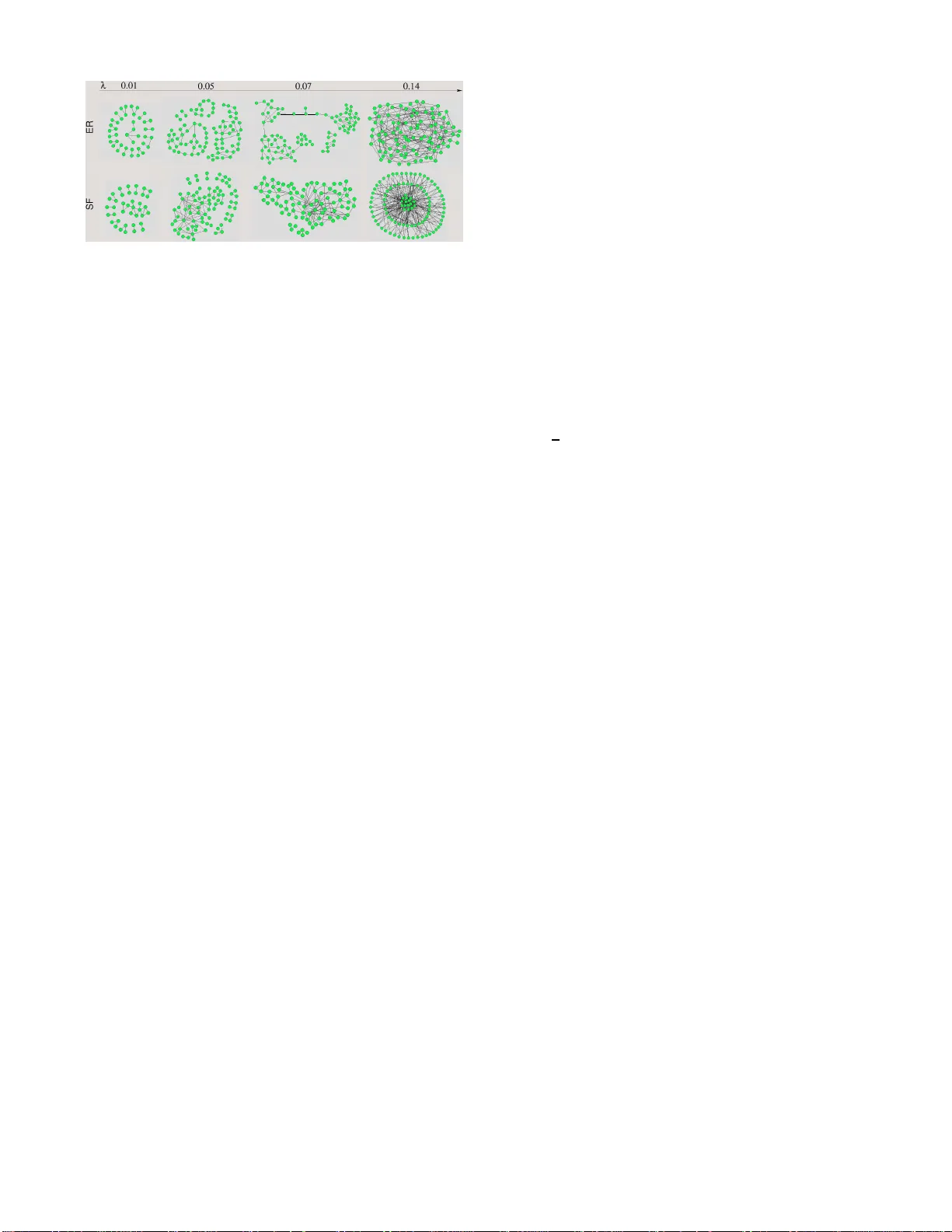
Comments & Academic Discussion
Loading comments...
Leave a Comment