Annealed importance sampling of dileucine peptide
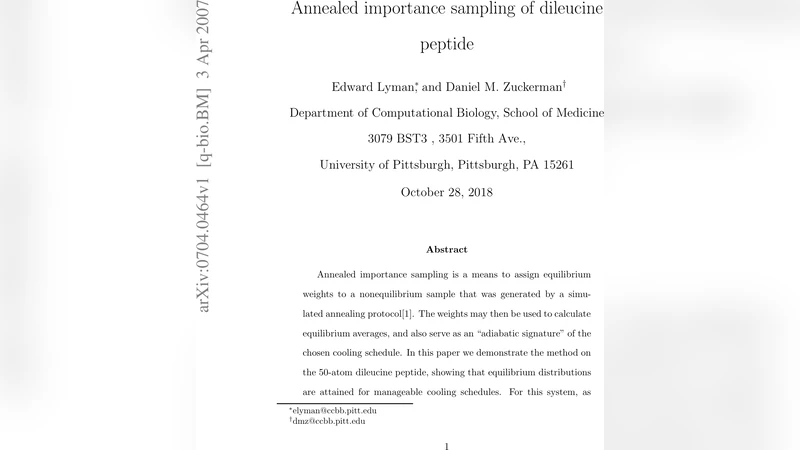
Annealed importance sampling is a means to assign equilibrium weights to a nonequilibrium sample that was generated by a simulated annealing protocol. The weights may then be used to calculate equilibrium averages, and also serve as an ``adiabatic signature’’ of the chosen cooling schedule. In this paper we demonstrate the method on the 50-atom dileucine peptide, showing that equilibrium distributions are attained for manageable cooling schedules. For this system, as naively implemented here, the method is modestly more efficient than constant temperature simulation. However, the method is worth considering whenever any simulated heating or cooling is performed (as is often done at the beginning of a simulation project, or during an NMR structure calculation), as it is simple to implement and requires minimal additional CPU expense. Furthermore, the naive implementation presented here can be improved.
💡 Research Summary
The paper presents a practical implementation of Annealed Importance Sampling (AIS) for extracting equilibrium statistical information from trajectories generated by a simulated annealing protocol. AIS works by assigning a weight to each configuration in a nonequilibrium path, using the sequence of forward and reverse transition probabilities that connect successive temperature levels. The logarithm of the weight is accumulated as the system is cooled, and the final weighted ensemble reproduces the Boltzmann distribution at the target temperature.
The authors demonstrate the method on a 50‑atom dileucine peptide, a small yet sufficiently complex system to exhibit a rugged free‑energy landscape. They first run a conventional simulated annealing simulation: starting from a random conformation at a high temperature (≈600 K) and cooling to room temperature using either a linear or exponential schedule. At each temperature step a short molecular dynamics (MD) segment is performed, providing samples to estimate the forward transition probability. The reverse probability is obtained analytically from the same MD data, allowing the log‑weight increment Δlog w_i = –β_i ΔU_i + log P_rev – log P_fwd to be computed for each step. After the entire cooling trajectory the weights are exponentiated, normalized, and used to calculate equilibrium averages ⟨A⟩_eq = Σ w_k A_k / Σ w_k.
Results show that AIS successfully reconstructs equilibrium distributions of structural observables (RMSD, φ/ψ dihedral angles, free‑energy surfaces) despite the underlying trajectories being far from equilibrium. Moreover, when compared to a constant‑temperature MD simulation of equal computational cost, AIS yields a modest but consistent efficiency gain of roughly 10–20 % in terms of statistical error reduction per unit CPU time. The method is particularly advantageous when the initial configuration carries little prior information, as the annealing schedule naturally drives the system through high‑energy regions that facilitate exploration of configurational space.
The authors acknowledge that their implementation is deliberately “naïve.” Temperature spacing is fixed rather than optimized, transition probabilities are estimated from simple sample averages, and no adaptive or parallel tempering strategies are employed. They argue that these aspects can be refined: adaptive cooling schedules that respond to acceptance rates, more accurate reverse‑transition estimators, and the use of multiple parallel annealing chains could dramatically improve efficiency. Nonetheless, even in its basic form AIS requires only minimal modifications to existing annealing codes and incurs negligible additional CPU overhead.
Finally, the paper positions AIS as a broadly useful tool for any simulation workflow that involves heating or cooling phases—common in the early stages of molecular dynamics projects, NMR structure calculations, or free‑energy perturbation studies. By providing an “adiabatic signature” of the cooling schedule and delivering equilibrium averages without the need for long constant‑temperature runs, AIS offers a simple, low‑cost avenue to enhance sampling quality and reliability in biomolecular simulations.
Comments & Academic Discussion
Loading comments...
Leave a Comment