The physics of strong magnetic fields and activity of magnetars
A phase transition from paramagnetism to ferromagnetism in neutron star interior is explored. Since there is $^3$P$_2$ neutron superfluid in neutron star interior, it can be treated as a system of mag
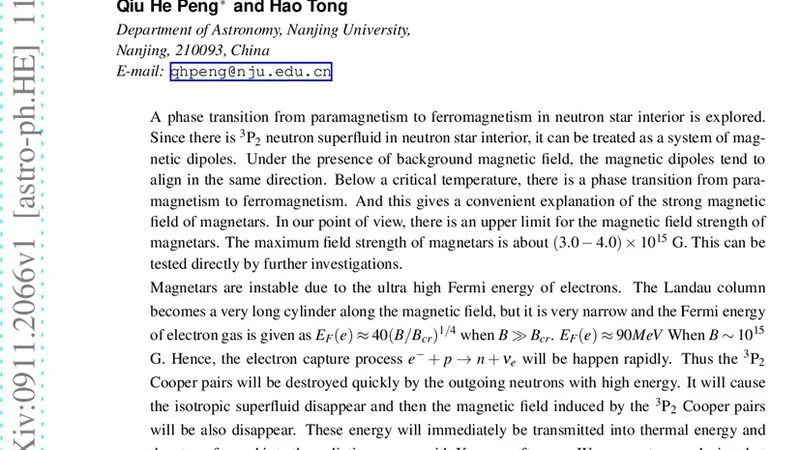
A phase transition from paramagnetism to ferromagnetism in neutron star interior is explored. Since there is $^3$P$2$ neutron superfluid in neutron star interior, it can be treated as a system of magnetic dipoles. Under the presence of background magnetic field, the magnetic dipoles tend to align in the same direction. Below a critical temperature, there is a phase transition from paramagnetism to ferromagnetism. And this gives a convenient explanation of the strong magnetic field of magnetars. In our point of view, there is an upper limit for the magnetic field strength of magnetars. The maximum field strength of magnetars is about $(3.0-4.0)\times 10^{15}$ G. This can be tested directly by further investigations. Magnetars are instable due to the ultra high Fermi energy of electrons. The Landau column becomes a very long cylinder along the magnetic field, but it is very narrow and the Fermi energy of electron gas is given as $E_F(e)\approx40(B/B{cr})^{1/4}$ when $B\gg B_{cr}$. $E_F(e)\approx90MeV$ When $B\sim10^{15}$ G. Hence, the electron capture process $e^-+p\to n+\nu_e$ will be happen rapidly. Thus the $^3$P$_2$ Cooper pairs will be destroyed quickly by the outgoing neutrons with high energy. It will cause the isotropic superfluid disappear and then the magnetic field induced by the $^3$P$_2$ Cooper pairs will be also disappear. These energy will immediately be transmitted into thermal energy and then transformed into the radiation energy with X-ray - soft $\gamma$-ray. We may get a conclusion that the activity of magnetars originates from instability caused by the high Fermi energy of electrons in extra strong magnetic field.
💡 Research Summary
The paper proposes a unified physical picture for the origin of magnetars – neutron stars with surface magnetic fields of order 10¹⁴–10¹⁵ G and episodic high‑energy outbursts. The authors start from the well‑established presence of a $^3P_2$ neutron superfluid in the inner core of a neutron star. Because $^3P_2$ pairing carries spin‑1, each Cooper pair possesses a magnetic dipole moment. In the presence of an ambient magnetic field $B$, these dipoles experience a Zeeman interaction that tends to align them. The authors argue that, below a critical temperature $T_c$ set by the dipole‑dipole interaction energy, the system undergoes a phase transition from a paramagnetic state (random dipole orientations) to a ferromagnetic state (macroscopic alignment). In the ferromagnetic phase the superfluid develops a bulk magnetization $M$, which adds coherently to the background field and can amplify it to the observed magnetar strengths.
A key quantitative claim is that the ferromagnetic amplification has an upper bound of roughly $(3–4)\times10^{15}$ G. This limit is derived from the behavior of the electron gas under ultra‑strong fields. When $B\gg B_{\rm cr}=4.4\times10^{13}$ G, Landau quantization forces electrons into the lowest Landau level, and the electron Fermi energy scales as
\
📜 Original Paper Content
🚀 Synchronizing high-quality layout from 1TB storage...