Fisher4Cast Users Manual
This is the Users’ Manual for the Fisher Matrix software Fisher4Cast and covers installation, GUI help, command line basics, code flow and data structure, as well as cosmological applications and extensions. Finally we discuss the extensive tests performed on the software.
💡 Research Summary
Fisher4Cast is a comprehensive software package designed to compute Fisher matrices for forecasting cosmological parameter constraints from upcoming surveys. This user manual serves as a complete guide, covering everything from installation to advanced customization, and it is organized into several logical sections.
The introductory chapter outlines system requirements and provides step‑by‑step installation instructions for Windows, macOS, and Linux platforms. It details how to set up the MATLAB or Octave environment, add necessary toolboxes, and configure the software path.
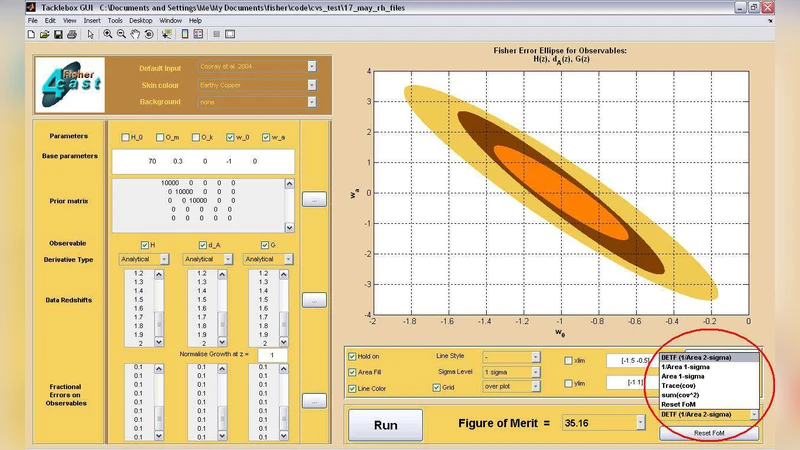
Chapter two focuses on the graphical user interface (GUI). The main window is divided into four tabs: Input File Loading, Parameter Definition, Observation Specification, and Results Visualization. Users can define parameter names, fiducial values, priors, and correlations; select observation types such as BAO, supernovae, or CMB; specify sampling densities and noise models; and finally generate the Fisher matrix with a single click. The results tab displays 1‑σ and 2‑σ confidence ellipses, marginal error bars, and correlation matrices, and it offers export options to PDF or LaTeX.
Chapter three describes the command‑line interface (CLI) for batch processing. The manual explains the syntax of the primary executable, the role of configuration files (YAML or JSON), and all available flags (e.g., –config, –output, –log). It provides examples of looping over multiple survey scenarios, automating the generation of comparative constraint plots, and handling errors through log files and a debug mode.
Chapter four delves into the internal code architecture and data structures. Input parsing is handled by InputParser.m, which converts user‑provided files into a structured “params” object. Fisher matrix computation occurs in FisherCalculator.m, where numerical or automatic derivatives of the cosmological model are evaluated for each observation and summed into a total information matrix. CovarianceEstimator.m inverts the Fisher matrix to obtain the parameter covariance, while ErrorPropagator.m extracts confidence intervals. Visualization functions reside in the Visualization/ directory and include plotContours.m, plotCorrelation.m, and related utilities.
Chapter five is dedicated to extensibility. Users can add new observation modules by creating a class in the Observations/ folder and implementing the addObservation interface. The manual walks through adding a 21 cm intensity‑mapping experiment, a gravitational‑wave standard siren module, and a weak‑lensing shear survey. It also explains how to link external optimization libraries such as Ceres Solver for joint parameter fitting and Fisher matrix evaluation.
The final chapter documents the extensive testing regime. Unit tests built with MATLAB’s unittest framework verify the correctness of each function. Regression tests compare current outputs against reference results from previous releases. Real‑world validation is performed using publicly available data sets, including Planck 2018 temperature and polarization spectra and mock catalogs from the DESI collaboration. The manual presents quantitative comparisons showing that Fisher4Cast reproduces expected constraints within statistical uncertainties.
Overall, the manual provides a clear, reproducible workflow for both novice and experienced users. It balances detailed procedural guidance with deep technical insight into the software’s architecture, enabling researchers to confidently employ Fisher4Cast for forecasting, to extend it for novel observational probes, and to integrate it into larger cosmological analysis pipelines.
Comments & Academic Discussion
Loading comments...
Leave a Comment