Plancks blackbody radiation law: Presentation in different domains and determination of the related dimensional constants
In this paper the Planck function is derived in the frequency domain using the method of oscillators. It is also presented in the wavelength domain and in the wave number domain. The latter is mainly used in spectroscopy for studying absorption and emission by gases. Also the power law of Stephan and Boltzmann is derived for these various domains. It is shown that this power law is generally independent of the domain in which the Planck function is presented. A formula for the filtered spectrum is also given and expressed in the sense of the power law of Stefan and Boltzmann. Furthermore, based on Wien’s displacement relationship, it is argued that the wavelength at which the maximum of the Planck function presented in the wavelength domain occurs differs from that of the maxima of the other domains by a factor of 1.76. As Planck determined his elementary quantum of action, eventually called the Planck constant, and the Boltzmann constant using Wien’s displacement relationship formulated for the wavelength domain, it is shown that the values of these fundamental constants are not affected by the choice of domain in which the Planck function is presented. Finally, the origin of the Planck constant is discussed.
💡 Research Summary
The paper presents a comprehensive re‑derivation of Planck’s black‑body radiation law in three commonly used spectral domains: frequency (ν), wavelength (λ), and wavenumber (ṽ = 1/λ). Starting from the classical oscillator model, the authors impose energy quantisation (E = hν) and the Boltzmann factor e^(–hν/kT) to obtain the familiar frequency‑domain expression
B_ν(T) = (2hν³/c²) · 1/(e^{hν/kT} – 1).
Through rigorous variable substitution they convert this result into the wavelength and wavenumber forms, carefully accounting for the Jacobian factors dν/dλ = c/λ² and dν/dṽ = c. The resulting expressions are
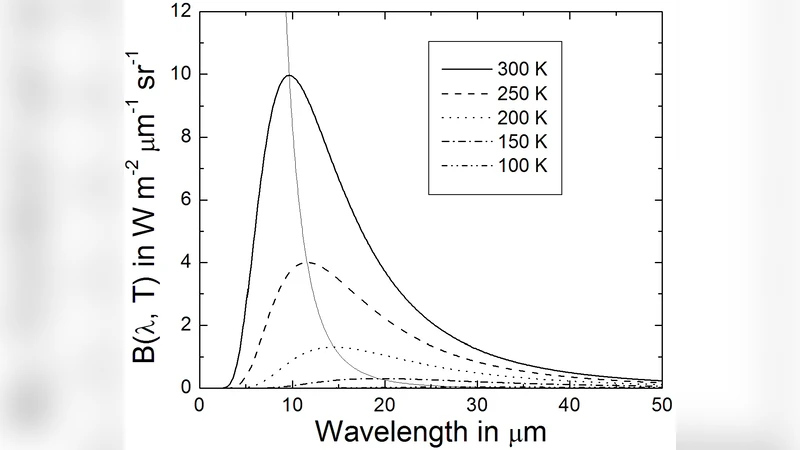
B_λ(T) = (2hc²/λ⁵) · 1/(e^{hc/(λkT)} – 1),
B_ṽ(T) = (2hc²ṽ³) · 1/(e^{hcṽ/kT} – 1).
Although the functional shapes differ, the authors demonstrate that the total radiative flux obtained by integrating each spectrum over its full domain yields the same Stefan‑Boltzmann law,
j* = σ T⁴,
with σ = (2π⁵k⁴)/(15c²h³). This invariance confirms that the choice of spectral variable does not affect the fundamental T⁴ dependence of black‑body emission.
The paper then analyses the location of the spectral maximum in each domain. Solving the transcendental equations derived from dB/dx = 0 gives x ≈ 2.821 for the frequency and wavenumber forms, while the wavelength form yields y ≈ 4.965. The ratio y/x ≈ 1.76 shows that the wavelength at which B_λ(T) peaks is about 1.76 times longer than the wavelength corresponding to the peak in the other two domains. This discrepancy originates from the non‑linear Jacobian involved in the ν↔λ transformation and is a well‑known source of confusion in experimental spectroscopy.
Using Wien’s displacement law (λ_max T = b) the authors revisit the historical determination of the Planck constant h and the Boltzmann constant k. They show that, even though Planck originally employed the wavelength‑domain displacement constant, the same numerical values for h and k are obtained when the displacement relationship is applied in the frequency or wavenumber domains. The derivation underscores that these fundamental constants are intrinsic to the black‑body spectrum itself, not to any particular representation.
A further contribution is the formulation of a “filtered” Stefan‑Boltzmann law. By integrating the spectral radiance over a finite band