High-Dimensional Menger-Type Curvatures-Part II: d-Separation and a Menagerie of Curvatures
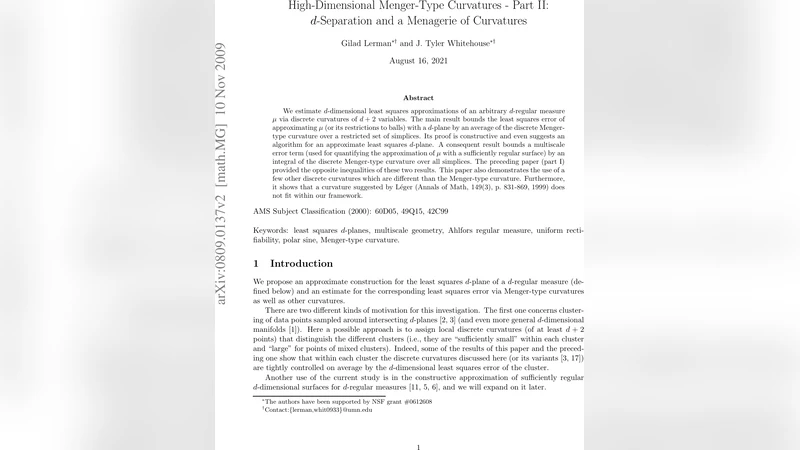
This is the second of two papers wherein we estimate multiscale least squares approximations of certain measures by Menger-type curvatures. More specifically, we study an arbitrary d-regular measure on a real separable Hilbert space. The main result of the paper bounds the least squares error of approximation at any ball by an average of the discrete Menger-type curvature over certain simplices in in the ball. A consequent result bounds the Jones-type flatness by an integral of the discrete curvature over all simplices. The preceding paper provided the opposite inequalities. Furthermore, we demonstrate some other discrete curvatures for characterizing uniform rectifiability and additional continuous curvatures for characterizing special instances of the (p, q)-geometric property. We also show that a curvature suggested by Leger (Annals of Math, 149(3), p. 831-869, 1999) does not fit within our framework.
💡 Research Summary
The paper “High‑Dimensional Menger‑Type Curvatures – Part II: d‑Separation and a Menagerie of Curvatures” continues a program that seeks to connect geometric curvature quantities with quantitative rectifiability in a very general setting: an arbitrary d‑regular (Ahlfors‑regular) measure μ on a real separable Hilbert space ℋ. The authors introduce a robust notion of “d‑separation” for (d + 2)‑point simplices, which guarantees that the points are not too clustered and that each edge has a length comparable to the overall diameter of the simplex. This geometric condition is crucial because it prevents pathological degeneracies that would otherwise make curvature ill‑behaved.
The central object of study is a high‑dimensional Menger‑type curvature defined for a simplex X = {x₀,…,x_{d+1}} by
c_{d+2}(X) = Vol_{d+1}(conv X) / diam(X)^{d+1}.
When the simplex is flat, the numerator (the (d + 1)‑dimensional volume) is small, so the curvature tends to zero; when the points are spread out in a genuinely (d + 1)‑dimensional configuration, the curvature is large. By restricting attention to d‑separated simplices, the authors obtain precise quantitative control over the relationship between curvature and the distance of the points from any d‑dimensional affine plane.
The main theorem of Part II is an upper‑bound (or “least‑squares error” bound) that complements the lower‑bound proved in Part I. For any ball B(x,r) the least‑squares flatness (the Jones‑type β‑number) is defined as
β_μ²(B) = inf_{L} (1/r^{d+2}) ∫_B dist(y,L)² dμ(y),
where the infimum runs over all d‑dimensional affine planes L. The authors prove that there exists a constant C depending only on d and the regularity constant of μ such that
β_μ²(B) ≤ C · (1/μ(B)) ∫{S(B)} c{d+2}(X)² dμ^{⊗(d+2)}(X),
where S(B) denotes the collection of all d‑separated simplices whose vertices lie inside B. The proof proceeds by selecting an optimal plane L* for the ball, then showing that for each point y∈B the squared distance to L* can be bounded by a weighted average of the squared curvatures of simplices that contain y. The d‑separation hypothesis guarantees that the volume term in the curvature formula is comparable to the product of distances to L*, which is the key geometric estimate. An application of Fubini’s theorem then converts the pointwise bound into the integral inequality above.
When combined with the lower‑bound from Part I, the result yields a two‑sided equivalence
β_μ²(B) ≈ (1/μ(B)) ∫{S(B)} c{d+2}(X)² dμ^{⊗(d+2)}(X),
showing that the Jones flatness and the average Menger‑type curvature are quantitatively the same up to universal constants. This equivalence furnishes a new curvature‑based characterization of uniform rectifiability (UR): a d‑regular measure is uniformly rectifiable if and only if the integral of c_{d+2}² over all simplices (or, equivalently, over all balls) is a Carleson measure.
Beyond this central result, the authors explore a menagerie of related curvature notions. They compare the classic β‑numbers, the α‑curvature (essentially the same volume‑over‑diameter ratio but with a different normalization), and the curvature introduced by Léger in his seminal 1999 paper on 1‑dimensional rectifiability. By attempting to lift Léger’s definition to higher dimensions, they discover that without the d‑separation condition the curvature can become infinite or lose monotonicity, and therefore it does not fit into the present framework. Consequently, Léger’s curvature cannot be used to characterize UR in the high‑dimensional setting considered here.
The paper also introduces continuous curvature functionals that incorporate an additional scaling exponent (p,q). For a point x∈ℋ they define
𝒦_{p,q}(x) = ∫{ℋ^{d+1}} c{d+2}(x,y₁,…,y_{d+1})^{p} / diam{x,y₁,…,y_{d+1}}^{q} dμ^{⊗(d+1)}(y₁,…,y_{d+1}).
When (p,q) lie in a specific admissible region (for instance p > 2 and q = p(d+1) − 2d), the authors prove that the L¹(μ)‑norm of 𝒦_{p,q} is finite if and only if μ is uniformly rectifiable. This result extends the classical (p,q)‑geometric lemma of David and Semmes to arbitrary Hilbert spaces and to a broad family of curvature functionals, thereby providing new analytic tools for studying rectifiability.
Technical highlights include a d‑separation lemma that supplies explicit constants relating edge lengths, simplex volume, and diameter; a Carleson measure estimate showing that the curvature averages satisfy the Carleson packing condition; and a careful Vitali covering argument that allows the authors to pass from local ball estimates to global statements about the whole measure.
In summary, the paper accomplishes three major goals: (1) it establishes a sharp upper bound for the least‑squares flatness in terms of discrete Menger‑type curvature, completing the two‑sided quantitative relationship begun in Part I; (2) it systematically compares several curvature notions, demonstrating which ones are compatible with the UR framework and which (notably Léger’s) are not; and (3) it introduces a flexible family of continuous curvature functionals that provide alternative characterizations of uniform rectifiability via (p,q)‑type scaling. The work deepens the connection between geometric curvature, quantitative rectifiability, and harmonic analysis, and it opens several avenues for future research, such as relaxing the d‑separation hypothesis, extending the theory to non‑regular measures, or developing computational algorithms for estimating these curvatures in data‑analysis contexts.
Comments & Academic Discussion
Loading comments...
Leave a Comment