Graph isomorphism and volumes of convex bodies
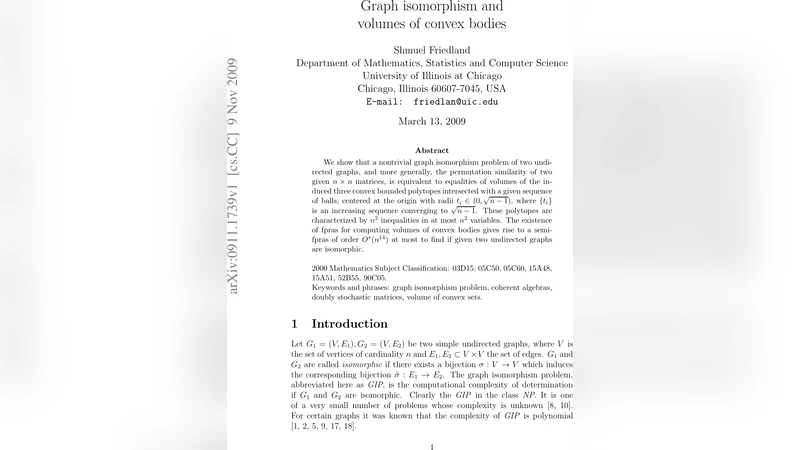
We show that a nontrivial graph isomorphism problem of two undirected graphs, and more generally, the permutation similarity of two given $n\times n$ matrices, is equivalent to equalities of volumes of the induced three convex bounded polytopes intersected with a given sequence of balls, centered at the origin with radii $t_i\in (0,\sqrt{n-1})$, where ${t_i}$ is an increasing sequence converging to $\sqrt{n-1}$. These polytopes are characterized by $n^2$ inequalities in at most $n^2$ variables. The existence of fpras for computing volumes of convex bodies gives rise to a semi-frpas of order $O^*(n^{14})$ at most to find if given two undirected graphs are isomorphic.
💡 Research Summary
The paper establishes a novel equivalence between the graph isomorphism problem and the comparison of volumes of certain high‑dimensional convex polytopes. Given two undirected graphs (G_{1}) and (G_{2}) with adjacency matrices (A) and (B), the authors first reformulate the question “does there exist a permutation matrix (P) such that (PAP^{-1}=B)?” as a feasibility problem in (\mathbb{R}^{n^{2}}). They introduce variables (x_{ij}) that form a matrix (X) and impose three families of linear inequalities: (i) double‑stochastic constraints (X\mathbf{1}=\mathbf{1}) and (X^{T}\mathbf{1}=\mathbf{1}); (ii) the commutation condition (AX=XB); and (iii) box constraints (0\le x_{ij}\le 1). The set of points satisfying all these inequalities defines a bounded polytope (\mathcal{P}(A,B)). An analogous polytope (\mathcal{P}(B,A)) is defined by swapping the roles of (A) and (B).
Next, the authors intersect each polytope with Euclidean balls centered at the origin: (B_{t}={x\in\mathbb{R}^{n^{2}}:|x|{2}\le t}) for radii (t) ranging from (0) up to (\sqrt{n-1}). For each radius they define the volume function (V{A,B}(t)=\operatorname{vol}(\mathcal{P}(A,B)\cap B_{t})). The central theorem proves that the graphs are isomorphic if and only if the two volume functions coincide for every (t) in the open interval ((0,\sqrt{n-1})). Consequently, detecting a single radius where the volumes differ is sufficient to certify non‑isomorphism.
Exact volume computation for high‑dimensional convex bodies is #P‑hard, but recent advances provide a Fully Polynomial Randomized Approximation Scheme (FPRAS) for volume estimation. The paper leverages this FPRAS to approximate (V_{A,B}(t_i)) and (V_{B,A}(t_i)) for a finite, increasing sequence of radii ({t_i}_{i=1}^{k}) that converges to (\sqrt{n-1}). Each approximation runs in time (O^{}(n^{13})); choosing (k=O(n)) yields an overall algorithm with complexity (O^{}(n^{14})). The algorithm proceeds as follows: (1) construct the two polytopes from the input adjacency matrices; (2) for each prescribed radius compute approximate volumes of the intersected bodies using the FPRAS; (3) compare the two approximations within the prescribed relative error (\varepsilon). If all comparisons succeed, the algorithm declares the graphs isomorphic; otherwise it declares them non‑isomorphic. The error probability can be made arbitrarily small by increasing the number of random samples, preserving the fully polynomial nature of the scheme.
The significance of this work lies in its geometric reinterpretation of graph isomorphism. By translating a discrete combinatorial problem into a continuous volume‑equality problem, the authors open the door to applying powerful tools from convex geometry, random sampling, and high‑dimensional integration. The approach is inherently parallelizable because the FPRAS relies on independent random walks or hit‑and‑run sampling, which can be distributed across many processors. Moreover, the method yields a semi‑deterministic algorithm: it is randomized but provides rigorous probabilistic guarantees on both runtime and approximation quality.
Nevertheless, practical deployment faces challenges. The dimension of the ambient space is (n^{2}), so the number of required samples grows rapidly with graph size, potentially limiting scalability to modest values of (n). Selecting an optimal sequence of radii ({t_i}) is non‑trivial; too coarse a grid may miss a radius where the volumes diverge, while too fine a grid increases computational burden. Numerical stability of the random walk procedures and the accumulation of approximation errors also demand careful analysis. The paper does not present empirical evaluations, leaving open questions about constants hidden in the (O^{*}) notation and the actual performance on benchmark graph families.
In summary, the authors present a theoretically sound reduction from graph isomorphism to volume comparison of three convex polytopes intersected with Euclidean balls, and they show that existing FPRAS techniques lead to a semi‑polynomial‑time randomized algorithm with overall complexity (O^{*}(n^{14})). This contribution bridges discrete graph theory and continuous convex geometry, offering a fresh perspective on one of computer science’s most enduring problems.
Comments & Academic Discussion
Loading comments...
Leave a Comment