Performance Analysis of Two-Hop Cooperative MIMO transmission with Relay Selection in Rayleigh Fading Channel
Wireless relaying is one of the promising solutions to overcome the channel impairments and provide high data rate coverage that appears for beyond 3G mobile communications. In this paper we present an end to end BER performance analysis of dual hop wireless communication systems equipped with multiple decode and forward relays over the Rayleigh fading channel with relay selection. We select the best relay based on end to end channel conditions. We apply orthogonal space time block coding (OSTBC) at source, and also present how the multiple antennas at the source terminal affects the end to end BER performance. This intermediate relay technique will cover long distance where destination is out of reach from source.
💡 Research Summary
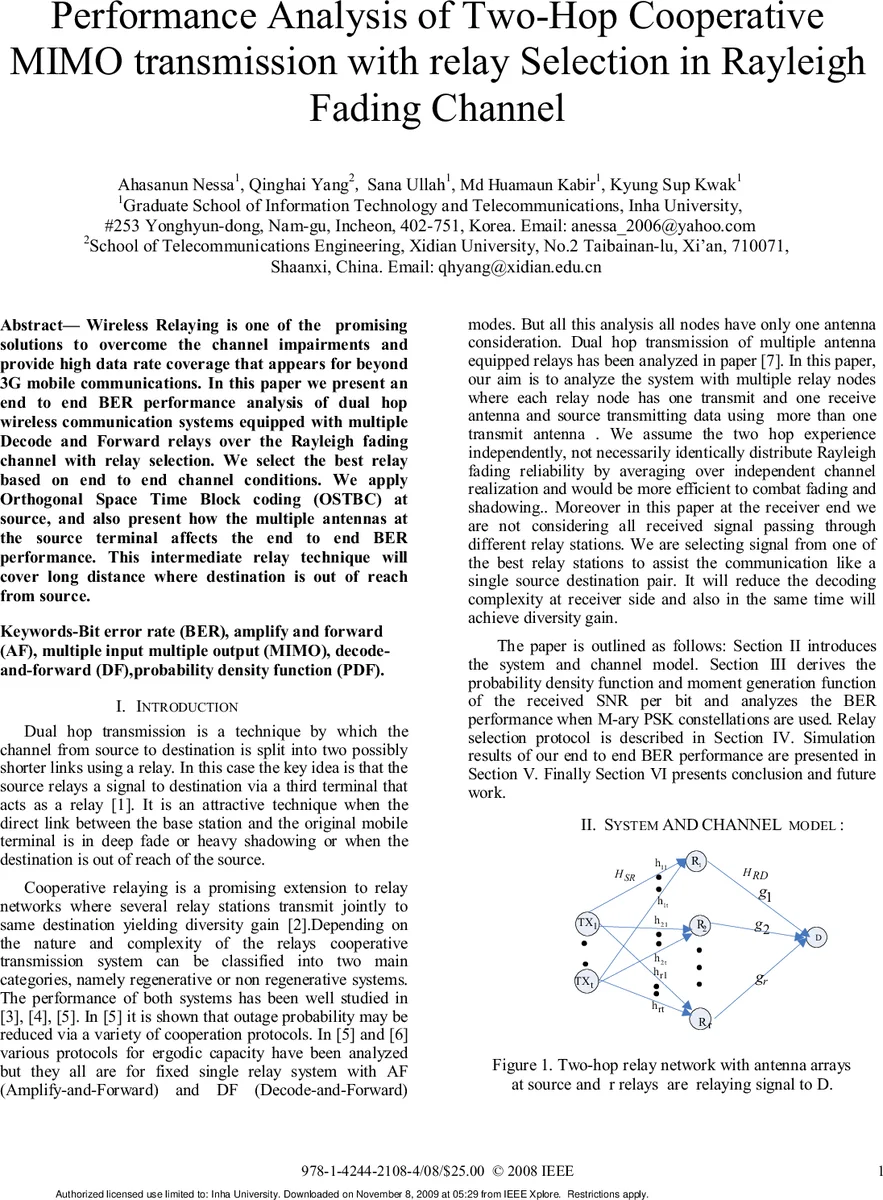
The paper investigates the end‑to‑end bit‑error‑rate (BER) performance of a dual‑hop cooperative wireless system that employs multiple decode‑and‑forward (DF) relays and orthogonal space‑time block coding (OSTBC) at a multi‑antenna source, all operating over independent Rayleigh fading channels. The authors assume that there is no direct link between source and destination; communication must pass through a relay. Each relay has a single antenna for both reception and transmission, while the source can have two or four transmit antennas. The source transmits OSTBC‑encoded symbols, providing spatial diversity. After reception, each relay decodes the block using a maximum‑likelihood detector, estimates its own source‑to‑relay (SR) and relay‑to‑destination (RD) channel state information (CSI), and then forwards the decoded block to the destination.
The core contribution is a closed‑form analytical expression for the BER of M‑ary PSK (specifically QPSK and 16‑QAM) under this two‑hop configuration. The analysis proceeds by first deriving the moment‑generating functions (MGFs) of the instantaneous SNRs for the SR and RD links, then applying inverse Laplace transforms to obtain their probability density functions (PDFs). Using these PDFs, the authors integrate the conditional error probability of PSK over the joint SNR distribution, yielding exact BER formulas (equations (12)–(15) in the manuscript). The derivations assume independent, identically distributed Rayleigh fading for each hop, perfect CSI at the relays, equal power allocation among the source antennas, and no inter‑relay interference.
Relay selection is performed on a per‑packet basis: each relay computes an end‑to‑end metric (either the minimum of its two hop SNRs or a harmonic‑mean‑type combination) and the relay with the highest metric is chosen to forward the data. Two selection rules (Rule 1 and Rule 2) are examined; simulation shows they produce virtually identical BER curves, confirming that the exact form of the metric is not critical as long as the “best” end‑to‑end path is selected.
Simulation results validate the analytical expressions. The authors present BER versus SNR curves for QPSK and 16‑QAM, with source antenna counts of 2 and 4, and relay counts ranging from 1 to 7. The key observations are: (i) increasing the number of transmit antennas at the source yields a noticeable diversity gain, shifting the BER curves downward; (ii) adding more relays improves performance because the probability of having a high‑quality end‑to‑end path increases, but the gain saturates as the number of relays becomes large; (iii) higher‑order modulation incurs a steeper BER slope, yet the system still benefits from antenna and relay diversity at moderate to high SNR; (iv) the two relay‑selection rules are essentially equivalent in performance.
The paper concludes that the proposed scheme—single‑relay selection combined with OSTBC at the source—offers a practical trade‑off between performance and receiver complexity, especially when the destination lacks CSI. However, several limitations are acknowledged: the analysis assumes perfect CSI, equal power allocation, and DF operation only; it does not consider amplify‑and‑forward (AF) relays, cooperative combining of multiple relays, or realistic channel estimation errors and feedback delays. Future work is suggested to address these issues, to explore adaptive power allocation, to incorporate multi‑hop extensions, and to evaluate the scheme under more realistic network conditions (e.g., mobility, shadowing, interference). Overall, the paper provides a solid theoretical foundation for relay‑selection‑based cooperative MIMO systems and highlights the potential BER improvements achievable through antenna and relay diversity in Rayleigh fading environments.
Comments & Academic Discussion
Loading comments...
Leave a Comment