Throughput Limits of IEEE 802.11 and IEEE 802.15.3
IEEE 802.11 and IEEE 802.15.3 are wireless standards originally designed for wireless local area network (WLAN) and wireless personal area network (WPAN). This paper studies MAC throughput analysis of both standards. We present a comparative analysis…
Authors: ** Sana Ullah¹, Yingji Zhong¹², Riazul Islam¹
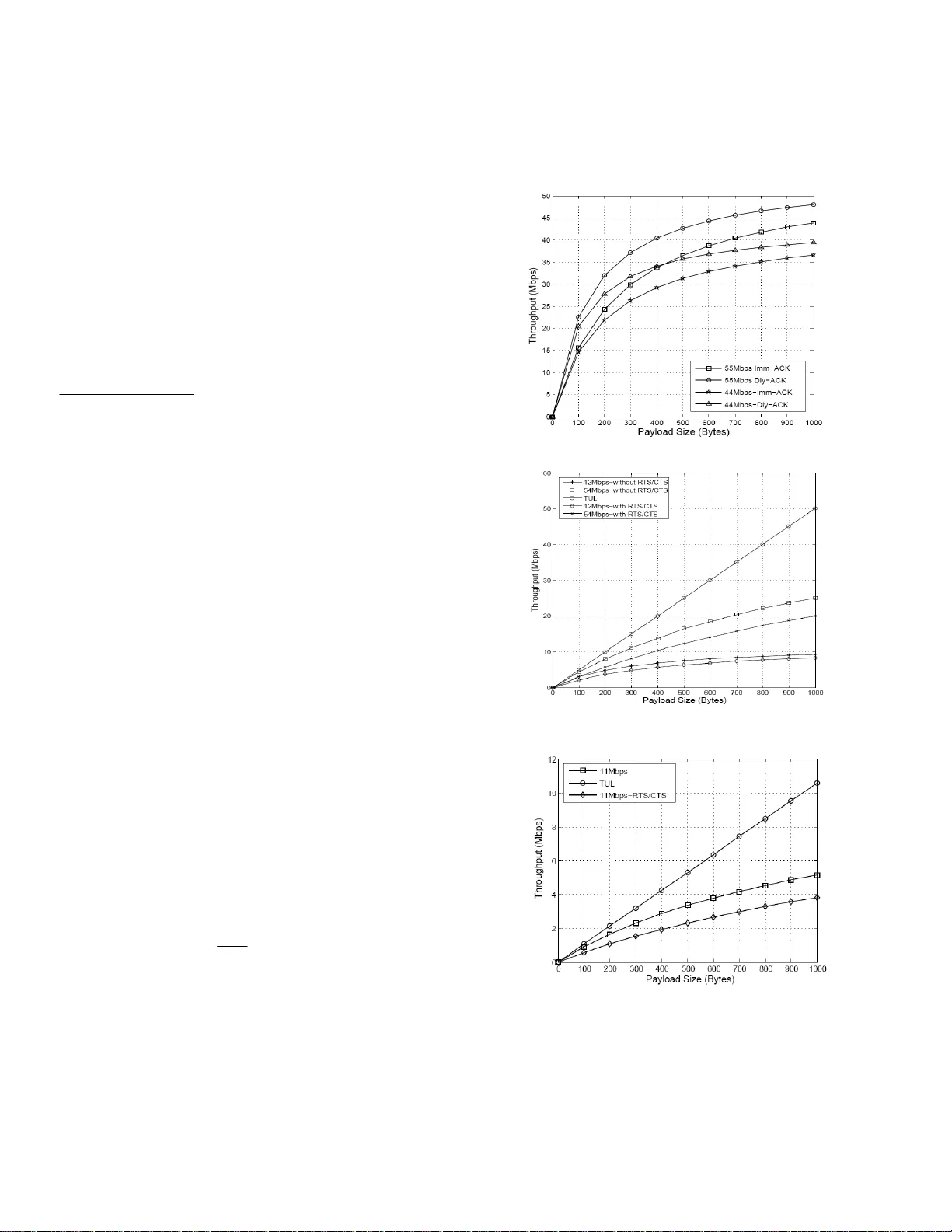
Throughput Limits of IEEE 802.11 and IEEE 802.15.3 Sana Ullah 1 , Yingji Zhong 1, 2 , Riazul I slam 1 , Ahasanun Nessa 1 , and Ky ung Sup Kwak 1 1 Grad uate Sc hool o f Info rmat ion T echno log y and T eleco mmunica tio ns, I nha Uni versit y 253 Yonghy un-dong , Nam-gu, Inch eon, 402-751, K orea. Email: sanajcs@h otmail.com, du bd96@y ahoo.com, anessa.inha@gm ail.com, kskwak@inha.ac.k r. 2 School of Informat ion Science and Eng ineering 27, Shan da Nan Road, ,Sh andong University,250100 ,Jinan,C hina. Email: zhongyingji32@s du.edu.cn. Abstract-I EEE 802.11 and IEEE 802.15.3 are wi reless standards orig inally desig n ed for Wireless Local Area Network (WLAN) and Wireless Pers onal Area Network (WPAN). This paper st udies MAC throug hput analysis of both stand ards. We present a comparative anal ysis of both standards in t erms of M AC throughput a nd bandw idth efficiency. Numerical results sh ow that the perform ance of IEEE 802.15.3 transcen ds IEEE 802.11 in all c ases. Keyw ords: Thr oughput , IEEE 802.11, IEE E 802.1 1a, IE EE 802 .11b, IEEE 802.15.3, W LAN, WPAN I. INTRODUCTI ON Wireless LANs are becoming more sophi sticated and inno vative due to low cost, genui ne mobi lit y, fast implementation, c ustomer satisfaction a nd high data rate communicat ion. IEEE 802.11 is a wirel ess LAN standard origin ally designed f or wireless communicat ion. It defines th e physical and MAC layer spe cifications for wireless LAN [1], where it s upports tw o modes of operation . Distribu ted Coordinat ion Func tion (DCF) doesn’ t have cen tral node and all nodes com pete for the channel us ing CSMA/CA protocol. Point Coor dinati on Func tio n (PCF) has a ce ntra l node , whic h cont rols the network by broadcasting beacon frames periodically . DCF and PCF modes can coexist in one cell by defining in terfra me spacing [2]. Moreover, it has one MAC, which interacts with three P HYs. Fr eque ncy Ho p Spr ead Spectrum (FHSS) operates in 2.4 GHz band , Direct Sequence Spread Spectr um (DSSS) operates in 2.4 GHz an d Infrared. There are diff erent versions of IEEE 802.11, w hich includes v ariations on physical l ayer. However, we focus on IEEE 802.11a - whi ch uses Orthogonal Freq uency Di visio n Multi plexin g (OFD M) tec hnique t o deli ver up to 54Mbps in 5 GHz Indu strial S cientific Medical (ISM) band, and IE EE 802.11b – w hich uses H igh Rate Direct Sequence Spread Spectrum (HR-DSSS) technique to deliver up to 11Mbps in 2.4 GHz ISM ba nd. In contrast to wireless LAN, wireless PAN (Personal Area Netw ork) contains a num ber of independent wi reless devices connected with in a small range around a person or object. IEEE 802.15.3 is a set of s tandards dev eloped for h igh data rat e wireless PAN [3]. The wireless PAN n etwork is controlled by a central coordinator called picon et, which controls the medium and maintai ns net work sync hroniz atio n timi ng via b eaco ns. T he channel is bounded by su perframes s tructure giv en in Fig 1, where each s uperframe begins with a beacon and c onsists of three componen ts: the beacon - which transmits con trol information to piconet, Con tention Access Period (CAP ) – which uses CSMA/CA mechanism to communicate commands or asyn chronous dat a, and Cont ention Free Period (CFP) – which uses TDMA protocol, where dev ices are assigned specifie d time slots for is ochro nous strea ms. The picone t coordinator can s ometime replace CAP with Management Time Slots (MTS) using slotted A loha access scheme. It uses Quadrature Amplitude Modulation (64-QAM) technique to deliver u p to 55Mbps in 2.4 GHz ISM ban d. A UWB phys ical layer f or wireles s PAN deliv ers up to 480 M bps in 3.1- 10.6 G Hz band [4]. This paper presen ts through put analysis of both standards provided by MAC layer, i .e., m aximum num ber of MSDUs transmitted in a unit time. We compare the bandwidth efficiency of both s tandards. The rest of the paper is cat egorized int o three section s. In Secti on 2, we discu ss abou t the th roughput calculation of both st andards. Section 3 presents the num erical results, and finally we present conclusio n to our work. Figure 1: IEEE 80 2.15.3 pico net supe rframe 978-1-4244-2108-4/08/$25.00 © 2008 IEEE 1 Authorized licensed use limited to: Inha University. Downloaded on November 8, 2009 at 04:56 from IEEE Xplore. Restrictions apply. II. THROUGHPUT CALCULATION The maximu m thro ughp ut is d efined as the ma ximum number of MAC Layer Service Data Units (MSDUs) that are transmitted in a unit time. We consider the MAC layer throughput comparis on of both standards. Each MSDU carries additional overhead at MAC and Physical layer such as PHY preambles an d MAC headers, control frames, interframe spacing and back- off time in case of IEEE 802.11. In IEEE 802.11 , the overhead is transm itted at control rate while in IEEE 802. 15.3, overhead is transmitted at basic data rate of 22Mbps. Our calculation considers all the assumptions defined in [5], i.e., there are no collision s in case of IEEE 802. 11, the transm ission is error free and at leas t one station has always a packet to send. In the following section, we present numerical calculations to derive th e maximum throu ghput of IEEE 802. 11 and I EEE 802.15.3. A. MAC Thr oughput of IEEE 80 2.11 In IEEE802.11, dat a frames and control fram es are transmitted at different rates. In case of CSMA/CA, the station transmits if the channel is free for Distributed Interfram e Spacing period (DIFS ). Short Interframe Spacing (SIFS) framing is used to separate transmission belo ng to a single dialog. Each frame in IEEE 802.11 is compos ed of additional delay created by interf rame spacing and back off period. In case of RTS/CTS, the transmission cycle contains 3 SIFS period in addition to RT S and CTS frames. The ma ximum through put of IEEE 802.11 is presen ted in [6], w here the upper th roughput limit of IEEE 802 .11a and I EEE 802.11b is deri ved. How ever, the deriv ation ignores R TS/CTS mechanism. The RTS/CTS mechanism is considered in [5], where th e through put is analyzed f or payl oad size of 400 0 by tes but th e propagation delay is ign ored. Our through put calculation of IEEE 802.11 is based on th e formulas g iven in [5] and [6] with a slight m odification in the MAC h eader MAC H and the addition of pro pagation delay τ in case of RTS/CTS mechanism . All other param eters are taken from the standard [1]. The maximu m thro ughp ut T M is calculated as the ratio of payl oad size x t o the transm ission delay per payload si ze and is given b y: Delay x M T 8 = (1) Where τ 2 ) ( + + + + + + + = ACK SIFS Data CTS RTS BO DIFS T T T T T T T x Delay (2) The transmission time of RTS/CTS is zero in case of CSM A/CA. The data transmission time Data T for IEEE 802. 11b is g iven by : R x H T T T MAC P PHY Data ) ( 8 + + + = (3) Data T for IEEE 802.1 1a is given by: DBPS MAC SYM P PHY Data N x H ceil T T T T )) ( 8 22 ( ( * + + + + = (4) where MAC H = 30bytes. B. MAC Thr oughput of IEEE 80 2.15.3 In IEEE 802.15.3, th e channel is divided into su perframes, with each superframe having three componen ts, i.e., beacon, opt ional C AP and CFP . For throug hput d erivat ion, we ignor e beacon and option al CAP period. We only consider the Channel Time Allocation Period (C TAP) based on TDMA access scheme. In CTAP, users are assigned specified time slots called Channel Time Al locations (C TAs) by the piconet coordi nator. Three acknowledgem ent policies are defined in the st andard [3]. Imm- ACK is issued for each data frame, Dly-ACK is issu ed for the burs t of fr ame s and No - AC K mea ns no a ckno wled ge ment for the data frame. The use of Dly-ACK improv es channel utilization by reducing the frequency of ACK and SIFS frames. The data transmission time of a frame is given by: TAIL STUFF FCS HCS MAC P PHY Data T T T R x T T T T T + + + × + + + + = ) / 8 ( ) ( (5) The maximu m thr oughp ut fo r I mm-ACK is de rived as SIFS ACK m Data ACK m T T T x M × + + = − − 2 8 Im Im (6) The maximu m thr oughp ut fo r Dl y-ACK is der ived a s n T T n T nT x M SIFS MIFS ACK m Data ACK DLY / ) 2 ) 1 ( ( 8 Im × + − + + = − − (7) 978-1-4244-2108-4/08/$25.00 © 2008 IEEE 2 Authorized licensed use limited to: Inha University. Downloaded on November 8, 2009 at 04:56 from IEEE Xplore. Restrictions apply. In IEEE 802.15.3 , MAC and PHY headers are transmitted at basic data rat e of 22Mbps, whil e payload including Fram e Check Sequence (FCS), tail symbols and stuff bits are transmitted at desired data rate. T ail symbols are added to end of the MAC fram e. For 11Mbps (QPSK-TCM form at), 3 tail symbol s are added to the end of MAC fram e. For 16/32/64- QAM formats, 4 tail sym bols are added to th e MAC f rame. If the size of MPDU (payload plus FCS) is not an integer multiple of bits /symbol , then stuff bi ts are added to t he MAC frame. The number of stuff bi ts should be l ess th an the num ber of bits contain ed in a symbol . Moreover, enough s tuff bits shou ld be added so that the MPDU plus stuff bits is an integer mu ltiple of the bit s/symbol. Stuff bits are added only to 33Mbps (3 bits/ symbol) an d 55Mbps (5 bits /symbol ) modes. In thi s case, MPDU is not a n integer m ultipl e of 3 and 5 i. e. 5 ) ( 8 FCS Payload + × =1.6 × (Payload + FCS ) (8) Hence, 0.4 is added as stuff bits. Fo r 11Mbps (1 bit/symbol), 22Mbps (2 bits/ symbol) an d 44Mbps (4 bits/sy mbol ) modes, there is no need of s tuff bits. III. NUMERICAL RESULTS The paramet ers for both standards are given in t able 1. The numer ical r esult s sho w that t hro ughput and b andwid th ef fici ency of IEEE 802.15 .3 is hi gher th an those of IEEE 802.11. Fi g 2 shows t he maximum throughput of IEEE 802.15.3 for Imm - ACK an d Dly-ACK. F or the pay load size of 1000 by tes and 55Mbps data rate , max imum through put is 44Mbps and 48Mbps for Imm-and Dly-ACK, respectivel y. The Dly-ACK is issued for the burs t of 5 f rames. Fig 3 presents t he maximum throughput of IEEE 802.11a. F or 54Mbps, the throughpu t is 25Mbps withou t RTS/CT S and 20 Mbps with RT S/CTS. T he use of RTS/CT S dec rease s the t hroug hput perfo rma nce. T he T hroughp ut Up per Limit (TUL) of IEEE 802.11a is 50.2 Mbps [6]. Du e to large overhead in IEEE 802.11, th e through put doesn’t not ex ceed TUL, even for higher dat a rate of 100,000 M bps. Fig 4 shows the MAC through put and TUL of IEEE 802.11b for vari ous data rates. Fig 5 and 6 pres ents the comparative analysis of both standards in terms of throughput and ban dwidth efficiency . Bandwi dth efficiency is th e ratio of m aximum throughpu t T M to the desired data rate R and is give n by: R M BE T = (9) The thro ughput p erfor mance of IEEE 80 2.15.3 is higher than th at of IEEE 802.11a in all cas es. For 55Mbps an d Imm- ACK, the through put of IEEE 802.15.3 is 44Mbps while the through put of IEEE 802.1 1a is 25Mb ps for 54Mbps. The perform ance of IEEE 802.1 1 is sig nificantly influenced by additional overhead such a s back off and control fra m es. T he bandw idth efficiency of IEEE 802.15.3 is 80% f or 55Mbps while its only 46% in IEEE 802.11a. F igure 2. Maximum MAC th roughput of I EEE 802.15. 3 F igure 3. Maximum MAC t hroughput of I EEE 802.11a- w ith R TS/CT S F igu re 4.Maximum MAC throug hput of I EEE 80 2.11b w ith RT S/CTS 978-1-4244-2108-4/08/$25.00 © 2008 IEEE 3 Authorized licensed use limited to: Inha University. Downloaded on November 8, 2009 at 04:56 from IEEE Xplore. Restrictions apply. Fig ure 5.T hrough put Compari son of I EEE 802.15.3 and I EEE 802.11a F igure 6.Ban dwidth Eff iciency Compar ison of I EEE 802.15.3 a nd IEEE 8 02.11a IV. CONCLUSIONS In this paper, we presented MAC throug hput analysis of IEEE 802.11 and IEEE 802. 15.3 stan dards. We calculated the theoretical throughpu t limit of bot h stan dards. Our numerical result s ur ge the use of D ly- ACK fo r hi gh tra ffic. T he comparative an alysis of bot h standards concluded that the perform ance of IEEE 802.1 5.3 trans cends IEEE 802.1 1 in te rms of th roughput and ban dwidth effi ciency. Howev er, the adaptation of any standard depends on the applicat ion and customer requ irements. For ins tance, IEEE 802.15.3 is suitable for home theat er, interactive video g aming and high s peed video transfer. In the futu re, the performance of bot h standards w ill be compared in terms of pow er consumption. The comparison of numerical and simu lation results is also part of our f uture work. TABL E 1: PARAMET ERS OF I EEE 802.11 A ND IEEE 802. 15.3 IEEE 802.11a IEEE 802.11b IEEE 802.15.3 PHY T 4 μ s 48 μ s 0.727 μ s P T 16 μ s 144 μ s 7.27 μ s MAC T 8*30/ R 30*30/ R 3.63 μ s HCS T - - 0.727 μ s STUFF T - - 4 bits TAIL T - - 4 bits SIFS T 16 μ s 10 μ s 10 μ s MIFS T - - 2 μ s T DIFS 34 μ s 50 μ s - T BO 15 31 - τ 1 μ s 1 μ s - T SYM 4 μ s - - ACKNOWLEDGMENT S This research was su pported by t he MKE (Minist ry of Knowledge Econ omy), Korea, under the ITRC (In formation Technology Research C enter) support prog ram su pervised by t h e IITA (Institute of Information Technology Assessm ent) (IITA-2008- C 1 090-080 1-0019 ). REFEREN CES: [1] Wir eles s LAN Medium A ccess Cont rol (MAC) and Phy sical L a ye r (PHY ) Specificatio n, I EEE 802.1 1 WG , Aug. 1999. [2] Pablo Bren ner, A techni cal tu torial on I EEE 802. 11 protoco l, Breez eCOM, 1997. [3] I EEE 802.15.3 W orking G roup, “P art 15.3: W irele ss medium access control (M AC) and physical layer (PHY) spec ifications for hi gh rate wireless perso nal area ne twor ks (WPAN ).” IEEE Draft Stan dard, Draf t P802. 15.3/D 16, Feb. 200 3. [4] High Rate Ultra Wideband PHY and MAC Standard , ECMA-368, 2nd Ed ition / De cembe r 2007 [5] Jangeun Jun, Pushkin Pedd abacha gari, Mih ail Sichitiu , Theoret ica l maximum throu ghput of IEEE 802.11 and its applications, Second I EEE Interna tiona l Symposium on Network Compu ting and App licat ions, 2003 . NCA 2003. [6] Y. Xiao and J. Rosdahl, Thro ughput a nd delay limits of I EEE 802.11, IEEE Co mmunicatio ns Le tters, v ol. 6, no . 8, pp. 355–3 57, Aug . 2002. 978-1-4244-2108-4/08/$25.00 © 2008 IEEE 4 Authorized licensed use limited to: Inha University. Downloaded on November 8, 2009 at 04:56 from IEEE Xplore. Restrictions apply.
Original Paper
Loading high-quality paper...
Comments & Academic Discussion
Loading comments...
Leave a Comment