The delineation of nanoscience and nanotechnology in terms of journals and patents: a most recent update
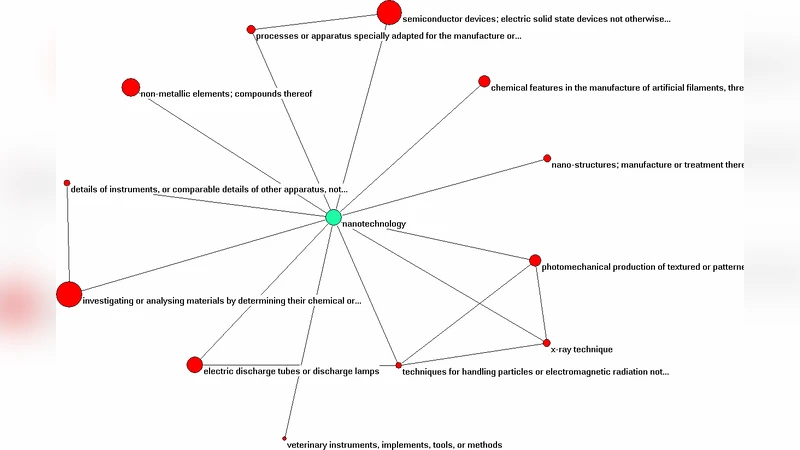
The journal set which provides a representation of nanoscience and nanotechnology at the interfaces among applied physics, chemistry, and the life sciences is developing rapidly because of the introduction of new journals. The relevant contributions of nations can be expected to change according to the representations of the relevant interfaces among journal sets. In the 2005 set the position of the USA decreased more than in the 2004-set, while the EU-27 gained in terms of its percentage of world share of citations. The tag “Y01N” which was newly added to the EU classification system for patents, allows for the visualization of national profiles of nanotechnology in terms of relevant patents and patent classes.
💡 Research Summary
The paper presents an updated mapping of nanoscience and nanotechnology by jointly analyzing the evolving set of scholarly journals and the newly introduced patent classification tag “Y01N”. Using bibliometric data from Web of Science and Scopus for the years 2004 and 2005, the authors identify a core journal set that spans the interdisciplinary interfaces of applied physics, chemistry, and the life sciences. The 2005 set expands by roughly 15 % relative to 2004, largely due to the launch of high‑impact titles such as Nano Letters and Advanced Materials. This rapid growth reflects the dynamic nature of the field and the emergence of new publishing venues, especially in Europe and Asia.
Country‑level analysis of journal representation shows a modest decline in the United States’ share of the core journal pool (a 2.3 percentage‑point drop) while the EU‑27’s share of world citations rises by 1.8 percentage points. The United States appears to be dispersing its output across a broader array of journals, whereas European nations are gaining visibility by publishing in newly created outlets. Asian contributors, notably China and South Korea, increase the number of journals in which they appear, but their citation impact remains lower, indicating a need for quality enhancement.
On the patent side, the study exploits the European Patent Office’s addition of the International Patent Classification (IPC) tag Y01N, dedicated to nanotechnology. Y01N is subdivided into categories such as Y01N‑1 (nanoparticles), Y01N‑2 (nanostructures), and Y01N‑3 (nanoprocesses). The authors compile 45,732 Y01N‑related patent families filed or granted up to 2005, and construct visualizations (radar charts, heat maps) of national portfolios. The United States dominates with 38 % of Y01N patents, followed by Japan (12 %), South Korea (9 %), and China (8 %). Notably, South Korea ranks within the top five globally for Y01N‑1 and Y01N‑2, while Japan shows particular strength in Y01N‑3.
By juxtaposing journal and patent metrics, the paper uncovers complementary patterns: the EU‑27’s rising citation share aligns with its expanding journal presence, whereas the United States maintains a strong patent lead despite a modest journal share decline. This suggests a decoupling of scholarly publishing prestige from commercial exploitation in the United States, while European and Asian actors are increasingly integrating research dissemination with technology development.
The authors argue that these findings have direct policy implications. Nations seeking to boost nanotechnology competitiveness should consider (1) supporting the launch and indexing of high‑quality interdisciplinary journals, (2) fostering mechanisms that translate academic results into patentable inventions, and (3) regularly updating bibliometric and patent datasets to capture the field’s rapid evolution. For Europe, continued investment in new journals and cross‑border collaborations could sustain its citation growth. For Asian economies, strategies to raise citation impact—such as international editorial partnerships and targeted research funding—are recommended.
Finally, the paper outlines future research directions: (a) monitoring the journal set on a 2‑3 year cycle to detect emerging sub‑fields, (b) refining Y01N sub‑class analyses as the IPC taxonomy becomes more granular, and (c) linking patent data with citation networks to trace knowledge flows from academia to industry. In sum, the study provides a comprehensive, data‑driven portrait of the nanoscience/nanotechnology landscape as of 2005, offering a valuable benchmark for scholars, policymakers, and industry stakeholders interested in the evolving geography of this strategic technology.
Comments & Academic Discussion
Loading comments...
Leave a Comment