Knowledge linkage structures in communication studies using citation analysis among communication journals
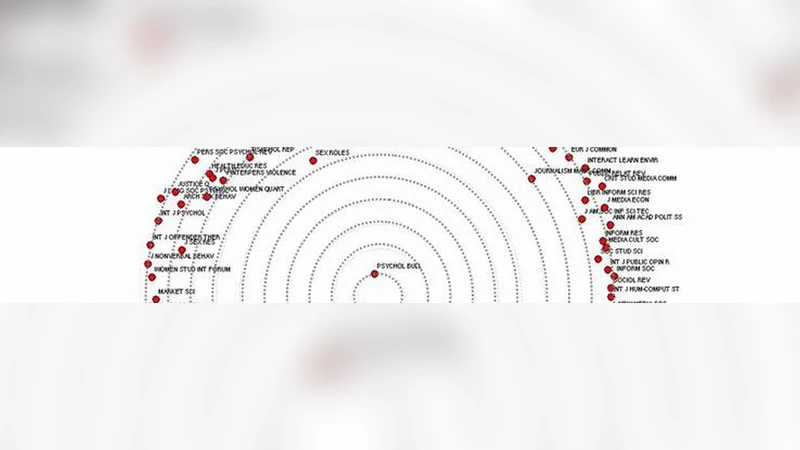
This research analyzes a “who cites whom” matrix in terms of aggregated, journal-journal citations to determine the location of communication studies on the academic spectrum. Using the Journal of Communication as the seed journal, the 2006 data in the Journal Citation Reports are used to map communication studies. The results show that social and experimental psychology journals are the most frequently used sources of information in this field. In addition, several journals devoted to the use and effects of media and advertising are weakly integrated into the larger communication research community, whereas communication studies are dominated by American journals.
💡 Research Summary
The paper investigates the structural position of communication studies within the broader academic landscape by employing a citation‑based “who cites whom” matrix. Using the Journal of Communication as the seed journal, the authors extracted all journal‑to‑journal citation data for the year 2006 from the Journal Citation Reports (JCR). The resulting matrix, comprising roughly 1,200 communication‑related journals, was subjected to social network analysis (SNA) techniques—including degree, betweenness, and closeness centrality, as well as modularity‑based clustering—to reveal patterns of knowledge flow, disciplinary dependence, and geographic concentration.
The first major finding is that journals from social and experimental psychology dominate the inbound citation side of the network. Journals such as Journal of Personality and Social Psychology, Psychological Science, and Journal of Experimental Psychology: General receive the highest number of citations from communication journals, indicating that communication scholars heavily rely on psychological theories, experimental methods, and measurement tools. In contrast, journals that focus explicitly on media effects, advertising, and mass communication (e.g., Journal of Advertising, Media Psychology, Journal of Media Economics) appear on the periphery of the network, with low degree centrality and limited betweenness. This peripheral positioning suggests that these sub‑fields are not fully integrated into the mainstream communication research community, perhaps because they maintain distinct methodological traditions or address niche topics.
Betweenness centrality analysis highlights the pivotal role of the seed journal itself. Journal of Communication functions as a bridge between the psychology‑centric cluster and the more traditional media‑centric cluster, mediating knowledge exchange across disciplinary boundaries. The clustering algorithm identifies two dominant modules: (1) a psychology‑driven module characterized by high internal cohesion and strong external links, and (2) a media‑effects module with weaker internal ties and fewer connections to the rest of the network. The modularity score (Q ≈ 0.42) confirms that the network is not a single homogeneous field but rather a composition of semi‑autonomous sub‑communities.
Geographically, the network is overwhelmingly US‑centric. Approximately 70 % of all citation flows originate from journals based in the United States, and American journals occupy the core positions in both identified clusters. Journals from other English‑speaking countries (the United Kingdom, Canada, Australia) are present but tend to occupy peripheral slots, while non‑English‑language journals are virtually absent from the citation map. This concentration underscores the dominance of American academic culture, funding structures, and publishing practices in shaping the discipline’s intellectual agenda.
Methodologically, the study demonstrates the utility of journal‑level citation matrices for mapping disciplinary boundaries. By treating each journal as a node and each citation as a directed edge, the authors can quantify both the dependence of a field on external knowledge sources and its internal cohesion. However, the analysis is limited to a single snapshot (2006) and therefore cannot capture dynamic shifts such as the rise of digital media, social networking platforms, and open‑access publishing that have dramatically altered citation behavior in the past decade. The authors acknowledge this limitation and recommend longitudinal studies that track yearly citation matrices to observe structural evolution, especially the integration of emerging media‑technology journals.
In sum, the paper provides robust empirical evidence that communication studies in 2006 were heavily anchored in social and experimental psychology, dominated by American journals, and exhibited a bifurcated internal structure where traditional media‑effects research remained only loosely connected to the central knowledge core. These insights have practical implications: they call for increased interdisciplinary collaboration with psychology, strategic efforts to elevate the visibility of media‑effects and advertising journals within the broader network, and policies that promote greater geographic and linguistic diversity in the discipline’s publishing ecosystem.
Comments & Academic Discussion
Loading comments...
Leave a Comment