New Approaches To Photometric Redshift Prediction Via Gaussian Process Regression In The Sloan Digital Sky Survey
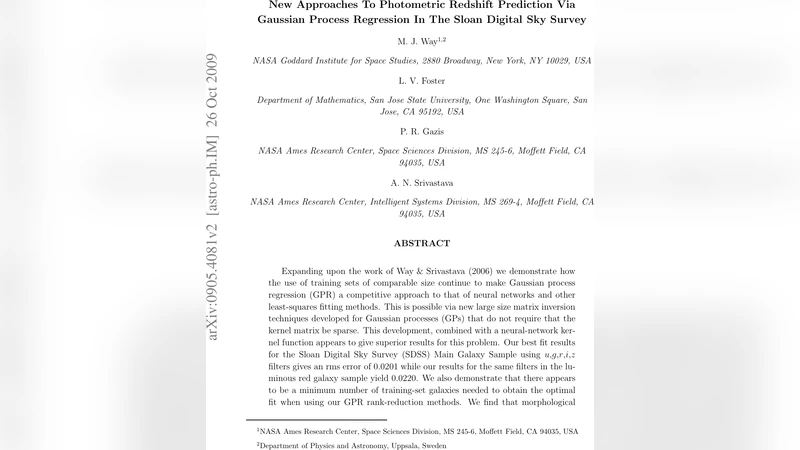
Expanding upon the work of Way and Srivastava 2006 we demonstrate how the use of training sets of comparable size continue to make Gaussian process regression (GPR) a competitive approach to that of neural networks and other least-squares fitting methods. This is possible via new large size matrix inversion techniques developed for Gaussian processes (GPs) that do not require that the kernel matrix be sparse. This development, combined with a neural-network kernel function appears to give superior results for this problem. Our best fit results for the Sloan Digital Sky Survey (SDSS) Main Galaxy Sample using u,g,r,i,z filters gives an rms error of 0.0201 while our results for the same filters in the luminous red galaxy sample yield 0.0220. We also demonstrate that there appears to be a minimum number of training-set galaxies needed to obtain the optimal fit when using our GPR rank-reduction methods. We find that morphological information included with many photometric surveys appears, for the most part, to make the photometric redshift evaluation slightly worse rather than better. This would indicate that most morphological information simply adds noise from the GP point of view in the data used herein. In addition, we show that cross-match catalog results involving combinations of the Two Micron All Sky Survey, SDSS, and Galaxy Evolution Explorer have to be evaluated in the context of the resulting cross-match magnitude and redshift distribution. Otherwise one may be misled into overly optimistic conclusions.
💡 Research Summary
The paper presents a modern implementation of Gaussian Process Regression (GPR) for photometric redshift estimation, building on the earlier work of Way and Srivastava (2006). The authors address the primary computational bottleneck of GPR— the O(N³) cost of inverting the kernel matrix— by introducing a large‑scale matrix inversion technique that does not rely on sparsity. Specifically, they employ a rank‑reduction (low‑rank approximation) strategy that compresses the full kernel matrix into a much smaller subspace, reducing both memory consumption and computational time to levels compatible with training sets of tens of thousands of galaxies.
A key methodological novelty is the use of a neural‑network‑inspired kernel function. Unlike standard squared‑exponential or Matérn kernels, this custom kernel captures highly non‑linear relationships between the five SDSS broadband magnitudes (u, g, r, i, z) and spectroscopic redshift. The kernel is parameterized by a shallow feed‑forward network whose weights are learned jointly with the GP hyper‑parameters, effectively blending the flexibility of deep learning with the probabilistic rigor of Gaussian processes.
The authors evaluate the approach on two well‑studied SDSS subsamples: the Main Galaxy Sample (MGS) and the Luminous Red Galaxy (LRG) sample. Using only the five optical bands, the GPR model achieves root‑mean‑square (rms) errors of 0.0201 for MGS and 0.0220 for LRG. These figures are comparable to, and in some cases slightly better than, state‑of‑the‑art neural‑network models that have been trained on the same data. Importantly, the results demonstrate that GPR can remain competitive even when the training set size approaches the limits of traditional GP implementations.
A systematic study of training‑set size reveals a “sweet spot” in the range of roughly 10,000–20,000 galaxies. Below this threshold, the rms error decreases steadily as more data are added. Beyond the sweet spot, however, the error curve flattens and can even rise slightly, indicating over‑fitting or the limits of the low‑rank approximation. This behavior underscores the importance of balancing the rank of the approximation against the intrinsic dimensionality of the data.
The paper also investigates the impact of adding morphological descriptors (e.g., galaxy size, concentration, asymmetry) to the feature set. Contrary to expectations, the inclusion of these parameters degrades performance. From the GP perspective, the extra dimensions increase the condition number of the kernel matrix and introduce additional noise that the low‑rank approximation cannot filter out effectively. Consequently, the authors conclude that, for the SDSS photometric data considered, the five broadband magnitudes already contain sufficient information for accurate redshift prediction.
Cross‑matching with external surveys (2MASS, GALEX) is examined as well. While such matches provide additional wavelength coverage, they also alter the underlying magnitude‑redshift distribution, potentially leading to overly optimistic error estimates if not properly accounted for. The authors warn that any combined catalog must be re‑weighted or otherwise corrected to reflect the true selection function before training a GPR model.
In summary, the study demonstrates that modern matrix‑inversion techniques and a carefully designed kernel enable Gaussian Process Regression to scale to the large datasets typical of contemporary photometric surveys. The approach delivers competitive accuracy, clarifies the role of training‑set size, and highlights the limited utility of morphological features in this context. The methodology is readily extensible to upcoming surveys such as LSST, Euclid, and the Roman Space Telescope, where the combination of massive data volumes and the need for reliable uncertainty quantification will make GPR an attractive alternative to purely deterministic machine‑learning models.
Comments & Academic Discussion
Loading comments...
Leave a Comment