Unique Normal Forms in Infinitary Weakly Orthogonal Term Rewriting
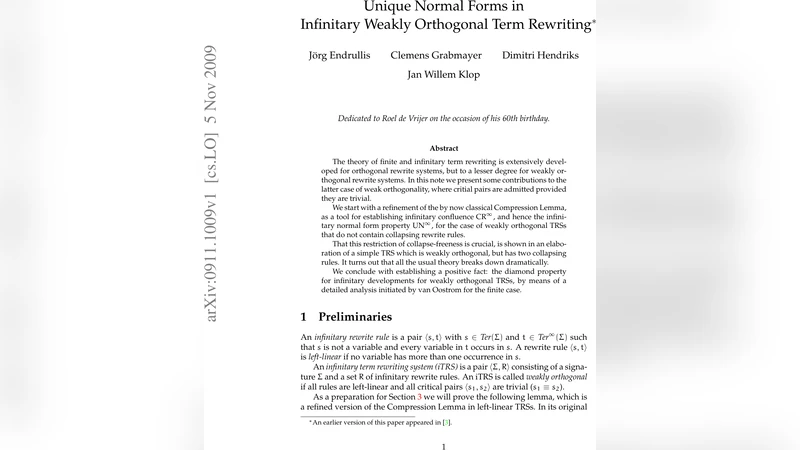
The theory of finite and infinitary term rewriting is extensively developed for orthogonal rewrite systems, but to a lesser degree for weakly orthogonal rewrite systems. In this note we present some contributions to the latter case of weak orthogonality, where critial pairs are admitted provided they are trivial. We start with a refinement of the by now classical Compression Lemma, as a tool for establishing infinitary confluence, and hence the property of unique infinitary normal forms, for the case of weakly orthogonal TRSs that do not contain collapsing rewrite rules. That this restriction of collapse-freeness is crucial, is shown in a elaboration of a simple TRS which is weakly orthogonal, but has two collapsing rules. It turns out that all the usual theory breaks down dramatically. We conclude with establishing a positive fact: the diamond property for infinitary developments for weakly orthogonal TRSs, by means of a detailed analysis initiated by van Oostrom for the finite case.
💡 Research Summary
This paper investigates infinitary term rewriting for weakly orthogonal rewrite systems (TRSs), extending the well‑developed theory for orthogonal systems to the more permissive weakly orthogonal case. The authors focus on the existence of unique infinitary normal forms (UINFs) and the conditions under which they hold.
The first major contribution is a refined Compression Lemma tailored to infinitary developments. The classical compression result guarantees that any finite reduction can be shortened without changing its endpoint, but it does not directly apply to reductions of length ω or greater. By assuming the TRS contains no collapsing rules (rules whose right‑hand side is a variable), the authors show that any infinitary reduction can be decomposed into a finite prefix followed by an ω‑length “development” that itself can be compressed to a reduction of length at most ω. The proof proceeds by isolating redexes that belong to independent developments, exploiting the weak orthogonality property that any critical pair is trivial, and then applying a well‑founded ordering on the positions of redexes to obtain a compressed form.
Using this refined compression, the paper establishes infinitary confluence for collapse‑free weakly orthogonal TRSs. The argument is a classic parallel‑moves construction: given two infinitary reductions from the same term, compress each to a standard form, then show that the compressed reductions can be synchronized step‑by‑step because any overlapping redexes are trivial. Consequently, every term has at most one infinitary normal form, i.e., UINFs exist for this class of systems.
The authors then demonstrate that the collapse‑free restriction is essential. They present a simple weakly orthogonal TRS containing two collapsing rules. In this system, a single starting term admits two distinct infinitary reductions that converge to different normal forms. The example illustrates that the presence of collapsing rules destroys the ability to compress developments and breaks infinitary confluence, so the unique normal‑form property collapses dramatically.
Finally, the paper revisits the diamond property for infinitary developments. Building on van Oostrom’s analysis for the finite case, the authors prove that weakly orthogonal TRSs enjoy a full diamond property even in the infinitary setting. The proof shows that any two developments from the same term can be rearranged into a common successor by repeatedly applying the trivial critical‑pair condition and the refined compression lemma. This diamond property provides an alternative route to infinitary confluence and reinforces the robustness of weak orthogonality when collapsing rules are absent.
In summary, the work clarifies the landscape of infinitary rewriting for weakly orthogonal systems: collapse‑free weakly orthogonal TRSs retain the desirable properties of confluence and unique infinitary normal forms, while the introduction of collapsing rules invalidates these results. The refined compression lemma and the infinitary diamond property constitute the technical core of the paper, offering tools for further exploration of infinitary rewriting beyond the orthogonal regime.
Comments & Academic Discussion
Loading comments...
Leave a Comment