Comments on "Particle Markov chain Monte Carlo" by C. Andrieu, A. Doucet, and R. Hollenstein
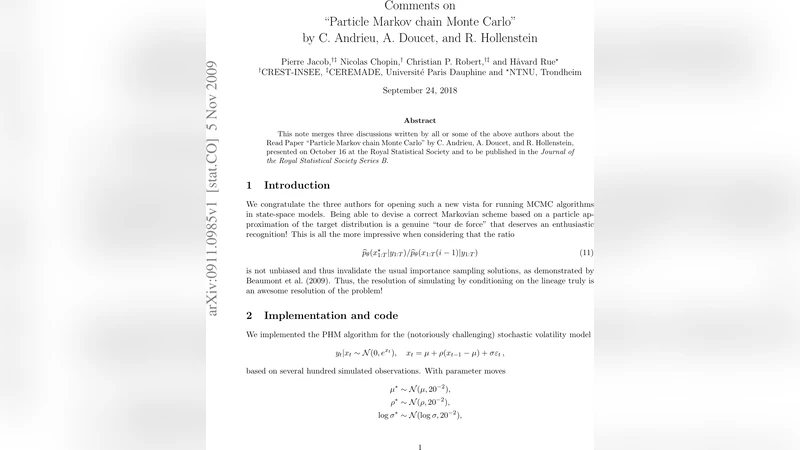
This is the compilation of our comments submitted to the Journal of the Royal Statistical Society, Series B, to be published within the discussion of the Read Paper of Andrieu, Doucet and Hollenstein.
💡 Research Summary
The paper under review is a collection of comments on the seminal work “Particle Markov chain Monte Carlo” (PMCMC) by Andrieu, Doucet, and Hollenstein. The authors of the comment acknowledge the innovative nature of PMCMC, which combines particle filtering with Metropolis–Hastings (MH) updates to enable exact Bayesian inference in high‑dimensional state‑space models. By using the particle filter to provide an unbiased estimator of the likelihood, the resulting Markov chain retains the target posterior as its invariant distribution, thereby overcoming the limitations of traditional Gibbs samplers in non‑linear, non‑Gaussian settings.
Despite these strengths, the comment identifies several critical issues that merit further investigation. First, the practical impact of particle‑filter bias on the MH acceptance probability is not fully quantified. While the original paper argues that bias vanishes as the number of particles grows, realistic applications often involve a limited particle budget, especially in high‑dimensional problems. The authors suggest incorporating unbiased particle estimators (e.g., zero‑variance control variates or debiased importance weights) and developing a theoretical framework that explicitly characterizes the bias‑variance trade‑off. Such a framework would guide practitioners in selecting an optimal particle count that balances computational cost against statistical efficiency.
Second, the computational and memory demands of PMCMC are substantial. The algorithm nests a particle filter within each MH iteration, leading to a double‑loop structure whose cost scales linearly with the number of particles and the length of the time series. The comment proposes several engineering solutions: thread‑level parameter sharing, particle recycling across iterations, and adaptive particle number control based on effective sample size (ESS) diagnostics. Moreover, leveraging GPU acceleration and distributed computing can dramatically reduce wall‑clock time, making PMCMC viable for large‑scale data streams.
Third, the empirical evaluation in the original paper is relatively narrow. The authors compare PMCMC mainly against Gibbs samplers on a few synthetic and real datasets, but they do not benchmark against more recent inference methods such as Stein Variational Gradient Descent (SVGD), No‑U‑Turn Sampler (NUTS), or advanced variational approaches. The comment calls for a comprehensive benchmark that standardizes computational resources, convergence diagnostics, and efficiency metrics (e.g., ESS per second). Such a study would clarify the circumstances under which PMCMC offers a genuine advantage over competing algorithms.
Fourth, the theoretical proofs in the original work assume that the particle filter’s resampling step does not disturb the Markov property of the overall chain. However, resampling introduces dependence among particles that can affect the martingale structure required for the invariant distribution proof. The comment recommends a strengthened martingale analysis that explicitly incorporates resampling, possibly by modeling the entire algorithm as an extended Markov chain on an augmented state space. Additionally, exploring alternative resampling schemes (systematic, stratified, residual) and their impact on convergence rates would enrich the theoretical foundation.
Finally, the comment outlines a research agenda: (1) design and analysis of unbiased particle estimators within PMCMC; (2) adaptive strategies for particle allocation and memory management; (3) systematic comparison with state‑of‑the‑art variational and MCMC methods; and (4) rigorous treatment of resampling within the Markov chain framework. Addressing these points would solidify PMCMC’s role as a robust, scalable tool for Bayesian inference in complex dynamical systems, spatial‑temporal models, and high‑dimensional hierarchical structures.
Comments & Academic Discussion
Loading comments...
Leave a Comment