Hybrid, Optical and Wireless Near-Gigabit Communications System
This paper presents the study and the realization of a hybrid 60 GHz wireless communications system. As the 60 GHz radio link operates only in a single-room configuration, an additional Radio over Fibre (RoF) link is used to ensure the communications in all the rooms of a residential environment. A single carrier architecture is adopted. The system uses low complexity baseband processing modules. A byte/frame synchronization technique is designed to provide a high value of the preamble detection probability and a very small value of the false alarm probability. Conventional RS (255, 239) encoder and decoder are used to correct errors in the transmission channel. Results of Bit Error Rate (BER) measurements are presented for various antennas configurations.
💡 Research Summary
The paper presents the design, implementation, and experimental validation of a hybrid 60 GHz wireless communication system enhanced with a Radio‑over‑Fiber (RoF) link to extend coverage throughout a residential environment. Recognizing that a 60 GHz radio link is limited to a single room due to high free‑space loss and line‑of‑sight (LOS) constraints, the authors integrate a 300‑m optical fiber segment that carries the intermediate‑frequency (IF) signal, thereby allowing the wireless link to reach other rooms without degrading the high‑frequency radio performance.
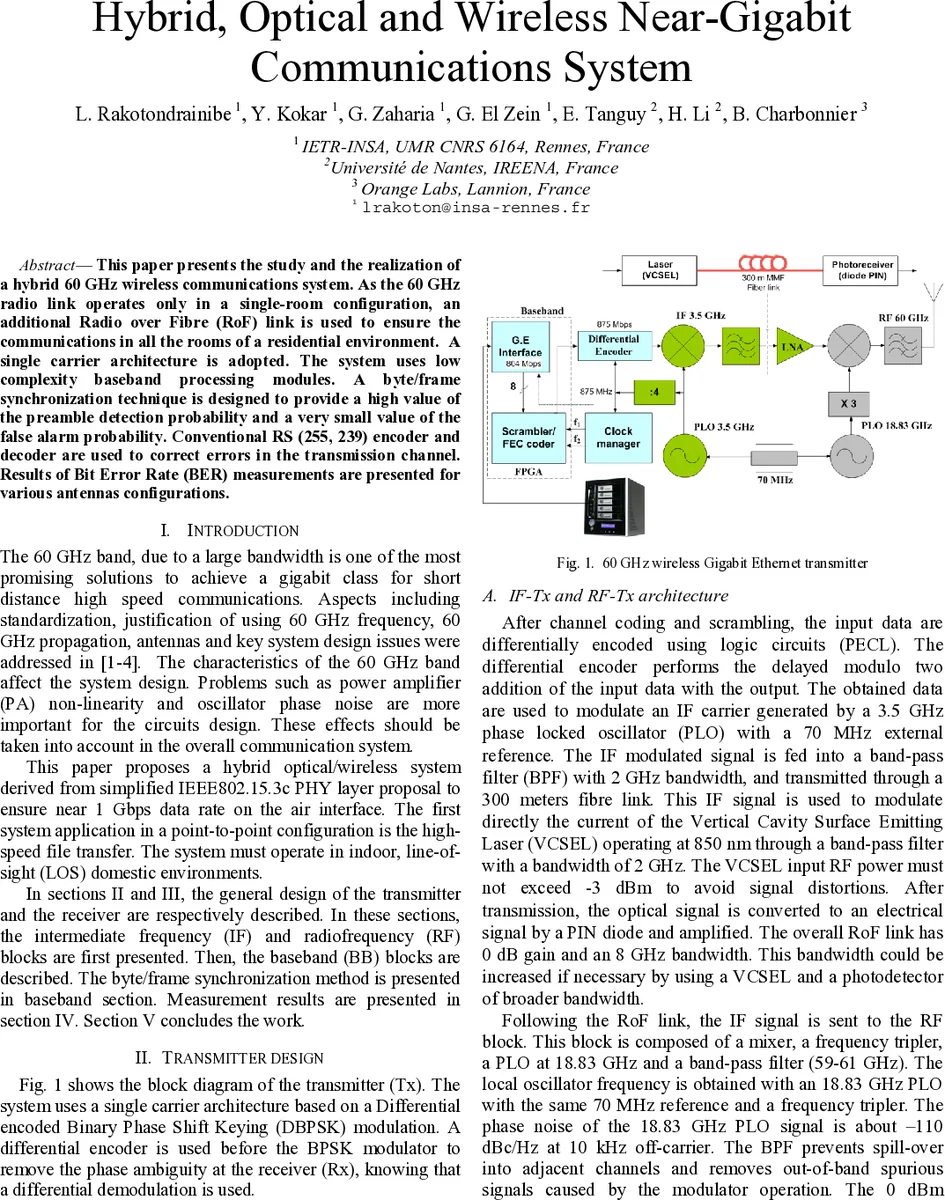
The transmitter architecture follows a single‑carrier differential binary phase‑shift keying (DBPSK) scheme. Data from a Gigabit Ethernet (GMII) interface are first buffered in a dual‑port FIFO operating with two asynchronous clocks (100.54 MHz write, 109.37 MHz read) to avoid overflow. A frame consists of a 4‑byte preamble (a 31‑bit PN sequence plus one bit), 239 data bytes, 16 Reed‑Solomon (RS) check symbols, and a single dummy byte. The dummy byte is carefully chosen (binary 00000010, decimal 64) to minimise the maximum cross‑correlation between the preamble and any shifted version of the frame, thereby reducing false‑alarm probability during synchronization. After scrambling, the data are differentially encoded, serialized, and used to modulate a 3.5 GHz IF carrier generated by a phase‑locked oscillator (PLO) locked to a 70 MHz reference. The IF signal drives a VCSEL (850 nm) directly, traverses the RoF link, and is reconverted to electrical form by a PIN photodiode.
In the RF section, the recovered IF is mixed with a 18.83 GHz local oscillator (derived from the same 70 MHz reference and a frequency tripler) to up‑convert to the 60 GHz band. A band‑pass filter (59–61 GHz) suppresses spurious emissions, and a high‑gain (22.4 dBi) horn antenna radiates the signal.
The receiver mirrors the transmitter’s RF chain: a band‑pass filter, low‑noise amplifier (40 dB gain), and automatic gain control (20 dB dynamic range) precede down‑conversion to 3.5 GHz IF. A non‑coherent differential demodulator, consisting of a mixer and a delay line equal to one symbol period (1.14 ns), extracts the DBPSK data. The resulting baseband signal passes through a 1 GHz low‑pass filter and a clock‑and‑data‑recovery (CDR) circuit.
Baseband reception employs a sophisticated preamble detection mechanism. Eight 32‑bit correlators evaluate all possible byte‑aligned shifts; two identical banks operate in parallel. A preamble is declared only when the same correlator index triggers in both banks, dramatically lowering the false‑alarm probability. With a detection threshold γ = 28, the miss‑detection probability falls below 10⁻⁴ while the false‑alarm probability reaches 10⁻¹⁰. After successful detection, the data are descrambled and passed through an RS(255,239) decoder capable of correcting up to eight erroneous bytes. The corrected byte stream is written back to the FIFO and finally presented to the Ethernet interface.
Experimental results obtained with a vector network analyser show a usable 2 GHz bandwidth and a clean impulse response with minimal side‑lobes. Eye diagrams at 875 Mbps confirm robust signal integrity. Bit‑error‑rate (BER) measurements reveal that with high‑gain horn antennas the system maintains BER < 10⁻⁹ up to 10 m separation, whereas patch antennas (8 dBi) suffer rapid degradation beyond 5 m. The authors note that the 60 GHz link is highly sensitive to blockage and beam‑pointing errors, suggesting a centralized ceiling‑mounted transmitter with a less directional antenna to mitigate shadowing, while the receiver can retain a directional antenna for link budget gains.
In conclusion, the hybrid optical‑wireless architecture delivers near‑gigabit throughput with modest hardware complexity. The custom byte‑synchronization and dual‑bank preamble detection provide high detection reliability and negligible false alarms. Future work will explore higher‑order modulations (e.g., QPSK), adaptive equalization, and multi‑antenna configurations to achieve multi‑gigabit rates, especially in non‑LOS indoor scenarios.
Comments & Academic Discussion
Loading comments...
Leave a Comment