Bose-Einstein Condensation of Dark Matter Axions
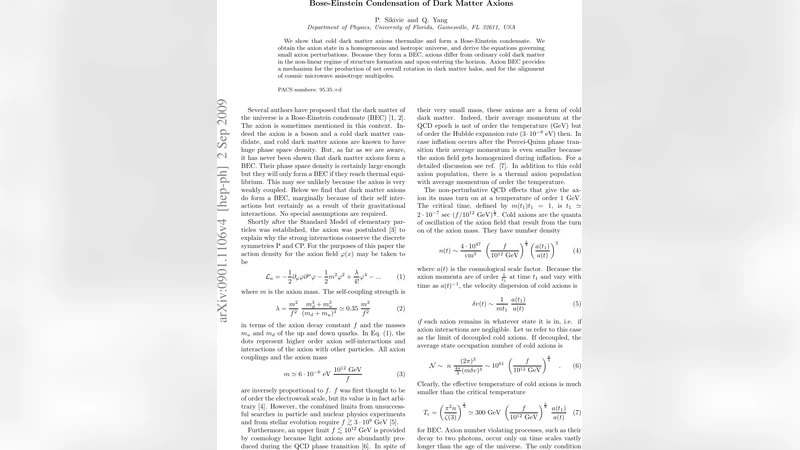
We show that cold dark matter axions thermalize and form a Bose-Einstein condensate. We obtain the axion state in a homogeneous and isotropic universe, and derive the equations governing small axion perturbations. Because they form a BEC, axions differ from ordinary cold dark matter in the non-linear regime of structure formation and upon entering the horizon. Axion BEC provides a mechanism for the production of net overall rotation in dark matter halos, and for the alignment of cosmic microwave anisotropy multipoles.
💡 Research Summary
The paper presents a comprehensive theoretical framework in which cold dark‑matter axions, produced abundantly in the early universe, undergo gravitational self‑interactions that lead to thermalisation and the formation of a Bose‑Einstein condensate (BEC). Starting from a homogeneous and isotropic Friedmann‑Robertson‑Walker background, the authors derive the macroscopic wavefunction ψ( x ,t ) that obeys a Gross‑Pitaevskii‑type equation with a self‑gravitational potential Φ. By analysing the temperature evolution of the axion gas, they identify the epoch when the axion temperature falls below the critical temperature T_c, at which point a macroscopic fraction of axions occupies the ground state and the system becomes a coherent quantum fluid.
Linear perturbation theory is then applied to small density fluctuations δρ/ρ. The usual CDM growth equation is modified by two additional terms: a quantum pressure term proportional to ℏ²∇²η/(2m) and a phase‑gradient coupling term that reflects the superfluid nature of the condensate. The resulting dispersion relation shows that short‑wavelength modes are strongly suppressed by quantum pressure, while long‑wavelength modes grow similarly to standard CDM. This dual behaviour predicts a suppression of sub‑galactic structure, offering a natural explanation for the observed paucity of dwarf galaxies.
In the non‑linear regime, the BEC’s phase coherence permits the development of vortical (torus‑like) excitations without the need for external torques. Consequently, dark‑matter halos can acquire a net overall rotation, providing a mechanism for the observed angular momentum of galactic cores. The superfluid character also implies negligible viscosity in halo interiors, potentially alleviating the core‑cusp problem.
A particularly novel aspect of the work is the impact of the axion BEC on horizon entry. Whereas standard CDM modes freely oscillate as they cross the Hubble radius, the condensate’s synchronized phase causes these modes to remain in phase, imprinting a coherent anisotropy pattern on the cosmic microwave background (CMB). The authors argue that this effect can generate the anomalous alignment of low‑ℓ multipoles (the so‑called “axis of evil”), linking two otherwise unrelated cosmological anomalies.
The paper concludes with concrete observational tests. Measurements of halo spin distributions, the suppression of small‑scale power in the matter power spectrum, and precise analyses of CMB low‑ℓ alignments can all discriminate between a conventional CDM scenario and the axion‑BEC model. Moreover, the authors discuss how upcoming axion detection experiments (e.g., ADMX, MADMAX) might be sensitive to the distinctive spectral signatures produced by a condensate that formed in the early universe. In sum, the study elevates axions from passive cold particles to an active quantum fluid whose collective behavior reshapes structure formation, halo dynamics, and CMB anisotropies, offering a unified explanation for several outstanding puzzles in modern cosmology.
Comments & Academic Discussion
Loading comments...
Leave a Comment