Construction of a Non-2-colorable k-uniform Hypergraph with Few Edges
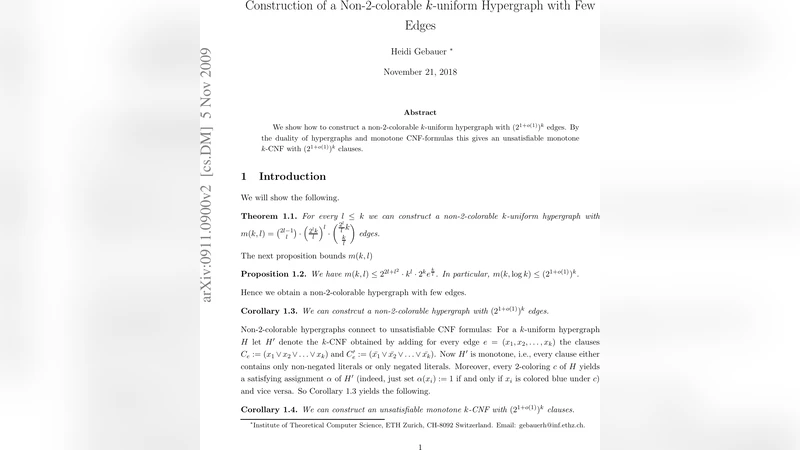
We show how to construct a non-2-colorable k-uniform hypergraph with (2^(1 + o(1)))^k edges. By the duality of hypergraphs and monotone k-CNF-formulas this gives an unsatisfiable monotone k-CNF with (2^(1 + o(1)))^k clauses
💡 Research Summary
The paper presents a construction of a k‑uniform hypergraph that is not 2‑colorable while using an asymptotically optimal (up to a sub‑exponential factor) number of edges, namely (2^{1+o(1)})^k. The authors start by fixing an integer ℓ with 1 ≤ ℓ ≤ k and introduce 2^ℓ−1 sequences A_i, each of length k′ = 2^ℓ·ℓ·k. For any 2‑coloring c of the vertex set, they define the notion of a “red majority” (or “blue majority”) in a sequence: at least half of the elements of the sequence receive the same color. By the pigeon‑hole principle, any coloring must have a subset of ℓ sequences that share the same majority color.
Given ℓ such sequences X_1,…,X_ℓ, the construction proceeds by cyclically shifting each sequence by an offset i_j ∈ {0,…,k′−1}. For each choice of offsets (i_1,…,i_ℓ) and each subset S ⊆ {1,…,k′} of size k/ℓ, the authors form a k‑element set e_{i_1,…,i_ℓ}(S) consisting of the elements x_{j,r+i_j} for r ∈ S and j = 1,…,ℓ. This set is taken as a hyperedge. By ranging over all possible offsets and all S, they obtain a hypergraph G_{X_1,…,X_ℓ} with at most k′·⌈k′/k⌉ edges. The final hypergraph G is the union of G_{X_1,…,X_ℓ} over all ℓ‑element subsets {X_1,…,X_ℓ} of the original 2^ℓ−1 sequences. Consequently the total number of edges equals ⌈(2^ℓ−1)/ℓ⌉·k′·⌈k′/k⌉.
To bound this quantity, the authors use the standard inequality for binomial coefficients, (\binom{n}{r} ≤ (en/r)^r). Applying it to (\binom{k′}{k/ℓ}) yields an upper bound of (2^ℓ·e·ℓ)^{k/ℓ}. Substituting k′ = 2^ℓ·ℓ·k and simplifying gives
(m(k,ℓ) ≤ 2^{2ℓ+ℓ^2}·k^{ℓ}·2^{k·ℓ}).
Choosing ℓ = ⌈log k⌉ makes the term 2^{2ℓ+ℓ^2}·k^{ℓ} sub‑exponential in k, and the dominant factor becomes 2^{k·ℓ} = (2^{1+o(1)})^k. Hence the authors obtain a non‑2‑colorable k‑uniform hypergraph with only (2^{1+o(1)})^k edges, improving upon previously known constructions.
The paper then exploits the well‑known duality between hypergraphs and monotone k‑CNF formulas. For each hyperedge e = {x_1,…,x_k} they introduce two clauses: C_e = (x_1 ∨ … ∨ x_k) and C’_e = (¬x_1 ∨ … ∨ ¬x_k). The resulting CNF H′ is monotone because each clause contains either only positive literals or only negative literals. Moreover, a 2‑coloring of the hypergraph corresponds directly to a truth assignment that satisfies H′: assign a variable true exactly when its vertex is colored blue. Consequently, if the hypergraph is not 2‑colorable, the associated monotone CNF is unsatisfiable. Therefore the construction yields an unsatisfiable monotone k‑CNF with the same number of clauses, namely (2^{1+o(1)})^k.
In summary, the authors provide a combinatorial construction that dramatically reduces the edge count required for a non‑2‑colorable k‑uniform hypergraph, and via hypergraph‑CNF duality they obtain matching bounds for unsatisfiable monotone k‑CNF formulas. The work bridges extremal hypergraph theory and propositional logic, offering tighter bounds that may influence both areas, especially in the study of lower bounds for proof complexity and the design of hard instances for SAT solvers.
Comments & Academic Discussion
Loading comments...
Leave a Comment