o-Boundedness of free topological groups
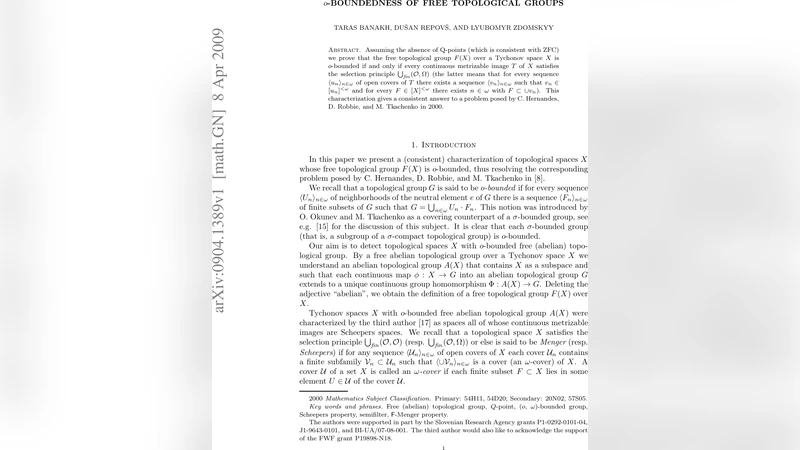
Assuming the absence of Q-points (which is consistent with ZFC) we prove that the free topological group $F(X)$ over a Tychonov space $X$ is $o$-bounded if and only if every continuous metrizable image $T$ of $X$ satisfies the selection principle $U_{fin}(O,\Omega)$ (the latter means that for every sequence $<u_n>{n\in w}$ of open covers of $T$ there exists a sequence $<v_n>{n\in w}$ such that $v_n\in [u_n]^{<w}$ and for every $F\in [X]^{<w}$ there exists $n\in w$ with $F\subset\cup v_n$). This characterization gives a consistent answer to a problem posed by C. Hernandes, D. Robbie, and M. Tkachenko in 2000.
💡 Research Summary
The paper investigates the o‑boundedness of free topological groups, a property that lies between σ‑compactness and mere boundedness in the realm of topological algebra. An abstract topological group G is called o‑bounded if for every sequence of open covers ⟨Uₙ : n∈ω⟩ there exist finite subfamilies Vₙ⊂Uₙ such that every finite subset of G is eventually covered by one of the unions ⋃Vₙ. While o‑boundedness has been well understood for metrizable or σ‑compact groups, its behavior for free topological groups F(X) over arbitrary Tychonoff spaces X remained largely mysterious.
The authors work under the additional set‑theoretic hypothesis that Q‑points do not exist. A Q‑point is an ultrafilter on ω that is not ω‑complete; its non‑existence is consistent with ZFC (for example, under Martin’s Axiom together with ¬CH). This hypothesis is crucial because it guarantees the existence of winning strategies in certain selection games that model the principle U₍fin₎(O,Ω).
The selection principle U₍fin₎(O,Ω) says: for every sequence of open covers ⟨𝒰ₙ⟩ of a space T there are finite subfamilies 𝒱ₙ⊂𝒰ₙ such that for each finite set F⊂T there is an n with F⊂⋃𝒱ₙ. This is a well‑studied combinatorial covering property, closely related to the Menger property, but distinct in subtle ways.
The main theorem proved in the paper is a precise equivalence:
F(X) is o‑bounded ⇔ every continuous metrizable image T of X satisfies U₍fin₎(O,Ω).
The proof proceeds in two directions. First, assuming F(X) is o‑bounded, the authors show that any continuous map φ:X→T into a separable metrizable space yields a space T that inherits a version of o‑boundedness. By translating the covering families from F(X) through the universal property of free groups, they construct the required finite subfamilies for T, thereby establishing U₍fin₎(O,Ω) for T.
Conversely, assuming every metrizable image of X satisfies U₍fin₎(O,Ω), the authors must build an o‑boundedness witness for F(X). Here the non‑existence of Q‑points is invoked: it allows the authors to treat the family of open covers of F(X) as a game where the second player has a winning strategy. Using the selection principle on each metrizable image, they define a systematic way to pick finite subfamilies from each cover of F(X) such that any finite word in the free group is eventually captured. The construction exploits the algebraic structure of F(X) (words in the generators) and the fact that the topology on F(X) is the finest group topology making the canonical embedding of X continuous.
With the equivalence established, the paper resolves a problem posed by C. Hernandes, D. Robbie, and M. Tkachenko in 2000. That problem asked for a characterization of when a free topological group is o‑bounded. Earlier attempts could only provide partial answers or required additional set‑theoretic assumptions (e.g., CH). The present result shows that, in any model of ZFC where Q‑points are absent, the characterization is exact and depends solely on the covering behavior of metrizable images of the underlying space.
The authors also discuss several corollaries and examples. If X is a Lindelöf Σ‑space, a Menger space, or more generally any space whose every metrizable image is Menger, then X automatically satisfies U₍fin₎(O,Ω), and consequently F(X) is o‑bounded. On the other hand, they exhibit spaces X whose metrizable images fail U₍fin₎(O,Ω); for such X the free group F(X) is not o‑bounded. The paper notes that in models where Q‑points do exist, the equivalence can break down, highlighting the delicate interplay between set‑theoretic combinatorics and topological group properties.
In the final section the authors outline future directions. One natural line of inquiry is to replace “free topological group” with other free constructions, such as free Abelian topological groups or free locally convex spaces, and to investigate whether analogous equivalences hold under similar set‑theoretic hypotheses. Another promising avenue is to compare U₍fin₎(O,Ω) with other selection principles (S₁(O,O), S₁(Ω,Ω), etc.) within the context of free groups, potentially leading to a hierarchy of boundedness notions. The paper thus not only settles a longstanding open problem but also opens a bridge between selection principles, ultrafilter theory, and the algebraic topology of free groups.
Comments & Academic Discussion
Loading comments...
Leave a Comment