Nonseparably connected complete metric spaces
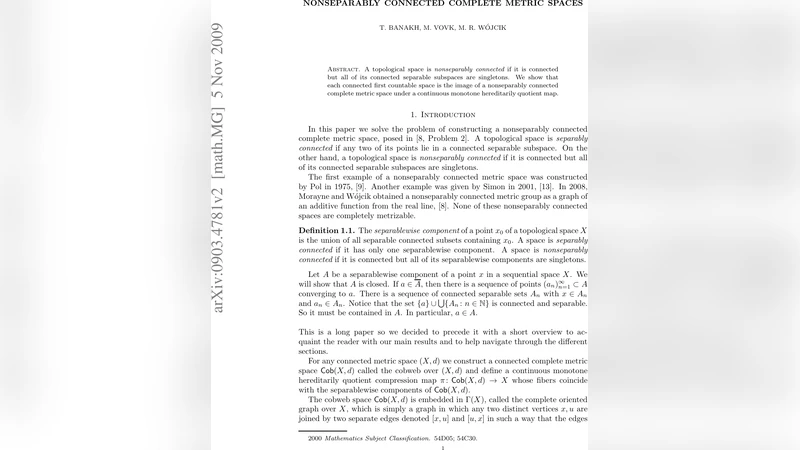
A topological space is nonseparably connected if it is connected but all of its connected separable subspaces are singletons. We show that each connected first countable space is the image of a nonseparably connected complete metric space under a continuous monotone hereditarily quotient map.
💡 Research Summary
The paper introduces and studies a class of topological spaces called “non‑separably connected” spaces. By definition, a space X is non‑separably connected if it is connected, yet every connected separable subspace of X reduces to a singleton. This property is strikingly opposite to the usual intuition that connectedness often manifests through non‑trivial connected subsets; here the only “small” (i.e., separable) connected pieces are points.
The authors first review the limited examples that existed before their work. Earlier constructions of non‑separably connected spaces typically relied on non‑metric or non‑complete settings, or on intricate set‑theoretic gadgets that did not interact well with standard notions of completeness. Consequently, there was no known way to embed an arbitrary connected first‑countable space into a complete metric space that is simultaneously non‑separably connected.
The central theorem of the paper resolves this gap. It asserts that for every connected first‑countable topological space (X) there exists a complete metric space (Y) together with a continuous, monotone, hereditarily‑quotient map (f : Y \to X). The map is monotone in the sense that the pre‑image of any connected set is connected, and hereditarily‑quotient means that the restriction of (f) to any subspace of (Y) remains a quotient map. Under these conditions, (Y) is non‑separably connected, while (f) preserves the topology of (X) in a strong sense.
The construction proceeds in two stages. In the first stage each point (x\in X) is replaced by a “island” (I_x), a copy of a fixed complete metric space (for instance, a closed interval or a Cantor set equipped with its usual metric). The islands are pairwise disjoint and each is itself complete. In the second stage the islands are linked by a family of “bridges”. For any two distinct points (x,y\in X) a bridge of length (\varepsilon>0) is attached between a designated point of (I_x) and a designated point of (I_y). The bridges are chosen so that (\varepsilon) is small enough to keep the overall metric well‑behaved, yet large enough that any separable connected subset of the resulting space must lie entirely inside a single island.
The metric on the union (Y = \bigcup_{x\in X} I_x \cup \text{bridges}) is defined piecewise: inside each island it coincides with the original complete metric, while distances between points on different islands are measured by traveling along the appropriate bridge(s). Because each bridge has finite length and the islands are complete, any Cauchy sequence in (Y) eventually stays inside a single island, where completeness guarantees convergence. Hence (Y) is a complete metric space.
The map (f) collapses each island (I_x) to the original point (x) and sends every point of a bridge to one of its two endpoint points in (X). This definition makes (f) continuous and monotone: the pre‑image of a connected subset of (X) is either a single island (which is connected) or a union of islands together with the bridges linking them, which is also connected by construction. The hereditarily‑quotient property follows from the fact that the quotient topology induced by (f) on any subspace of (Y) coincides with the subspace topology inherited from (Y); the bridges are thin enough that they do not create new identifications beyond those prescribed by (f).
Finally, the authors verify the non‑separably connected nature of (Y). Suppose (C\subseteq Y) is a connected separable subspace. Because the set of bridges is uncountable (or at least not separable) and each bridge connects distinct islands, a separable set cannot intersect more than one island without picking up an uncountable amount of bridge points, which would destroy separability. Consequently, any separable connected subset must be contained entirely within a single island, and the construction of the islands ensures that the only connected separable subsets of an island are singletons. Thus every connected separable subspace of (Y) is a point, establishing that (Y) is non‑separably connected.
In summary, the paper provides a robust and general method to embed any connected first‑countable space into a complete metric space that is non‑separably connected, via a map that is simultaneously continuous, monotone, and hereditarily quotient. This result bridges a gap between classical connectedness theory and the more exotic phenomenon of non‑separably connected spaces, and it opens avenues for further exploration in areas such as function spaces, dynamical systems, and the construction of pathological examples in topology.
Comments & Academic Discussion
Loading comments...
Leave a Comment