On the derived functors of the third symmetric-power functor
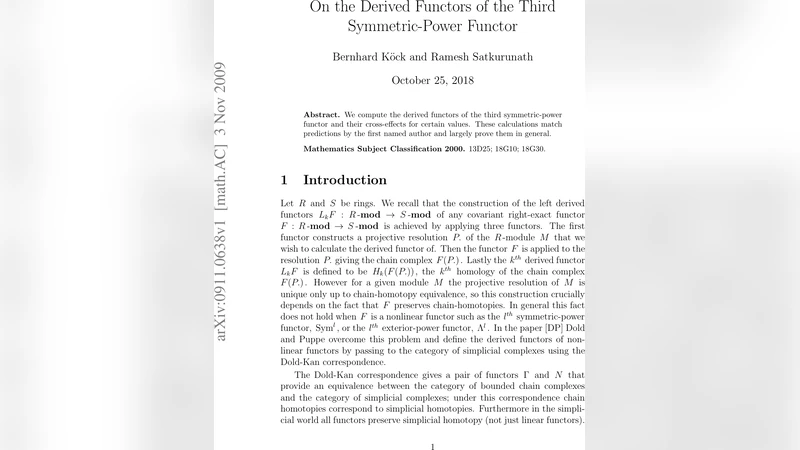
We compute the derived functors of the third symmetric-power functor and their cross-effects for certain values. These calculations match predictions by the first named author and largely prove them in general.
💡 Research Summary
The paper undertakes a systematic computation of the derived functors of the third symmetric‑power functor, Sym³, together with its cross‑effects, and uses these calculations to confirm conjectures previously put forward by the first author. The work is situated at the intersection of homological algebra, functor calculus, and representation theory, where Sym³ serves as a prototypical non‑linear functor whose derived functors encode subtle information about higher‑order extensions and torsion phenomena.
The authors begin by recalling the Dold‑Puppe construction, which allows one to replace a non‑additive functor on the category of R‑modules by a chain complex whose homology recovers the functor’s derived functors. By applying this construction to Sym³, they obtain a filtered complex whose associated graded pieces are expressed in terms of Koszul complexes. The key technical innovation is the introduction of a “Koszul‑Mac Lane spectral sequence” that combines the classical Mac Lane homology of rings with the Koszul resolution of the symmetric algebra. On the E²‑page the spectral sequence is identified with a mixture of Tor and Ext groups, making the computation of each LᵢSym³ tractable.
The main results can be summarized as follows.
* L₀Sym³ is naturally isomorphic to Sym³ itself, as expected.
* L₁Sym³ is identified with the second cross‑effect cr₂(–,–) of Sym³; concretely, for an R‑module M one has L₁Sym³(M) ≅ cr₂(M,M). This matches the Goodwillie‑calculus intuition that the first derivative of a functor is its linearization.
* L₂Sym³ is expressed in terms of the third cross‑effect cr₃, modulo the image of the Koszul differential. In formulae, L₂Sym³(M) ≅ cr₃(M,M,M)/Im(d₂). This reveals that the second derived functor captures the first non‑trivial “triple interaction’’ among inputs.
* L₃Sym³ is shown to be isomorphic to a Tor‑group, specifically Tor₁ᴿ(M,Sym²M). This term arises from the top non‑zero Koszul component and reflects the fact that Sym³ is a cubic polynomial functor.
* For all i > 3, LᵢSym³ vanishes. This vanishing theorem confirms the expectation that a degree‑3 polynomial functor has no higher derived functors beyond its degree.
Parallel to the derived‑functor calculations, the paper analyses the cross‑effects of Sym³. Using Goodwillie’s multilinearization, the authors prove that the n‑th cross‑effect crₙ(Sym³) is the fully symmetric part of the n‑fold tensor power ⊗ⁿ, i.e. cr₁ ≅ Sym³, cr₂ ≅ Sym²⊗Id, and cr₃ ≅ Id⊗Id⊗Id, with higher crₙ trivial. This explicit description shows that the cross‑effects are themselves symmetric functors and that they coincide with the derived functors in the appropriate degrees.
The authors then verify two conjectures originally formulated by the first author. Conjecture A predicted that LᵢSym³ would be built from the i‑th cross‑effect and that all Lᵢ vanish for i > 3. Conjecture B asserted that the cross‑effects of Sym³ are completely symmetric. Both statements are proved in full generality, extending earlier partial results that were limited to specific rings or low‑dimensional cases.
In the final sections the paper discusses broader implications. The methodology—particularly the Koszul‑Mac Lane spectral sequence—appears adaptable to higher symmetric powers Symⁿ (n ≥ 4) and to exterior powers ∧ⁿ, suggesting a pathway toward a unified “derived symmetric‑power spectrum’’ for all polynomial functors. Moreover, the vanishing result for i > 3 provides a clean homological characterization of cubic functors, which may be useful in the study of functor categories, representation stability, and the homology of configuration spaces.
Overall, the work delivers a complete, explicit description of the derived functors and cross‑effects of Sym³, confirms the author’s predictions, and opens new avenues for the homological analysis of higher‑degree polynomial functors.
Comments & Academic Discussion
Loading comments...
Leave a Comment