The Revolution in Astronomy Education: Data Science for the Masses
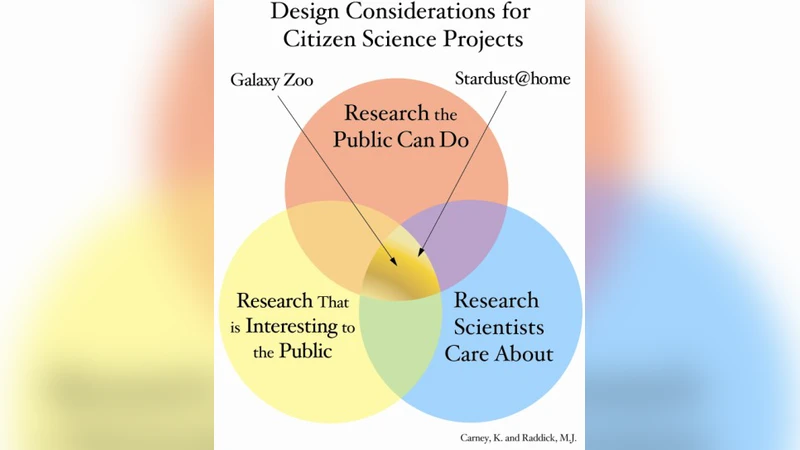
As our capacity to study ever-expanding domains of our science has increased (including the time domain, non-electromagnetic phenomena, magnetized plasmas, and numerous sky surveys in multiple wavebands with broad spatial coverage and unprecedented depths), so have the horizons of our understanding of the Universe been similarly expanding. This expansion is coupled to the exponential data deluge from multiple sky surveys, which have grown from gigabytes into terabytes during the past decade, and will grow from terabytes into Petabytes (even hundreds of Petabytes) in the next decade. With this increased vastness of information, there is a growing gap between our awareness of that information and our understanding of it. Training the next generation in the fine art of deriving intelligent understanding from data is needed for the success of sciences, communities, projects, agencies, businesses, and economies. This is true for both specialists (scientists) and non-specialists (everyone else: the public, educators and students, workforce). Specialists must learn and apply new data science research techniques in order to advance our understanding of the Universe. Non-specialists require information literacy skills as productive members of the 21st century workforce, integrating foundational skills for lifelong learning in a world increasingly dominated by data. We address the impact of the emerging discipline of data science on astronomy education within two contexts: formal education and lifelong learners.
💡 Research Summary
The paper “The Revolution in Astronomy Education: Data Science for the Masses” presents a comprehensive argument that the rapid expansion of astronomical data—driven by multi‑wavelength, time‑domain, and non‑electromagnetic observations—has created a profound “data‑awareness gap.” Over the past decade, sky surveys have grown from gigabytes to terabytes, and the next decade promises petabyte‑scale archives (hundreds of petabytes in some cases). This deluge demands a new educational paradigm that equips both specialists (research astronomers) and non‑specialists (the public, teachers, students, and the broader workforce) with robust data‑science competencies.
Key Drivers
- Data Volume and Variety – Projects such as LSST, SKA, Euclid, and JWST generate heterogeneous data streams (images, spectra, time‑series, catalogs, gravitational‑wave alerts, particle detections). Traditional manual analysis cannot keep pace.
- Data as a Societal Asset – Astronomical datasets are increasingly valuable beyond pure research; they serve as training grounds for AI, inform technology development, and provide material for citizen‑science initiatives.
Implications for Specialists
Astronomers must master modern data‑science tools:
- Machine Learning & Deep Learning for classification of transients, de‑blending of crowded fields, and anomaly detection.
- Bayesian Statistics to quantify uncertainties in model fitting and hierarchical inference.
- High‑Performance & Cloud Computing for parallel processing of petabyte‑scale image stacks and real‑time event pipelines.
- Data‑fusion techniques that combine simulations with observations to test cosmological models.
The authors advocate embedding these skills in graduate curricula through hands‑on projects, collaborative code repositories, and mandatory coursework in statistical computing.
Implications for Non‑Specialists
For the broader public and workforce, the paper defines “data literacy” as a foundational 21st‑century competency. Core components include:
- Understanding data provenance, quality assessment, and bias.
- Basic statistical reasoning (means, variances, confidence intervals).
- Proficiency with visualization tools (Python’s Matplotlib/Seaborn, Tableau, web‑based dashboards).
- Awareness of ethical, legal, and privacy issues surrounding large datasets.
These abilities enable citizens to participate meaningfully in projects like Zooniverse, interpret scientific news, and transition into data‑driven occupations.
Educational Strategies
The authors split the educational response into two complementary tracks:
-
Formal Education (K‑12 and Higher Education)
- Curriculum Integration: Introduce a “Data Science Foundations” module early, followed by a “Astronomy Data Lab” that uses open archives (SDSS, Gaia, Pan‑STARRS).
- Project‑Based Learning (PBL): Students conduct authentic investigations—e.g., measuring redshift distributions, constructing light curves of variable stars, or mapping Milky Way substructure—thereby learning data cleaning, feature extraction, model building, and result communication.
- Teacher Professional Development: Provide summer institutes and online micro‑credentials to upskill teachers in Python, Jupyter notebooks, and cloud resources.
-
Lifelong Learning (Adult, Workforce, Citizen Scientists)
- MOOCs and Modular Courses: Short, stackable courses on “Astronomy Data Mining” and “AI for Space Science” hosted on platforms like Coursera or edX.
- Virtual Laboratories: Metaverse‑style or web‑based labs where learners can drag‑and‑drop data pipelines, run pre‑configured notebooks on cloud GPUs, and instantly visualize outcomes.
- Citizen‑Science Platforms: Enhance existing portals with built‑in tutorials, automated quality checks, and gamified feedback loops to keep participants engaged and educated.
Infrastructure and Policy Recommendations
- National Data Infrastructure: Investment in high‑performance computing clusters, petabyte‑scale storage, and fast network links accessible to educational institutions.
- Open‑Source Toolkits: Support development of education‑focused libraries (e.g., AstroML extensions, simplified TensorFlow wrappers) that lower the barrier to entry.
- Cross‑Sector Partnerships: Form consortia of universities, space agencies, industry (cloud providers, AI firms), and NGOs to co‑fund curriculum design, produce shared teaching materials, and evaluate outcomes through longitudinal studies.
- Funding Mechanisms: Establish dedicated grant lines for “Data‑Science‑Enabled Astronomy Education” that require measurable impacts on both research productivity and public engagement.
Conclusion
The paper concludes that data science is not merely an auxiliary skill for astronomers; it is the lingua franca of modern astrophysics and a catalyst for inclusive, future‑ready education. By simultaneously upgrading specialist training and democratizing data literacy, the astronomical community can close the data‑awareness gap, accelerate scientific discovery, and empower a data‑savvy society. The authors call for an integrated, well‑funded roadmap that aligns curriculum reform, infrastructure development, and policy support to realize this vision.
Comments & Academic Discussion
Loading comments...
Leave a Comment