The signature package on Witt spaces, I. Index classes
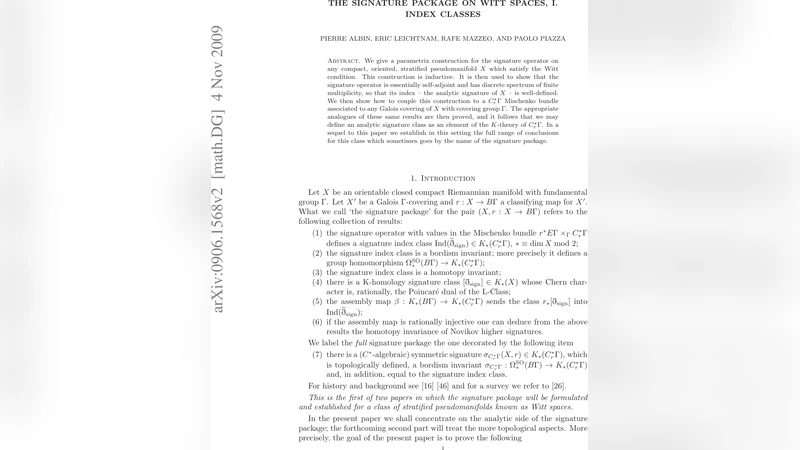
We give a parametrix construction for the signature operator on any compact, oriented, stratified pseudomanifold X which satisfies the Witt condition. This construction is inductive. It is then used to show that the signature operator is essentially self-adjoint and has discrete spectrum of finite multiplicity, so that its index – the analytic signature of X – is well-defined. We then show how to couple this construction to a C^_r(Gamma) Mischenko bundle associated to any Galois covering of X with covering group Gamma. The appropriate analogues of these same results are then proved, and it follows that we may define an analytic signature class as an element of the K-theory of C^_r(Gamma). In a sequel to this paper we establish in this setting the full range of conclusions for this class which sometimes goes by the name of the signature package.
💡 Research Summary
The paper addresses the analytic theory of the signature operator on compact, oriented, stratified pseudomanifolds that satisfy the Witt condition. The authors begin by recalling the classical Atiyah‑Patodi‑Singer framework for smooth manifolds and explain why it does not directly apply to spaces with singular strata. The Witt condition, which forces the middle‑dimensional intersection homology of each link to vanish, is identified as the crucial hypothesis that restores enough regularity near singularities to make analytic constructions feasible.
The core technical contribution is an inductive parametrix construction. The stratified space X is decomposed according to depth, and at each depth a model operator together with suitable boundary conditions is defined. By exploiting the vanishing of the problematic middle‑dimensional cohomology guaranteed by the Witt condition, the authors are able to glue together local parametrices into a global one. This global parametrix yields a regularized Green’s operator Q satisfying (D_{\text{sign}}Q = I - K) with K compact. Consequently, the signature operator (D_{\text{sign}}) is shown to be essentially self‑adjoint on an appropriate Sobolev‑type domain, and its spectrum is discrete with finite multiplicities. These spectral properties allow the definition of the analytic signature as the index of the chiral part of (D_{\text{sign}}).
Having established the analytic foundation, the paper proceeds to the non‑commutative setting. For any Galois covering (\widetilde{X}\to X) with covering group (\Gamma), the Mishchenko bundle (\mathcal{L}\Gamma = \widetilde{X}\times\Gamma C^_r(\Gamma)) is introduced. Tensoring the signature operator with this bundle produces a (C^r(\Gamma))-linear operator (D{\text{sign}}^\Gamma). The previously constructed parametrix is compatible with the (C^r(\Gamma))-module structure, so the same arguments prove that (D{\text{sign}}^\Gamma) is essentially self‑adjoint and Fredholm in the (C^_r(\Gamma))-sense. Its class (
Comments & Academic Discussion
Loading comments...
Leave a Comment