Parameter estimation of spinning binary inspirals using Markov-chain Monte Carlo
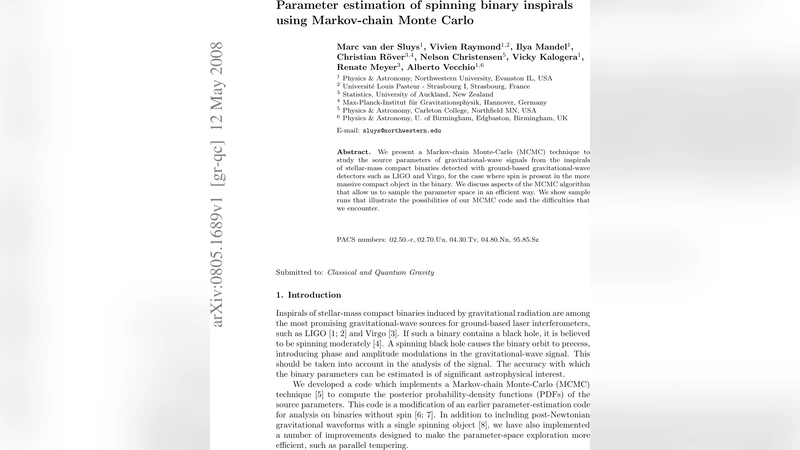
We present a Markov-chain Monte-Carlo (MCMC) technique to study the source parameters of gravitational-wave signals from the inspirals of stellar-mass compact binaries detected with ground-based gravitational-wave detectors such as LIGO and Virgo, for the case where spin is present in the more massive compact object in the binary. We discuss aspects of the MCMC algorithm that allow us to sample the parameter space in an efficient way. We show sample runs that illustrate the possibilities of our MCMC code and the difficulties that we encounter.
💡 Research Summary
The paper presents a comprehensive Markov‑chain Monte‑Carlo (MCMC) framework for estimating the source parameters of gravitational‑wave signals from compact binary inspirals that include spin in the more massive component. The authors target ground‑based interferometers such as LIGO and Virgo and focus on the situation where only one body (typically a black hole) carries spin, which induces orbital precession and consequently modulates both the phase and amplitude of the waveform.
The implementation builds on a previously developed non‑spinning MCMC code, extending it to handle a twelve‑dimensional parameter space: chirp mass, symmetric mass ratio, spin magnitude, spin‑orbit angle, luminosity distance, sky location (right ascension and declination), coalescence time, orbital phase, precession phase, and the two angles defining the direction of the total angular momentum. Waveforms are generated in the time domain using a post‑Newtonian (PN) model that includes phase terms up to 1.5 PN order and a simple precession prescription; amplitudes are kept at Newtonian order. The simulated data consist of these waveforms injected into stationary Gaussian noise with a power‑spectral density (PSD) matching the design sensitivity of the detectors. PSD estimation uses a 256‑second noise segment, and the likelihood is evaluated in the frequency domain as the usual Gaussian noise inner product.
A Bayesian approach is adopted: priors are chosen to be uniform in physically motivated variables (log distance, cosine of spin‑orbit angle, sine of declination, etc.), and the posterior is proportional to the product of the prior and the likelihood across all detectors. The MCMC proposal mechanism combines two complementary strategies. First, uncorrelated proposals draw independent Gaussian jumps for each parameter, with adaptive step sizes (σ_jump) tuned to achieve an acceptance rate of roughly 25 %. Second, correlated proposals exploit the empirical covariance matrix accumulated over blocks of ~10⁴ iterations; a multivariate Gaussian jump is then drawn using the Cholesky decomposition of this matrix. The algorithm updates either a single parameter (uncorrelated) or the full parameter vector (correlated) and switches between them with a typical ratio of 10–30 % uncorrelated to 70–90 % correlated moves.
To overcome the difficulty of simultaneously exploring a broad parameter volume and finely resolving the region of maximum likelihood, the authors employ parallel tempering. Multiple chains run at different temperatures T≥1; hotter chains accept likelihood‑decreasing moves more readily according to a temperature‑scaled Metropolis criterion, thereby traversing the space more freely. Chains periodically attempt swaps, with acceptance governed by the temperature difference and the respective likelihoods. The temperature ladder is constructed on a log‑scale, usually with seven chains and a maximum temperature of 30–50 for signal‑to‑noise ratios (SNR) between 10 and 20. To reduce computational load, a sinusoidal temperature modulation is introduced for all hot chains, allowing a smaller number of chains (≈4–5) while preserving swap efficiency. The modulation period is set to about five times the correlated‑proposal block length to maintain the Markov property.
Simulation studies focus on a fiducial binary consisting of a 10 M⊙ spinning black hole (spin magnitude a∈
Comments & Academic Discussion
Loading comments...
Leave a Comment