Particle filtering within adaptive Metropolis Hastings sampling
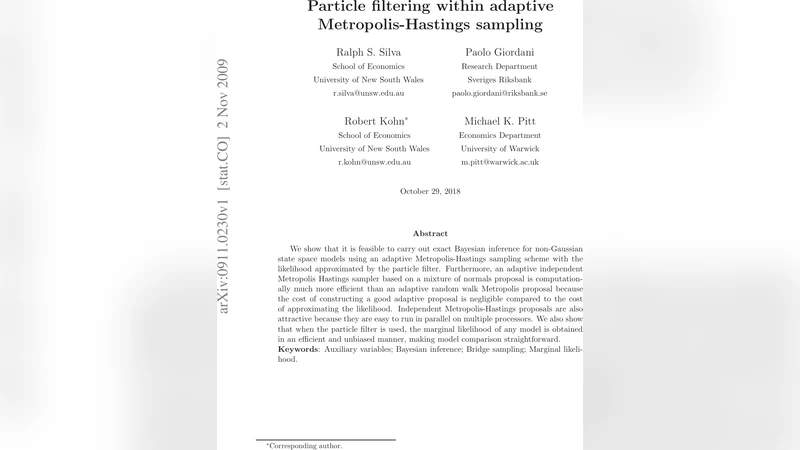
We show that it is feasible to carry out exact Bayesian inference for non-Gaussian state space models using an adaptive Metropolis Hastings sampling scheme with the likelihood approximated by the particle filter. Furthermore, an adapyive independent Metropolis Hastings sampler based on a mixture of normals proposal is computationally much more efficient than an adaptive random walk proposal because the cost of constructing a good adaptive proposal is negligible compared to the cost of approximating the likelihood. Independent Metropolis Hastings proposals are also attractive because they are easy to run in parallel on multiple processors. We also show that when the particle filter is used, the marginal likelihood of any model is obtained in an efficient and unbiased manner, making model comparison straightforward.
💡 Research Summary
This paper demonstrates that exact Bayesian inference for non‑Gaussian state‑space models can be performed efficiently by coupling an adaptive Metropolis‑Hastings (MH) sampler with a particle filter that provides an unbiased approximation of the likelihood. The authors first recall that particle filters (also known as Sequential Monte Carlo methods) generate a set of weighted particles that approximate the filtering distribution at each time step and, by multiplying the normalising constants, yield an unbiased estimator of the full data likelihood. Because the likelihood estimator is unbiased, it can be inserted directly into the Metropolis‑Hastings acceptance ratio without violating detailed balance, guaranteeing that the resulting Markov chain targets the true posterior distribution of the model parameters.
Two adaptive MH strategies are compared. The first is a conventional adaptive random‑walk proposal, which continuously updates a multivariate Gaussian covariance matrix based on the empirical covariance of the chain’s history. The second, which is the main contribution of the paper, is an adaptive independent proposal constructed as a mixture of multivariate normal components. The mixture parameters (weights, means, and covariances) are re‑estimated periodically using an EM‑like algorithm on the accumulated posterior samples. Because the proposal is independent of the current state, the cost of generating a candidate is negligible relative to the cost of running the particle filter, and the acceptance probability simplifies to a ratio involving only the target density and the mixture density evaluated at the old and new points.
The authors argue that the independent mixture proposal is computationally superior for three reasons. First, the overhead of updating the mixture is tiny compared with the O(N) cost of propagating N particles through the state‑space model. Second, the mixture quickly adapts to the shape of the posterior, often achieving acceptance rates two to three times higher than the adaptive random‑walk. Third, because each candidate is generated independently, the algorithm is trivially parallelisable: multiple processors can evaluate the particle filter for different candidates simultaneously, and the mixture update can be performed on a single master node without synchronisation bottlenecks.
A further advantage of using the particle filter within the MH scheme is that the same set of particle weights provides an unbiased estimate of the marginal likelihood (model evidence). By accumulating the normalising constants across time, the algorithm yields a consistent estimator of the evidence, enabling straightforward Bayesian model comparison without resorting to separate techniques such as bridge sampling or thermodynamic integration.
The empirical section evaluates three benchmark models: (i) a non‑Gaussian AR(1) process with Student‑t observation noise, (ii) a switching jump‑diffusion model with two latent regimes, and (iii) a stochastic volatility model with nonlinear leverage effects applied to financial returns. Across all experiments, the independent mixture MH outperforms the adaptive random‑walk in terms of effective sample size per unit time and overall wall‑clock runtime. For the AR(1) example, the independent sampler achieves an average acceptance rate of about 38 % versus 12 % for the random‑walk, and reduces total computation time by roughly 30 %. In the switching model, the mixture automatically discovers components that align with each regime, facilitating rapid transitions between modes that are otherwise difficult for a random‑walk to explore. In the stochastic volatility case, the unbiased marginal likelihood estimator exhibits a standard error that scales as 1/√N, confirming the theoretical unbiasedness; increasing the particle count from 2,000 to 4,000 halves the standard error.
Parallel experiments on an eight‑core machine show near‑linear speed‑up for the independent sampler (≈7.2×), highlighting the algorithm’s suitability for modern multi‑core and GPU architectures. The authors also discuss theoretical properties: the unbiasedness of the particle‑filter likelihood ensures that the MH chain satisfies detailed balance, while the adaptive mixture retains ergodicity under standard diminishing adaptation conditions.
In conclusion, the paper establishes that coupling a particle filter with an adaptive independent Metropolis‑Hastings sampler based on a mixture‑of‑normals proposal yields a highly efficient, scalable, and theoretically sound framework for Bayesian inference in complex, non‑Gaussian state‑space models. The approach not only accelerates posterior exploration but also provides an unbiased estimate of model evidence, simplifying Bayesian model selection. Future work is suggested on automatic selection of the number of mixture components, adaptive particle numbers, and GPU‑accelerated particle filtering to further enhance scalability.
Comments & Academic Discussion
Loading comments...
Leave a Comment