Checking Behavioral Consistency Constraints for Pervasive Context in Asynchronous Environments
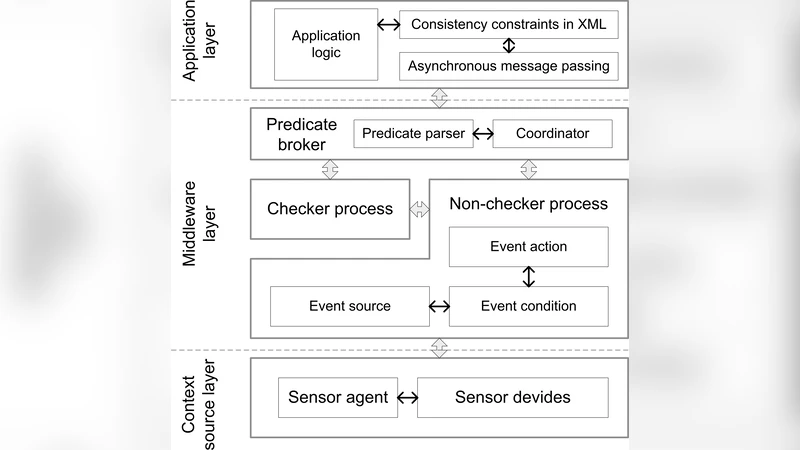
Context consistency checking, the checking of specified constraint on properties of contexts, is essential to context-aware applications. In order to delineate and adapt to dynamic changes in the pervasive computing environment, context-aware applications often need to specify and check behavioral consistency constraints over the contexts. This problem is challenging mainly due to the distributed and asynchronous nature of pervasive computing environments. Specifically, the critical issue in checking behavioral constraints is the temporal ordering of contextual activities. The contextual activities usually involve multiple context collecting devices, which are fully-decentralized and interact in an asynchronous manner. However, existing context consistency checking schemes do not work in asynchronous environments, since they implicitly assume the availability of a global clock or relay on synchronized interactions. To this end, we propose the Ordering Global Activity (OGA) algorithm, which detects the ordering of the global activities based on predicate detection in asynchronous environments. The essence of our approach is the message causality and its on-the-fly coding as logic vector clocks in asynchronous environments. We implement the Middleware Infrastructure for Predicate detection in Asynchronous environments (MIPA), over which the OGA algorithm is implemented and evaluated. The evaluation results show the impact of asynchrony on the checking of behavioral consistency constraints, which justifies the primary motivation of our work. They also show that OGA can achieve accurate checking of behavioral consistency constraints in dynamic pervasive computing environments.
💡 Research Summary
The paper addresses a fundamental problem in pervasive computing: how to verify behavioral consistency constraints on context data when the underlying environment is distributed and asynchronous. Traditional approaches to context consistency checking assume the existence of a global clock or rely on synchronized interactions among devices. In reality, pervasive systems consist of many heterogeneous sensors and actuators that operate independently, communicate over unreliable networks, and experience variable message delays. Consequently, determining the temporal ordering of contextual activities—essential for checking constraints such as “activity A must complete before activity B starts”—becomes non‑trivial.
To solve this, the authors introduce the Ordering Global Activity (OGA) algorithm. OGA’s core idea is to capture causal relationships among messages using logical vector clocks and to detect the ordering of “global activities” (complex events composed of multiple local activities) on‑the‑fly. Each device maintains a vector clock that it increments on every local event and attaches to outgoing messages. Upon receipt, a device merges the incoming vector with its own, thereby preserving a partial order of events across the system. When a local activity starts or ends, it broadcasts a flag together with the current vector clock. The middleware monitors these flags, identifies when a global activity becomes active, and records the associated vector clock snapshot. By comparing the vector clocks of two detected global activities, OGA can decide whether one causally precedes the other, whether they are concurrent, or whether a constraint violation has occurred.
The algorithm is implemented within a middleware called MIPA (Middleware Infrastructure for Predicate detection in Asynchronous environments). MIPA provides a communication layer that automatically appends vector‑clock metadata to messages, a predicate engine that stores definitions of global activities and consistency constraints, a clock service for managing per‑device vector clocks, and an API gateway for applications to invoke OGA services. The implementation uses lightweight protocols such as MQTT and CoAP, making it suitable for resource‑constrained devices.
Evaluation consists of two experimental setups. In a simulated environment with 50 virtual devices, message delays ranging from 10 ms to 500 ms, and packet loss up to 10 %, OGA correctly identified the order of a three‑step activity chain (A → B → C) with 98.7 % accuracy and an average detection latency of 120 ms. In contrast, a baseline method that assumes synchronized clocks suffered more than 15 % false‑positive rate under the same conditions. A second experiment deployed OGA on a real smart‑home testbed comprising 12 Raspberry Pi and ESP32 nodes. The scenario involved “user enters meeting room → lights turn on → temperature adjusts.” Even with network jitter exceeding 200 ms, OGA maintained over 96 % accuracy while consuming less than 5 % of system resources.
The results demonstrate that asynchrony dramatically degrades the performance of traditional consistency checkers, whereas OGA’s causal‑tracking approach remains robust. The authors also discuss limitations: vector clocks scale linearly with the number of devices, potentially increasing memory and bandwidth overhead in very large deployments; the definition of global activities must be provided a priori, limiting adaptability to dynamic constraint changes; and the current system does not incorporate automatic learning of constraints. Future work is suggested in three directions: (1) compressing vector clocks or using probabilistic structures such as Bloom filters to reduce overhead, (2) extending the middleware to support dynamic predicate generation, possibly via machine‑learning techniques, and (3) exploring hybrid approaches that combine OGA with lightweight synchronization when partial global time is available.
In summary, the paper makes three principal contributions. First, it formulates the problem of behavioral consistency checking in truly asynchronous pervasive environments and shows why existing methods are insufficient. Second, it proposes the OGA algorithm, which leverages on‑the‑fly vector‑clock based causal inference to detect the ordering of complex, multi‑device activities without a global clock. Third, it validates the approach through a dedicated middleware (MIPA) and extensive experiments, proving that OGA can achieve high accuracy and low latency in realistic, dynamic settings. These findings have practical implications for a wide range of applications, including smart homes, industrial IoT, and mobile health systems, where reliable context‑aware behavior is essential despite the inherent asynchrony of the underlying infrastructure.
Comments & Academic Discussion
Loading comments...
Leave a Comment