Derived Algebraic Geometry VI: E_k Algebras
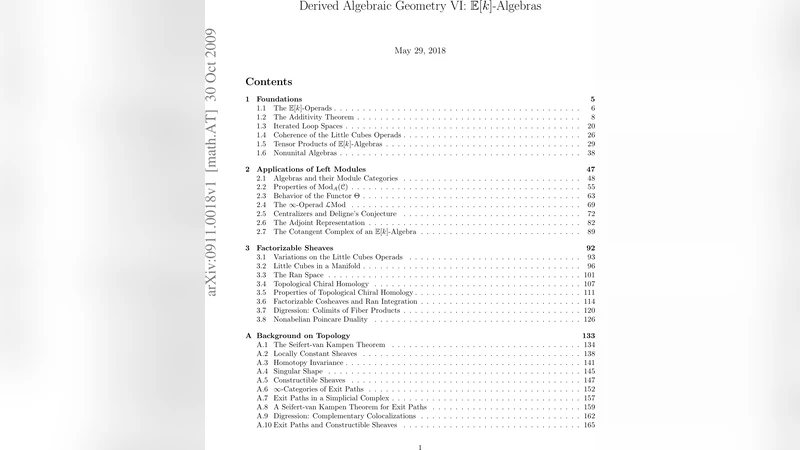
In this paper, we study algebras over the little cubes operads introduced by Boardman and Vogt, using the formalism of higher category theory.
💡 Research Summary
The paper “Derived Algebraic Geometry VI: Little Cubes Operads and Eₖ Algebras” presents a comprehensive higher‑categorical treatment of algebras over the little‑cubes operads originally introduced by Boardman and Vogt. The authors adopt the modern language of ∞‑operads and monoidal ∞‑categories, following Lurie’s framework, to reinterpret the classical Eₖ‑algebra theory in a way that is compatible with derived algebraic geometry and homotopical algebra.
The first part of the work revisits the definition of the little‑cubes operad Cₖ, emphasizing its topological description as configurations of disjoint k‑dimensional cubes inside a unit cube. By encoding Cₖ as a complete Segal object in the category of spaces, the authors show that the operad satisfies the Segal and completeness conditions required of an ∞‑operad. Consequently, algebras over Cₖ are identified with objects of the ∞‑category Alg_{Cₖ}(𝒞) for any presentable monoidal ∞‑category 𝒞. This reformulation provides a clean bridge between classical operadic homotopy theory and the higher‑categorical machinery needed for derived geometry.
The second section develops an ∞‑module theory for Cₖ‑algebras. Classical module categories are replaced by ∞‑categories Mod_A of A‑modules for a given Cₖ‑algebra A. The authors construct a “module operad” M_{Cₖ} that endows Mod_A with its own monoidal structure, compatible with the original Cₖ‑action. A novel notion of a crossed operad is introduced to describe how the tensor product of two modules respects the Eₖ‑structure. This yields a fully homotopical version of the familiar tensor product of modules, now living inside a stable ∞‑category and preserving higher coherence data.
A major highlight is the higher‑Koszul duality theorem. The paper proves that the ∞‑operad Cₖ is Koszul dual to the operad C_{n‑k} (where n is the ambient dimension), and that this duality lifts to an equivalence between the ∞‑category of Cₖ‑algebras and the ∞‑category of C_{n‑k}‑coalgebras. The proof relies on the construction of a bimonoidal ∞‑category and a dualization functor that interchanges algebraic and coalgebraic structures while preserving homotopical information. As a corollary, the Hochschild‑type homology of an Eₖ‑algebra is identified with the co‑homology of its Koszul dual E_{n‑k}‑coalgebra, providing a conceptual generalization of the Hochschild‑Kostant‑Rosenberg theorem to the derived setting.
The final part of the paper establishes a transfer principle for Eₖ‑algebras across different model structures. Using Quillen equivalences between various presentations of the underlying ∞‑categories (e.g., simplicial sets, symmetric spectra, and chain complexes), the authors demonstrate that the Eₖ‑algebra structure is invariant under these equivalences. In particular, they treat the passage from an unstable topological model of Cₖ to its stabilized spectral counterpart, showing that the operadic multiplication and higher coherence maps survive the stabilization process as genuine maps in the stable homotopy category. This principle allows one to move freely between geometric, topological, and algebraic incarnations of Eₖ‑algebras without losing essential structure.
Overall, the paper makes four substantial contributions:
- Higher‑Operadic Recasting – It embeds the classical little‑cubes operads into the ∞‑operadic framework, enabling the use of modern higher‑category tools.
- ∞‑Module Theory – It defines and studies modules over Eₖ‑algebras as objects of a monoidal ∞‑category, complete with a coherent tensor product.
- Higher Koszul Duality – It establishes a robust Koszul duality between Eₖ‑algebras and E_{n‑k}‑coalgebras, extending classical algebraic dualities to the derived context.
- Transfer Across Models – It proves that Eₖ‑structures are preserved under Quillen equivalences, providing a flexible method to transport results between topological, spectral, and algebraic settings.
These results deepen the connection between derived algebraic geometry, homotopical algebra, and higher‑dimensional topological field theory, where Eₖ‑algebras model observables and operations. By furnishing a solid ∞‑categorical foundation, the paper opens the door to new applications such as factorization homology, deformation quantization in derived settings, and the study of higher‑categorical symmetries in mathematical physics.
Comments & Academic Discussion
Loading comments...
Leave a Comment