Stochastic Nonlinear Dynamics of Interpersonal and Romantic Relationships
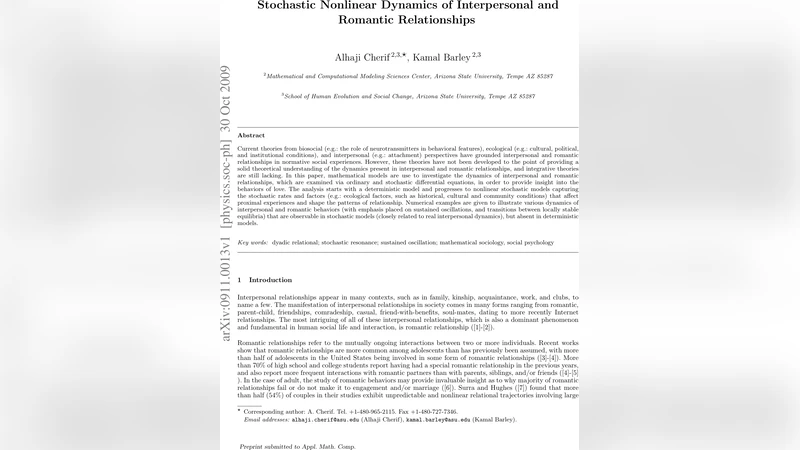
Current theories from biosocial (e.g.: the role of neurotransmitters in behavioral features), ecological (e.g.: cultural, political, and institutional conditions), and interpersonal (e.g.: attachment) perspectives have grounded interpersonal and romantic relationships in normative social experiences. However, these theories have not been developed to the point of providing a solid theoretical understanding of the dynamics present in interpersonal and romantic relationships, and integrative theories are still lacking. In this paper, mathematical models are use to investigate the dynamics of interpersonal and romantic relationships, which are examined via ordinary and stochastic differential equations, in order to provide insight into the behaviors of love. The analysis starts with a deterministic model and progresses to nonlinear stochastic models capturing the stochastic rates and factors (e.g.: ecological factors, such as historical, cultural and community conditions) that affect proximal experiences and shape the patterns of relationship. Numerical examples are given to illustrate various dynamics of interpersonal and romantic behaviors (with emphasis placed on sustained oscillations, and transitions between locally stable equilibria) that are observable in stochastic models (closely related to real interpersonal dynamics), but absent in deterministic models.
💡 Research Summary
The paper tackles the long‑standing gap between qualitative theories of romantic and interpersonal relationships and a quantitative, predictive framework. Drawing on biosocial, ecological, and attachment perspectives, the authors argue that existing models lack the dynamical rigor needed to capture how relationships evolve over time. To fill this void, they construct a series of mathematical models, beginning with a deterministic two‑dimensional ordinary differential equation (ODE) system that represents the emotional states of two partners, (x(t)) and (y(t)). Non‑linear interaction functions—typically sigmoid or hyperbolic‑tangent forms—replace simple linear couplings, allowing the model to exhibit saturation, feedback loops, and multiple equilibria. Linear stability analysis of the Jacobian matrix identifies conditions under which the system possesses a single stable fixed point, a pair of symmetric stable points, or a Hopf bifurcation that gives rise to a limit cycle. The limit cycle is interpreted as the “oscillatory love” observed in real couples, where affection rises and falls in a regular pattern.
Recognizing that real relationships are constantly perturbed by cultural shifts, historical events, and personal stressors, the authors extend the deterministic framework to a stochastic differential equation (SDE) model. They introduce multiplicative noise terms, (\sigma_x x,dW_x(t)) and (\sigma_y y,dW_y(t)), where (W_x) and (W_y) are independent Wiener processes. This choice reflects the empirical observation that stronger emotions tend to be more volatile. Using Itô calculus, the authors derive equations for the evolution of the mean and variance, and they formulate the associated Fokker‑Planck equation to study the probability density’s time‑dependent behavior.
Key analytical findings include:
-
Persistence of Oscillations – Near the deterministic Hopf point, small stochastic perturbations do not destroy the limit cycle; instead, they create a stochastic “trapping” effect that keeps trajectories close to the deterministic cycle. This explains why couples often maintain rhythmic emotional patterns despite everyday stress.
-
Noise‑Induced Transitions – When noise intensity exceeds a critical threshold, the system can escape from one basin of attraction and settle into another. The transition rate follows a Kramers‑type escape law, depending exponentially on the height of the effective potential barrier and inversely on noise strength. This mechanism captures relationship crises, recoveries, and shifts to new relational stages (e.g., from dating to cohabitation).
-
Ecological Parameter Sensitivity – By embedding cultural or institutional factors as parameters (\gamma) (positive normative influence) and (\delta) (negative pressure), the authors show that increasing (\gamma) expands the region of stable equilibria, while larger (\delta) enlarges the unstable region. Thus, macro‑level social conditions can be directly linked to micro‑level dyadic stability.
Numerical experiments employ the Euler‑Maruyama scheme to simulate both deterministic and stochastic versions across a wide parameter space. Deterministic runs converge to a single trajectory (either fixed point or limit cycle), whereas stochastic runs produce a rich ensemble of paths: some remain near the deterministic cycle, others wander between multiple stable points, and still others exhibit sudden jumps triggered by random shocks. Visualizations illustrate sustained oscillations, stochastic resonance, and noise‑driven bifurcations that are absent in the purely deterministic setting.
The discussion emphasizes the interdisciplinary relevance of the work. By providing a mathematically rigorous description of love dynamics, the model offers testable predictions for relationship counseling, informs policy design aimed at fostering supportive cultural environments, and suggests avenues for integrating dynamic relational models into AI‑driven matchmaking platforms. Future extensions could incorporate heterogeneous agents, larger social networks, and data‑driven parameter estimation to bridge the model further with empirical observations.
In sum, the paper demonstrates that deterministic ODE models capture only a limited slice of relational dynamics, whereas stochastic nonlinear models reveal the full spectrum of behaviors—persistent oscillations, multistability, and random transitions—that characterize real‑world interpersonal and romantic relationships.
Comments & Academic Discussion
Loading comments...
Leave a Comment