CH, a problem of Rolewicz and bidiscrete systems
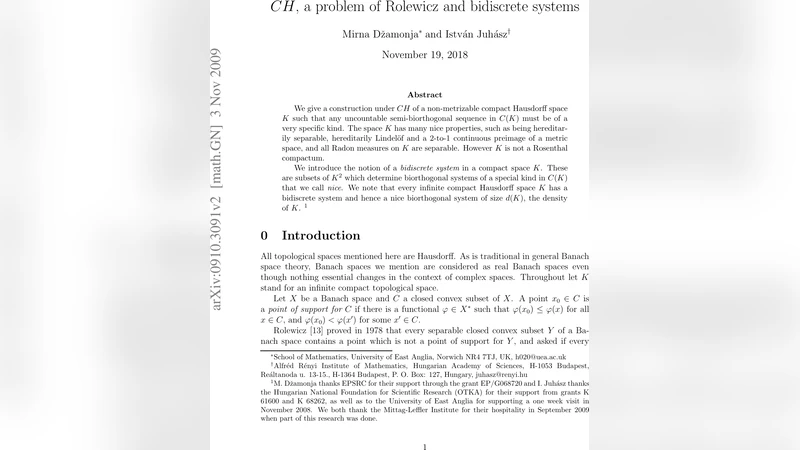
We give a construction under $CH$ of a non-metrizable compact Hausdorff space $K$ such that any uncountable semi-biorthogonal sequence in $C(K)$ must be of a very specific kind. The space $K$ has many nice properties, such as being hereditarily separable, hereditarily Lindel"of and a 2-to-1 continuous preimage of a metric space, and all Radon measures on $K$ are separable. However $K$ is not a Rosenthal compactum. We introduce the notion of bidiscrete systems in compact spaces and note that every infinite compact Hausdorff space $K$ must have a bidiscrete system of size $d(K)$, the density of $K$. This, in particular, implies that $C(K)$ has a biorthogonal system of size $d(K)$.
💡 Research Summary
The paper addresses a long‑standing question of Rolewicz concerning the existence and structure of semi‑biorthogonal sequences in spaces of continuous functions on compact Hausdorff spaces. Working under the Continuum Hypothesis (CH), the authors construct a compact Hausdorff space (K) with a very unusual combination of properties.
First, (K) is non‑metrizable, yet it is hereditarily separable (every subspace contains a countable dense set) and hereditarily Lindelöf (every subspace is Lindelöf). Moreover, there exists a continuous surjection (\pi:K\to M) onto a metric space (M) such that each fibre of (\pi) consists of exactly two points; in other words, (K) is a 2‑to‑1 continuous preimage of a metric space. All Radon measures on (K) are separable, i.e., each measure is supported on a countable set. Despite these “nice’’ features, (K) fails to be a Rosenthal compactum, showing that the class of Rosenthal compacta does not capture all compact spaces with such regular measure‑theoretic behaviour.
The construction proceeds by an inverse‑limit of a carefully designed tree of compact spaces, each stage being a 2‑to‑1 extension of the previous one. The CH assumption guarantees that at each stage one can choose countable dense subsets and compatible bonding maps, ultimately yielding a limit space with the required properties.
Having built (K), the authors turn to its Banach space of continuous real‑valued functions, (C(K)). They prove that any uncountable semi‑biorthogonal sequence ({(f_\alpha,\mu_\alpha):\alpha<\omega_1}) in (C(K)) must be of a very restricted form: each function (f_\alpha) takes the values (+1) and (-1) exactly on the two points of a fibre of (\pi) and is zero elsewhere, while the corresponding measure (\mu_\alpha) is supported precisely on that fibre. Consequently, the only possible uncountable semi‑biorthogonal sequences are those arising from the 2‑to‑1 structure of (K). This result gives a positive answer to Rolewicz’s problem under CH: the space (C(K)) does not admit “exotic’’ semi‑biorthogonal sequences.
A central new notion introduced in the paper is that of a bidiscrete system. For a compact space (X) and a cardinal (\kappa), a family ({(x_\alpha,y_\alpha):\alpha<\kappa}) together with pairwise disjoint open neighbourhoods (U_\alpha) of (x_\alpha) and (V_\alpha) of (y_\alpha) (with (U_\alpha\cap V_\beta=\varnothing) for (\alpha\neq\beta)) is called a (\kappa)-sized bidiscrete system. The authors prove a general theorem: every infinite compact Hausdorff space (X) possesses a bidiscrete system of size equal to its density (d(X)). The proof extracts a dense set of size (d(X)) and, using the normality of compact Hausdorff spaces, separates each point from the rest by disjoint open sets, then pairs the points appropriately.
An immediate corollary is that (C(X)) always contains a biorthogonal system of cardinality (d(X)). Indeed, given a bidiscrete system ({(x_\alpha,y_\alpha)}), one can define functions (f_\alpha) that are (1) at (x_\alpha), (-1) at (y_\alpha), and (0) elsewhere, together with the Dirac measures (\delta_{x_\alpha}-\delta_{y_\alpha}); these form a biorthogonal family. This bridges a gap between topological density and linear‑algebraic structure of function spaces.
Finally, the paper shows that despite the abundance of bidiscrete systems, the specific space (K) constructed earlier does not embed into any Rosenthal compactum. The argument uses the fact that Rosenthal compacta are characterized by being pointwise compact subsets of Baire‑1 functions; the 2‑to‑1 fibre structure of (K) forces any such embedding to collapse distinct points, contradicting the Hausdorff property.
In summary, the article makes three major contributions: (1) under CH it provides a concrete non‑metrizable compact space with a rich collection of regularity properties yet not Rosenthal; (2) it settles Rolewicz’s semi‑biorthogonal sequence problem for this space, showing that any uncountable such sequence must arise from the inherent 2‑to‑1 fibre structure; and (3) it introduces bidiscrete systems, proving their universal existence at the level of the space’s density and deriving the corresponding biorthogonal systems in (C(K)). These results deepen the interplay between set‑theoretic assumptions, topological structure, and Banach space geometry.
Comments & Academic Discussion
Loading comments...
Leave a Comment