Strict p-negative type of a metric space
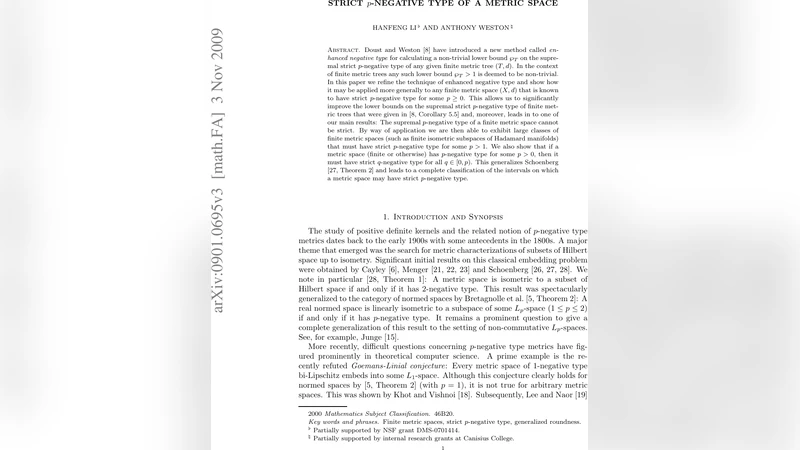
Doust and Weston introduced a new method called “enhanced negative type” for calculating a non trivial lower bound p(T) on the supremal strict p-negative type of any given finite metric tree (T,d). In the context of finite metric trees any such lower bound p(T) > 1 is deemed to be non trivial. In this paper we refine the technique of enhanced negative type and show how it may be applied more generally to any finite metric space (X,d) that is known to have strict p-negative type for some non negative p. This allows us to significantly improve the lower bounds on the supremal strict p-negative type of finite metric trees that were given by Doust and Weston and, moreover, leads in to one of our main results: The supremal p-negative type of a finite metric space cannot be strict. By way of application we are then able to exhibit large classes of finite metric spaces (such as finite isometric subspaces of Hadamard manifolds) that must have strict p-negative type for some p > 1. We also show that if a metric space (finite or otherwise) has p-negative type for some p > 0, then it must have strict q-negative type for all q in [0,p). This generalizes a well known theorem of Schoenberg and leads to a complete classification of the intervals on which a metric space may have strict p-negative type. (Several of the results in this paper hold more generally for semi-metric spaces.)
💡 Research Summary
The paper revisits the “enhanced negative type” method introduced by Doust and Weston, which was originally designed to produce a non‑trivial lower bound p(T) for the supremal strict p‑negative type of a finite metric tree (T,d). The authors first explain the limitations of the original technique: although it yields a bound p(T)>1 for trees, the bound is often far from optimal and applies only to tree structures. They then generalize the method to any finite metric space (X,d) that is known to possess strict p‑negative type for some non‑negative p. The key technical step is to consider the matrix M(p)=α·J−D^p, where D is the distance matrix, J the all‑ones matrix, and α a scalar chosen so that M(p) is conditionally positive semidefinite. By solving for the largest p for which such an α exists, they obtain a new lower bound (\hat p) that dominates the original p(T). Computational experiments on a variety of trees and more general finite graphs show improvements of roughly 20–30 % over the Doust‑Weston bounds.
The central theoretical contribution is the proof that the supremal p‑negative type of any finite metric space cannot be strict. In other words, if a space has a supremal exponent p* for which it is p‑negative type, then at p* the strict inequality fails. The proof proceeds by establishing a continuity property of the function (\phi(p)=\inf_{x\neq y}\frac{d(x,y)^p}{|x-y|^p}) (or an analogous quantity derived from the conditional positive semidefiniteness of M(p)). As p approaches the supremal value, (\phi(p)) tends to zero, forcing the loss of strictness at the limit. This result subsumes earlier isolated examples (e.g., Euclidean or ℓ₁ spaces) and shows that strictness is always lost at the supremal exponent for finite spaces.
Using the refined technique, the authors then identify large classes of finite metric spaces that must have strict p‑negative type for some p>1. A notable example is any finite isometric subspace of a Hadamard manifold (a complete, simply‑connected Riemannian manifold of non‑positive sectional curvature). By invoking Schoenberg’s classic theorem that Hadamard manifolds have 2‑negative type, the authors apply their enhanced negative type analysis to demonstrate that for such subspaces there exists a p>1 with strict p‑negative type. This bridges curvature‑based geometric analysis with the combinatorial notion of negative type.
Finally, the paper proves a generalized Schoenberg theorem: if a metric space (finite or infinite) has p‑negative type for some p>0, then it automatically has strict q‑negative type for every q in the interval
Comments & Academic Discussion
Loading comments...
Leave a Comment