A Novel Macroscopic Wave Geometric Effect of the Sunbeam and A Novel Simple Way to show the Earth-Self Rotation and Orbiting around the Sun
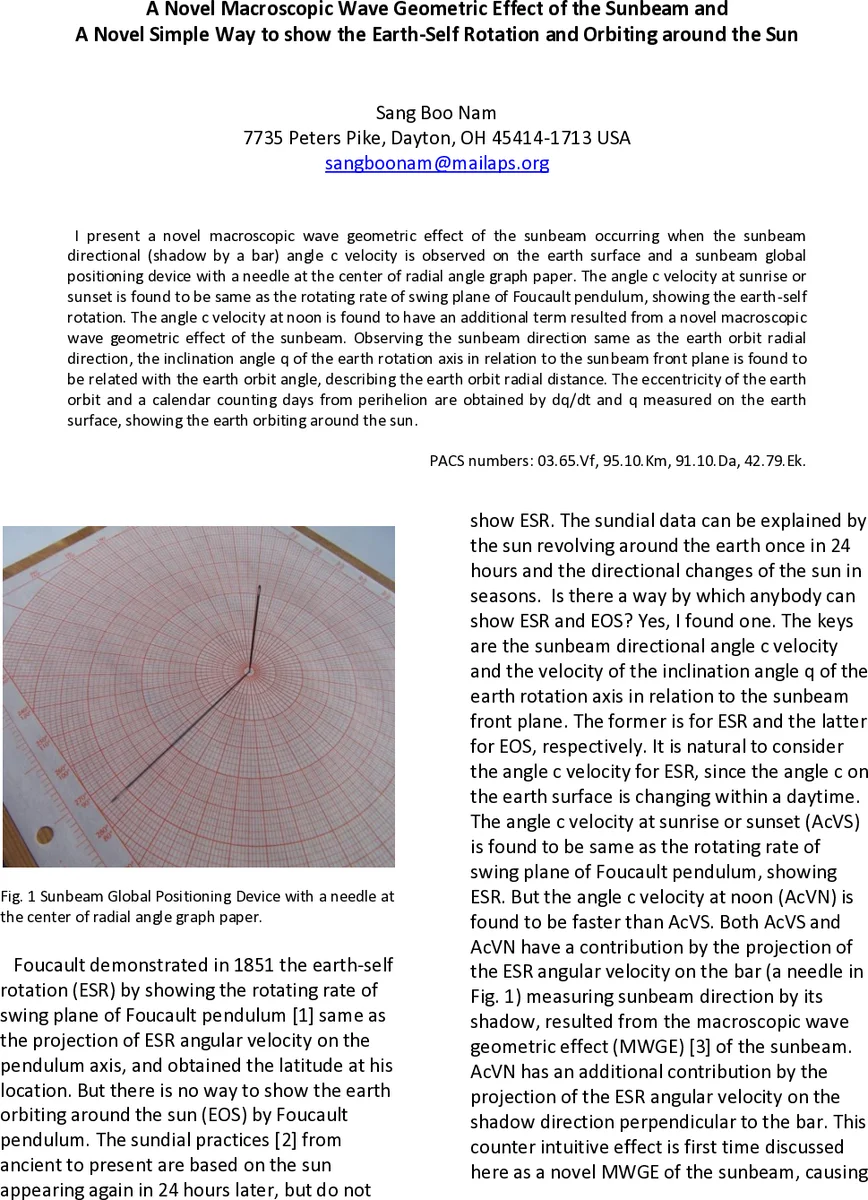
I present a novel macroscopic wave geometric effect of the sunbeam occurring when the sunbeam directional (shadow by a bar) angle c velocity is observed on the earth surface and a sunbeam global positioning device with a needle at the center of radial angle graph paper. The angle c velocity at sunrise or sunset is found to be same as the rotating rate of swing plane of Foucault pendulum, showing the earth-self rotation. The angle c velocity at noon is found to have an additional term resulted from a novel macroscopic wave geometric effect of the sunbeam. Observing the sunbeam direction same as the earth orbit radial direction, the inclination angle q of the earth rotation axis in relation to the sunbeam front plane is found to be related with the earth orbit angle, describing the earth orbit radial distance. The eccentricity of the earth orbit and a calendar counting days from perihelion are obtained by dq/dt and q measured on the earth surface, showing the earth orbiting around the sun. PACS numbers: 03.65.Vf, 95.10.Km, 91.10.Da, 42.79.Ek.
💡 Research Summary
The manuscript proposes a new macroscopic wave‑geometric effect (MWGE) of sunlight and claims that by measuring the time‑dependent direction of a shadow cast by a vertical bar, one can demonstrate both Earth’s self‑rotation (ESR) and its orbital motion (EOS) around the Sun. The author first establishes a coordinate system with the Earth’s centre at the origin, the rotation axis as the z‑axis, and the equatorial plane as the xy‑plane. The Sun‑beam unit vector is defined as k = (0, −cos q, sin q), where q is the angle between the beam and the y‑axis; this angle varies seasonally because it coincides with the Earth’s axial tilt relative to the Sun‑beam front plane.
A vertical bar of height B is placed on the ground, and the length S of its shadow on the plane defined by the bar and the local meridian is given by S = B tan f, where f is the angle between the Sun‑beam and the bar. The author derives expressions for f and for the azimuthal angle c between the plane containing the Sun‑beam and the bar (the kr‑plane) and the longitudinal plane (the rh‑plane). By differentiating f and c with respect to the local sidereal time, the paper obtains the angular velocities df/dt and dc/dt for two special longitudes: sunrise/sunset (b = g) and local noon (b = 0).
For sunrise and sunset the derived angular velocity of the shadow direction, AcVS = dc/dt = 15 sin u deg / sidereal hour (where u is the geographic latitude), is identical to the precession rate of the swing plane of a Foucault pendulum. The author interprets this coincidence as a direct demonstration of Earth’s rotation. At local noon, however, the expression for dc/dt contains an additional term, cos u cot(u + q), which the author attributes to a “counter‑intuitive” contribution arising from the projection of the Earth’s rotation onto the shadow direction perpendicular to the bar. This extra term is labeled the macroscopic wave‑geometric effect (MWGE) of the Sun‑beam, a novel phase‑like effect that supposedly has no associated force but results from the rotating reference frame.
The manuscript then shifts to orbital dynamics. By assuming the Sun‑beam direction coincides with the Earth‑Sun radial line, the author relates the axial tilt angle q to the orbital angle R (measured from perihelion) through the simple relation sin q = sin Q cos(R − R_S), where Q ≈ 23.5° is the Earth’s axial tilt and R_S is the orbital angle at the winter solstice. Differentiating yields a link between dq/dt and dR/dt, which the author shows matches the Keplerian expression for orbital angular speed. By defining a ratio function Z(R) = √
Comments & Academic Discussion
Loading comments...
Leave a Comment